
AI Customer Satisfaction Questions Generator: Create Better CSAT Surveys, Faster
“Are you satisfied?” is fine.
But if you want answers you can actually use, you need questions that point to the real reason someone is happy (or quietly planning their breakup email).
StoryLab.ai’s AI Customer Satisfaction Questions Generator helps you create CSAT, NPS, and CES question sets with smart follow-ups, clean scales, and wording tailored to your product or service.
Strong customer satisfaction surveys start with clear, relevant questions. An AI Customer Satisfaction Questions Generator turns a short brief into draft CSAT items you can refine fast.
You get a head start on wording, coverage, and tone, so teams spend less time staring at a blank page and more time listening to customers.
Chapters
- Como o gerador de perguntas de satisfação do cliente de IA ajuda você a escrever melhores perguntas de CSAT
- Quando usar um gerador de CSAT de IA
- Manual de instruções: como obter excelentes resultados
- Banco de questões do CSAT que você pode adaptar
- Escalas e formatos que reduzem o atrito
- Lista de verificação de preconceitos (soluções rápidas que você pode aplicar)
- Antes vs depois: reescritas neutras
- Modelos compactos de CSAT para cenários comuns
- Plano de implementação: da ideia à pesquisa ao vivo
- Interpretando resultados sem adivinhação
- O que você pode gerar com o Gerador de Perguntas de Satisfação do Cliente com IA
- Modelo de resumo de pesquisa (copiar, preencher, gerar)
- Manual de instruções: copie e cole perguntas para pesquisas de satisfação
- Banco de questões: CSAT, NPS, CES (pronto para copiar)
- Modelos de pesquisa por ponto de contato (implementação rápida)
- Opções de resposta (escalas limpas que você pode copiar)
- Quadro de pontuação da pesquisa (crie perguntas que valham a pena responder)
- Perguntas frequentes
How the AI Customer Satisfaction Questions generator helps you write better CSAT questions

The tool turns a short scenario into a set of ideas you can edit. It adapts to your audience, uses plain language, and avoids tricky constructions that lower completion rates.
You can ask for multiple choice, Likert, open-ended, or matrix style items. Run more than one pass with different prompts, then merge the best results. This is a fast path to a clean, bias-aware survey that feels natural to customers.
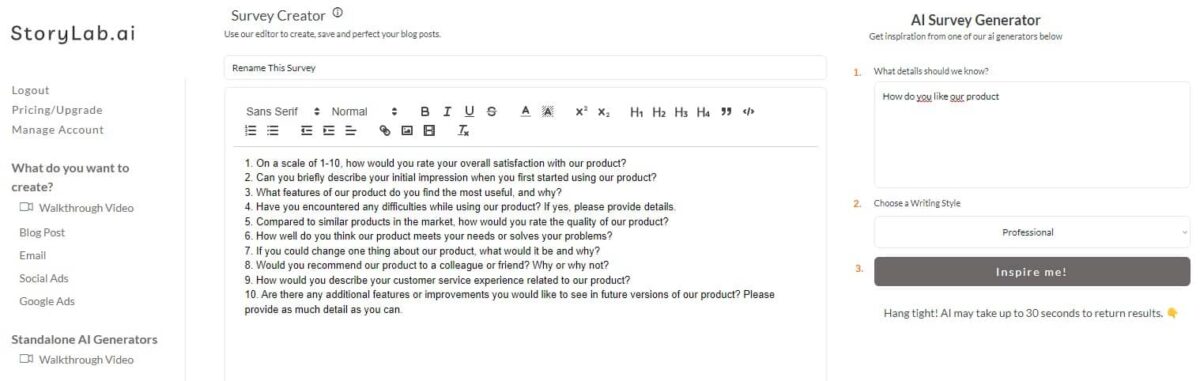
Here’s what the AI Customer Satisfaction Questions Generator looks like:
When to use a. AI CSAT generator
- Post-purchase: capture first impressions on product quality, delivery, and packaging.
- After support: measure resolution, speed, and clarity once a ticket closes. You can also automate this process using tools like AI Voice Agents to collect real-time feedback and improve post-support satisfaction seamlessly.
- Service visits: ask about punctuality, courtesy, and workmanship right after the appointment.
- Renewal moments: learn what earns loyalty and what still needs work.
- Onboarding: check early friction points before bad habits set in.
Prompt playbook: how to get great outputs
Give the generator a tight brief. Mention audience, touchpoint, and what you want to learn. Add constraints for scale, count, and reading level.
Prompt formula
Audience + scenario + outcomes + format + count + tone
Example prompts
“New customer CSAT after first order. Focus on delivery time and product condition. 8 questions. 5-point scale. Friendly tone.”
“Support chat CSAT for SaaS users. Resolution, clarity, and speed. 6 mixed questions with 1 open-ended.”
“In-store pickup CSAT. Queue time, staff helpfulness, signage. 7 questions. Simple reading level.”
CSAT question bank you can adapt
Use these as starting points. Edit names and details to match your context.
Overall satisfaction
- Overall, how satisfied are you with your experience today
- Did we meet your expectations
- How likely are you to choose us again
Speed and ease
- How satisfied are you with the time it took to complete your task
- How easy was it to get what you needed
Clarity and support
- How clear was the information you received
- How helpful was the person or resource you contacted
- Was your issue resolved to your satisfaction
Product or service quality
- How satisfied are you with the quality of the product or service
- Was everything as described on our site or in store
Value and future intent
- How satisfied are you with value for money
- How likely are you to recommend us to a friend or colleague
Open-ended follow-ups
- What worked well for you
- What should we improve before your next visit or order
- Anything else you would like us to know
Scales and formats that reduce friction
Choose one scale and stick with it. Switching scales increases mistakes and drop-off.
- CSAT scale: 5-point from Very dissatisfied to Very satisfied.
- Agreement scale: 5-point from Strongly disagree to Strongly agree for statements like “I could complete my task without help.”
- Binary items: Yes or No for simple checks like “Was your issue resolved.”
- Open-ended: one or two prompts at the end to capture context.
Tip: Label both ends of the scale and the midpoint. Customers answer faster and more accurately.
Bias checklist (quick fixes you can apply)

Run your draft through these checks, then regenerate any item that fails.
- Leading language: remove praise words like “excellent” in the question stem.
- Double-barrel: split “How easy and helpful…” into two separate items.
- Unbalanced options: use full ranges, not only positive choices.
- Jargon: replace internal terms with words customers use.
- Negations: avoid “not” and “except” where possible. Ask in a simple, positive form.
Before vs after: neutral rewrites
Before: How amazing was our support today
After: How would you rate your experience with support today
Before: How easy and helpful was the documentation
After: How easy was the documentation to use
Before: Did our fast delivery impress you
After: How satisfied are you with delivery time
Compact CSAT templates for common scenarios
Post-purchase CSAT (8 items)
- Overall satisfaction
- Delivery time satisfaction
- Product condition on arrival
- Ease of checkout
- Clarity of order updates
- Value for money
- Likelihood to purchase again
- What should we improve for next time
Post-support CSAT (7 items)
- Overall satisfaction with support
- Speed of first response
- Clarity of explanation
- Professionalism of the agent
- Issue resolved to your satisfaction
- Likelihood to contact support again if needed
- What could we have done better
Onboarding CSAT (6 items)
- Ease of getting started
- Clarity of steps or instructions
- Availability of help when needed
- Time to first success
- Overall satisfaction with onboarding
- What was the hardest step
Rollout plan: from idea to live survey
Week 1: Define audience and touchpoint. Use the generator to create a long list. Shortlist 10 to 15 items.
Week 2: Run a soft pilot with 30 to 50 responses. Watch completion rate and drop-offs per question.
Week 3: Cut low-value items. Keep it short. Add one open-ended prompt for color.
Week 4: Launch broadly. Track response rate, satisfaction score, and time to complete. Start a monthly review cycle.
Interpreting results without guesswork
Segment by touchpoint: checkout, delivery, live support, or AI answering service interactions to spot where automation performs best, and where human follow-up is needed
- Compare period over period: look for real movement, not single spikes.
- Pair scores with comments: open-ended answers explain the “why.”
- Close the loop: if a customer leaves a low score and contact info, follow up with a short, helpful note.
Ready to create your CSAT survey?
Describe your scenario, generate a clean set of questions, and publish a survey customers can finish in minutes.
What you can generate with the AI Customer Satisfaction Questions Generator
- CSAT (Customer Satisfaction) questions and follow-ups
- NPS (Net Promoter Score) questions with reason prompts
- CES (Customer Effort Score) questions for support and onboarding
- Post-purchase surveys for ecommerce
- Support ticket and chat satisfaction questions
- Product feedback and feature satisfaction questions
- Role-based surveys (admins vs end users)
Survey brief template (copy, fill, generate)
| Brief field | What to write | Example |
|---|---|---|
| Business type | SaaS, ecommerce, agency, local business, etc. | “SaaS (project management tool)” |
| Survey goal | What you want to learn | “Identify churn risks + onboarding friction” |
| Touchpoint | When you ask | “After onboarding week 1” |
| Audience | Who answers | “New users (non-technical)” |
| Length | How many questions | “6 questions max” |
| Scale preference | 1–5, 1–7, 0–10, yes/no, etc. | “1–5 + one open-text” |
| Product moments | Key experiences to evaluate | “Setup, first project, integrations, reporting” |
| Segments | Groups to compare (optional) | “Admins vs collaborators” |
Prompt Playbook: copy-paste prompts for satisfaction surveys
| Goal | Copy-paste prompt template |
|---|---|
| CSAT Survey (short + actionable) | “Create a 6-question CSAT survey for [business type] at the touchpoint: [touchpoint]. Goal: [goal]. Use a 1–5 scale and include 2 open-ended questions that reveal the ‘why’ behind the score.” |
| NPS survey (with follow-ups) | “Write an NPS survey for [product/service]. Include the 0–10 recommendation question and 5 follow-up questions that differ for promoters (9–10), passives (7–8), and detractors (0–6).” |
| CES survey (effort + friction) | “Create a Customer Effort Score (CES) question set for [touchpoint]. Include the main CES question, 3 diagnostic follow-ups, and 2 questions to identify the biggest friction points.” |
| Post-purchase ecommerce survey | “Create a post-purchase survey for an ecommerce brand selling [product]. Include product satisfaction, shipping experience, value-for-money, and an open-ended ‘what could we improve?’ question.” |
| Support ticket satisfaction survey | “Create a 4-question support satisfaction survey for after a ticket is resolved. Include resolution satisfaction, agent clarity, speed, and an open text field.” |
| Churn risk survey | “Write a churn-risk survey for customers who cancelled [product]. Keep it under 7 questions. Include reason categories, satisfaction score, missing features, and ‘what would bring you back?’” |
Question bank: CSAT, NPS, CES (ready to copy)
CSAT questions (Customer Satisfaction)
| Question | Scale | When to use |
|---|---|---|
| How satisfied are you with your experience today? | 1–5 (Very dissatisfied → Very satisfied) | After a support interaction or milestone |
| How satisfied are you with [feature/product/service]? | 1–5 | Feature feedback |
| Did we meet your expectations? | Yes/No + optional text | Quick pulse checks |
| What’s the main reason for your score? | Open text | Always pair with score |
| What’s one thing we could improve? | Open text | Actionable insights |
NPS questions (Net Promoter Score)
| Question | Scale | Why it helps |
|---|---|---|
| How likely are you to recommend [brand/product] to a friend or colleague? | 0–10 | Tracks loyalty over time |
| What’s the main reason for your score? | Open text | Explains the number |
| What do you value most about [product/service]? | Open text | Finds your strongest messaging |
| What almost stopped you from recommending us? | Open text | Surfaces hidden friction |
| What’s one feature or improvement that would make you rate us higher? | Open text | Prioritization input |
CES questions (Customer Effort Score)
| Question | Scale | Best for |
|---|---|---|
| How easy was it to complete [task]? | 1–5 (Very difficult → Very easy) | Onboarding, key workflows |
| I was able to complete [task] without extra help. | Agree/Disagree (1–5) | Self-serve success |
| What made this harder than it needed to be? | Open text | Pinpoint friction |
| Where did you get stuck? | Multiple choice + “Other” | Pattern detection |
| What would have made this easier? | Open text | Improvement ideas |
Survey templates by touchpoint (fast to deploy)
| Touchpoint | Best metric | Suggested questions (short set) | Ideal length |
|---|---|---|---|
| After support ticket | CSAT + CES | CSAT score, ease, resolution, agent clarity, open-text why | 3–5 |
| After onboarding | CES | Ease of setup, stuck points, confidence, next-step clarity | 4–6 |
| Quarterly product pulse | NPS + CSAT | NPS score, reason, top value, biggest friction, feature request | 4–6 |
| Post-purchase | CSAT | Product satisfaction, delivery experience, value, repurchase intent, improvement | 4–7 |
| Cancellation/churn | Churn reasons + CSAT | Reason categories, satisfaction score, missing features, what would bring back | 5–7 |
Answer options (clean scales you can copy)
| Scale type | Options | Best for |
|---|---|---|
| CSAT (1–5) | Very dissatisfied / Dissatisfied / Neutral / Satisfied / Very satisfied | Experience satisfaction |
| Ease (1–5) | Very difficult / Difficult / Neutral / Easy / Very easy | Effort and friction |
| Agreement (1–5) | Strongly disagree / Disagree / Neutral / Agree / Strongly agree | Statements and claims |
| NPS (0–10) | 0–10 (Not likely → Extremely likely) | Recommendation likelihood |
| Frequency | Never / Rarely / Sometimes / Often / Always | Usage and behavior |
Survey Scorecard (make questions worth answering)
| Score (1-5) | What to check | Quick test |
|---|---|---|
| Clarity | Each question is easy to understand | Read it once: any confusing words? |
| Actionability | You can do something with the answers | What decision will this question inform? |
| Brevity | Survey is short | Can you cut 2 questions? |
| Balance | Mix of rating + “why” | At least one open-text “reason” question |
| Touchpoint fit | Questions match the moment | Would this feel relevant right now? |
FAQ
What is a Customer Satisfaction Questions Generator
It is a tool that drafts CSAT questions from a short brief so you can build a survey faster with clear, relevant wording.
How many questions should a CSAT survey include
Keep it short. Five to ten items is a good range for response rate and signal. Add one or two open-ended prompts at the end.
Which scale should I use
A 5-point satisfaction or agreement scale works well. Stay consistent across the whole survey.
How do I avoid biased questions
Remove leading words, split double ideas, use balanced options, and write in plain language. Regenerate any item that fails these checks.
Can I use this for different touchpoints
Yes. Create versions for post-purchase, post-support, onboarding, renewals, or in-store visits. Keep only the items that fit the moment.
What are customer satisfaction questions?
Customer satisfaction questions are survey questions that measure how happy customers are with your product, service, or specific experience, and why they feel that way.
What’s the difference between CSAT, NPS, and CES?
CSAT measures satisfaction with an experience, NPS measures recommendation likelihood, and CES measures how easy it was to complete a task.
How many satisfaction questions should a survey include?
Keep it short. Many teams use 3–7 questions depending on the touchpoint, with at least one open-ended “why” question.
When should I send a customer satisfaction survey?
Common times include after support interactions, after onboarding, after purchase or delivery, and during quarterly product check-ins.
What’s a good CSAT scale?
A simple 1–5 scale works well for most teams because it’s fast to answer and easy to analyze.
What follow-up question should I ask after a score?
Ask: “What’s the main reason for your score?” It’s the fastest path to actionable insights.
How do I get more people to complete surveys?
Keep surveys short, ask at the right moment, and make questions easy. If you add open text fields, keep them optional.
Other Interesting Articles
- AI LinkedIn Post Generator
- Gardening YouTube Video Idea Examples
- AI Agents for Gardening Companies
- Top AI Art Styles
- Pest Control YouTube Video Idea Examples
- Automotive Social Media Content Ideas
- AI Agent for Plumbing Business
- Plumber YouTube Video Idea Examples
- AI Agents for Pest Control Companies
- Electrician YouTube Video Idea Examples
- AI Agent for Electricians
- How Pest Control Companies Can Get More Leads
- AI Google Ads for Home Services
- Phone Editing That Feels Studio Ready
Master the Art of Video Marketing
AI-Powered Tools to Ideate, Optimize, and Amplify!
- Spark Creativity: Unleash the most effective video ideas, scripts, and engaging hooks with our AI Generators.
- Optimize Instantly: Elevate your YouTube presence by optimizing video Titles, Descriptions, and Tags in seconds.
- Amplify Your Reach: Effortlessly craft social media, email, and ad copy to maximize your video’s impact.