
The Best New Marketing Tools to Grow Your Business

You know the drill.
You find a new marketing tool or strategy that allows you to get some edge on your competitors, only to find out a few months later that they have already caught up and much of the edge is gone. That’s why everyone is constantly on the lookout for the new kids on the block that would help them improve their operations or make them more effective.
With the emergence of artificial intelligence, martech startups are trying to insert AI into the processes that were until now done manually and take advantage of its seamlessly unlimited capacity. An AI Readiness Checker can also help businesses assess how prepared they are to incorporate AI into their processes. The other trend to notice among the up-and-coming marketing tools is customer centricity.
Acquiring new customers is getting more and more expensive and with nothing to suggest this trend will reverse, companies are increasingly aware of the value of the customers they already have and the importance of either just keeping them, or being able to sell them more.
With that said, let’s look at the 6 new marketing tools that came into the spotlight and explore what they have to offer.
Chapters
GlobalOwls: Free Nonprofit Social Media Post Generator

Small nonprofits often need more social media content than their teams have time to design.
Fundraising campaigns need graphics.
Volunteer programs need recruitment posts.
Events need promotion.
Donors need thanking.
Impact stories need sharing.
The Free Nonprofit Social Media Post Generator from GlobalOwls gives nonprofit teams a simple way to create those visuals without needing complicated design software.
Users can upload an image, add campaign text, choose a social media format, adjust typography and visual settings, and download the completed graphic. The tool supports formats for platforms including Instagram, Facebook, LinkedIn, Pinterest, X, Stories, and Reels.
What nonprofits can create
The tool can be used for:
- Fundraising campaign graphics
- Donation appeals
- Volunteer recruitment posts
- Awareness campaigns
- Donor thank-you graphics
- Impact quote cards
- Event promotions
- Peer-to-peer fundraising
- Community updates
- Nonprofit LinkedIn content
- Instagram Stories and Reels graphics
- Facebook campaign posts
- Pinterest graphics
Best for
Nonprofits, charities, community organizations, fundraisers, volunteer coordinators, and mission-driven teams that need quick social media visuals.
Useful marketing workflow
Start with one real campaign message.
For example:
“Help us provide 500 meals this month.”
Then:
- Choose a real campaign or impact image.
- Upload it to the tool.
- Select the social media format.
- Add one strong headline.
- Make the CTA clear.
- Download the graphic.
- Adapt the caption for each social platform.
One campaign can then become several pieces of content without redesigning everything from scratch.
MightyCross: Free Christian Social Media Video Generator
Churches, ministries, Christian nonprofits, and faith-based creators increasingly need short-form video.
But not every church has a video editor.
Not every ministry needs complicated video software.
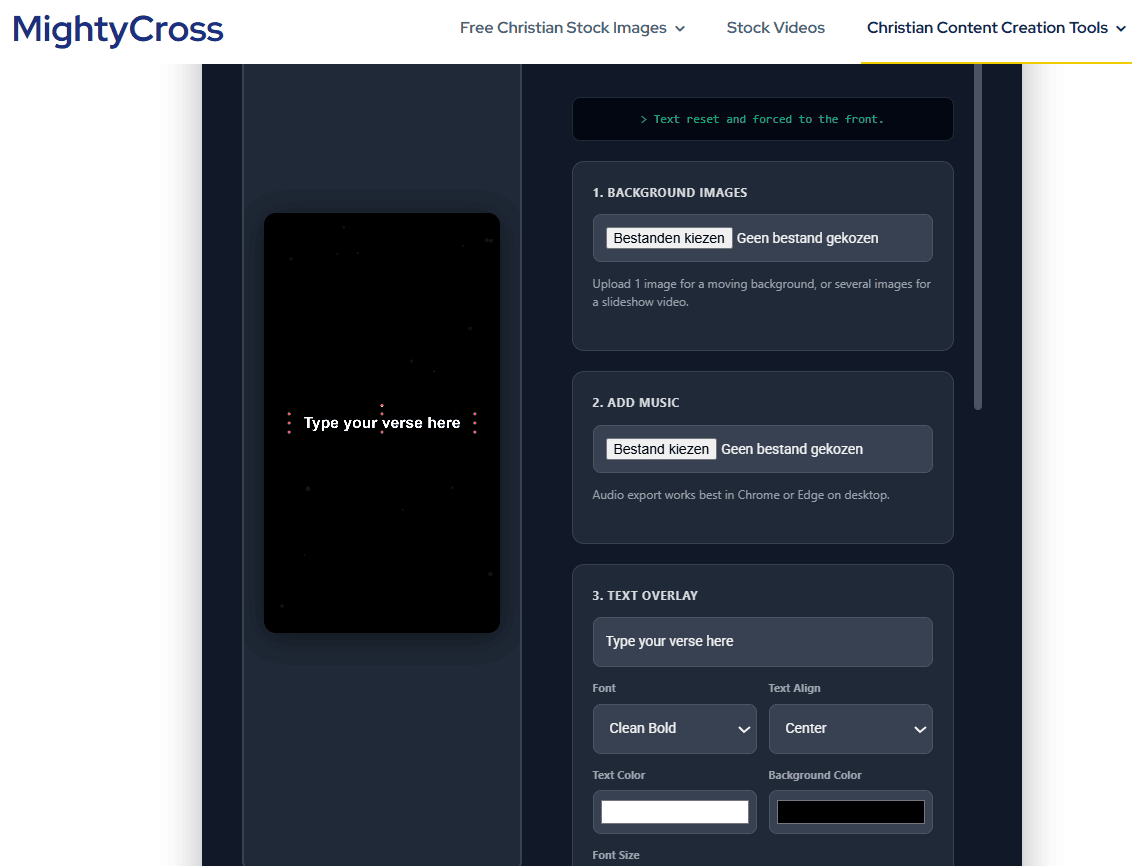
The Free Christian Social Media Video Generator from MightyCross helps users turn Christian images and messages into short social media videos.
Users can upload one or more images, add a Bible verse, prayer, sermon quote, church announcement, worship message, or devotional text, add music, choose motion and styling options, and generate the finished video. The tool can be used for Instagram Reels, Facebook, TikTok, YouTube Shorts, Pinterest, church pages, ministry updates, and devotional content. (mightycross.com)
What Christian creators can make
Use it for:
- Bible verse videos
- Prayer videos
- Sermon quote clips
- Christian encouragement videos
- Worship invitations
- Church announcements
- Ministry updates
- Devotional videos
- Sunday service invitations
- Christian holiday videos
- Instagram Reels
- TikTok videos
- YouTube Shorts
- Pinterest videos
Best for
Churches, pastors, ministries, Christian nonprofits, worship teams, Bible study groups, Christian creators, and faith-based organizations.
Useful marketing workflow
One Bible verse or church message can become several assets.
For example:
- Choose one verse or message.
- Create a still social media post.
- Upload the same image to the video generator.
- Add the verse or message.
- Add appropriate music.
- Create a short animated version.
- Publish it as an Instagram Reel, TikTok, Facebook video, or YouTube Short.
That helps smaller faith-based teams create both static and video content from the same idea.
Out of Dark
This new customer journey mapping tool helps you to keep track of and gather data about all your customer touchpoints and gives you complete control over the overall customer experience. Rather than having the customer experience-related information scattered over countless apps, docs, and even the employees’ minds, you can visualize them using powerful touchpoints that can hold a wide range of data including performance metrics.
Creating customer personas and attaching them to relevant touchpoints allows you to customize the CX without worry that you will get lost in its complexity. Apart from visualizing the customer journey, Out of Dark pushes you to improve it with built-in touchpoint-oriented project management. The company has also announced it’s working on an AI Assistant that will crunch the performance metrics from every touchpoint, warn you when something is off, and give you insights you would spend countless hours looking for yourself.

Smartlook
Smartlook enables you to gather session recordings and analyze the behavior of your website visitors. Utilizing quantitative analytics, it can help you understand every user action and provide insights into any struggles users encounter during the website visit. Recordings can be segmented using various filters and even display JavaScript errors when the user encounters a technical problem or experiences a bug.
Individual events can be grouped into funnels which will help you to identify strong and weak points of the user’s journey, and traditional heatmaps will give you an idea about the “busiest” parts of your pages. You can also integrate multiple analytics, customer service, and e-commerce tools and platforms into your session recording and event tracking.

Journy.io
Journy.io operates at the intersection of marketing and sales and will be ideally utilized by the cooperation of these two departments in your company. After it collects your product, customer, and subscription data, it keeps an eye on all your users and uses artificial intelligence to identify those who are most likely to subscribe, expand their subscription, or churn, while providing you key information about every single one of them and creating profiles of your ideal customers.
It also uses this data to identify usage patterns and their impact on acquisition, conversion, expansion, and churn. You can create playbook automations that will be automatically applied to automatically-identified users.

Brand24
Brand24 is like that High School friend who keeps track of everything that’s ever said or merely mentioned about you (or anyone else) – who said it, when, and how exactly it was meant. This tool is constantly scraping the internet for any mentions of your brand using more than 25 million sources while being able to identify the sentiment of these mentions and pass you the most relevant information they convey. This information can be then presented and evaluated in various reports.
This tool is an ideal assistant when rolling out new features or making a major announcement to show you in real time how the audience reacts. It can also serve as a kind of insurance policy – if something goes wrong and has the potential to become a PR catastrophe, you can catch this in its roots, see how bad it is, and take necessary actions to prevent it from spreading even further.

Arcane
Every marketer has dreamed of a personal assistant who wouldn’t have to be paid much and would be able to help with the tiresome but necessary tasks of the marketer’s daily life. Arcane can help you with just that – automate manual tasks with workflows and save hours of work every week. Companies that have 4 day work weeks can especially benefit from these efficiencies, maximizing productivity in a shorter timeframe.
It’s able to integrate and work with data from the most popular marketing platforms and even measure the effectiveness of cross-channel campaigns. If you want your marketing team of 3 to function like a marketing team of 5, Arcane is a tool to go for.

RAD AI
RAD can monitor, process, and evaluate a huge amount of marketing data and provide you with insights only artificial intelligence is capable of sourcing. Its Persona Engine can segment your audience and define its traits and interests. It can then use this information to suggest the best influencers to work with to effectively target these audiences and use their reach to enhance your brand awareness.
The whole process is data-based and it claims to outperform human-based discovery by staggering numbers, while also giving you a clear idea of ROI, which is one of the biggest reasons why some companies aren’t fully onboard the influencer train and claim it’s difficult to track. RAD also offers tailored solutions utilizing their proprietary AI language models to launch hyper-optimized marketing campaigns.

Profound: AI Search Visibility and Answer Engine Optimization
Traditional SEO tools answer questions like:
Where do we rank?
Which keywords generate traffic?
Which competitors rank above us?
AI search creates a different set of questions.
Does ChatGPT recommend us?
Does Gemini know what our product does?
Which sources influence how AI systems describe our company?
Why does a competitor appear in AI answers when we do not?
Profound is built around those questions.
Its Answer Engine Insights platform tracks how brands appear across AI answer engines and provides views around visibility, citations, sentiment, prompts, regions, competitors, and factual accuracy.
This is particularly useful for companies where customers research products through:
- ChatGPT
- Gemini
- Perplexity
- Microsoft Copilot
- Google AI experiences
- Other answer engines
What marketers can monitor
Profound can help identify:
- Whether a brand appears in AI answers
- Which competitors appear more often
- Which websites AI systems cite
- Which topics generate visibility
- How the brand is described
- Whether AI answers contain inaccurate information
- How visibility changes over time
Profound’s current Answer Engine Insights also lets marketers investigate changes across visibility, citations, sentiment, and factual accuracy and compare performance across platforms, regions, personas, and competitors.
Best for
Brands already investing significantly in SEO, content, PR, reputation, and AI search optimization.
Useful marketing workflow
- Track important commercial prompts.
- Find questions where competitors appear and you do not.
- Review which sources are being cited.
- Identify the content or authority gap.
- Improve the relevant pages.
- Monitor the same prompts again.
The dashboard is not the strategy.
The value comes from what you change after seeing the data.
Common Room: Buyer Intelligence From More Than Form Fills
A buyer does not always announce themselves by filling out a demo form.
Before that happens, they might:
- Visit several product pages
- Read documentation
- Join your community
- Use your free product
- Follow your company
- Change jobs
- Attend an event
- Return to the website
- Research your category
Individually, these signals can look unimportant.
Together, they may indicate real buying intent.
Common Room is built around connecting those signals.
Its buyer-intelligence platform combines first-party data and real-world intent to help revenue teams identify which people and accounts may be worth engaging. Its current system brings together signals from areas such as websites, product activity, communities, CRM activity, and job changes.
Instead of:
“Someone from Company X visited the website.”
you can move closer to:
“Several people from Company X are engaging with the product, one recently changed roles, and the account has returned to pricing content.”
That is much more useful.
Best for
B2B SaaS, product-led companies, revenue teams, and businesses with multiple customer signals spread across several platforms.
Marketing use cases
Common Room can help with:
- Account prioritization
- Product-led growth
- Website visitor intelligence
- Community signals
- Customer expansion
- Lead enrichment
- Intent monitoring
- Job-change signals
- Re-engagement campaigns
Useful marketing workflow
Instead of sending the same campaign to every account, create different plays.
For example:
Existing product user + company hiring rapidly
Send expansion-oriented content.
Past opportunity + renewed website activity
Alert sales.
Free user + repeated team usage
Start a product-led conversion sequence.
Former customer champion + new company
Create a re-engagement opportunity.
Better signals allow better timing.
Clay: GTM Data, Enrichment, Research, and AI Workflows
Marketing databases become outdated quickly.
People change jobs.
Companies raise money.
Teams grow.
Technologies change.
Job openings appear.
Websites change.
Buying signals emerge.
Clay helps go-to-market teams collect, enrich, research, and act on this type of information.
Clay has expanded far beyond basic enrichment and now positions itself as infrastructure for GTM engineering, combining data, orchestration, AI agents, enrichment, prospecting, audiences, and execution workflows.
Its current product development includes AI-assisted enrichment, account research agents, audiences, workflow automation, sequencing, APIs, and connections to external AI environments.
What marketers can do with Clay
Use Clay to:
- Build account lists
- Enrich company data
- Enrich contact data
- Research target accounts
- Find signals
- Score prospects
- Create segments
- Personalize outreach
- Build ABM workflows
- Sync audiences
- Trigger campaigns
For example, instead of targeting:
“Software companies with 100–500 employees”
you might build:
“B2B software companies with 100–500 employees that recently hired a VP of Marketing, use HubSpot, are expanding internationally, and have increased marketing headcount.”
That creates a much more relevant campaign.
Best for
Growth teams, demand generation, ABM, GTM engineers, RevOps, and teams running sophisticated outbound or account-based programs.
Avoid the personalization trap
More data does not automatically mean better marketing.
Bad personalization:
“Hi Sarah, I saw your company has 243 employees and uses HubSpot.”
Useful personalization:
“Your team appears to be expanding into several European markets. We often see reporting complexity increase quickly when marketing operations spread across regions.”
The goal is relevance.
Not proving that you found someone’s data.
Unify: Turn Buying Signals Into GTM Actions
Many marketing teams have plenty of data.
The problem is timing.
A high-value prospect:
- Visits the website
- Watches a webinar
- Downloads something
- Starts using the product
- Changes jobs
- Receives funding
Marketing sees the signal.
Sales follows up two weeks later.
The opportunity has cooled down.
Unify focuses on connecting signals directly to action.
Its Plays system lets teams create workflows triggered by signals such as website behavior, product activity, job changes, CRM events, and other account information. Those workflows can then trigger prospecting, enrichment, AI research, messaging, and sales actions.
Example workflow
A target account visits your pricing page twice.
Unify could:
- Detect the activity.
- Match the account.
- Research the company.
- Identify relevant contacts.
- Check CRM status.
- Exclude current customers.
- Generate contextual outreach.
- Add the prospect to an approved sequence.
- Notify the sales rep.
That compresses a workflow that might otherwise involve several people and tools.
Best for
B2B companies with an active outbound or account-based sales motion.
Signals worth testing
Instead of creating automation around every possible trigger, start with signals that have a reasonable connection to buying intent.
For example:
- Repeat pricing page visits
- Product usage growth
- Trial activation
- New executive hire
- Previous opportunity returning
- Webinar attendance from target accounts
- High-intent content engagement
Then measure whether those signals actually lead to better opportunities.
Do not automate noise.
HockeyStack: Connect Marketing Activity to Pipeline
Marketing has never had a shortage of activity metrics.
Impressions.
Clicks.
Downloads.
Webinar registrations.
Engagement.
Website visits.
The harder question is:
Which marketing activity actually influenced revenue?
HockeyStack focuses on B2B attribution and revenue intelligence.
Marketing attribution connects touchpoints across the buyer journey to leads, opportunities, pipeline, and closed deals. HockeyStack’s current approach combines activity across marketing and sales so teams can understand which channels, campaigns, and content contribute to revenue rather than only measuring the final click.
That becomes especially valuable in B2B.
A customer might:
- Discover your company through LinkedIn.
- Read three blog posts.
- Attend a webinar.
- Return through Google.
- Download a guide.
- Speak with sales.
- Share your product internally.
- Return weeks later.
- Request a demo.
- Buy months later.
Giving 100% of the credit to step nine tells a very incomplete story.
Best for
B2B SaaS companies with long sales cycles, several stakeholders, and multiple marketing channels.
Questions attribution should answer
- Which channels influence pipeline?
- Which campaigns attract qualified accounts?
- Which content appears in successful buyer journeys?
- Which webinars influence deals?
- Which paid campaigns generate revenue rather than leads?
- Which combinations of touchpoints frequently appear before conversion?
HockeyStack has also been expanding beyond backward-looking attribution into analysis of recurring engagement patterns and pipeline forecasting.
Do not turn attribution into fake certainty
No attribution model perfectly recreates human decision-making.
Someone may:
Read your content.
Hear about your company from a colleague.
See a LinkedIn post.
Search your brand later.
Then book a demo.
The system will capture some of that journey.
Not necessarily all of it.
Use attribution to improve decisions.
Do not pretend every customer decision can be reduced to a perfectly weighted dashboard.
What Makes a New Marketing Tool Worth Adding?

New software is easy to buy.
Useful software is harder to implement.
Before adding another marketing platform, answer five questions.
1. What problem does it solve?
Do not start with:
“This AI tool looks impressive.”
Start with:
“We spend eight hours every week manually researching accounts.”
or:
“We have no idea whether our brand appears in AI search.”
or:
“We cannot connect marketing campaigns to pipeline.”
Specific problems make tool evaluation easier.
2. Who will actually use it?
A tool that everyone likes in the demo but nobody opens later is expensive shelfware.
Define:
- Tool owner
- Daily users
- Occasional users
- Administrator
- Reporting owner
Someone should be responsible for making the tool useful.
3. Which existing tool might it replace?
Adding software without removing anything creates tool sprawl.
Ask:
Does it replace spreadsheets?
Does it replace manual research?
Does it replace another analytics tool?
Does it consolidate multiple data sources?
Does it replace several point solutions?
Sometimes a more expensive platform reduces total cost because it eliminates three smaller tools.
4. What does it need to connect to?
Modern marketing tools often rely on integrations with:
- CRM
- Analytics
- Advertising platforms
- Product data
- Data warehouse
- Website
- Calendar
- Sales engagement
- Social platforms
The tool may be excellent.
If your data cannot reach it, the value drops quickly.
5. How will you know if it worked?
Define the measurement before implementation.
Do not wait six months and ask:
“Do we think the tool helped?”
Choose the result in advance.
Marketing Tool Evaluation Checklist
| Area | Question |
|---|---|
| Problem | Which specific problem does this tool solve? |
| Users | Who will use it every week? |
| Workflow | Where does it fit into an existing process? |
| Integration | Does it connect to the systems we already use? |
| Data | What information does it need? |
| Output | Does it produce information or help us take action? |
| AI | What exactly does the AI feature improve? |
| Accuracy | How will we verify AI-generated recommendations or data? |
| Permissions | What systems and customer information can it access? |
| Security | Does it meet our security and privacy requirements? |
| Training | How difficult is it for the team to learn? |
| Cost | What will the realistic annual cost be? |
| Overlap | Does another tool already perform most of these functions? |
| Success | Which KPI should improve if the implementation works? |
Choose Marketing Tools Around Workflows, Not Categories
A modern marketing stack works better when tools connect around workflows.
Consider this B2B workflow:
Research
Clay identifies and enriches the right accounts.
Buyer intelligence
Common Room identifies which accounts show meaningful buying signals.
Activation
Unify turns selected signals into outbound actions.
Content
StoryLab.ai helps create campaign messages, content, ads, emails, and social posts.
Measurement
HockeyStack connects activity to pipeline.
Brand monitoring
Brand24 tracks external conversations.
AI discovery
Profound monitors how the brand appears across AI search.
The point is not that every company needs all seven platforms.
Most do not.
The point is that every tool should have a defined role.
A stack should look like a system.
Not a collection.
Do Not Buy Every AI Feature
AI is becoming part of almost every marketing platform.
That does not mean every AI feature creates value.
Zapier describes a current marketing-software environment where almost every tool now includes AI, making it increasingly difficult to distinguish genuinely useful capabilities from expensive novelty.
Ask:
What happens without the AI feature?
What happens with it?
For example:
Without AI
A marketer manually researches 200 companies.
With AI
The tool researches them and highlights 25 relevant opportunities.
Clear value.
Another example:
Without AI
A marketer clicks “export report.”
With AI
A chatbot says, “Your report is ready.”
Not necessarily meaningful value.
Judge AI by the workflow improvement.
Not the label.
Start With One High-Value Workflow
Do not introduce five new marketing platforms in the same month.
Pick one problem.
For example:
Problem: Marketing generates many leads, but sales does not know which accounts are genuinely interested.
A possible pilot:
- Connect website and CRM signals.
- Define several high-intent behaviors.
- Create one alert or workflow.
- Run it with a small sales group.
- Compare results with the previous process.
- Improve the signal definition.
- Expand only after it works.
The same approach works for:
- AI visibility monitoring
- Social listening
- Attribution
- Data enrichment
- Content automation
- Outbound orchestration
Small successful implementations are easier to expand than giant failed transformations.
Give AI Agents Clear Boundaries
New marketing platforms increasingly use agents that can:
- Research
- Write
- Qualify
- Enrich
- Segment
- Trigger campaigns
- Send messages
- Modify CRM records
- Build reports
That creates more power.
It also creates more risk.
Set boundaries.
For example:
An AI agent can:
Research 1,000 accounts.
But a human approves the targeting criteria.
An AI agent can:
Draft personalized emails.
But approved messaging rules control what claims it can make.
An AI agent can:
Recommend budget changes.
But a marketer approves major spend changes.
Automation should increase capacity without removing accountability.
Measure the Result, Not Tool Usage
Do not celebrate:
“Marketing created 9,000 AI outputs this quarter.”
Measure what changed.
| Tool Type | Useful Business Metrics |
|---|---|
| AI search visibility | Priority prompt visibility, citations, branded discovery, qualified traffic |
| Buyer intelligence | Qualified opportunities, conversion rate, pipeline |
| Enrichment | Match rate, research time saved, campaign quality |
| Outbound automation | Replies, meetings, qualified pipeline |
| Attribution | Pipeline visibility, budget efficiency, revenue insight |
| Social listening | Response time, reputation insights, campaign learning |
| Content AI | Production speed, engagement, traffic, conversions, content quality |
A tool can have thousands of features.
If it does not improve an important outcome, it is still unnecessary software.
Use StoryLab.ai Across Your Marketing Workflow
Marketing intelligence becomes valuable when you turn it into content and campaigns.
A listening platform may reveal a customer problem.
An attribution tool may reveal a high-performing topic.
An AI visibility platform may show that competitors dominate an important question.
A buyer-intelligence platform may identify a specific audience segment.
Those insights need creative execution.
StoryLab.ai can help turn them into:
- Campaign concepts
- Blog ideas
- Social posts
- Ads
- Email copy
- Landing-page messaging
- Video concepts
- Video scripts
- YouTube content
- Content repurposing
Useful tools include:
- AI Content Idea Generator
- AI Campaign Builder
- AI Social Media Caption Generator
- AI Social Media Repurposing Generator
- AI Video Script Generator
- AI Email Copy Generator
- AI Blog Outline Generator
- AI Marketing Guide
A simple workflow might be:
- Find the marketing insight.
- Decide which audience it matters to.
- Define the campaign angle.
- Create several messaging options.
- Adapt the message for each channel.
- Publish.
- Measure what happens.
- Feed the result back into your marketing data.
That creates a loop:
Insight → Content → Campaign → Data → Better Insight
Frequently Asked Questions
What are the best new marketing tools?
Useful newer and fast-evolving marketing tools include Profound for AI search visibility, Common Room for buyer intelligence, Clay for GTM data and enrichment, Unify for signal-based outbound, HockeyStack for attribution, and Brand24 for social listening.
The right choice depends on the marketing problem you need to solve.
What is an AI marketing tool?
An AI marketing tool uses artificial intelligence to support tasks such as research, content creation, personalization, analytics, customer engagement, audience segmentation, optimization, automation, or campaign execution.
Canva describes AI marketing tools as software that uses technologies such as machine learning, natural language processing, and data analytics to support and improve marketing work.
Do marketers need more AI tools?
Not necessarily.
Many teams need fewer tools used more effectively.
Add an AI tool when it solves a clear problem, improves a real workflow, or replaces significant manual work.
Do not add software simply because it contains AI.
How do I choose a new marketing tool?
Start with the business problem.
Then evaluate:
- Features
- Workflow fit
- Integrations
- Data requirements
- Security
- Ease of use
- Cost
- Team adoption
- Existing tool overlap
- Expected business result
Pilot the tool before rolling it out widely.
What is a buyer-intelligence platform?
A buyer-intelligence platform combines signals about potential customers to help teams understand which people or accounts may be worth engaging.
Signals may include website visits, product usage, CRM activity, community participation, job changes, company changes, and other intent indicators.
What is signal-based marketing?
Signal-based marketing uses observed customer or account activity to decide when and how to engage.
Instead of targeting only based on demographics or static lists, teams react to signals such as:
- Product usage
- Pricing page visits
- Event attendance
- Job changes
- Website engagement
- CRM events
This can make campaigns more timely and relevant.
What is AI search visibility?
AI search visibility describes whether and how a brand appears in answers generated by platforms such as ChatGPT, Gemini, Perplexity, and other answer engines.
Tools such as Profound track visibility, citations, sentiment, prompts, and competitors across AI-generated responses.
Is social listening still important?
Yes.
Online conversations are spread across social media, forums, news sites, podcasts, videos, review platforms, and communities.
Social listening can help marketers understand brand sentiment, identify customer concerns, discover trends, track competitors, and respond to reputation issues.
What is marketing attribution?
Marketing attribution is the process of connecting marketing touchpoints to outcomes such as leads, opportunities, pipeline, and revenue.
In B2B marketing, attribution becomes especially important because customers often interact with several channels and pieces of content before buying.
Should small businesses use these tools?
Some of these platforms are built more for larger B2B teams.
Small businesses should start with simpler tools that solve immediate problems.
A small team may gain more value from:
- Better content creation
- Email marketing
- Social media management
- Website analytics
- Local SEO
- Simple CRM automation
than from a sophisticated enterprise buyer-intelligence platform.
Buy according to complexity.
Not aspiration.
How many marketing tools should a company use?
There is no ideal number.
Use enough software to support the workflows you need without creating unnecessary duplication.
Each platform should have:
- A clear purpose
- An owner
- Active users
- Useful integrations
- Measurable value
If nobody can explain why a tool exists, review whether you still need it.
Can AI marketing tools replace marketers?
AI tools can automate and accelerate many marketing tasks.
They can research, generate drafts, analyze data, find patterns, and execute workflows.
Humans still need to make decisions about:
- Positioning
- Strategy
- Customer understanding
- Brand voice
- Creative direction
- Ethics
- Accuracy
- Prioritization
- Business tradeoffs
The strongest marketing teams use AI to increase capacity while keeping people responsible for judgment.
Build a Smarter Marketing Stack, Not a Bigger One
There will always be another marketing tool.
Another AI agent.
Another dashboard.
Another automation platform.
Another feature promising to transform your marketing.
You do not need all of them.
The strongest marketing stack is not the stack with the most logos.
It is the one where every tool has a clear job.
Then connect those insights to content and campaigns.
Choose the problem first.
Choose the tool second.
Measure the result.
Remove what no longer creates value.
That is how new marketing technology becomes a competitive advantage instead of another monthly subscription.
Master the Art of Video Marketing
AI-Powered Tools to Ideate, Optimize, and Amplify!
- Spark Creativity: Unleash the most effective video ideas, scripts, and engaging hooks with our AI Generators.
- Optimize Instantly: Elevate your YouTube presence by optimizing video Titles, Descriptions, and Tags in seconds.
- Amplify Your Reach: Effortlessly craft social media, email, and ad copy to maximize your video’s impact.