
How To Get More Website Traffic With The Help Of AI
Processes and Tools

AI can help you produce more content, but more content does not automatically create more website traffic.
Millions of businesses now have access to tools that can generate articles, social posts, emails, images, and campaign ideas within minutes. This makes production faster. It also means the internet is filling up with more content that says roughly the same thing.
The real opportunity is not to publish faster than everyone else.
It is to use AI to understand your audience, find overlooked questions, improve existing pages, create content worth clicking, distribute it consistently, and learn which visitors are most likely to become subscribers, leads, or customers.
Website discovery is changing too.
People can now receive answers through traditional search results, AI-generated search summaries, conversational assistants, social media, video platforms, online communities, and recommendations. Sometimes they click through to the source. Sometimes the answer removes the need for a visit.
That means your website traffic strategy needs two things:
- Strong visibility across several discovery channels
- A clear reason for people to visit your website instead of settling for a summary
AI can support both.
This guide explains how to use AI to grow website traffic through SEO, social media, content strategy, AI search, content refreshing, visitor experience, and performance analysis. More importantly, it shows how to attract the right visitors and give them a reason to return.
In this article, we will go over tools, processes, and frameworks to help you get more website visits through SEO and Social Media Marketing.
If you want to go deeper into this subject, check out the entire book on increasing website traffic with the help of AI.
In this article:

Growth Mindset
Growing website traffic takes a certain type of mindset. There are no quick and easy ways. AI has arrived and it’s making things easier. It is especially taking care of a lot of boring and repetitive tasks, but growing website traffic still takes time and you need to put in the work and ‘trust the process’.
In this article, we’re going to discuss how to increase website traffic with AI using Social Media Marketing and SEO. Chances are that you’ll be stronger at one or the other. Make sure you prioritize your strengths but also experiment with the other.

Common Challenges When Growing Website Traffic
The most common challenges I see people make when trying the grow their website traffic are the following:
- No deep understanding of their target group and the value they bring;
- No deep focus on the content they create;
- Basic SEO knowledge;
- Basic Social Media knowledge;
If you follow the steps presented in this article, you’ll be able to grow your website traffic in no time.
The better you overcome the abovementioned challenges, the faster you will grow.
All your marketing activities revolve around your audience. Make sure you understand them well and help them with valuable content.

Growing Website Traffic With Social Media And AI
There are two ways AI can help you grow website traffic with Social Media Marketing.
- Creating social media posts to promote existing content (blog post, webinar, video, eBook, etc.);
- Creating social media posts without existing content in mind.
Let’s first have a look at how AI can help you create great social media captions to promote an existing blog article.
StoryLab.ai has a cool tool that helps you create up to 25 social media captions from one blog post. Check out the video below to see how easy it is. All you need to do is copy/paste snippets from your blog post and after the AI tool did the heavy lifting, you add your human touch to the ideas and schedule them.
Now let’s have a look at how AI can help you create effective social posts without having an existing content piece in mind.
Simply enter your thoughts in StoryLab.ai’s AI-Powered Social Media Caption Generator and get inspired by the various angles the AI uses to talk about that topic.
Here’s what it looks like when I enter ‘The state of AI’
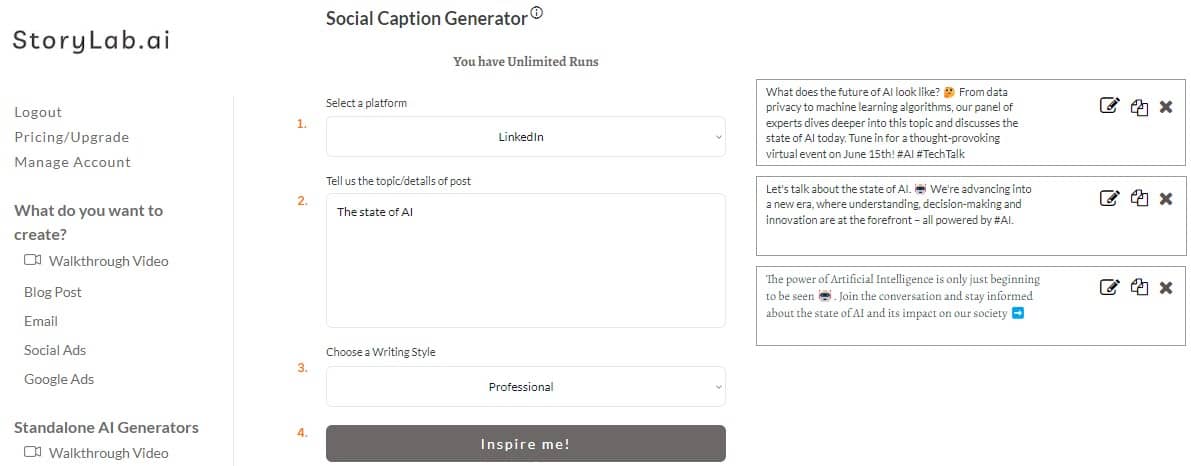
Outputs the AI Tool Generated on the first run:
- What does the future of AI look like? 🤔 From data privacy to machine learning algorithms, our panel of experts dives deeper into this topic and discusses the state of AI today. Tune in for a thought-provoking virtual event on June 15th! #AI #TechTalk
- Let’s talk about the state of AI. 🤖 We’re advancing into a new era, where understanding, decision-making and innovation are at the forefront – all powered by #AI.
- The power of Artificial Intelligence is only just beginning to be seen 🤖. Join the conversation and stay informed about the state of AI and its impact on our society ➡️
I decided to give the tool another run and here’s the second batch of ideas:
- AI is on the rise. From powering internet searches to automating customer service, artificial intelligence will play an increasingly large role in our lives. 🤖 What does the future of AI look like? Let’s find out together!
- AI is transforming our world. With research at an all-time high, now’s the time to discuss the state of #AI and how it will continue to shape the future. What are your thoughts? 🤔
- What’s the future of AI? With new advancements in artificial intelligence, machine learning, and robotics emerging every day- the possibilities are seemingly limitless! 🤖 #AI #FutureSoBright

Growing Website Traffic With SEO And AI
There are also a couple of common mistakes I see when people are creating content that is meant to rank well in Google and get traffic in.
The most common mistakes I see, specifically for SEO, are:
- Not having a great understanding of their target audience;
- Not creating content that actually answers a question people might search in Google;
- Going after highly competitive keywords right away;
- Not building enough authority for the topic they’re trying to rank for.
You don’t just want traffic. You want the right people to visit your website and therefore you need to have a deep understanding of who your target group is, what questions they have and answer those questions with great content.
To figure out if people actually search for a topic you want to create content for and understand how competitive a keyword is, you can use Keyword Research Tools like Semrush to get that data.
StoryLab.ai has partnered with Semrush to give you a 14-day free trial instead of a 7-day free trial. You can create an account for free and cancel anytime within the 14 days without getting charged. When creating your account, Semrush will ask for a credit card to ensure people don’t just create new accounts every 14 days.
Check out the tool, get the data you need, and create the right type of content.
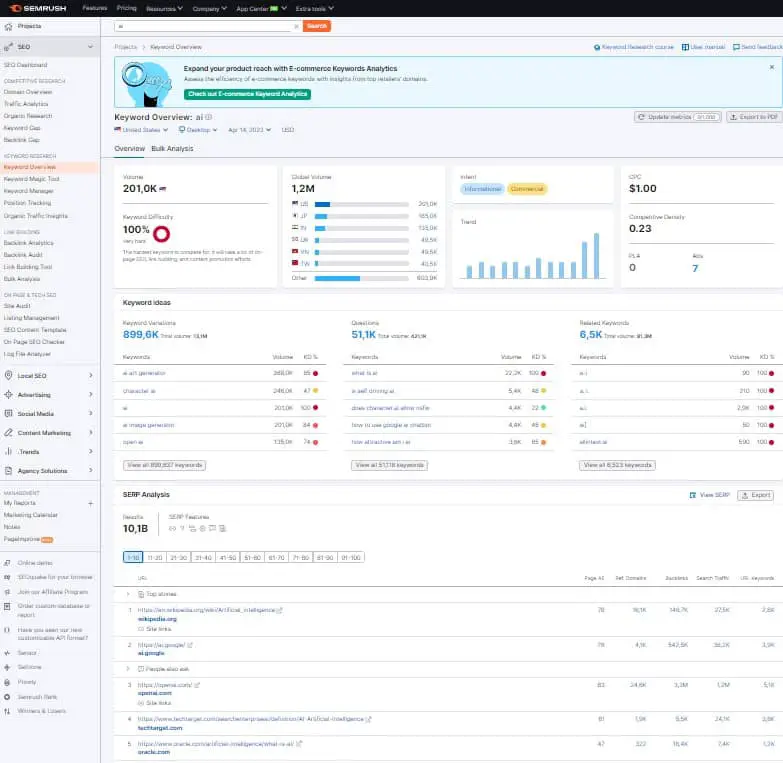
Bonus resource: How to do Keyword Research for SEO [Free worksheet included]
Next to understanding your audience and what type of content you should be creating, you also need to build authority within Google.
One of the best ways of doing that is by making sure you’re creating highly related content on a topic.
Example:
If you’re running a Gardening Blog, you might be tempted to write about apple trees, strawberries, watermelons, tomatoes, etc. If you want to really build authority as fast as possible, pick one topic, create at least 20 articles around that topic, use internal links, and only then proceed to the next topic.
For the gardening example, you might want to first write about apple trees. You can write about:
- Pruning apple trees in the winter;
- Pruning apple trees in the summer;
- Common apple tree pruning mistakes;
- Growing healthy apple trees;
- Most delicious apples to grow;
- Best apples to grow in USA;
- etc.
This will signal to Google that you are an authority when it comes to apples and apple trees and will increase your chances to rank well.
The downside is… It’s boring! You want to also write about delicious strawberries, pumpkins, you name it.
That’s where AI comes in! AI can help with boring repetitive tasks.
AI can help you come up with content ideas, blog outlines, blog titles, blog intros, and more.
StoryLab.ai’s co-founder, Erwin Lima, wrote an article on how to write an article within 30 minutes with the help of AI. Be sure to check it out.
The way you should use AI to grow website traffic with SEO is:
- Understand your audience;
- Do your keyword research;
- Cluster your content and cover a topic the best you can before proceeding to the next topic;
- Use AI to help with boring repetitive tasks and overcome writer’s block.

Growing Website Traffic With AI Strategy
AI and other tools are great for marketers to achieve goals like growing website traffic. Tools are never at the center. They are there to help with execution and allow you to focus on what matters most (strategy) while doing boring, repetitive tasks quicker.
Make sure your strategy is sound and you experiment with how AI can help. Here are some additional resources to help you on your way to success:
Dive deeper into what we’ve been discussing in this article. Check out the entire book on increasing website traffic with the help of AI.
Website Traffic Is Changing in the Age of AI Search
Search engines are no longer limited to a list of links.
A customer may ask a detailed question and receive a generated answer containing recommendations, comparisons, explanations, and links to supporting sources. The same person may also research the topic through ChatGPT, Gemini, Perplexity, YouTube, Reddit, LinkedIn, or another platform.
This changes what website visibility means.
A business may now be discovered through:
- A traditional organic result
- A Google AI Overview
- An AI Mode response
- A citation inside an AI assistant
- A social media recommendation
- A YouTube description
- A discussion inside an online community
- An email forwarded by a colleague
- A branded search after someone encountered the business elsewhere
You still need SEO. You also need content that is useful enough to be mentioned, cited, shared, saved, or searched for by name. Experts in answer engine optimization such as Austin Heaton track which of those mentions actually turn into citations.
Google explains that its generative search features still rely on its core search ranking and quality systems. The foundations remain familiar:
- Create useful content
- Make pages crawlable
- Build a clear site structure
- Provide a good experience
- Add relevant images and video
- Demonstrate real knowledge
- Keep important information accurate
Do not chase imaginary AI search hacks
You do not need to break every paragraph into tiny pieces, create hundreds of near-identical FAQ pages, or rewrite an article for every possible prompt.
Those tactics usually create more pages, not more value.
Instead, give searchers and AI systems reliable material to work with:
- Clear answers
- Original examples
- First-hand experience
- Useful comparisons
- Supporting evidence
- Relevant internal links
- Visual explanations
- Practical next steps
- Transparent authorship
- Updated information
Your goal is not to write for a robot. Your goal is to publish something a robot cannot easily replace with one generic paragraph.
Focus on Qualified Website Traffic, Not Just More Visitors
A traffic graph moving upward looks encouraging.
But 10,000 visitors who leave immediately may be less valuable than 500 people who closely match your target audience.
Qualified traffic consists of people who are likely to benefit from what the website offers.
Depending on the business, these visitors may:
- Read several related pages
- Subscribe to an email list
- Start a free trial
- Request a demonstration
- Download a guide
- Use an online tool
- Purchase a product
- Return later
- Share the page with someone else
- Contact the company
AI can help distinguish traffic volume from traffic quality by analyzing patterns across sources, pages, audiences, and outcomes.
| Traffic question | Weak measurement | Stronger measurement |
|---|---|---|
| Did our content attract attention? | Total page views | Views from the intended audience and topic |
| Did visitors find the page useful? | Number of sessions | Engaged sessions, related-page visits and return visits |
| Did social promotion work? | Likes and impressions | Qualified referral visits and resulting actions |
| Did the article support growth? | Organic clicks | Signups, leads, sales or assisted conversions |
| Did AI search visibility help? | Referral sessions alone | Referral quality, branded searches and conversions |
Before trying to grow traffic, define what a valuable visit looks like.
An online store may prioritize revenue and product views. A B2B company may care about qualified demos. A media website may value returning readers. A free tool may measure usage and account creation.
AI can summarize the data. Your business still needs to decide which outcomes matter.
Create Content That AI Answers Cannot Replace
A short AI answer can easily summarize common knowledge.
It can explain what email marketing is, list basic SEO tips, or describe the advantages of social media. A searcher may not need to click a website for information that is available everywhere.
To earn visits, create content that offers something beyond a generic answer.
Add first-hand experience
Share:
- What your team tried
- What happened
- What failed
- What changed
- What surprised you
- Which recommendation you would make now
- Which common advice did not work in your situation
First-hand experience gives readers something they cannot get from a rearranged summary of other articles.
Include original examples
Do not only tell readers to improve their headlines.
Show:
- The original headline
- The rewritten version
- The reason for the change
- The result
- When the same approach may not work
Specific examples make advice easier to apply and harder to replace with a two-sentence answer.
Provide useful assets
Pages can attract links, shares, and repeat traffic by including:
- Templates
- Calculators
- Interactive tools
- Checklists
- Worksheets
- Comparison tables
- Downloadable resources
- Prompt frameworks
- Original images
- Videos
- Research summaries
A reader may not visit another website for a definition. They may visit to use a tool or download something practical.
Share a clear point of view
Content becomes forgettable when it avoids every opinion.
A useful point of view might challenge a common assumption:
“Publishing daily is not the fastest way to grow traffic. Improving the distribution and conversion of your strongest pages may create more value.”
The argument still needs evidence and nuance. The purpose is not to be controversial for attention. It is to say something worth considering.
Answer the question and improve the decision
Many pages stop after providing information.
Stronger content helps the reader decide what to do next.
For example, an article about AI marketing tools could include:
- Which tool category fits each task
- When a free tool is enough
- When custom development is unnecessary
- Which features often overlap
- How to compare total costs
- A scorecard for making the final selection
That gives the reader a reason to visit even when an AI assistant has already summarized the basic topic.
Use AI to Find Content Gaps in Real Customer Conversations

Keyword data is useful, but some of the best traffic opportunities are hidden inside customer conversations.
Review:
- Sales call notes
- Customer support tickets
- Website search queries
- Survey responses
- Product reviews
- Demo questions
- Chat transcripts
- Email replies
- Community discussions
- Comments on social posts and videos
AI can group these conversations into themes and identify:
- Repeated questions
- Common objections
- Confusing terminology
- Missing instructions
- Comparison requests
- Use cases customers care about
- Problems customers experience after buying
- Questions that existing content answers poorly
For example, support tickets may reveal that customers repeatedly ask how two features differ. That could become:
- A comparison page
- An FAQ
- A tutorial
- A short video
- An onboarding email
- A product-page section
- A sales enablement resource
One customer question can support several useful assets.
A practical customer-question prompt
Use a prompt such as:
“Group the following customer questions into recurring themes. For each theme, identify the customer’s likely goal, stage in the buying journey, missing information, and a useful content format. Do not invent questions that are not present in the source material.”
Review the output manually. Customer information may contain private or sensitive details that should not be uploaded to an unapproved AI platform.
Refresh Existing Content Before Publishing More
Website traffic growth does not always require another article.
An existing page may already have:
- Search impressions
- Backlinks
- Internal links
- Historical rankings
- Returning visitors
- Brand recognition
- A clear connection to your products
Improving that page may create results faster than starting again.
Find content-refresh opportunities
Look for pages with:
- High impressions but low click-through rates
- Falling organic clicks
- Rankings near the first page
- Outdated examples
- Broken links
- Weak introductions
- Missing sections
- Old screenshots
- Poor mobile formatting
- No clear next step
- Traffic but few conversions
- Several overlapping articles competing for the same topic
AI can help compare the page with current customer questions, competitor coverage, internal data, and recent developments.
Do not change the date without changing the content
A meaningful refresh may involve:
- Rewriting the introduction
- Updating examples
- Removing outdated advice
- Adding missing steps
- Improving the title
- Adding a comparison table
- Including original experience
- Updating screenshots
- Improving internal links
- Answering new questions
- Adding a relevant tool or template
- Clarifying the call to action
Changing only the publication date does not make the page more useful.
Google recommends focusing on substantial improvements rather than making content appear fresh without meaningful changes.
Use AI as an editor, not a repainting machine
Do not ask AI to rewrite every sentence simply to make the article appear different.
Instead, give it focused tasks:
- Identify unsupported claims
- Find repeated sections
- Highlight unclear language
- Compare the title with the actual content
- List unanswered reader questions
- Suggest better examples
- Find sections that no longer support the main topic
- Turn dense information into a usable table
The goal is to make the page better, not merely newer.
Build a Content Distribution Loop
Publishing is the beginning of distribution, not the end.
A strong content asset can continue attracting visitors for weeks or months when it is adapted and shared through several relevant channels.
A simple distribution loop could be:
- Publish one useful website resource.
- Turn its main ideas into social posts.
- Create a short video from the strongest lesson.
- Include the resource in an email.
- Answer a related community question.
- Link to it from relevant website pages.
- Revisit the idea when new information appears.
- Analyze which version attracted the best visitors.
- Use that insight to improve the original page.
AI can accelerate the adaptation process.
StoryLab.ai’s AI Social Media Repurposing Generator can help turn one content asset into platform-specific social ideas.
For larger campaigns, the AI Campaign Builder can help develop connected assets across several channels.
Adapt the message instead of copying it
The same idea should look different across channels.
| Channel | Useful adaptation | Traffic opportunity |
|---|---|---|
| A strong opinion, lesson or practical framework | Bring professional readers to the complete guide | |
| YouTube | A demonstration or detailed explanation | Direct viewers to a supporting resource or tool |
| A personal introduction and one useful takeaway | Bring subscribers back to the website | |
| Online community | A direct answer based on real experience | Earn visits when the full resource genuinely helps |
| Short-form video | One problem, lesson or surprising result | Create awareness and branded searches |
| Internal linking | A contextual recommendation from a related page | Move existing visitors deeper into the website |
Do not force a link into every interaction. Provide enough value on the platform itself. The website link should be a useful next step, not a toll booth.
Turn One-Time Visitors Into a First-Party Audience
Traffic is fragile when every visit depends on another platform.
Search rankings change. Social reach fluctuates. Recommendation systems evolve. Advertising costs rise.
A first-party audience gives people a direct way to return.
This could include:
- An email newsletter
- A free account
- Saved preferences
- A customer community
- A regular research report
- A useful tool
- A recurring webinar
- A downloadable resource
- A branded video or podcast series
The strongest reason to subscribe is not “join our newsletter.”
Give visitors a clear benefit.
Examples include:
- Receive one practical AI marketing experiment each week
- Get the complete website traffic checklist
- Save your generated content
- Receive updates when the research changes
- Access free templates and campaign frameworks
- Get new examples before they are published elsewhere
AI can help personalize follow-up content, summarize new resources, and adapt emails for different audience segments.
The final communication should still feel like it came from a business that understands why the person subscribed.
Improve What Happens After the Click
Traffic growth is wasted when the landing page confuses visitors.
A visitor should quickly understand:
- What the page is about
- Whether it matches their question
- Why the information is trustworthy
- What they should read next
- What action they can take
AI can help evaluate page clarity, but real user behavior should guide the final decision.
Check the opening
The first section should confirm the promise made by the title, search result, social post, advertisement, or email.
Avoid making visitors read five paragraphs before discovering whether the page answers their question.
Make pages easy to scan
Use:
- Descriptive headings
- Short paragraphs
- Tables
- Relevant lists
- Images
- Examples
- Callout boxes
- Clear links
- Summaries
Scanning does not mean readers dislike detail. It means they want to find the detail that matters to them.
Add meaningful internal links
An internal link should help the visitor continue their journey.
For example:
- A beginner article can link to an implementation guide.
- A strategy page can link to a practical template.
- A tool roundup can link to a selection framework.
- An educational guide can link to a relevant free generator.
Avoid adding a collection of unrelated links simply because the words happened to appear on the page.
Match the call to action to the reader’s stage
| Visitor stage | Likely need | Suitable next step |
|---|---|---|
| Discovering a problem | Education | Read a related guide |
| Exploring solutions | Comparison | Use a checklist or view examples |
| Evaluating a provider | Proof | Read a case study or try a tool |
| Ready to act | Low-friction action | Start free, book a demo or purchase |
| Existing customer | Ongoing value | Access tutorials, updates or advanced resources |
A reader learning the basics may not be ready to book a sales call. Give them a next step that fits their current intent.
How to Track Traffic From ChatGPT and Other AI Platforms
AI referral traffic may appear inside Google Analytics as referral traffic when an AI platform sends a visitor through a detectable link.
The exact source depends on how the platform, browser, application, and link pass referral information. Some visits may appear under direct traffic when that information is missing.
Check AI referrals in GA4
A practical starting point is:
- Open Reports.
- Go to Acquisition.
- Open Traffic Acquisition.
- Change the primary dimension to Session source/medium.
- Search for known AI platform domains.
- Compare sessions, engaged sessions, conversions, and revenue.
The Traffic Acquisition report is session-scoped. It shows where sessions came from, including returning visits.
You can also create an Exploration using dimensions such as:
- Session source
- Session medium
- Landing page
- Page referrer
- Session campaign
Possible AI referral sources may change over time. Review the report instead of relying permanently on one fixed list.
Create a custom AI traffic group
You can group known AI referral sources with a custom report, exploration filter, audience, or data transformation outside GA4.
Your group might include referral domains associated with:
- ChatGPT
- Perplexity
- Gemini
- Copilot
- Claude
- Other conversational or AI search platforms
Maintain the group as platforms and referral patterns change.
Compare quality, not only sessions
For each source, review:
- Landing pages
- Engagement rate
- Average engagement time
- Key events
- Signups
- Leads
- Revenue
- Return visits
AI referral traffic may be smaller than organic search traffic while containing visitors with stronger intent. A person who clicks after a detailed AI conversation may already understand the problem and be closer to making a decision.
Use Google Search Console for Google visibility
Search Console provides:
- Clicks
- Impressions
- Click-through rate
- Average position
- Queries
- Pages
- Countries
- Devices
- Search appearances
Use it to identify:
- Pages receiving more impressions but fewer clicks
- Queries where interest is growing
- Pages that have lost clicks
- Search topics near the first page
- Titles with weak click-through rates
- New query variations worth answering
AI Overviews and other search-result features can affect how impressions turn into clicks. Do not look at rankings alone.
Website Traffic Metrics That Matter
A useful traffic dashboard should connect acquisition with behavior and outcomes.
| Metric | What it tells you | Question to ask |
|---|---|---|
| Users | How many people visited | Are we reaching more of the intended audience? |
| Sessions | How many visits occurred | Are people returning? |
| Engaged sessions | How many visits met GA4 engagement criteria | Which traffic sources create meaningful visits? |
| Organic clicks | Visits from Google Search results | Which pages and queries attract clicks? |
| Search impressions | How often pages appeared in Google Search | Where is visibility growing before traffic follows? |
| Click-through rate | Percentage of impressions that become clicks | Do titles and descriptions match search intent? |
| Landing-page conversions | Actions completed after entering through a page | Does the page guide visitors toward a suitable next step? |
| Traffic-source conversions | Outcomes associated with each source | Which channels attract the most valuable visitors? |
| Returning users | People who visit again | Are we building an audience or renting attention? |
| Assisted conversions | Touchpoints that influenced an outcome | Which channels help even when they are not the final click? |
| Revenue or lead value | Commercial impact of traffic | Is traffic growth supporting business growth? |
Avoid making decisions based on one week of noisy data.
Compare suitable periods, account for seasonality, and examine changes by source, page, device, audience, and location.
Use AI to Analyze Website Traffic Data
AI can help marketers interpret reports when the input is properly prepared.
Possible tasks include:
- Summarizing changes by channel
- Finding pages with declining traffic
- Grouping search queries by intent
- Identifying high-impression, low-click opportunities
- Comparing conversion rates across landing pages
- Finding content with traffic but no clear next step
- Detecting sudden anomalies
- Preparing questions for deeper investigation
Example analysis prompt
“Analyze this website performance table. Identify the largest positive and negative changes by landing page. Separate changes in impressions, clicks, click-through rate, engagement, and conversions. Do not assume causation. List possible explanations and the additional data required to test each explanation.”
The phrase “do not assume causation” matters.
AI may confidently explain why traffic fell even when the data only shows that it fell.
Use AI to generate hypotheses. Verify them through analytics, Search Console, campaign history, technical checks, and customer behavior.
An AI Website Traffic Audit
Use the following audit to decide where to focus next.
| Audit area | Question | Possible action |
|---|---|---|
| Audience | Do we know which visitors we want? | Define audience problems, intent and desired actions |
| Traffic quality | Which sources generate valuable visits? | Compare engagement and conversion by source |
| Search visibility | Which pages receive impressions but few clicks? | Improve titles, relevance and search-result appeal |
| Content depth | Does the page add anything beyond common knowledge? | Add experience, examples, evidence or useful assets |
| Content freshness | Which important pages contain outdated information? | Complete a substantial content refresh |
| Distribution | Does every important asset have a promotion plan? | Create social, email, video and internal-link variations |
| AI referrals | Are AI platforms sending visitors? | Create a GA4 report or exploration |
| Visitor journey | Is the next step clear? | Add relevant internal links and calls to action |
| Audience ownership | Can visitors subscribe or return directly? | Create a useful newsletter, account or recurring resource |
| Measurement | Are traffic metrics connected to business outcomes? | Define and track key events, leads or revenue |
A 30-Day AI Website Traffic Improvement Plan
Week 1: Measure and diagnose
- Review GA4 Traffic Acquisition.
- Review Search Console pages and queries.
- Identify the highest-value landing pages.
- Find pages losing clicks.
- Find pages with high impressions and low click-through rates.
- Review AI referral sources.
- Define what a qualified visit means.
Week 2: Improve existing pages
Choose three to five pages with clear potential.
For each page:
- Update outdated information.
- Improve the introduction.
- Add unanswered customer questions.
- Include one original example.
- Add a table, tool, template, or checklist.
- Improve internal links.
- Add a relevant next step.
- Review the mobile experience.
Week 3: Build the distribution system
For each updated page:
- Create several social angles.
- Write one email.
- Create one short video idea.
- Link from relevant existing pages.
- Answer a related community question.
- Share the page with partners or colleagues who may genuinely find it useful.
Use StoryLab.ai’s Marketing Copy Generators to create first drafts, then adapt them to your brand and audience.
Week 4: Review outcomes
Compare:
- Search impressions
- Clicks
- Click-through rate
- Referral traffic
- Engagement
- Conversions
- Returning visitors
Document what changed and which explanation is supported by the data.
Then choose the next three to five pages.
Traffic growth becomes more manageable when it is treated as a repeated improvement cycle rather than one giant publishing challenge.
Common AI Website Traffic Mistakes
Publishing large volumes of generic content
AI lowers production costs, but publishing hundreds of weak pages can dilute quality and create maintenance problems.
Google warns that using generative AI to create many pages without adding value may violate its scaled content abuse policy.
Measuring output instead of results
The number of posts, articles, and emails created does not reveal whether the work attracted the right audience.
Connect production to traffic quality and conversions.
Trusting generated research without checking it
AI may invent sources, statistics, quotes, and case studies.
Verify factual claims before publishing.
Creating content without a distribution plan
A strong article can remain invisible when nobody knows it exists.
Plan distribution before publication.
Sending every visitor to the same call to action
A beginner, returning customer, and ready-to-buy prospect need different next steps.
Match the action to the visitor’s intent.
Relying on one traffic source
A business that depends entirely on one search engine, social platform, or advertising account is vulnerable to sudden changes.
Build a mix of discovery channels and a first-party audience.
Treating AI referral traffic as the whole AI-search impact
AI visibility may also create:
- Branded searches
- Direct visits
- Later organic searches
- Word-of-mouth
- Assisted conversions
Referral sessions are useful, but they do not capture every influence.
Final Thoughts
AI can help you grow website traffic, but it cannot make people care about a page that offers nothing new.
Use it to understand customer questions, analyze data, improve existing content, create stronger campaign variations, distribute ideas, and identify where visitors lose interest.
Then add what the machine does not have:
- Your experience
- Your evidence
- Your customers
- Your examples
- Your perspective
- Your judgment
The strongest website traffic strategy does not chase the largest possible number of visits.
It attracts people with a real reason to visit, gives them something useful when they arrive, and creates a clear path for them to return.
FAQ
What are effective SEO strategies to increase website traffic?
Implementing effective SEO strategies such as keyword optimization, creating quality content, improving site speed, and obtaining backlinks from reputable sources can significantly increase website traffic.
How can social media be used to drive more traffic to a website?
Use social media platforms to share content, engage with followers, and promote your website. Regularly posting interesting and relevant content can attract more visitors to your site.
Can email marketing help in increasing website traffic?
Yes, email marketing can drive traffic by sending regular newsletters, updates, and promotions that encourage recipients to visit your website.
What role do blog posts play in attracting more website visitors?
Regularly publishing informative, engaging, and SEO-optimized blog posts can attract more visitors through search engines and establish your website as an authority in your field.
How can guest blogging increase website traffic?
Guest blogging on reputable sites in your industry can expose your brand to a broader audience and bring more traffic through backlinks to your website.
Is paid advertising effective for increasing website traffic?
Paid advertising, such as Google AdWords or social media ads, can be highly effective in driving targeted traffic to your website, especially for new websites or special promotions.
How does optimizing website design impact traffic?
A well-designed, user-friendly website can greatly improve user experience, decrease bounce rates, and encourage visitors to explore more pages, increasing overall traffic. Businesses without the time to manage these moving parts in-house can also turn to reliable AI website management and SEO services that handle technical optimization and ongoing site updates on their behalf.
Can participating in online forums and communities boost website traffic?
Actively participating in relevant online forums and communities, and sharing valuable insights and information, can drive traffic to your site when you include your website link in your profile or posts.
How important is mobile optimization for website traffic?
With the increasing use of mobile devices, mobile optimization is crucial. A mobile-friendly website provides a better user experience, which can lead to increased traffic and higher search engine rankings.
What impact does multimedia content have on website traffic?
Including multimedia content like videos, infographics, and podcasts can make your website more engaging and shareable, potentially increasing traffic through improved user engagement and social shares.
How can leveraging influencers boost website traffic?
Collaborating with influencers can expose your website to a larger audience. Influencers can drive their followers to your site through endorsements or by sharing your content.
What is the role of analytics in increasing website traffic?
Using analytics tools helps in understanding your audience, tracking which sources bring the most traffic, and identifying which content performs best, guiding you to make informed decisions.
Can hosting webinars increase website traffic?
Hosting webinars can attract visitors interested in your topic. Promote the webinar through your website and encourage participants to visit your site for more information or resources.
How does updating old content improve website traffic?
Updating old content with current information, additional details, or new keywords can revive its relevance, potentially improving its search rankings and attracting more traffic.
Can affiliate marketing contribute to more website traffic?
Engaging in affiliate marketing can increase traffic as affiliates promote your products or services to their audience, driving visitors to your site.
What impact does local SEO have on website traffic?
For businesses with a physical location, local SEO, like optimizing for local keywords and listing in local directories, can attract more local visitors to the website.
How do online partnerships and collaborations increase traffic?
Collaborating with other websites or businesses in complementary fields can drive traffic. This can include link exchanges, co-authored content, or joint promotions.
Can participating in podcasts increase website traffic?
Being a guest on podcasts relevant to your industry can introduce your website to a new audience, driving interested listeners to visit your site.
How does creating a forum on your website increase traffic?
A forum can increase engagement and repeat visits. Users coming to participate in discussions or seek advice create a community around your website, boosting traffic.
What is the effect of a responsive website design on traffic?
A responsive design ensures your website is accessible and provides a good user experience on any device, which is crucial for retaining visitors and improving search engine rankings.
Can offering free tools or resources increase website traffic?
Offering free tools, resources, or downloadable content can attract visitors to your site. People are drawn to free, valuable offerings and may share them, increasing your traffic.
How does a strong call to action (CTA) influence website traffic?
A strong CTA in your content or advertisements can significantly impact website traffic by clearly instructing visitors on the next steps, whether it’s to read a blog post, sign up for a newsletter, or purchase a product.
Can implementing a referral program boost website traffic?
A referral program incentivizes existing customers or visitors to refer others to your website, potentially increasing traffic through word-of-mouth.
What role does site speed play in attracting more website visitors?
Faster websites provide a better user experience, reducing bounce rates and improving search engine rankings, which can lead to increased traffic.
How effective is video content in driving traffic to a website?
Video content, especially if it’s informative or entertaining, can attract a significant amount of traffic. Videos shared on platforms like YouTube can direct viewers to your website.
Can interactive content increase website engagement and traffic?
Interactive content such as quizzes, polls, or interactive infographics can increase engagement, keeping visitors on your site longer and encouraging them to share your content.
How does networking with other website owners influence traffic?
Networking can lead to cross-promotion, guest blogging opportunities, and backlinks, all of which can increase website traffic.
What impact does a clear brand message have on website traffic?
A clear and compelling brand message can attract more visitors as it resonates with your target audience and differentiates you from competitors.
Can regularly updating your website’s content boost traffic?
Regular updates keep your website content fresh and engaging, encouraging repeat visits and improving search engine rankings, which drives more traffic.
How does a well-structured website navigation affect traffic?
A well-structured, easy-to-navigate website provides a better user experience, encouraging visitors to explore more pages and return in the future, thereby increasing traffic.
Author bio:
 Raul Tiru: Raul loves to build companies and help startups and scale-ups grow. Raul started his first website when he was 17 years old, has held several growth marketing positions in fast-growing companies, and has helped companies via his Freelance Marketing services. Raul is the Founder of GlobalOwls, Co-Founder of StoryLab.ai, and Co-Founder of StrongEcho.
Master the Art of Video Marketing
AI-Powered Tools to Ideate, Optimize, and Amplify!
- Spark Creativity: Unleash the most effective video ideas, scripts, and engaging hooks with our AI Generators.
- Optimize Instantly: Elevate your YouTube presence by optimizing video Titles, Descriptions, and Tags in seconds.
- Amplify Your Reach: Effortlessly craft social media, email, and ad copy to maximize your video’s impact.