
Consistent Brand Messaging: How to Measure Brand ROI

A customer should not have to solve a puzzle to understand your brand.
Your website says one thing. Your advertisements emphasize something else. Sales introduces a third promise. Social media sounds as if it belongs to another company entirely. Then an AI writing tool joins the team and produces ten more variations before lunch.
Every individual message may look acceptable. Together, they create confusion.
Consistent brand messaging means repeatedly connecting your company with the same core value, audience problem, personality, and proof across every meaningful interaction. The wording can change. The central idea should remain recognizable.
That consistency helps people understand what you offer, remember why it matters, and trust that the experience will match the promise. It can also make performance marketing more effective because prospects arrive with greater familiarity and confidence.
Measuring the financial effect is more difficult.
A customer may see a video, read several articles, hear about the company from a colleague, search for the brand weeks later, and finally convert through an advertisement. Giving the full value to the final click would miss most of the journey.
Brand measurement therefore requires several layers. You need to track whether the team communicates consistently, whether audience awareness and perception are changing, whether buyer behavior is improving, and whether those changes contribute to commercial growth.
This guide explains how to build a consistent brand messaging system, use AI without losing your voice, select meaningful brand metrics, and create a realistic framework for measuring brand ROI.
When talking about marketing efforts and plans, it can be fairly difficult to come up with an explanation for why it’s hard to measure the direct impacts of brand messaging on end-of-the-line conversions.
It can be equally difficult to explain why, if it’s so difficult to directly attribute conversions to any effort on brand building, we do need to focus on it.
“Sure, I understand we need to build our brand or thought leadership through an organic social media presence. But how do we measure the effect of that on our sales?”
In this short article, we discuss:
What most people get wrong about Branding and Digital Marketing/Growth Hacking

To many people in the digital marketing and growth hacking world, Brand building seems like a nice to have, while direct, attributable activation based marketing activities seem like a must-have.
This is precisely because Brand building works in relatively mysterious ways, and because it is inherently difficult to demonstrate ROI beyond a shadow of a doubt.
Brand building and activation work on different timescales
The thing is: Brand building and short-term growth activities like acquisition and activation — which is fairly often an important part of what Growth Hackers or Digital Marketers focus on — help you achieve the same thing, only on different timescales:
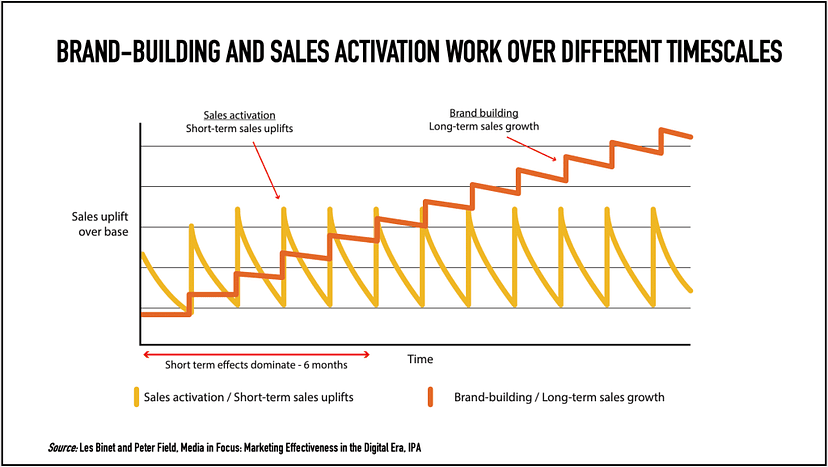
Research by Binet and Fields shows how Brand building and sales activation actually work together, in the best cases, synergistically, to increase sales over the short term and the long term. Agencies like clay.global specialize in building the kind of cohesive brand identity that makes this long-term compounding effect possible.
Building & consistently loading and refining a brand
Building a brand is about much more than how the thing looks or the stale old guidelines about how it must always look at all costs. It’s about the core idea or mission, or even the purpose of a company.
And it’s about the validation and refinement of that core idea from step number one: actually creating the brand story and all of the expressions of the brand identity.
All the way down to constantly refining and market-validating how the product or service works, looks, feels, and how the product is promoted through how the content looks and sounds — by way of using the brand as a guideline and conversely adapting and evolving the brand strategically.
And if you do this well, building a brand can get you immense value — in terms of employee engagement, customer satisfaction, and financial growth — in the long run.
If you build your brand up in this way, and you communicate it consistently across the 4 brand vectors (Wally Olins; product, environment, communication, behaviour) and especially in your messaging in the places where your target audience lives, it will help you increase conversion rates on every step of the customer journey.
Don’t forget to attach shorter-term activation strategies to your branding activities.
And vice versa: don’t forget to attach a long-term brand strategy to your shorter-term Growth Hacking or Digital Marketing activities and campaigns, activation-oriented or otherwise.
The Golden Ratio
Well, then, if all of that is true, and I’m supposed to divert some of my resources to activation and some to brand strategies and activities — what is the ratio that I should strive for? Based on their research, Binet & Fields advise a golden ratio of 60/40 investment in brand messaging versus activation to get synergy and sustainable growth.
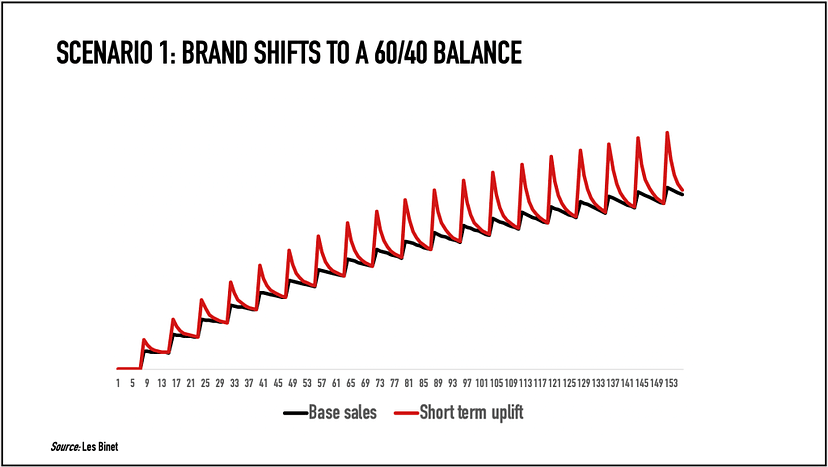
The idea is that as short-term activation spikes growth in sales in the short term, and brand building creates long-term growth — maximum results are found in some combination of both. The exact, best fitting ratio will vary on your exact context, and there appear to be some standards for specific verticals, for instance — read on for more on that.
How Brand building impacts activation and conversions
Now, how this all works is because short-term activation-oriented campaigns help brand awareness on the one hand: more people seeing more ads with your logo and brand name, helps with that. Brand campaigns on the other hand, make brands more emotionally appealing, keep brands salient and thereby make activation-oriented campaigns more efficient because leads become easier and therefore less costly to close.
The importance of Salience
Salience, in this equation, is of utmost importance. When a prospective customer in your target audience at some point feels and experiences the problem that your product or services solve, and is driven to seek a solution, salience is the thing that decides whether or not your brand or product will pop up in their head.
According to Binet and Fields, to create this loop of mutual reinforcement, in most industries and markets the perfect ratio between brand campaigns and strategies versus activation campaigns will be somewhere around 60/40 — however in more recent research, they dive in deeper to find the sweet spot for various industries.
How to approach Brand ROI in an imperfect world

Now, how do we actually show or at least reasonably indicate the ROI of our investments of time and resources in branding activities and campaigns?
In an imperfect world, the attribution of (sales) conversion to any marketing channel is at best, polluted, and at worst — as in the case of showing ROI of branding activities — near impossible.
How will we perfectly measure if, at the point where our prospective client decides they need help, and they remembered our name and googled it, this was because their colleague had mentioned our company? Or because they had seen one of our ads in a magazine? Or because our organic content keeps popping up in their social feed? It’s impossible.
Yet, from the research above and from other research (as well as our own experience as marketers), we know the impact exists, and we even have a reasonable sense of how big the impact is — in the broad sense.
Now, how do we measure the ROI of branding efforts? How can we integrate our branding efforts into an attribution model or KPI measurement model, in the world of digital marketing?
Measuring Branding ROI
There are, in reality two broad ways to go about this:
- We hire an, often expensive, specialized agency who does polling and interviews with our target audience to measure the reach of our brand building efforts and their effects.
- We use certain digital marketing KPIs as a proxy, as an imperfect indicator of the effects of brand building.
Each have their own drawbacks. But for this article we’ll focus on number two, because method number one can be exceedingly expensive, not to mention time-intensive. Logically, using certain digital metrics as a proxy is the quick-and-dirty, but at the same time trend-indicating way to measure the success and effects of our branding efforts.
Digital Metrics as a proxy for Brand ROI
Digital metrics we might track might be:
Direct traffic
If we measure direct traffic to our website in a period where we do little in terms of brand building activities, and then in a period of time where we are more active, correcting for special events or trends in the market we can extrapolate the effect of our branding activities by measuring the difference in direct traffic to our website. The rationale for this is that people who have been confronted with your name/logo/messaging more, will be more likely to type it in on Google or even go directly to your web address.
Reach
A vanity metric in and of itself, reach (on social media, but even in terms of ads) is a great indicator of how many people have been confronted with your brand name, logo and messaging in a certain period of time.
Return traffic
People who know and trust your brand more, will be more likely to come back to your website after a first and even after a second visit.
Rising Conversion rates
We could even argue that conversions across the entire customer journey, from first social post or ad view, to website visit, to return visit and website conversion, to sales, should rise as a consequence of brand building. But if we do that, and even if we are able to show that, we understand that more than showing or proving ROI, we are confounding ROI. While we do know that the effects exist. Attribution within a digital marketing world, is a funny thing.
Ofcourse, to actually calculate ROI, all you have to do is take a given metric, apply the factors you need to apply from that point in the funnel to actual sale, to get a certain ratio — and then multiply that by your average deal size or customer Lifetime Value.
Links for further reading
- Read more about the differences and synergies between long-term and short-term marketing activities, and an interesting approach to measure share of brand voice, here.
- Read more about the financial and long-term value of brand building, here.
Are You Looking for Ways to Improve and Strengthen Your Brand?
My name is Erwin Lima, I am a Brand Growth Storytelling Consultant at Neo Alpha [www.lifebeyond.one] and co-founder and Head of Storytelling at StoryLab.ai. Over the course of the last 10 years, I have helped hundreds of people, teams, and brands grow their reach, engagement, and revenue through the power of their own story.
Are you looking for more help in improving and strengthening your brand?
FAQ
What is consistent brand messaging?
Consistent brand messaging means communicating the same central positioning, promise, value, personality, and proof across customer touchpoints.
The wording and format can adapt to the audience, channel, and situation. The strategic meaning should remain recognizable.
Why is consistent brand messaging important?
Consistent messaging helps people understand what a company offers, connect it with a category or benefit, and recognize it across different channels.
It also gives employees and partners clearer guidance, reducing conflicting claims and fragmented customer experiences.
How do you measure brand consistency?
Audit a representative sample of website pages, advertisements, emails, social posts, sales materials, customer messages, and product content.
Score each item against criteria such as positioning, message pillars, voice, terminology, proof, visuals, and customer promise.
A basic message consistency rate is:
Number of compliant assets ÷ Total assets audited × 100
How do you measure brand ROI?
Start by defining the business outcome the brand activity should influence. Establish a baseline and track connected measures across four levels:
Brand execution
Audience awareness and perception
Customer behavior
Commercial performance
More advanced methods include brand lift studies, controlled experiments, matched-market testing, marketing mix modelling, and customer-level research.
What is the formula for brand ROI?
A basic formula is:
Brand ROI = (Incremental financial return attributed to brand activity − Brand investment) ÷ Brand investment × 100
The challenge is estimating the incremental return. Revenue generated during the campaign should not automatically be attributed entirely to branding.
Use experiments, baselines, comparison groups, brand tracking, or modelling to improve the estimate.
Is direct website traffic a reliable brand metric?
Direct traffic can support brand measurement, but it is not a clean measure of brand awareness.
Google Analytics may classify traffic as direct when referral information is missing, when visitors use bookmarks or copied links, when links are untagged, or when tracking is disrupted.
Use it alongside branded search, surveys, repeat visits, share of search, and commercial results.
What is branded search volume?
Branded search volume represents searches that include a company, product, campaign, or other brand-specific name.
Growth in branded search can indicate increasing awareness or demand. It does not reveal exactly which marketing activity caused the increase.
What is share of search?
Share of search compares search demand for one brand with the combined search demand for a group of competitors.
A basic formula is:
Brand search volume ÷ Combined search volume for all selected brands × 100
Use a consistent competitor set, market, data source, and calculation method.
What is a brand lift study?
A brand lift study compares the attitudes or responses of people exposed to a campaign with those of a control audience that was not exposed.
It may measure ad recall, awareness, familiarity, favorability, consideration, message association, or purchase intent.
Is the 60:40 brand and activation split suitable for every business?
No.
The 60:40 principle is a useful rule of thumb that highlights the need to balance long-term brand building with short-term sales activation.
The suitable division can change according to brand size, category, buying cycle, business stage, audience, and campaign objective.
Can AI help maintain consistent brand messaging?
Yes. AI can apply defined messaging, tone, terminology, and campaign instructions across multiple formats.
The results depend on the context provided. Give the tool an approved brand framework, audience details, proof points, examples, and terms to avoid.
Human review is still needed to check accuracy, claims, context, originality, and brand fit.
Top AI Marketing Generators
Author bio:
 Erwin Lima: What inspires Erwin is helping people, teams and brands to become the best version of themselves. Guiding them with curiosity, empathy, and Growth Storytelling.
Over the past 10+ years as a copywriter, author, consultant, and coach, he’s helped dozens of Brands, Teams, and individual human beings to grow their sense of motivation and focus, but also their reach, engagement, and revenue— through the power of their own story. You can find Erwin on LinkedIn and on his website.
Master the Art of Video Marketing
AI-Powered Tools to Ideate, Optimize, and Amplify!
- Spark Creativity: Unleash the most effective video ideas, scripts, and engaging hooks with our AI Generators.
- Optimize Instantly: Elevate your YouTube presence by optimizing video Titles, Descriptions, and Tags in seconds.
- Amplify Your Reach: Effortlessly craft social media, email, and ad copy to maximize your video’s impact.