
SEO Taxonomy Tips for Content and AI Search

SEO taxonomy is how your website organizes content so people and search engines can understand what each page is about, where it belongs, and how it connects to related topics.
A strong taxonomy does more than keep your blog tidy. It helps search engines crawl your site, helps readers find the next useful page, and helps your content build authority around clear topics. For AI-powered search experiences, taxonomy also matters because large language models and search systems need structure, context, and consistent relationships between pages to understand which sources are worth referencing.
Think of SEO taxonomy as the framework behind your content library. Categories, tags, topic clusters, breadcrumbs, internal links, product filters, and landing pages all play a role. When they work together, your site becomes easier to navigate, easier to crawl, and easier to trust.
In this guide, we will look at how SEO taxonomy supports content discovery, AI search visibility, internal linking, topical authority, and scalable site growth.
So, you’ve optimized your web pages, invested time and effort in creating tons of articles and earning backlinks, but your SEO KPIs are still failing. What could be the issue?
Your site taxonomy is likely the hitch. This crucial yet often overlooked element of search engine optimization tactics is related to website structure. When it’s poorly organized, users and web crawlers will struggle to navigate your blog, store, or service pages.
A good SEO taxonomy is like a detailed roadmap, where every piece of content is strategically placed so search engines can index and rank your pages correctly and visitors can easily find what they need.
In this article, we’ll explain taxonomy and why it’s important for your website. You’ll also learn some useful tactics for creating a user- and SEO-friendly taxonomy.
Chapters
- What is Taxonomy in SEO?
- What are the Types of Taxonomies in SEO?
- What are SEO Taxonomy Best Practices?
- How SEO Taxonomy Helps Search Engines Understand Your Website
- SEO Taxonomy and AI Search Visibility
- Building Topic Clusters With SEO Taxonomy
- Categories vs Tags: How to Use Them Without Creating SEO Problems
- Internal Linking and SEO Taxonomy
- How to Prevent Taxonomy From Creating Duplicate or Thin Pages
- SEO Taxonomy for SaaS, AI Tools, and Content Libraries
- Using Taxonomy to Match Search Intent
- When to Create a New Category, Tag, or Hub Page
- How to Audit Your SEO Taxonomy
- Future-Proof your Online Presence with Taxonomies
- FAQ
- About the Author
What is Taxonomy in SEO?

The term taxonomy comes from biology and refers to classifying organisms into different groups based on common traits. In relation to a website, taxonomy focuses on organizing digital content on a granular level, creating hierarchies and connections between different content types.
An intuitive and logical organization, coupled with optimized website speed, makes it a breeze for visitors to browse through and understand the information, which is essential for SEO. Working with an experienced SEO agency like Embarque.io can help ensure your website’s taxonomy is both user-friendly and optimized for search engines.
People will actively interact with a site if there’s no friction in the navigation flow. Moreover, the more users engage with the content, the lower the bounce rates you have.
SEO taxonomy takes the website structure a step further and organizes content not just for human visitors but for crawlers as well. It has a two-fold purpose:
- improve user experience;
- boost the website’s rankings in search results.
As the experience of top SEO companies in USA shows, an online store with a large inventory can use SEO taxonomy to divide products by top-level categories (Women’s, Men’s, Kids’ clothing, Accessories, etc.) and subcategories (Shirts, Pants, Shoes, and so on). These subcategories can further be broken into smaller groups by brand, color, or other criterion.
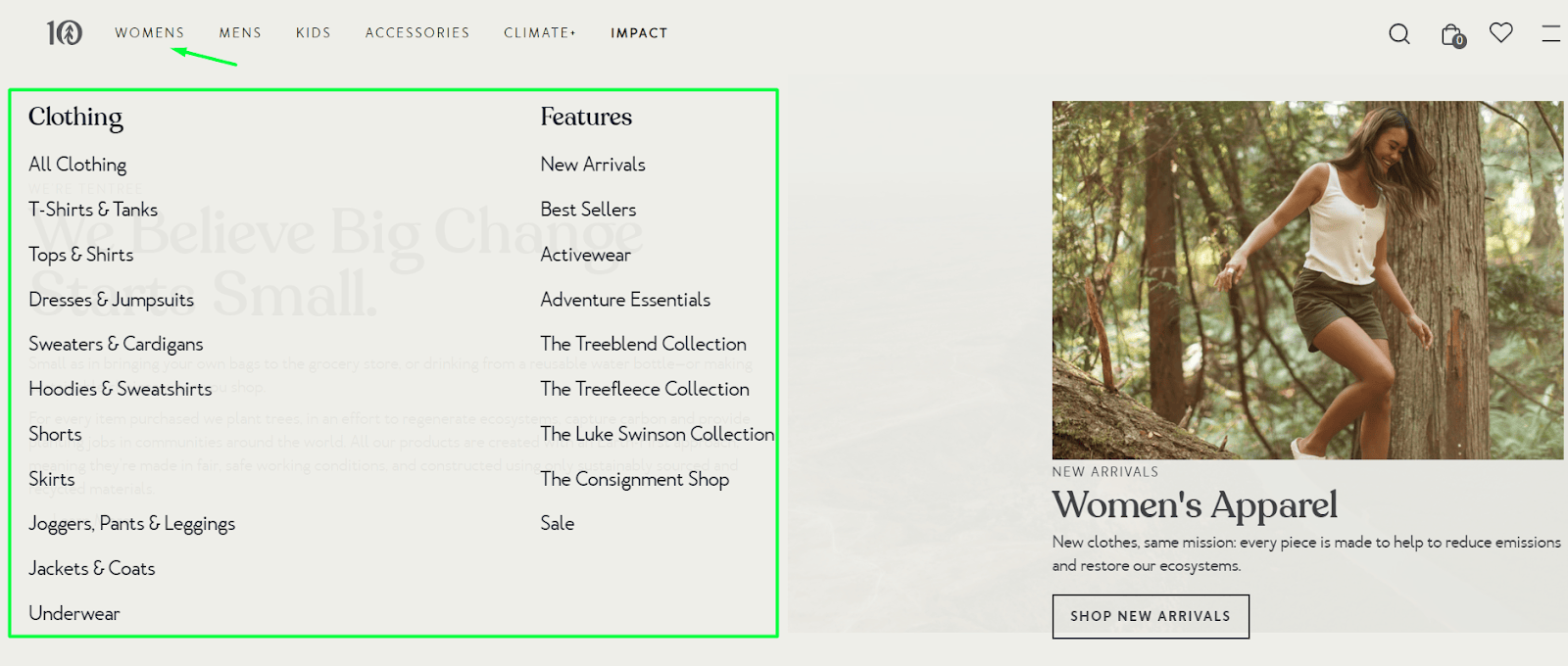
Such meticulous structuring makes it easier for search engines to crawl and index the website and for customers to search for goods.
Categories (broad groups) and subcategories (more specific sections) aren’t the only elements contributing to flawless navigation and crawlability. Other crucial taxonomy SEO components include:
- Tags. These keywords or phrases elaborate on the topic and help group content by specific subjects or characteristics, regardless of the broader category it falls into. For instance, “all-season wear”, “oversized”, “workout gear”, and “breathable fabric” could be tags for the article about women’s sweatsuits.
- Attributes. These are filters like “color,” “size,” “material,” “brand,” etc., that help users quickly find what they need instead of wading through multiple pages.
- The URL structure is the individual address of a webpage. It should be neat and clear and mirror the organization of content on the website, like this “https: www.cookingblog.com/recipes/desserts/chocolate-cake”.
What are the Types of Taxonomies in SEO?
We’ll consider the four main types of taxonomies: hierarchical, network, matrix, and faceted. Each has its strengths and applications, reflecting how different content elements relate to each other and how users can find them. Choosing the right option will largely depend on content and website complexity, as well as user needs.
Hierarchical
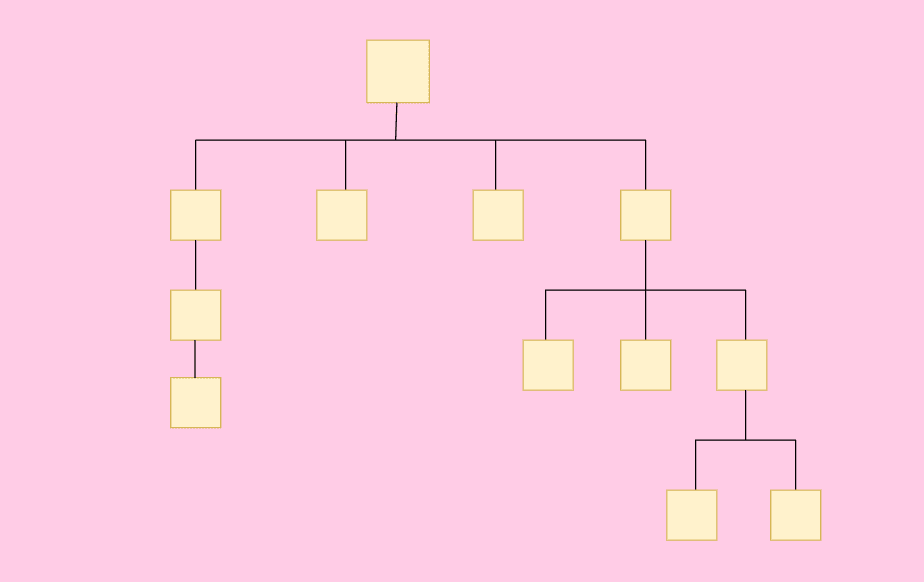
It’s the most common and intuitive type. A hierarchical taxonomy is like a family tree. It has general groups at the top and more specific subgroups below to specify the main topic.
It’s best for websites where content falls into precise categories and subcategories. This type ensures a logical flow of information and enhances the user experience. Let’s take an online apparel store as an example. It might have a hierarchical taxonomy with “Women’s Clothing” as a primary category and “Skirts“, “Sweaters“, “Tops“, etc., as its subcategories.
Pro-tips: This taxonomy type is easy to scale, meaning as your website and content expand, you can easily add new subcategories under the existing ones without ruining the UX. However, don’t get carried away by creating too many categories so as not to overwhelm users. Strive for a balance.
Consider running a card sorting test to see how real users group content pieces together. It can help reveal any inconsistencies or gaps and spark an idea of how to improve your taxonomy.
One more key point: when labeling categories, opt for clear and descriptive language. Avoid using jargon and complicated technical terms. Also, spell out abbreviations since not all viewers may be familiar with them.
Network

This type has a web-like structure, enabling you to organize different content pieces into associative groups because they share some related information. You can integrate such a taxonomy with a hierarchical type.
It’s best for websites where content overlaps across various categories. For example, on a movie streaming site, the same film may fall into the “Action” and “Comedy” groups because it has elements of both genres.
Large websites may benefit from the network taxonomy. It allows you to cross-link multiple related pages and seamlessly guide users from one web page to another.
Pro-tips: If you choose to implement such a taxonomy connecting numerous related pages, consider dedicating a separate section for your current content that users enjoy most. By highlighting trending articles and posts, you keep readers up to date and improve the UX.
Pay attention to the anchor text. This clickable phrase should clearly describe the content of the page it takes you to. Wherever possible, insert appropriate keywords into your anchor text to help Google bots understand the relationship between the linked web pages.
Make a mental note to update internal links regularly. Add high-value links, fix broken ones, and continuously optimize anchor texts for better SEO.
Matrix
This taxonomy organizes data or content elements by two or more criteria simultaneously. It’s similar to a grid with rows and columns where you set conditions to find a specific item.
For example, Booking.com, one of the largest travel marketplaces, applies matrix taxonomy and allows visitors to filter content using fairly narrow characteristics.
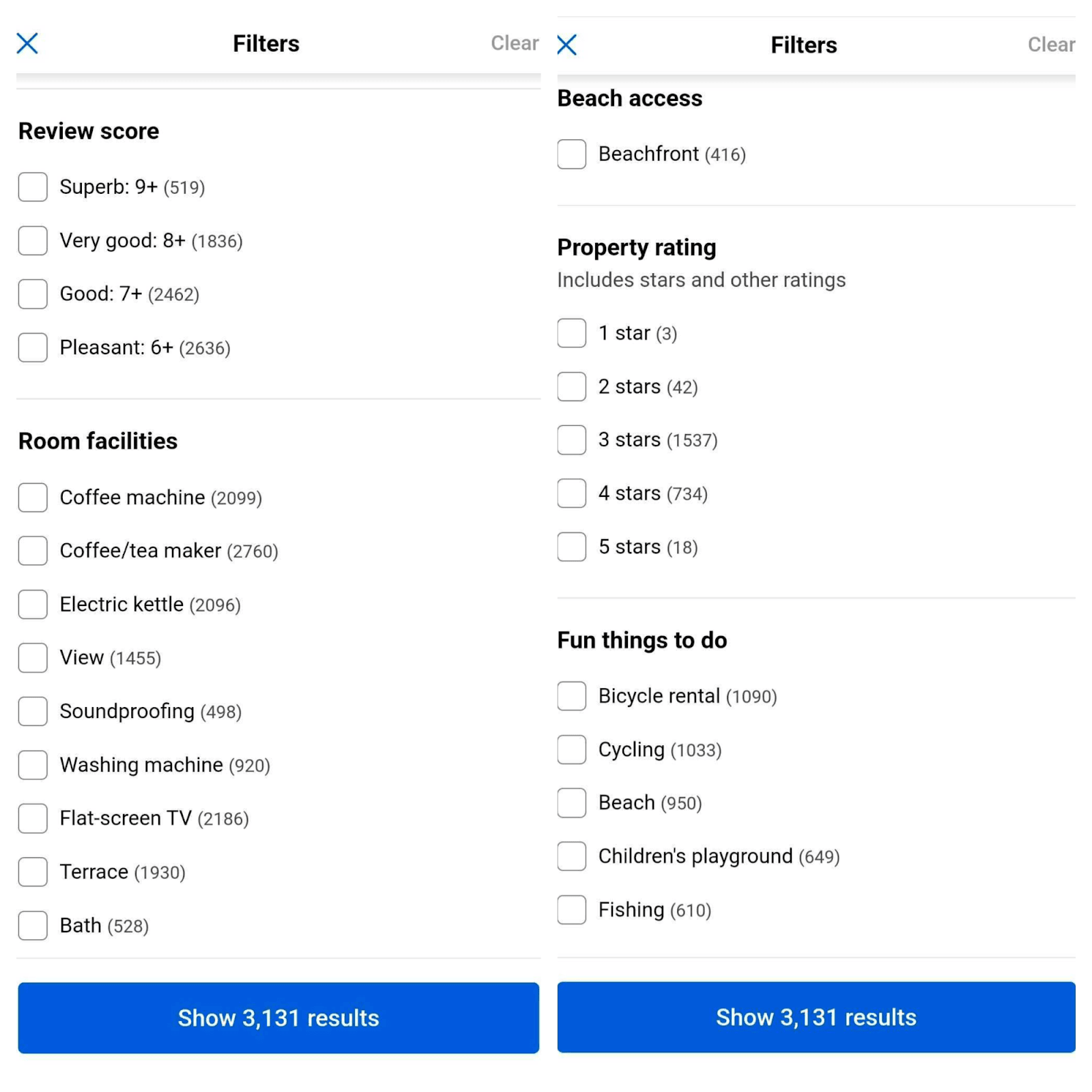
The matrix structure better suits websites with extensive data sets where items belong to particular intersections of criteria. Such a taxonomy also enables users to chart their navigation path through search and filters, which adds to a flexible and personalized UX.
Pro tips: Clarity and consistency are the prime factors to take into account when developing a matrix taxonomy structure that uses multiple classification criteria.
Start by defining clear and distinct categories and subcategories that represent your content or products. Choose self-explanatory names for each grouping to spare users from getting lost in a maze of terms. Add visual elements like color coding or icons to improve clarity.
Make sure your website’s backend returns correct search results at category intersections. Suppose a customer filters for “Sneakers” and “Nike.” They should see only Nike sneakers, not a mix of different brands or shoe types. A well-organized database and logical display setup are crucial points.
Additionally, apply UX/UI features like breadcrumbs and distinct filter/search options to help users navigate your site effortlessly. Once they know their location in the multi-layer matrix, visitors can backtrack without a hitch.
Faceted
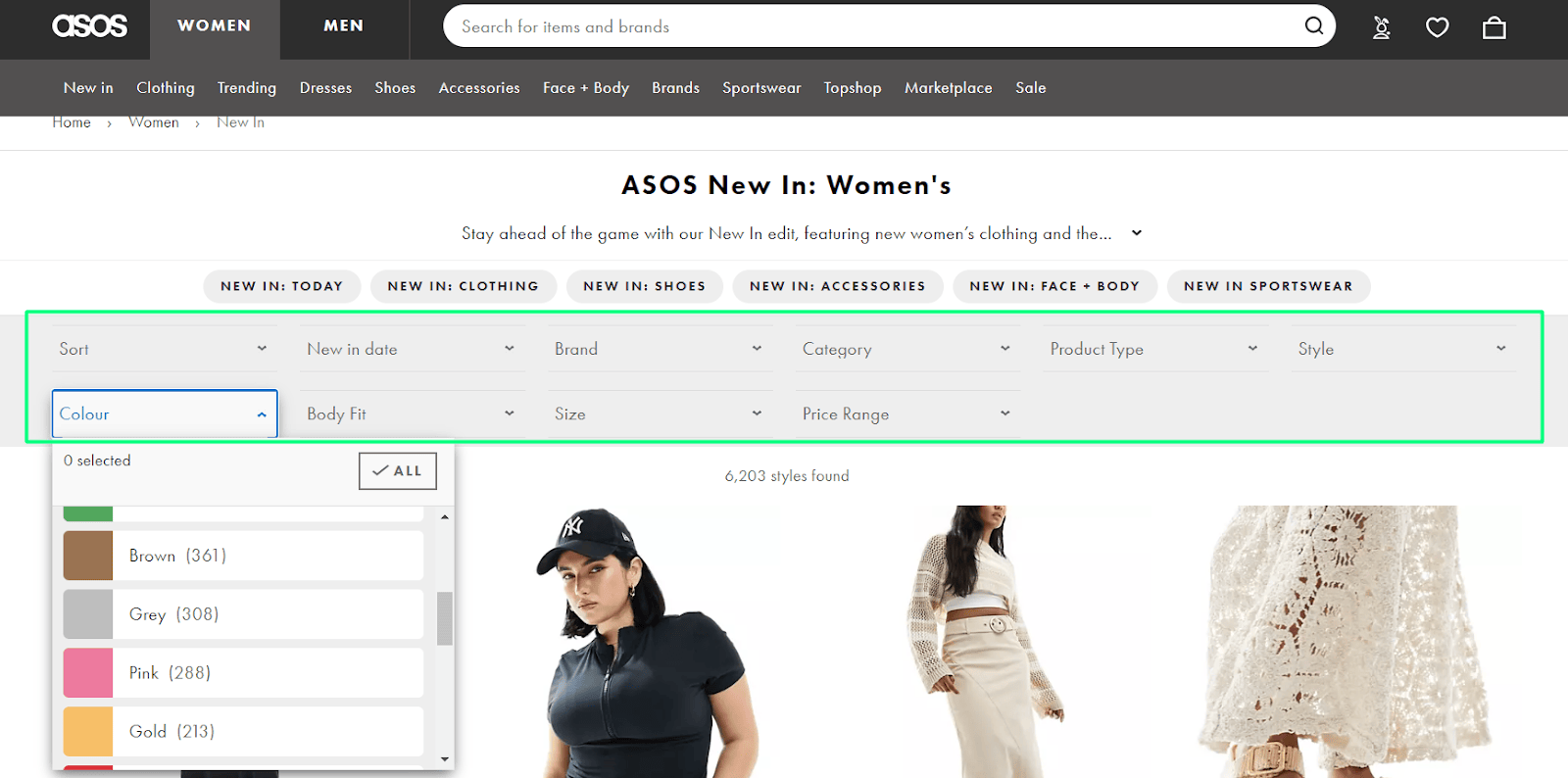
Faceted taxonomy is pretty similar to the previous type, yet they’re not the same. Matrix taxonomy has a more rigid structure and requires content to conform to predetermined intersections. Meanwhile, the faceted type has greater flexibility, allowing you to combine any number of attributes (size, color, brand, price, etc.) for search and navigation.
It’s an ideal choice if you’re planning to incorporate various taxonomy structures and sell numerous products on your website. For example, a faceted taxonomy is the go-to solution for online stores that have a wide choice of goods with multiple attributes. It ensures customers can filter and quickly find what they need.
Pro tips: Maintain balance in setting up faceted taxonomy. Too many filters can overwhelm users. Focus on the most important points based on user behavior analytics. Also, place key classifications like price range, brand, or product type prominently at the top to enhance the search experience.
This taxonomy type creates a risk of duplicate content since products can appear in various facet combinations. As a result, search engine bots may crawl the same pages multiple times, which is bad for SEO. To avoid such scenarios, we suggest:
- Implementing canonical tags or noindex directives to guide spiders to the preferred URL.
- Ensuring users can select a variety of options within facets. For example, in an online apparel store, customers should have a choice to filter for both “Casual” and “Formal” wear simultaneously. Also, instantly update search results to match set criteria.
What are SEO Taxonomy Best Practices?
A well-planned taxonomy can make a big difference in your SEO strategy. Therefore, it’s crucial to know how to implement it correctly. Read on to learn a few practical tips. These practical strategies can be thought of as SEO power plays, small but impactful improvements that can strengthen your site structure and search visibility.
Choose Structures Suiting your Site and Audience
There’s no one-size-fits-all approach to choosing the most appropriate taxonomy structure. When creating a website, it’s essential to consider your specific content and user browsing behavior, as you may need to combine several taxonomy types to achieve optimal results.
For example, an eCommerce site selling clothes might combine a hierarchical and faceted taxonomy. The first might classify items into main categories like “Women,” “Men,” and “Kids,” and broader subcategories, while the latter could assist potential customers in narrowing their search according to multiple attributes.
Perform Topic and Keyword Research
Creating the right taxonomy starts with a little homework on keywords and topics. This step forms the basis of any solid SEO strategy and helps you in numerous ways:
- Understanding the audience’s preferences and search habits better.
- Classifying taxonomy into practical units.
- Creating relevant content for each category.
- Naming groupings in line with user search patterns.
Manually brainstorming keywords can be a daunting task. Luckily, there are plenty of tools, such as Ahrefs, Moz, and Google Keyword Planner, that speed up the process immensely.
Keyword stuffing is a big no. Your chosen keywords shouldn’t appear in every single paragraph. Also, focus on generating engaging and informative content that centers around your topics.
Optimize URLs
A website’s taxonomy and URL setup are two sides of the same coin. They work together to establish a transparent and organized system for both users and search engines.
The URL path should clearly reflect the page location within the broader hierarchy of your website’s categories and subcategories. Let’s break it down with the following example: website.com/books/fiction/mystery:
- The domain is website.com/;
- The page is in subfolders books/fiction/;
- The slug /mystery indicates the specific topic.
Looking at this predictable URL, users and bots can easily grasp the content of the page. By the way, such a straightforward setup boosts your taxonomy and SEO efforts.
Add Internal Links
Internal linking is a crucial point to amp up your site taxonomy SEO. The main reasons for cross-linking pages are as follows:
- Enhance user navigation and encourage people to explore more of your website content.
- Distribute link equity by connecting high-authority pages to other pages with relevant context within your site.
- Help search engines understand your content organization and hierarchy, leading to better crawling and indexing.
It’s essential to avoid over-linking or cross-linking within your taxonomy. Try to distribute links naturally and focus on navigating to informative and high-quality content within your taxonomy.
Balance User-Centric and SEO-Focused Taxonomy
Designing a successful taxonomy for your website implies a strategic balance between addressing your target audience’s needs and optimizing for search engines.
The user-centric approach revolves around your client’s requirements. It includes carrying out usability testing, analyzing key metrics like time spent on page or click-through rates, and gathering feedback.
Based on the insights, you can propose an intuitive and user-friendly taxonomy, which can also enhance customer satisfaction, foster repeat visits, and boost sales.
However, it’s not that simple to achieve if your website doesn’t show up in search or drive enough traffic. That’s where the SEO-focused strategy comes in.
It aims to optimize your website for search engine algorithms. One of the key methods of boosting rankings is by choosing high-value keywords with decent search volume but moderate competition and placing them strategically.
The winning formula is to blend both approaches. While search engines direct visitors to your site, it’s the users who decide to engage with your content. Therefore:
- Choose category names that appeal to your audience and contain target keywords.
- Create a website architecture that is both logical and easy to navigate.
- Apply SEO best practices like generating content that search engines can easily crawl and index, optimizing images, and using descriptive meta tags.
- Leverage user behavior metrics, and rankings reports to refine your strategies.
Be Open to Change
Audience preferences, search behavior, and market demand change over time. New topics, products, services, and content formats may become important, while some older categories may no longer be useful.
That is why your taxonomy should stay flexible. As your website grows, you may need to add new categories and tags, merge overlapping sections, remove obsolete groupings, or use tools like The SEO Agent to spot content structure opportunities and keep your site easier to organize, crawl, and improve.
Sometimes, taxonomy updates can get out of control. Follow this advice to make the modification process easier:
Create a clear and consistent list of terms for tagging future content to prevent confusion. For example, use “sneakers” instead of “running shoes” or “trainers.”
Set precise guidelines for when to add new categories and remove old ones.
Determine how to handle retired groupings, such as 302 redirects for temporary changes and 301 redirects for permanent changes.
Assign a team or owner responsible for taxonomy changes.
Keep a detailed log of all modifications to understand how your content strategy develops and which practices work best.
How SEO Taxonomy Helps Search Engines Understand Your Website
Search engines do not only look at individual pages. They also look at how pages connect.
A clear SEO taxonomy helps search engines understand which topics are most important on your website, which pages support those topics, and how deep each page sits inside your site structure. When your categories, subcategories, tags, and internal links are organized well, your website sends stronger signals about relevance and hierarchy.
For example, a marketing site may organize content like this:
- Marketing
- Content Marketing
- AI Content Creation
- AI Copywriting Tools
- AI Blog Writing
- AI Social Media Content
This type of structure gives both users and search engines a clearer path. A broad topic leads to a more specific topic, then to individual guides, examples, tools, or product pages.
The same idea applies to e-commerce, SaaS, education, media, nonprofit, and B2B websites. If every page lives in a logical place, search engines can better understand which pages are central and which pages support them.
SEO taxonomy also helps avoid a common problem: having too many disconnected articles that cover related topics but do not clearly support each other. Without structure, good content can feel scattered. With structure, your content becomes a connected library.
SEO Taxonomy and AI Search Visibility
AI-powered search tools rely on clear, trustworthy, well-structured information.
When search systems generate answers, summarize content, or cite sources, they need to understand what a page is about and how reliable the source appears to be. A strong taxonomy can support that process by making your expertise easier to interpret.
For example, if your website has many strong pages around AI marketing, those pages should not sit randomly across the site. They should connect through clear categories, related pages, internal links, and topic clusters.
A strong AI marketing taxonomy could include:
- AI Marketing
- AI Content Creation
- AI Social Media Marketing
- AI SEO
- AI Email Marketing
- AI Video Marketing
- AI Ad Copywriting
- AI Marketing Tools
Each section helps show that the site covers the topic in depth. That can make it easier for both traditional search engines and AI-driven systems to understand your topical focus.
AI search visibility is not only about writing one strong article. It is about building a clear content system where every important page supports a larger subject area.
Building Topic Clusters With SEO Taxonomy
Topic clusters are one of the most practical ways to use SEO taxonomy.
A topic cluster connects a broad pillar page with more specific supporting pages. The pillar page gives a complete overview of the topic, while the supporting pages answer deeper questions.
For example, a website about AI marketing could build a cluster like this:
Pillar page: AI Marketing
Supporting pages:
- AI Marketing Tools
- AI Copywriting
- AI Social Media Content
- AI Email Subject Lines
- AI Blog Post Generators
- AI Video Script Generators
- AI SEO Tools
- AI Ad Copy Generators
Each supporting page should link back to the pillar page when relevant. The pillar page should also link out to the supporting pages. This creates a clear content hub that helps users explore the topic and helps search engines understand the relationship between the pages.
The goal is not to create random internal links. The goal is to connect pages that belong together.
A good topic cluster answers three questions:
- What is the main topic?
- What subtopics should readers understand?
- Which pages provide the best answers for each subtopic?
When taxonomy and topic clusters work together, your site becomes easier to crawl, easier to navigate, and easier to recognize as a useful source.
Categories vs Tags: How to Use Them Without Creating SEO Problems
Categories and tags are useful, but they can create SEO problems when used carelessly.
Categories should represent the main sections of your website. They are broad, stable, and easy to understand. Tags should describe more specific themes, formats, or related details.
For example:
Category: AI Marketing
Tags: AI copywriting, AI video, AI SEO, content automation, social media captions
A common mistake is creating too many tags for small variations of the same topic. For example:
- AI writing
- AI writer
- AI writing tools
- AI content writer
- AI copywriter
- AI copywriting tool
If each tag creates a thin archive page with only one or two posts, the site may end up with many low-value pages. That can make the taxonomy messy and harder to crawl.
A better approach is to keep categories focused and use tags only when they help users find related content. Tags should not be created just because a phrase appears in an article. They should be used when they group a meaningful set of pages.
Before adding a new tag, ask:
- Will this tag be used on several strong pages?
- Would a visitor benefit from browsing this tag archive?
- Is this tag meaningfully different from an existing tag?
- Could this become a useful landing page?
If the answer is no, it may not need to exist.
Internal Linking and SEO Taxonomy
Internal linking is what turns taxonomy from a static structure into a useful search experience.
A category page, tag page, or topic hub is only useful if it helps people move to relevant next pages. Internal links also help search engines discover and understand your content.
A strong internal linking structure usually includes:
- Links from broad pages to specific pages
- Links from specific pages back to broader hub pages
- Links between closely related articles
- Links from old articles to newer, stronger resources
- Links from high-traffic pages to high-value pages
For example, an article about AI voice generators can naturally link to pages about AI video scripts, AI social media content, AI ad copy, and AI content repurposing. These links help readers continue learning and help search engines see the relationship between those topics.
Internal links should feel helpful, not forced. The anchor text should describe the page clearly. Avoid vague links like “click here” when a descriptive phrase would be more useful.
Good internal linking makes your taxonomy visible in the actual reading experience.
How to Prevent Taxonomy From Creating Duplicate or Thin Pages
A messy taxonomy can create too many low-value URLs.
This often happens when websites generate archive pages, tag pages, filter pages, pagination pages, or parameter-based URLs without a clear SEO purpose. The result can be index bloat, duplicate content, or crawl waste.
Common examples include:
- Tag pages with only one post
- Filter pages with nearly identical content
- Internal search result pages
- Category pages with no useful introduction
- Author archives with little value
- Date archives that repeat existing content
- URL parameters that create endless combinations
Not every taxonomy page needs to be indexed. Some pages are useful for users but not valuable as search landing pages.
A good SEO taxonomy should separate:
- Pages that should rank
- Pages that help navigation
- Pages that should not be indexed
- Pages that should be merged
- Pages that should be removed
For important category and hub pages, add useful introductory content, clear links, and a focused purpose. For low-value taxonomy pages, consider whether they should be noindexed, consolidated, or removed from important navigation.
The goal is not to index every possible page. The goal is to make your strongest pages easier to find and understand.
SEO Taxonomy for SaaS, AI Tools, and Content Libraries
SaaS and AI tool websites often need a different taxonomy than a simple blog.
A SaaS site may have product pages, feature pages, use case pages, industry pages, integration pages, comparison pages, templates, examples, guides, and blog articles. If these are not organized clearly, users may struggle to understand what the product does and who it is for.
A strong SaaS taxonomy can include:
- Features
- Use cases
- Industries
- Templates
- Examples
- Tools
- Integrations
- Comparisons
- Resources
- Blog topics
For an AI marketing platform, this could become:
- AI Writing Tools
- AI Social Media Tools
- AI Ad Copy Tools
- AI Email Tools
- AI Blog Tools
- AI Video Script Tools
- Marketing Examples
- Prompt Examples
- SEO Guides
- Content Strategy Guides
This helps users find the right entry point. Someone looking for a tool may want a product page. Someone looking for examples may want a library page. Someone comparing options may want a comparison page. Someone learning the basics may want a guide.
A good taxonomy supports different search intents instead of forcing every visitor into the same type of page.
Using Taxonomy to Match Search Intent
SEO taxonomy works best when it matches how people search.
Some visitors search for definitions. Others search for tools. Others search for examples, templates, comparisons, pricing, alternatives, or step-by-step instructions.
Your taxonomy should make room for these different intents.
For example, around the topic “AI social media content,” search intent may include:
What is AI social media content?
- Best AI social media tools
- AI social media post examples
- AI caption generator
- AI content calendar generator
- AI social media strategy
- AI prompts for social media
- AI tools for Instagram captions
If all of these pages sit randomly on your website, they may compete with each other or feel disconnected. If they are organized into a clear taxonomy, they support each other.
This also helps readers. A visitor who lands on an example page may later want a tool. A visitor who lands on a tool page may want a guide. A visitor who reads a guide may want templates.
Taxonomy should guide people from one intent to the next.
When to Create a New Category, Tag, or Hub Page
Not every topic deserves its own taxonomy page.
A new category, tag, or hub page should exist only when it helps users and supports a clear SEO purpose. Creating too many small sections can make a website harder to manage and harder to crawl.
Create a new taxonomy page when:
- The topic has enough existing or planned content
- The topic has clear search demand
- The page can become a useful landing page
- The topic is different from existing sections
- Users would benefit from browsing related pages
- The page can be internally linked from relevant content
Avoid creating a new taxonomy page when:
- Only one article fits the topic
- The topic overlaps with an existing tag or category
- The wording is just a slight keyword variation
- The page would contain thin content
- The page has no clear search or user purpose
A taxonomy should grow with the website, but it should not grow randomly. Review it regularly and merge sections that overlap.
How to Audit Your SEO Taxonomy
An SEO taxonomy audit helps you find structure problems before they hurt search visibility.
Start by listing your categories, tags, hub pages, archive pages, and important content sections. Then look for gaps, overlap, thin pages, and confusing naming.
Useful questions to ask during a taxonomy audit:
- Are categories broad enough to stay useful?
- Are tags being used consistently?
- Do important topics have strong hub pages?
- Are thin tag pages being indexed?
- Are related articles internally linked?
- Are old pages connected to newer resources?
- Do users have a clear path from broad topics to specific answers?
- Are search engines able to crawl important pages easily?
- Do URL structures reflect the content hierarchy?
- Are there multiple pages targeting the same intent?
You may find that some pages should be merged, renamed, noindexed, redirected, or turned into stronger landing pages.
A clean taxonomy makes every new piece of content easier to place. It also makes your website easier to scale without creating clutter.
Future-Proof your Online Presence with Taxonomies
If you don’t want your website to become a maze of content, consider investing time and effort in building a taxonomy. This is often an underrated yet powerful SEO tool that can streamline navigation, enhance user experience, and improve search engine crawlability.
Choose the right taxonomy type for your website and implement it wisely, following the tips we’ve shared in the article. Embrace the power of organization with a well-planned taxonomy!
FAQ
What is SEO taxonomy?
SEO taxonomy is the way a website organizes pages into categories, tags, subcategories, hubs, and internal linking structures. It helps users and search engines understand how content is grouped and how pages relate to each other.
Why is taxonomy important for SEO?
Taxonomy is important for SEO because it helps search engines crawl pages, understand site hierarchy, identify important content, and discover related pages. It also helps users navigate from broad topics to more specific answers.
What is the difference between categories and tags in SEO?
Categories are broad sections of a website, while tags are more specific labels used to group related content. Categories usually define the main structure. Tags should only be used when they help users find a meaningful set of related pages.
Can too many tags hurt SEO?
Too many tags can create thin archive pages, duplicate content, and crawl waste if every small keyword variation creates a separate URL. Tags should be used carefully and only when they group useful, related content.
Should taxonomy pages be indexed?
Important taxonomy pages can be indexed if they provide value, have useful content, and help users find related pages. Thin tag pages, duplicate filter pages, and low-value archive pages may not need to be indexed.
How does SEO taxonomy help AI search visibility?
SEO taxonomy helps AI search visibility by making your content easier to understand, group, and evaluate. Clear topic hubs, internal links, categories, and related pages help search systems understand your expertise around a subject.
What is a topic cluster in SEO taxonomy?
A topic cluster is a group of related pages built around a main pillar page. The pillar page covers the broad topic, while supporting pages cover subtopics in more detail. Internal links connect the pages so users and search engines can understand the relationship.
How often should you audit your SEO taxonomy?
You should audit your SEO taxonomy when your site grows, when you publish many new pages, when rankings decline, or when categories and tags become messy. Regular audits help remove thin pages, merge overlapping topics, and improve internal linking.
What is the difference between categories and tags?
Categories are broad groups that define the main structure of a website.
Tags are more specific labels that connect related content across categories.
For example, a marketing blog may use categories like “SEO,” “Social Media,” and “AI Marketing.” Tags could include more specific topics like “internal linking,” “Instagram captions,” “AI search,” or “keyword research.”
The best setup is simple: use categories for the main content hierarchy and tags only when they help users discover genuinely related content.
How many categories should a website have?
There is no perfect number of categories for every website.
A small blog may only need a few main categories. A large ecommerce site, SaaS resource library, or media website may need a deeper structure with categories, subcategories, filters, and hub pages.
The key is to avoid creating too many overlapping categories. Every category should have a clear purpose, enough content to justify it, and a useful path for visitors.
Are tags bad for SEO?
Tags are not bad by themselves.
They become a problem when a website creates too many thin, duplicate, or low-value tag archive pages. For example, a WordPress site with hundreds of tags and only one article per tag can create clutter instead of clarity.
If tags create useful topic pages with enough related content, they can help users navigate. If they create thin pages, consider noindexing low-value tag archives, merging tags, or removing unused ones.
Google’s robots meta documentation explains that noindex tells search engines not to show a page in search results.
Should category and tag pages be indexed?
Useful category pages can often be indexed.
Thin or duplicate tag pages may be better set to noindex, especially if they do not provide unique value for users.
A category page is usually worth indexing when it has:
- A clear topic
- Enough related content
- Helpful intro copy
- Internal links
- A logical place in the site structure
- Search demand
- A useful experience for visitors
A tag page is often not worth indexing when it only lists one or two posts and adds no unique value.
How does URL structure affect SEO taxonomy?
URL structure can support taxonomy by making page relationships easier to understand.
For example:
/seo/internal-linking/
is clearer than:
/post?id=8472
Google recommends using a crawlable URL structure and warns that poor URL structures can lead to inefficient crawling.
Do URLs need to match the full category structure?
Not always.
A clear URL is useful, but it does not need to include every category, subcategory, and tag.
For example, a simple URL like:
/seo-taxonomy/
may be better than:
/blog/seo/technical-seo/site-architecture/taxonomy/seo-taxonomy-guide/
Keep URLs short, descriptive, and stable. Use navigation, breadcrumbs, internal links, and hub pages to show the full structure when needed.
What are breadcrumbs, and do they help SEO?
Breadcrumbs show users where a page sits inside the website structure.
Example:
Home > Blog > SEO > SEO Taxonomy
Breadcrumbs help users move back to broader sections and can also help search engines understand the relationship between pages. Google’s SEO Starter Guide says Google can learn breadcrumbs automatically based on URL words, and breadcrumb structured data can also influence them.
What is faceted navigation in SEO?
Faceted navigation lets users filter content or products by attributes such as size, color, price, brand, location, rating, or material.
It is common on ecommerce sites, directories, real estate websites, job boards, travel sites, and large content libraries.
Faceted navigation is useful for users, but it can create many URL combinations. If unmanaged, those pages can cause duplicate content, crawl waste, and indexing problems.
Google recommends managing faceted navigation carefully and links to faceted navigation crawl guidance from its ecommerce site-structure documentation.
How do you prevent duplicate content from taxonomy pages?
Duplicate content can happen when category pages, tag pages, filters, archives, and parameter URLs show the same or very similar content.
Ways to reduce the risk include:
- Use clear canonical URLs
- Noindex thin archive pages
- Avoid creating unnecessary tags
- Merge overlapping categories
- Limit indexable filter combinations
- Add useful intro copy to important taxonomy pages
- Link internally to the preferred pages
- Keep sitemap URLs focused on important pages
Google says canonical URLs can be specified with redirects, rel=”canonical” annotations, and sitemap inclusion, with redirects and canonical annotations being stronger signals.
How does taxonomy support topical authority?
Taxonomy supports topical authority by grouping related content into clear topic areas.
For example, instead of publishing random SEO posts, a site can build a structured SEO hub with pages about technical SEO, internal linking, keyword research, content optimization, AI search, taxonomy, and reporting.
This helps users find related resources and helps search engines understand that the site covers a topic in depth.
A strong taxonomy should connect pillar pages, supporting articles, tool pages, case studies, and FAQs through clear internal links.
How does internal linking connect to SEO taxonomy?
Internal links turn taxonomy from a static structure into a usable path.
Menus, breadcrumbs, category pages, related posts, hub pages, and contextual links all help users and search engines move through the site.
Google says it analyzes relationships between pages based on links and can use the number of links it needs to follow and the number of links to a page to infer relative importance.
How does taxonomy help AI search visibility?
AI search systems still need clear, crawlable, useful content.
Google says SEO best practices continue to matter for generative AI search features because those features are rooted in core Search ranking and quality systems. Google also says pages need to be indexed and eligible to show a snippet to appear in generative AI features on Google Search.
A strong taxonomy helps by making your site easier to understand, easier to crawl, and easier to connect around clear topics.
Do I need special schema, llms.txt, or GEO tricks for taxonomy SEO?
Not for Google Search.
Google says website owners do not need special machine-readable files, AI text files, special markup, or Markdown files to appear in Google Search, including its generative AI capabilities. It also warns against chasing inauthentic mentions as an AI visibility shortcut.
Focus on crawlable pages, helpful content, clear internal links, strong structure, and useful topic coverage.
How often should you audit your SEO taxonomy?
Audit your taxonomy whenever the site grows, content strategy changes, product categories expand, or organic performance starts to flatten.
A useful taxonomy audit should check:
- Duplicate categories
- Unused tags
- Thin archive pages
- Important pages buried too deep
- Broken internal links
- Overlapping topics
- Confusing labels
- Missing hub pages
- Poor URL structure
- Crawl and indexation issues
- Category pages with no helpful content
- Filter pages creating too many URLs
For growing sites, review taxonomy at least a few times per year. For large ecommerce or media sites, taxonomy should be part of ongoing SEO maintenance.
What is the biggest SEO taxonomy mistake?
The biggest mistake is creating categories, tags, and filters without a clear purpose.
A messy taxonomy makes users work harder and gives search engines a weaker understanding of your site.
Good taxonomy should answer three questions:
Where does this page belong?
What related pages should users visit next?
Which pages are most important in this topic area?
If your taxonomy cannot answer those questions, it needs cleanup.
About the Author
 Art Malkovich is CEO and co-founder of Onilab, an eCommerce development company. He has about 10 years of experience in team management and web development for eCommerce. He is passionate about keeping up with recent technologies and working on innovative projects like headless commerce solutions and PWAs in particular.
Master the Art of Video Marketing
AI-Powered Tools to Ideate, Optimize, and Amplify!
- Spark Creativity: Unleash the most effective video ideas, scripts, and engaging hooks with our AI Generators.
- Optimize Instantly: Elevate your YouTube presence by optimizing video Titles, Descriptions, and Tags in seconds.
- Amplify Your Reach: Effortlessly craft social media, email, and ad copy to maximize your video’s impact.