
How Content Plagiarism Affects SEO

Copying content may look like a shortcut.
It is not.
For SEO, plagiarism can create serious problems. It can weaken trust, reduce originality, confuse search engines, damage your brand reputation, create copyright risk, and make your content less useful than the pages you copied from.
But there is also an important difference between plagiarism and normal duplicate content.
- Not every repeated sentence is plagiarism.
- Not every duplicate URL is a penalty.
- Not every quote is a problem.
- Not every product description, legal disclaimer, or syndicated article creates the same risk.
Google says some duplicate content on a site is normal and not automatically a violation of its spam policies. However, when content is copied, created with little added value, or used to manipulate search visibility, it can become a serious SEO issue.
That means the real goal is not to chase a fake “perfect plagiarism percentage.”
The real goal is to create content that is useful, original, accurate, properly sourced, and clearly better than a copied version of what already exists.
Good SEO content should add something valuable:
- Original examples
- Clear explanations
- Better structure
- Expert insight
- Real experience
- Updated information
- Useful visuals
- Stronger comparisons
- Better answers to reader questions
- Proper citations when using outside sources
Plagiarism checkers can help, but they should not be your full quality-control process. A low plagiarism score does not automatically mean the article is good. A rewritten copied article can still be thin, generic, misleading, or unhelpful.
In this guide, we’ll explain how plagiarism affects SEO, how it differs from duplicate content, how to check for copied material, and how to build a better content workflow that protects both rankings and trust.
What is Plagiarism?
Plagiarism, in simple words, is copying someone’s work and using it without proper credit or appreciation. There are different of plagiarism, and the most common one is done by newbies and beginners who just search for a relevant keyword, copy-paste the text they like, and use it as their own.
At first, the search engines didn’t have enough technology to detect duplicate content, and thus for the sake of SEO boost, the content was copied, but this changed after plagiarism-detecting tools surfaced. Detection alone left writers with a flagged report and no way to act on it, which is where a plagiarism remover tool came in, rebuilding the matched passages until the similarity score dropped.
Plagiarism checkers are present within the search engines and are available for the general public and offered by different websites like “Plagiarismchecker.ai” and others. Also, along with plagiarism detectors, paraphrasing tools emerged and are now used as duplicate content removers from any kind of text and have gained much popularity ever since.
How to Check for Content Plagiarism?
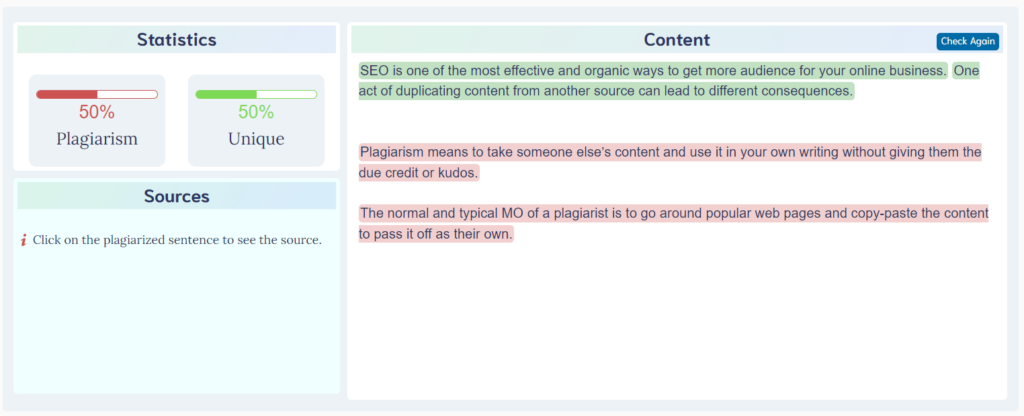
Plagiarism is both intentional and unintentional. If you know which sites you used to copy and paste your content, there is no point in checking the originality of the text, but if you research and write correctly, you should still check it through the plagiarism checker. In case you find excessive plagiarism, you can always use an AI plagiarism remover tool. The tool would help you ensure 100% originality within seconds. It can rewrite duplicate words and phrases, and make your text undetectable.
All you need is to go to a plagiarism checker tool website and paste the text in the fields given and hit the check plagiarism button. If there is plagiarism present in the text, it will highlight those phrases or paragraphs for you.
The acceptable percentage from search engines is around 5% which can occur mostly on universal phrases, quotations, words, etc. However ideally, you should remove this, but generally, you can use this.
Effects of Plagiarism On Search Engine Optimization
Plagiarism may not lead you to face legal issues, but it can still cause a lot of damage, and thus, it needs to be avoided. Here are a couple of ways plagiarism affects your SEO efforts.
It affects the Ranking in Search Engines
Google ranks some websites at the top based on metrics like the valuable content generation that provides value to the users, proper keyword adjustments, high readability, and many other factors. When plagiarism occurs, Google will penalize and de-rank your content in the SERPs.
If the issue gets serious, the website may get removed too. However, Google understands that accidental plagiarism can occur because millions of web pages cover every topic possible, so it allows little room for duplicate content.
Google approves content with 10% plagiarism or less, but if you find this much duplicate content when checking through online tools, you might find more, so you should aim for 0-5% plagiarism at max before publishing your text online.
Your Site’s Reputation is at stake
Another thing that most writers overlook and follow Google’s instructions mainly. After AI-powered content generation tools, articles can be written in minutes using machines, but that still doesn’t do any good to your website; so many AI-tools-based articles and blogs are approved by Google but get no appreciation from the readers.
You need to understand that you are writing content for the readers. If you fail to produce any value to the readers, you may get some traffic, but ultimately will hurt you in the long run in terms of traffic.
Readers might not trust your website after one visit when they see you do not have any original information to offer. This is true that readers do not know whether your article is a duplicate, but compared with other top pages, they will quickly find similarities that may shutter your content’s integrity, and users will not rely on the information you are sharing or read more of your blogs.
How to Avoid Plagiarism in your SEO Content?
Well, the best possible way is to practice paraphrasing and learn how to do extensive research. You need to make your content as much unique as possible. However, here are some ways to avoid plagiarism in your content, even if you are a beginner at writing.
Be Original
Indeed, you cannot be an expert in everything you write, but the best possible way to write original content is to do extensive research. Most of the writers deliberately do just a simple search on Google and use the information they find helpful in their text.
You can use various platforms, forums, and websites where experts share their answers and opinions and use it in your text in your own words to avoid any sort of plagiarism occurs.
Get Paraphrasing in your Advantage
Paraphrasing is rewriting an existing text into your own words, ideas and expressions while retaining the original context. Paraphrasing is a skill that will help you a lot in this field.
To be good at paraphrasing, you need to have a vast vocabulary and know how to express yourself differently to get uniqueness. However, fortunately, there are tools present for such tasks that can help you automatically rewrite any text for you.
You can use this technique or tool to rewrite all the texts that come under plagiarism.
Give credit where due
There is no harm in giving credit to the rightful owner. You need to understand this and make sure whenever you quote something from someone; you need to ensure that they get the credit for it.
You must use quotation marks on the text you copy and use citation techniques to ensure proper credit to the author.
Plagiarism vs. Duplicate Content vs. Legitimate Reuse
Many SEO problems start because people use these terms as if they mean the same thing.
They do not.
| Content issue | What it means | SEO risk | What to do |
|---|---|---|---|
| Plagiarism | Using someone else’s words, structure, ideas, or creative expression without proper credit or permission. | Can damage trust, create legal risk, and result in low-value or copied content. | Create original content, cite sources, quote carefully, and get permission where needed. |
| Duplicate content | The same or very similar content appears on more than one URL. | May confuse canonical selection, split signals, and make reporting harder. | Use canonical tags, redirects, better URL structure, or unique page content. |
| Syndicated content | Content is republished with permission across multiple sites. | Search engines may choose another version as the canonical or primary result. | Use proper attribution, canonical guidance where appropriate, and add unique value. |
| Quoted content | A small part of another source is quoted to support your point. | Usually low risk when limited, relevant, and properly credited. | Use quotation marks, cite the source, and add your own analysis. |
| AI-rewritten copied content | Copied material is paraphrased or spun to look different. | Still risky if it adds little original value or mainly exists to manipulate rankings. | Use AI to improve your own work, not to disguise copied work. |
Google’s canonicalization documentation explains that duplicate pages can happen for many normal reasons, including regional variants, device variants, HTTP/HTTPS versions, sorting/filtering pages, and accidental variants. Duplicate content is not automatically spam, but it can create search and tracking problems.
That distinction matters.
The fix for duplicate URLs may be technical.
The fix for plagiarism is editorial.
How Plagiarism Can Hurt SEO
Plagiarism can hurt SEO in several ways.
It reduces content originality
Search engines want to show useful results.
If your article mostly repeats what already exists elsewhere, it gives Google and readers fewer reasons to choose your page.
Copied content rarely adds new value.
It often lacks:
- Original examples
- First-hand experience
- Better explanations
- Updated context
- Unique visuals
- Stronger research
- Clearer structure
- Useful comparisons
- Brand perspective
That makes the page less competitive.
It can create trust problems
Readers may not know immediately that content is copied.
But they can often feel when an article is generic, shallow, or almost identical to other pages.
That can hurt:
- Brand trust
- Time on page
- Return visits
- Email signups
- Link earning
- Social sharing
- Conversion rates
SEO is not only about rankings.
It is also about whether people trust the page after they click.
It can lead to canonical confusion
When the same or very similar content appears on multiple URLs, Google may cluster those pages and choose one canonical version to show in search. Google says it uses the canonical page as the main source to evaluate content and quality.
This matters because your copied page may not be the version Google decides to show.
Even if the content is on your site, duplicate versions can make performance tracking and ranking signals messier.
It can create spam-policy risk
Google’s spam policies focus on practices that deceive users or manipulate search systems. Sites that violate those policies may rank lower or not appear in results.
Copied content becomes especially risky when it is:
Published at scale
Created with little effort
Used mainly to manipulate rankings
Filled with affiliate links without clear value
Republished without editorial oversight
Not useful for the reader
Disconnected from the site’s real purpose
It can create copyright risk
Copyright rules vary by country, but protected works can include written content such as articles and blog posts. WIPO explains that copyright protection is generally automatic once an original work exists and does not usually require formal registration under the Berne Convention.
That means copying content is not just an SEO issue.
It can also become a rights and permission issue.
There Is No Official “Safe Plagiarism Percentage” for SEO
One common myth is that Google allows a certain plagiarism percentage, such as 5% or 10%.
That is not a good way to think about SEO.
Google does not publish a universal “safe plagiarism percentage” for content.
A plagiarism checker score is only a tool signal. It is not a Google rule.
A page with 3% matched text can still be low quality if the idea, structure, examples, and value are copied.
A page with 12% matched text may be fine if the matches are properly quoted, cited, boilerplate, product names, legal language, or common phrases.
Instead of asking:
“What plagiarism percentage is safe?”
Ask better questions:
| Better question | Why it matters |
|---|---|
| Did we copy someone else’s words without credit? | This is a plagiarism and trust issue. |
| Does the article add original value? | SEO content should be more useful than copied summaries. |
| Are quotes limited and properly cited? | Attribution helps readers verify claims. |
| Are facts checked with reliable sources? | Accuracy matters more than passing a detector. |
| Is the page too similar to another URL on our own site? | This may need canonicalization, consolidation, or rewriting. |
| Would a reader choose this page over the original source? | This is the real originality test. |
Do not write for a percentage.
Write for usefulness, originality, and trust.
How to Check for Plagiarism Before Publishing
Plagiarism checking should be part of your editing process, especially when working with freelancers, guest posts, AI-assisted drafts, or outsourced SEO content.
Use this workflow:
Check exact copied text
Use a plagiarism checker or search exact phrases in Google.
Look for:
- Full copied paragraphs
- Reused introductions
- Copied definitions
- Copied list items
- Copied examples
- Copied conclusion sections
- Copied FAQ answers
Check source quality
Not every match is equally serious.
Common phrases, product names, quotes, legal language, or short definitions may appear across many sites.
A full copied explanation, structure, or article section is a much bigger problem.
Review the structure
Plagiarism is not only word-for-word copying.
A writer may copy another article’s exact structure, order, examples, and arguments while changing words.
That still creates weak content.
Compare:
- Heading structure
- Examples
- Tables
- Key arguments
- Order of ideas
- Research sources
- FAQ questions
- Conclusion angle
Check AI-assisted rewrites
AI can make copied content look different.
That does not automatically make it original.
If the draft was based on copied material, ask:
- What new examples were added?
- What real expertise was included?
- What original research was added?
- What new structure was created?
- What sources were checked?
- What is the unique point of view?
Verify citations
Make sure sources actually support the claims.
Do not cite a source just to decorate the article.
Citations should help readers verify data, quotes, definitions, claims, and recommendations.
How to Avoid Plagiarism in SEO Content
Avoiding plagiarism is not complicated, but it does require a better writing process.
Start with your own outline
Do not copy the top-ranking article’s structure.
Research the topic, then create your own outline based on:
- Search intent
- Audience needs
- Your expertise
- Customer questions
- Your product or service angle
- Missing information in existing results
- Better examples
- Better structure
StoryLab.ai’s AI Blog Outline Generator can help you create outline options, but the final structure should still be reviewed by a human.
Use sources for facts, not for copying
Sources should support your article.
They should not become your article.
Use reliable sources to verify facts, then explain the topic in your own words with your own examples and analysis.
Add original value
Every SEO article should add at least one of these:
- Real examples
- Personal experience
- Expert commentary
- Original screenshots
- Better comparison tables
- Updated data
- Clearer instructions
- Customer insights
- Templates
- Checklists
- Practical workflows
- Stronger explanations
Quote carefully
A quote should be short, necessary, and credited.
Do not build an article from copied quote blocks.
Use quotes to support your own explanation.
Be careful with paraphrasing tools
Paraphrasing can help improve wording.
But using a paraphrasing tool to hide copied content is not a good SEO strategy.
Google says generative AI can be useful for research and structure, but generating many pages without adding value may violate its spam policy on scaled content abuse.
Use AI to improve original work.
Do not use it to disguise copied work.
Create editorial guidelines
If you work with writers, freelancers, agencies, or AI tools, create clear rules.
Include:
- No copy-paste writing
- Required citations for claims
- Proper quote formatting
- No fake sources
- No AI rewriting of competitor articles
- Required originality checks
- Human editing before publishing
- Clear rules for syndicated or guest content
What to Do If You Find Plagiarized Content on Your Site
Finding copied content on your site does not mean you need to panic.
But you should fix it.
Use this process:
| Step | What to do | Why it matters |
|---|---|---|
| Identify the source | Find where the copied text came from. | You need to understand whether it is copied from another site, a guest post, a vendor, or your own content. |
| Assess the risk | Check how much is copied and whether it includes protected expression, unique structure, or original research. | Not every match has the same severity. |
| Remove copied sections | Delete or rewrite copied paragraphs, examples, tables, and conclusions. | This reduces plagiarism and quality risk. |
| Add original value | Add examples, analysis, screenshots, workflows, opinions, and better explanations. | Rewriting alone is not enough. |
| Cite where needed | Add proper source links for facts, data, quotes, and references. | Citations improve transparency and trust. |
| Check internal duplicates | Look for similar pages on your own site. | You may need to merge pages or set canonical URLs. |
| Republish and monitor | Update the article, request indexing if appropriate, and monitor performance. | SEO recovery depends on quality and crawl/indexing changes over time. |
If the issue is legal or involves a serious copyright complaint, get professional advice.
For normal SEO cleanup, start by improving the page quality and originality.
Duplicate Content Fixes for SEO
Some duplicate content problems are technical, not editorial.
Examples include:
- HTTP and HTTPS versions
- WWW and non-WWW versions
- URL parameters
- Category filters
- Tag archives
- Printer-friendly pages
- Paginated pages
- Product variants
- Regional pages in the same language
- Staging or demo sites indexed by mistake
Google says site owners can specify canonical URLs using redirects, rel=”canonical” annotations, and sitemap inclusion, and these signals can help Google understand the preferred version.
Use this table:
| Duplicate content issue | Best fix |
|---|---|
| Two URLs show the same article | Use a canonical tag or redirect to the preferred URL. |
| Old article replaced by a new article | Use a 301 redirect if the old page no longer needs to exist. |
| Product filters create many similar URLs | Review indexation, canonicalization, and internal linking rules. |
| Regional pages share almost identical content | Use hreflang and canonicalization correctly where appropriate. |
| Guest post appears on multiple sites | Use attribution and clarify which version should be primary. |
| Several thin articles cover the same topic | Merge them into one stronger page and redirect weaker versions. |
Do not use canonical tags to solve plagiarism.
Use them to solve duplicate URL problems.
Content Originality Checklist Before Publishing
Use this checklist before publishing SEO content.
| Check | Question | Why it matters |
|---|---|---|
| Original structure | Did we create our own outline? | Copying the structure of another article can still make content feel unoriginal. |
| Original wording | Are the sentences written in our own words? | Copied language damages trust and can create rights issues. |
| Added value | Does the article add something beyond existing results? | Search visibility depends on usefulness, not just uniqueness. |
| Examples | Did we include real or specific examples? | Examples make content more helpful and harder to copy generically. |
| Sources | Are facts, statistics, and claims properly supported? | Readers should be able to verify important claims. |
| Quotes | Are direct quotes limited and credited? | Quotes should support the article, not replace original writing. |
| AI use | Was AI used to support original content rather than hide copied content? | AI should improve quality, not disguise plagiarism. |
| Internal duplication | Does this page overlap too much with another page on our site? | Similar pages can compete with each other or confuse canonical selection. |
| Human review | Has an editor checked originality, accuracy, and usefulness? | Tools can help, but humans make the final quality decision. |
This checklist is more useful than chasing a single plagiarism score.
How StoryLab.ai Can Help Create More Original SEO Content
StoryLab.ai can help writers and marketers create better content faster.
But it should be used responsibly.
Use StoryLab.ai to support originality, not replace it.
Helpful workflows include:
- AI Content Idea Generator – brainstorm fresh angles before writing.
- AI Blog Outline Generator – create a unique article structure instead of copying competitors.
- AI Blog Title Generator – test headline angles without copying existing titles.
- AI Blog Introduction Generator – create opening variations for your own topic.
- AI Paraphrase Generator – improve wording, clarity, and tone after you have original input.
- Content Creation Guide – improve the full content workflow.
A practical workflow:
- Research the topic.
- Create your own outline.
- Add your own examples and expertise.
- Use StoryLab.ai to generate structure, title, intro, or wording variations.
- Check facts and sources manually.
- Run an originality check.
- Edit for usefulness, clarity, and brand voice.
- Publish the strongest version.
- Update the article when the topic changes.
AI can help with speed.
Your research, examples, judgment, and editing make the content worth ranking.
Conclusion
Now you know you should never copy someone’s work if you want to get traffic or rank high in the search engines. To check plagiarism, you can use plagiarism-checking tools, and if you want to remove plagiarism in your content, you can get help from paraphrase tools present online.
Author Bio:
FAQ
What is content plagiarism?
Content plagiarism involves copying or closely imitating the language, ideas, or expressions of another author’s work without permission, attribution, or proper acknowledgment, presenting it as one’s own original work.
How does content plagiarism affect SEO?
Content plagiarism negatively affects SEO by leading to potential penalties from search engines, reduced rankings, loss of credibility with your audience, and a decrease in website traffic. Search engines prioritize unique, high-quality content and can demote sites with duplicated content.
Can search engines detect plagiarized content?
Yes, search engines like Google use sophisticated algorithms to detect plagiarized content. They compare web pages across the internet to identify duplicate content and can penalize sites by lowering their search rankings or removing pages from search results entirely.
What are the consequences of having plagiarized content on your website?
Consequences include decreased search engine rankings, loss of website credibility and authority, potential legal issues, and diminished user engagement. It can also negatively impact the trust of your audience and partners.
How can you check for plagiarism in your content?
You can check for plagiarism by using online tools and software designed to detect duplicate content, such as Copyscape, Grammarly’s plagiarism checker, or Turnitin. These tools compare your content against a vast database of web pages and publications to identify potential matches.
What steps should you take if you discover plagiarized content on your website?
If you discover plagiarized content, remove or rewrite the content to ensure it’s original and unique. If the content was created by someone else, address the issue with the creator and consider implementing stricter content creation and review processes.
How can you prevent content plagiarism?
Prevent content plagiarism by establishing clear guidelines for content creation, educating your team or contributors about the importance of originality, using plagiarism detection tools as part of your content creation process, and encouraging proper citation and attribution practices.
Can rewriting or spinning articles protect you from plagiarism penalties?
Article spinning or rewriting content to avoid plagiarism without adding substantial value can still lead to SEO penalties. Search engines prioritize content that provides unique insights, comprehensive information, or original research.
Does citing sources help in avoiding plagiarism and its SEO impacts?
Citing sources can help avoid plagiarism, but for SEO, the key is to ensure your content is substantially original and adds value beyond what’s available from the cited sources. Proper attribution shows integrity but doesn’t substitute for originality in content creation.
What role does unique and original content play in SEO success?
Unique and original content is critical for SEO success because it helps establish your site as a valuable, authoritative source of information. It can improve search rankings, increase user engagement, and drive organic traffic, all of which are pivotal for online visibility and credibility.
Top AI Marketing Generators
Master the Art of Video Marketing
AI-Powered Tools to Ideate, Optimize, and Amplify!
- Spark Creativity: Unleash the most effective video ideas, scripts, and engaging hooks with our AI Generators.
- Optimize Instantly: Elevate your YouTube presence by optimizing video Titles, Descriptions, and Tags in seconds.
- Amplify Your Reach: Effortlessly craft social media, email, and ad copy to maximize your video’s impact.