
Creating a Content Distribution Strategy [Work Sheet Included]
I bet you’ve heard the phrase:
“Content is king!”
Have you also heard the phrase:
“Content is king – Distribution is Queen!”
Also.
How much time do you spend on creating content and how much time do you spend on distributing new AND older content?
I’ve always been big on Content Distribution. I’ve also always been amazed by how little time people spend on distributing content and I’ve often received questions around how I got such a large following, engagement, and traffic from multiple platforms. Even from teams with a strong Inbound Marketing Strategy in place.
For me. The answer is easy.
I follow a Content Distribution Framework that I created over many years.
Every time I start at a new company, I copy / paste this framework, personalize it a bit, and rock it.
In this post, I’ll be sharing that exact framework, give you guidance on how to personalize it to your needs and how to achieve your Content Marketing Goals a little bit easier.
But first, Let’s start with a couple of basics to make sure we’re all on the same page.
In this article
Content Distribution Statistics: Search Behavior, Buyer Influence, and Owned Media

Recent research highlights why distribution plans should account for website visits, on-platform engagement, and information shared within buying groups.
42% of surveyed B2B marketers identified owned media among their top three areas for expected investment or investment growth in 2027. The Content Marketing Institute and MarketingProfs report was published in November 2026 and draws on 861 B2B respondents, mostly from North America. This measures investment priorities, not proof that owned media outperforms every other channel.
Google users clicked a traditional search result on 8% of visits with an AI summary, compared with 15% of visits without one. Pew Research Center analyzed browsing activity from 900 U.S. adults in March 2025, with search results collected in April. The findings describe an observed difference; they do not establish that AI summaries alone caused it.
Links inside AI summaries received clicks on just 1% of visits to search pages containing a summary in that study. Being cited and receiving a website visit are different outcomes, so measure them separately where possible.
95% of hidden B2B buyers said strong thought leadership made them more receptive to sales and marketing outreach. Edelman and LinkedIn describe these buyers as stakeholders such as finance, legal, procurement, and operations professionals who influence purchases without necessarily being the main sales contact. This is a self-reported attitude, not a measured conversion lift.
These findings support a practical approach: create content people can use where they encounter it, provide a clear reason to explore further, and build direct audience relationships alongside platform reach.
What is Content Distribution?
Content Distribution is promoting new and existing content over multiple channels and platforms over time.
The importance Content Distribution?
Promoting your content is a must. Without content distribution, you’re basically publishing and praying.
What I’ve noticed is not that people don’t promote their content, it’s that they don’t do it enough.
Here’s how most Content Distribution Plans look like:
- Publish new content.
- Share it on Social Media once (sometimes schedule a couple of posts).
- Up to creating the next piece of content.
Not looking into promoting it on multiple platforms / channels like Reddit, Quora, Medium, etc. No re-distributing older content. For video, auto-posting tools like PostOnce publish one clip to TikTok, Instagram, YouTube Shorts and six other platforms at once, and can re-publish older posts too.
The main focus on is creating.
If that’s the case for you too, you’re missing out on growing a following, growing your E-mail list, building your SEO authority and overall bottom line.
Proper Content Distribution is important!
Setting up a Content Distribution Strategy
A well-designed Content Distribution Strategy is more than simply adding new channels or going back and promoting older content.
Content Distribution takes a lot of time. How do you make sure you invest your time in what gives the best returns?
Before we hand you the Content Distribution Framework in a Google Sheet, we’re going to explain how all elements work together so you can make decisions on what is most valuable to you and what you should add to make it even better.
1. How to select the right channels to distribute your content
If you’ve already used our Content Marketing Strategy framework, you should already have a good idea of the channels that work best for you.
Find out where your audience listens and reads for the subject matter and type of story you’re sharing. What platforms are your audience or potential customers active on? Do your research, talk to people, and test the response you get on various channels.
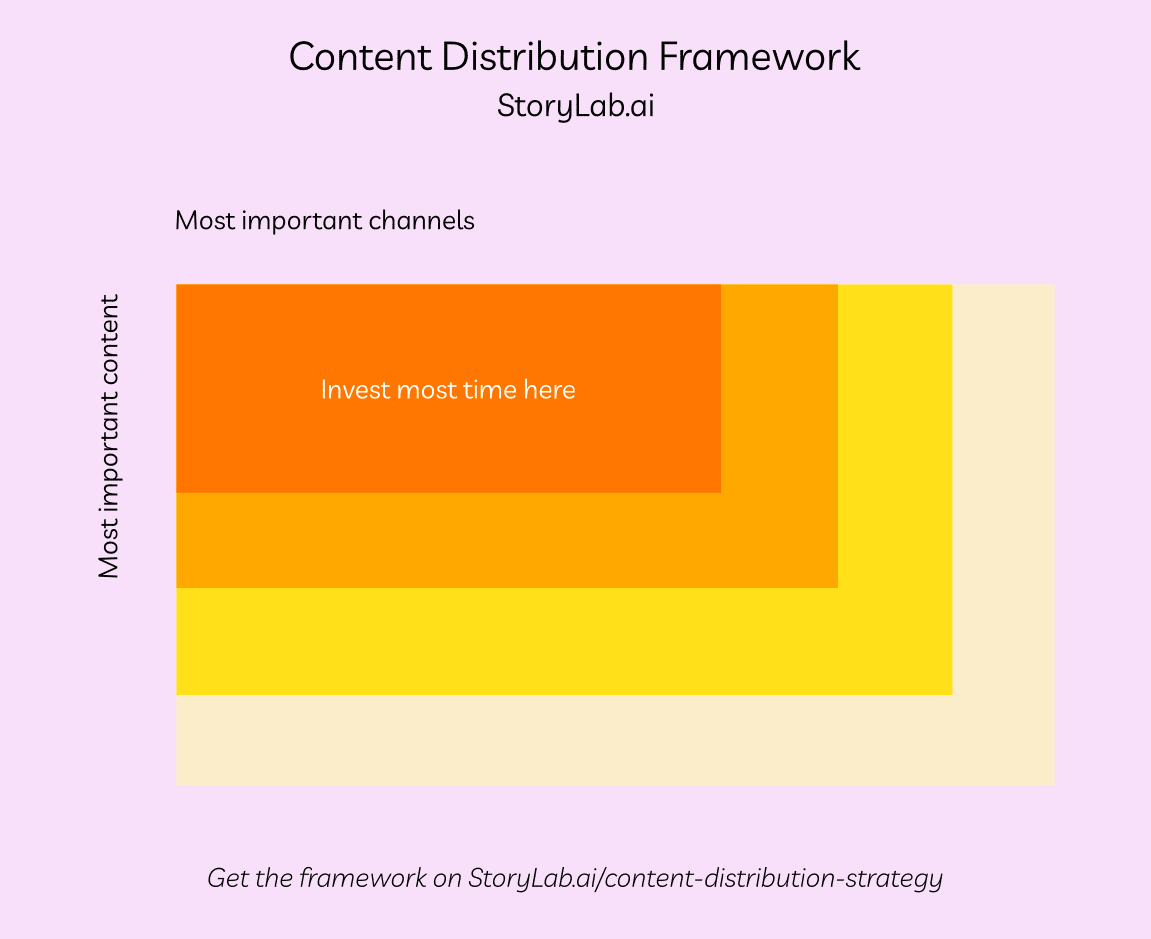
Your distribution channels are going to be on the X-axis of your Google Sheet.
The channels that have the biggest impact or potential to have the biggest impact should be on the left and the ones that have the least impact, but maybe are easy to plug your content into, go on the right side.
You will see a vizualisation of the importance of this later in this guide.
So to recap, for selecting the right channels it’s important to:
- Select channels your audience is active on
- Select channels that give you the best return on time investment or the potential to give you the best return. (Chances are that there are platforms you’re not utilizing yet and thus, starting out will give you poor results at first, but the potential can be big.)
- Put your most important channels on the left in descending order (don’t worry about being perfect).
- This list will be evolving over time. You should add, delete, and move channels around as you see fit.
Examples of possible distribution channels
- Social Media Platforms
- Your e-mail list
- Google WebStories
- Medium
- SubStack
- Quora
- SubReddits
- Refind
- LinkedIn and Facebook groups
- HackerNews
- IndieHacker.com
- GrowthHackers.com
- Etc.
2. Which articles, videos, ideas do you spend most the time on
After you’ve figured out which channels you’ll be using as a starting point, it’s time to prioritize which articles, videos, ideas you want to promote first and most often.
The same principle applies here.
Which piece of content / idea will give you the best bang for your buck if it attracts 100 more visitors?
If this is too simplistic, maybe the following guidelines can help:
- Which pieces of content have attracted the most subscribers, buyers, etc.?
- Which pieces of content already rank well in Google and need a little boost?
- Which pieces of content have the highest potential to rank well in Google?
- What types of content have helped build a Social Following – which new ideas deserve more priority?
Your most important pieces of content go on the first rows in descending order.
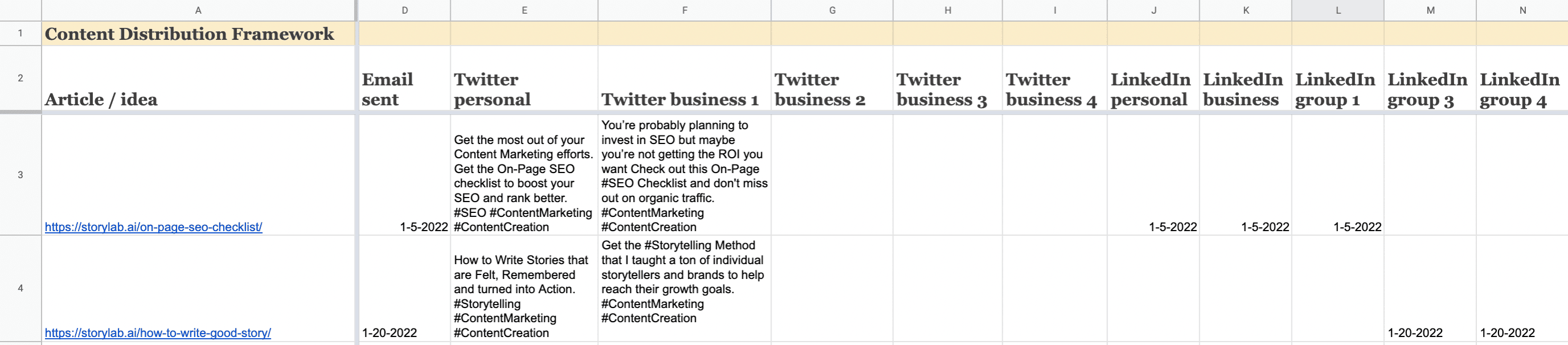
Here’s how the sheet should look like:
It can be that you have 10,000 pieces of content and ideas or that you have 100.
It doesn’t matter.
You now have a framework / process for spending time in terms of content distribution on what matters most.
You can now work your way from the top left to the bottom right.
Continually distributing your content
It is not possible to work through the dark orange (most important) quadrant first, and then light orange, etc.
Let’s say your top distribution channels are:
You can check off sending an e-mail to your subscribers but you might want to create 6 Tweets that go out over the course of a couple of weeks, you might want to create 2 Google Web Stories, write 3 Medium posts and share them on 4 relevant LinkedIn groups you’re active in.
You should not do all of that promotion the day you publish your piece of content.
So you will have gaps in your most important quadrant.
That’s ok.
It’s a work sheet.
You can fill in the gaps when the time is right.
This helps you to not just have a big distribution plan on day one, but also to continually promote a piece of content.
I’m mentioning it because a friend of mine started using this content distribution framework and… did send out 6 Tweets in a week, shared it on 4 LinkedIn groups in a day, etc.
You’ll get the most out of the framework by understanding the principles mentioned above in the strategy and making this framework your own.
This is what gaps can look like in your sheet:
That’s ok.
I now know that I have opportunities to Tweet more about it over time and that I have room to promote it in more LinkedIn groups.
BTW. On my sheet and it also should be on yours, I don’t have LinkedIn group 1, 2, 3. I have stated the name of the groups and a direct link to them. More on practicalities later.
Daily Content Distribution routine
How much time you spend on creating new content and how much you spend on content distribution is entirely up to you.
This framework will most likely showcase your habits.
Are you constantly adding new pieces of content and only sending out one Tweet?
Are you filling in all the blanks and hardly ever creating new pieces of content?
Or is there a nice balance?
I notice that I spend about 50/50 on Content Creation / Content Distribution. But I’ve been running this framework for years. You might need some time to get a feeling for it.
What I advise is to:
- Always add an article or content idea to the list when an article has been published or idea is mentioned.
- After an article is published, promote it. Fill in the sheet and visualize what you have done so far. (same day)
- Take time to fill in the gaps in the most important quadrants. (daily)
- Take time to check your data. Are the articles / ideas ranked on top still worth being on top? (quarterly)
- Check if the channels you find most impactful are still driving results or show potential. (quarterly)
- Find new channels. (quarterly)
- Find ways to work more effectively (Content Creation and Content Distribution). (quarterly)
Practicalities for using this Content Distribution Framework
- Invest time in understanding the core principles and make it your own.
- Name and link to your Distribution Channels in the sheet. So no LinkedIn group 1 but LinkedIn group – Entrepreneurs, for instance with a direct link to that group.
- When possible, add a link to posted content. For instance, if you have written a short article on Medium for your article On-Page SEO Checklist, don’t just add an ‘X’ in that cell (done), but add the link to that Medium article.
- Add dates when it makes sense. Usually when you don’t want to flood your audience. For instance when you sent out an email, published on Twitter, or group, etc.
- Write multiple Social Media Captions in one go and mark the captions you have not used yet with a different color (I use light grey). It’s just easier to write them all at once, while you’re still in the flow of the article. Be sure to use StoryLab.ai’s Social Media Caption Generator to inspire you.
- You can add anything that you find helpful. I always add ‘topic’ and number of internal keywords to filter easily and know which articles deserve some more internal links.
- Start simple and add as you go. It’s ok to just add a couple of articles and channels and get a feel for it without getting overwhelmed.
- Never spam!
- You will receive a link to the sheet, make a copy and start working.
Getting the most out of your Content Marketing Efforts
Content Creation and Content Distribution is just one piece of the entire Content Marketing puzzle.
For instance, you can write a great piece of content and distribute it far and wide, but if it’s not tailored to your audience and not matching a keyword that people search for, it will never be as effective as it could be.
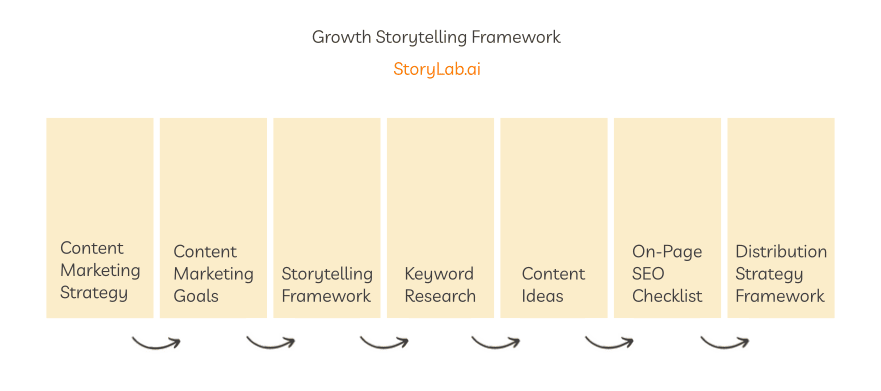
Our Content Distribution Framework sits within a Growth Storytelling Framework. You can access it for free here. No signup needed.
Go forth and create the best possible content and tell your best stories.
We will be here to support you however we can. Join our LinkedIn group to ask us any question.
How AI can help with Content Distribution
Even if you prioritize doing content distribution for your top content and on your top channels, the promotion will still take quite some time.
AI Marketing Copy Generators can help you do some heavy lifting, especially for your Social Media Marketing. It can be quite difficult to come up with different ways of promoting a piece of content.
Let’s dive into some AI Marketing examples for Social Media.
For this example, we want to promote this article. The keyword phrase we’re going to use for the AI Social Media Post Generator is going to be:
“The importance of content distribution”
Let’s start creating a couple of Tweets with the AI Tweet Generator.
Here’s what that looks like:
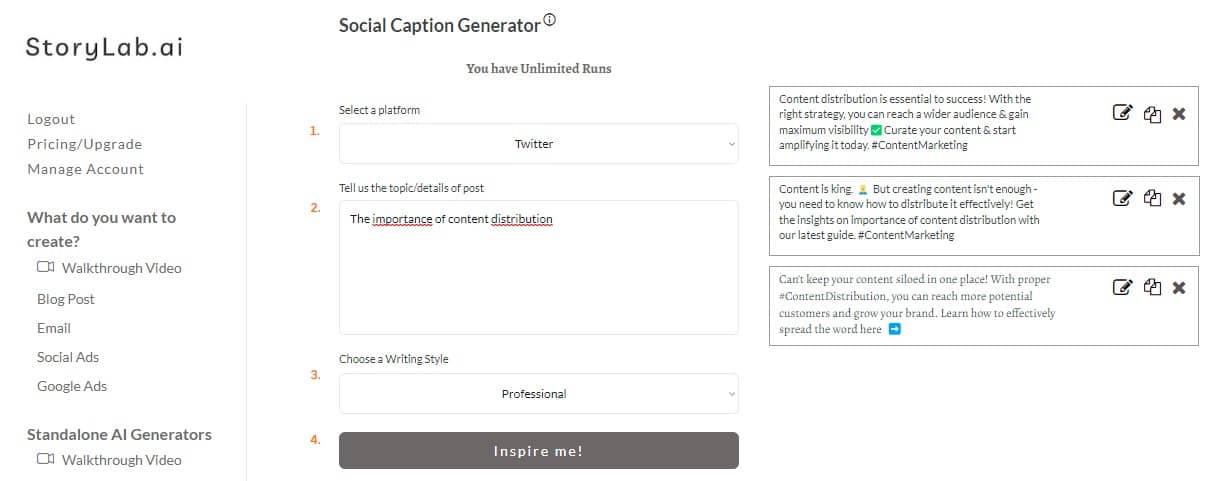
Examples of what the Tweet Generator created for us:
- Content distribution is essential to success! With the right strategy, you can reach a wider audience & gain maximum visibility✅Curate your content & start amplifying it today. #ContentMarketing
- Content is king. 🤴 But creating content isn’t enough – you need to know how to distribute it effectively! Get insights on the importance of content distribution with our latest guide. #ContentMarketing
- Can’t keep your content siloed in one place! With proper #ContentDistribution, you can reach more potential customers and grow your brand. Learn how to effectively spread the word here ➡️
Pretty cool, right?
Let’s run the Tweet Generator again and see how it can inspire us more. Here’s what we got on two consecutive runs:
- #ContentDistribution is the key to success! Invest in the right strategies and make sure your content reaches your target audience. Find more tips here 👉
- Content is key! Learn more about the importance of content distribution and how it helps you reach your audience in our new blog post. 📝 Click the link to check it out ⬇️
- Content distribution is key to success in digital marketing. Take the time to ensure that your content reaches the right people, at the right place, and at the right time. #ContentStrategy #ContentMarketing
- Get the word out 📣 Content distribution is key for effective marketing. Let us help you reach more people with our multichannel approach and proven strategies. Contact us today! #ContentDistribution
- Get your content seen by the right people with the power of strategic distribution. Invest in creating great content, and make sure it reaches its intended audience! #ContentMarketing #ContentDistribution
- Content distribution is key! It helps you find the right audience and create more meaningful relationships. Let us show you how to make your content strategy work for you. #ContentDistribution #DigitalMarketing
We can now select a couple of Tweets we like, add our unique human touch, perfect them, and schedule them for the next couple of weeks or even months.
We can take the same social caption inspirations and create social posts for other platforms too, or we can decide to run the AI Tool again, choosing a different social channel. Let’s see what it looks like if we choose the AI LinkedIn Caption Generator:
Examples of what the LinkedIn Caption Generator created for us:
- Content is King, but distribution is Queen. Tap into the full potential of content creation and make sure you master your content distribution strategy! 🤳 Learn more about what it takes to ensure effective reach with our new blog post ➡️
- Content is king, but don’t forget about content distribution. Outsmart your competition by amplifying your message with a strategic and effective content distribution plan. #contentmarketing #digitalstrategy
- Content is king, but distribution is queen. We must understand how to distribute quality content effectively in order to maximize our reach and visibility. Share your tips with us below! #ContentDistribution
If you want to make the body of your post a bit bigger, you can use our AI Text Expander to do just that. Here’s what that looks like for the first example:
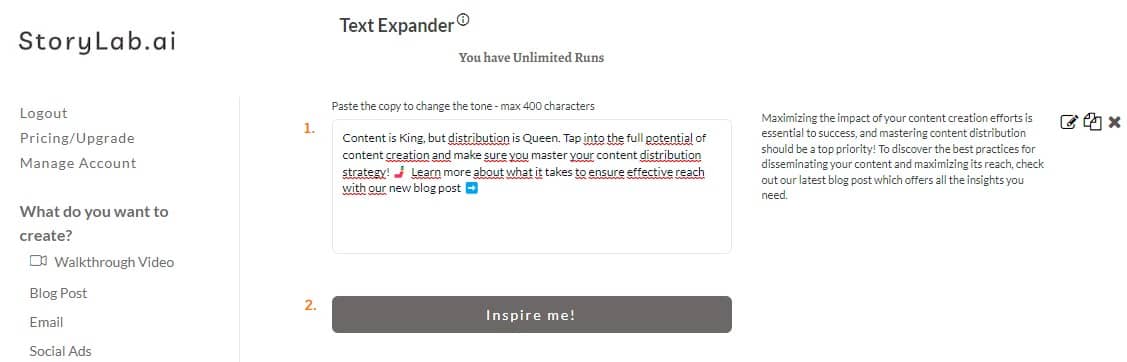
Examples of what the AI Text Expander created for us:
- Maximizing the impact of your content creation efforts is essential to success, and mastering content distribution should be a top priority! To discover the best practices for disseminating your content and maximizing its reach, check out our latest blog post which offers all the insights you need.
Yes, you can take this piece of text and expand on that with the tool as well.
What you can also do is use our AI Tone Changer to change the tone of your social post.
Here’s what that looks like when we take the text we just got and change it to ‘Storytelling’:
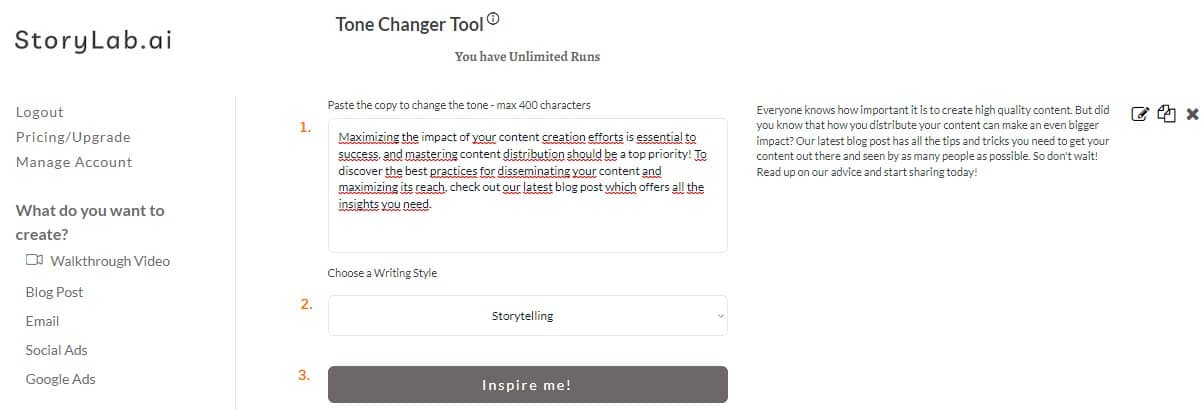
Examples of what the AI Tone Changer created for us:
- Everyone knows how important it is to create high-quality content. But did you know that how you distribute your content can make an even bigger impact? Our latest blog post has all the tips and tricks you need to get your content out there and seen by as many people as possible. So don’t wait! Read up on our advice and start sharing today!
Pretty cool right? There are a bunch of different tone styles you can choose from and play around with.
Various AI Use Cases for Content Distribution
The examples we showed above are just the start. There are various ways you can make use of AI to distribute your content more easily. It can help you create cool emails for your subscriber list, Titles, Outlines, and introductions for your Medium posts, Titles, and Descriptions for your YouTube Shorts, and much more depending on your needs.
Write a Distribution Brief Before Creating the Content
Distribution becomes easier when the content is designed around a specific audience and use.
Before production starts, write a short brief covering five decisions.
Identify the Reader and Their Situation
Go beyond a broad audience label such as “marketing managers.”
For example:
“Marketing managers at growing software companies who need to explain why website traffic is falling while leadership expects more leads.”
That situation points toward useful content: an explanation, supporting evidence, diagnostic questions, and a resource they can share internally.
Define the Main Takeaway
Write the one idea the reader should remember.
For example:
“Evaluate content performance across discovery, engagement, and business outcomes instead of using website traffic alone.”
This becomes the thread connecting the article, email, video, and social posts.
Choose a Primary Distribution Route
Select the first route based on where this audience already seeks help.
A practical starting mix might include:
- A relevant email audience for a detailed explanation.
- A professional social channel for discussion.
- A partner audience for additional reach.
Treat this as a focused experiment. Expand when the results and your capacity justify it.
Match the Next Step to the Reader’s Need
A reader exploring a problem may want a checklist. Someone evaluating approaches may want a detailed example or comparison.
Choose an invitation that follows naturally from the content. Asking every reader to book a meeting can create an unnecessary jump.
Assign Ownership
Record who prepares each version, publishes it, responds to questions, and reviews performance.
A distribution plan is incomplete if everyone assumes someone else will handle the replies.
Repurpose the Insight for Each Channel
Effective repurposing preserves the main idea while adapting how the audience experiences it.
An article introduction rarely makes a strong video opening without revision. A webinar transcript usually needs editing before it becomes a useful email.
Start by extracting a small set of reusable elements:
- The central argument.
- One well-supported finding.
- A practical example.
- A common mistake.
- A short sequence of actions.
- A question worth discussing.
Then build each format around one of those elements.
Make Social Posts Useful Without Requiring a Click
Explain a complete idea in the post itself.
For example, share three questions readers can use to review their distribution strategy. Link to the full guide when it provides useful depth, examples, or a worksheet.
This lets the post serve readers who stay on the platform while giving interested people a reason to continue.
Give Email a Specific Editorial Angle
Instead of announcing “We published a new article,” explain why the topic matters to that audience.
An email could introduce one overlooked problem, provide a practical answer, and invite readers to explore the full resource.
Keep the promise in the subject line aligned with the message and destination.
Use Video to Demonstrate
Show a process, explain a decision, or walk through an example.
A short demonstration of turning one article into three channel-specific assets can be more useful than a spoken list of generic distribution tips.
Use AI With a Controlled Source Brief
AI can help draft adaptations, identify potential excerpts, and suggest opening lines. Give it the approved source material and clear boundaries.
For example:
Turn this approved article into one educational social post, one email introduction, and one short video outline. Preserve the main claim and its limitations. Use only facts in the source. Do not invent statistics, customer results, quotations, or product capabilities. Give each version one relevant next step.
Review each output for meaning and context. A statistic that was carefully qualified in the article can become misleading when shortened.
Distribute Content in Waves and Give Older Assets a New Purpose
A publication date should begin a distribution cycle.
Plan several reasons to revisit the content rather than repeatedly sharing the same announcement.
Wave One: Introduce the Main Idea
Publish the main resource, share its strongest takeaway, and introduce it to the most relevant audience.
Check that the destination works on mobile, the promised resource is easy to find, and the next step is clear.
Wave Two: Answer the Questions It Creates
Use responses to develop a follow-up post, demonstration, or short explanation.
If readers ask how to apply the framework with a small team, answer that question directly. Their response provides a useful angle for continued distribution.
Wave Three: Reach a Relevant Partner Audience
Offer a collaborator something useful for their readers:
- A concise explanation.
- An original chart with context.
- An expert contribution.
- A practical excerpt.
- A discussion topic for an event or newsletter.
Explain why it fits their audience. A generic request to share your link gives them little reason to participate.
Wave Four: Refresh and Recirculate
Review evergreen content when a relevant change creates a new reason to share it.
Update outdated facts, broken links, examples, and screenshots before promotion. Explain the substantive change when announcing the refresh.
Retire assets that no longer support an accurate or useful message.
Add a Review Date to the Plan
Alongside the publication date, record when the content should be checked again.
Research summaries may need review when new evidence appears. Product guidance may need review after a feature change. Seasonal material may need attention before the next relevant period.
Redistribution works best when the underlying content still deserves attention.
Prepare Content for AI Search and Internal Sharing
People can encounter your ideas through search summaries, forwarded emails, screenshots, presentations, and private conversations.
Make the content understandable when it travels beyond its original page.
Keep Claims Attached to Their Evidence
Place sources close to important facts. Include the date, population, and limitations where they affect interpretation.
For original research, explain how the information was collected and what the sample represents.
A chart shared without its definitions can communicate a very different message from the one you intended. Put essential context into the asset itself.
Publish Clear Answers and First-Hand Detail
Useful material includes:
- Direct explanations of common questions.
- Original examples and observations.
- Practical comparisons with stated criteria.
- Expert analysis that explains trade-offs.
- Findings with transparent methods.
These qualities give readers something concrete to reference. They do not guarantee citation by an AI system.
Google says established SEO practices remain relevant to AI Overviews and AI Mode. Important information should be available as text, and no special AI markup is required. Pages must meet eligibility requirements, but inclusion is not guaranteed. Source: Google Search Central
Help Readers Share the Argument Internally
For B2B content, consider the colleague who receives the resource without knowing your brand.
Include a concise explanation of:
- The problem.
- Why it matters.
- The evidence.
- Available approaches.
- Costs, constraints, or trade-offs.
- Questions to discuss before deciding.
Make the title and introduction specific enough that a forwarded link still makes sense.
Offer a Reason to Return
An answer may satisfy an immediate question without generating a visit. Give interested readers something worth seeking out later: original research, a worked example, a useful worksheet, or a consistently valuable newsletter.
Build the relationship around continued usefulness rather than requiring a click for every small piece of information.
Measure Distribution Across Reach, Response, and Business Value
A distribution report should explain what happened and what the team should change.
Use the StoryLab.ai Distribution Measurement Framework:
Reach → Engage → Return → Act
Reach: Did the Intended Audience Encounter the Content?
Track relevant exposure, such as search visibility, qualified audience reach, newsletter delivery, and partner placements.
Raw impressions are incomplete. A large audience outside your market may contribute less than a smaller group with a clear need for the content.
Engage: Did the Content Earn Attention or a Response?
Review meaningful signals such as:
- Substantive comments and questions.
- Email replies.
- Video retention.
- Saves and shares.
- Engaged visits to the destination.
Interpret each measure in context. A save indicates interest, but does not establish that someone later used the resource.
Return: Did People Continue the Relationship?
Look for repeat visits, continued newsletter engagement, repeat event attendance, or readers exploring related resources.
This helps distinguish a brief spike in attention from an audience that keeps finding your work useful.
Act: Did Readers Take a Relevant Next Step?
Define the action before publishing.
Depending on the objective, it might be a confirmed subscription, completed worksheet, qualified inquiry, event registration, trial, or purchase.
Match the measure to the content’s role. An educational article can contribute to a later decision without producing an immediate sale.
Account for Measurement Gaps
Campaign tracking links can help distinguish identifiable traffic sources. They cannot reveal every private share, offline conversation, or interaction with an AI answer.
Combine behavioral reporting with questions such as “How did you first hear about us?” Treat self-reported answers as additional evidence rather than perfect attribution.
Avoid adding reach figures from several channels and presenting the total as unique people. The same person may encounter the content more than once.
Compare Results With the Effort Required
Include distribution labor, adaptation, design, and promotion costs.
Cost per qualified action = total distribution cost ÷ qualified actions
For example, €600 in distribution costs producing 20 qualified actions equals €30 per action. This is an illustrative calculation, not a benchmark.
At each review, make a practical decision: strengthen a promising format, improve the destination, change the audience, update the content, or stop an activity that is not earning its place in the plan.
FAQ
What is content distribution?
Content distribution is the process of sharing, publishing, and promoting content such as articles, videos, podcasts, and infographics across various channels and platforms to reach a wider audience.
What are the main types of content distribution channels?
The main types include owned channels (like websites and blogs), earned channels (such as guest posts and PR), and paid channels (including PPC advertising and sponsored content).
How important is content distribution in a marketing strategy?
Content distribution is crucial as it maximizes the reach and impact of content, driving traffic, engaging audiences, and supporting overall marketing goals.
What role does social media play in content distribution?
Social media platforms are key for content distribution, allowing for wide reach, audience engagement, and the ability to share content easily and quickly.
How can email marketing be used for content distribution?
Email marketing can distribute content directly to interested audiences, personalize messages, and segment content based on subscriber preferences and behaviors.
What is the significance of SEO in content distribution?
SEO is significant as it enhances the visibility of content in search engine results, driving organic traffic to the content and improving its overall reach.
Can content distribution help in lead generation?
Effective content distribution can drive lead generation by reaching potential customers through various channels and guiding them to conversion points.
How does paid advertising support content distribution?
Paid advertising can amplify content reach, target specific audiences, and place content in high-visibility areas, boosting traffic and engagement.
What strategies can be used to distribute content effectively?
Strategies include understanding the target audience, choosing the right channels, tailoring content for each platform, and regularly analyzing and adjusting tactics based on performance.
How can businesses measure the success of their content distribution efforts?
Success can be measured through metrics like website traffic, engagement rates, conversion rates, social shares, and overall ROI of content distribution activities.
How can partnerships and collaborations enhance content distribution?
Partnerships with influencers, industry leaders, or complementary brands can extend the reach of content, tapping into their audiences and lending additional credibility to the shared content.
What is the role of content syndication in distribution?
Content syndication involves republishing content on third-party sites, helping to reach a broader audience and drive traffic back to the original site.
How does repurposing content aid in distribution efforts?
Repurposing content into different formats (like turning blog posts into videos or infographics) can maximize reach and engagement by appealing to diverse audience preferences.
What is cross-promotion, and how is it used in content distribution?
Cross-promotion involves promoting content across different channels or in partnership with others, leveraging various platforms to increase content visibility and reach.
Can community forums and groups be effective for content distribution?
Sharing content in community forums and groups can be effective, provided the content is relevant and adds value, thereby engaging members and driving traffic.
What is the importance of a content calendar in distribution?
A content calendar ensures a consistent and strategic approach to distribution, helping plan when and where content is shared for maximum impact.
How can businesses leverage user-generated content for distribution?
Encouraging and sharing user-generated content can broaden reach, as it often comes with built-in audiences and increased trust from being customer-centric.
What are the benefits of using content distribution networks (CDNs)?
CDNs can enhance the reach and speed of content delivery, especially for high-bandwidth content like videos, ensuring a better user experience globally.
How do metrics and analytics support content distribution?
Metrics and analytics provide insights into content performance, audience behavior, and channel effectiveness, guiding more informed and strategic distribution decisions.
What are some common challenges in content distribution, and how can they be addressed?
Challenges include content saturation, finding the right distribution channels, and measuring effectiveness. These can be addressed through targeted strategies, regular analysis, and adapting to audience feedback and market trends.
Related articles
Author bio:
Raul Tiru: Raul loves to build companies and help startups and scale-ups grow. Raul started his first website when he was 17 years old, has held several growth marketing positions in fast-growing companies, and has helped companies via his Freelance Marketing services. Raul is the Founder of GlobalOwls, Co-Founder of StoryLab.ai, and Co-Founder of StrongEcho.
Interesting articles
- Demystifying Google’s Core Web Vitals: A Guide to SEO Success
- AI-Powered Content Creation: Tools and Techniques for Marketers
- 5 ways of using AI to Improve your Marketing Efforts
- The Importance of Branding in Digital Content Creation
- How to Write Press Releases for Optimal Results
- Revitalize Your Blog: Fresh Content Ideas to Engage Your Audience and Generate Leads
- The Psychology Behind Choosing The Right Color For Your App Designing
- Avoid Data Loss in Google Workspace: A Comprehensive Guide
Master the Art of Video Marketing
AI-Powered Tools to Ideate, Optimize, and Amplify!
- Spark Creativity: Unleash the most effective video ideas, scripts, and engaging hooks with our AI Generators.
- Optimize Instantly: Elevate your YouTube presence by optimizing video Titles, Descriptions, and Tags in seconds.
- Amplify Your Reach: Effortlessly craft social media, email, and ad copy to maximize your video’s impact.