
Effective Startup Social Media Content Ideas [+ AI Tool]

Startups do not need to post random content just to “be active” on social media.
That is how you end up with three product screenshots, one awkward team photo, a quote from Steve Jobs, and a founder wondering why nobody cares.
Social media can help startups build awareness, test messaging, attract early users, show progress, earn trust, and create conversations with the people they want to reach. But the content needs a purpose.
The good news is that you do not need a huge marketing team to start. You need a clear audience, a few repeatable content themes, a simple posting rhythm, and enough useful ideas to keep showing up without starting from a blank page every week.
Below, you’ll find startup social media content ideas you can use for LinkedIn, Instagram, X, TikTok, Facebook, YouTube Shorts, and other channels. After the list, we’ll also show how to turn these ideas into better posts with AI, stronger hooks, clearer captions, and a more practical content workflow.
Why Startups should post consistently on Social Media
Startups should post consistently on social media for several reasons:
- Build Brand Awareness: Consistent posting on social media platforms like Twitter, Facebook, LinkedIn, and Instagram can help startups to establish and build brand awareness. By consistently sharing relevant and interesting content, startups can keep their brand at the forefront of their audience’s minds.
- Engage with Audience: Consistent posting on social media platforms can also help startups to engage with their followers and potential customers. By responding to comments and messages in a timely manner, startups can build relationships with their audience and demonstrate that they are responsive and trustworthy.
- Establish Thought Leadership: Consistent posting on social media platforms can also help startups establish themselves as thought leaders in their industry. By sharing valuable insights, opinions, and expertise related to their industry, startups can demonstrate their knowledge and expertise and build credibility with their audience.
- Drive Traffic and Sales: Consistent posting on social media platforms can also help startups drive traffic to their website and increase sales. By sharing links to their website or products/services, startups can encourage their followers to take action and make a purchase.
- Build Community: Consistent posting on social media platforms can also help startups to build a community around their brand. By sharing content that resonates with their audience, startups can foster a sense of community and belonging among their followers.
In summary, consistent posting on social media platforms is important for startups because it can help them build brand awareness, engage with their audience, establish thought leadership, drive traffic and sales, and build community.
Additional free resources:
- How to create a Social Media Marketing Strategy
- How to get more Twitter Followers
- How to get more LinkedIn followers for your Company Page
AI Tools to help you come up with ideas and create cool Social Media Captions
At StoryLab.ai we’re committed to helping your Startup to become more effective by helping you tell more and better stories. We do that with our resources and with our tools.
- Our AI-Powered Content Idea Generator helps you come up with awesome new ideas.
- Our AI-Powered Social Media Caption Generator helps you take those ideas and turn them into social media captions in seconds
How the AI-Powered Social Media Caption Generator works
For this example, we’ve taken one of the social media content ideas below and entered it into our AI-Powered LinkedIn Caption Generator.
In the image below you can see what the AI Tool created for us in seconds:
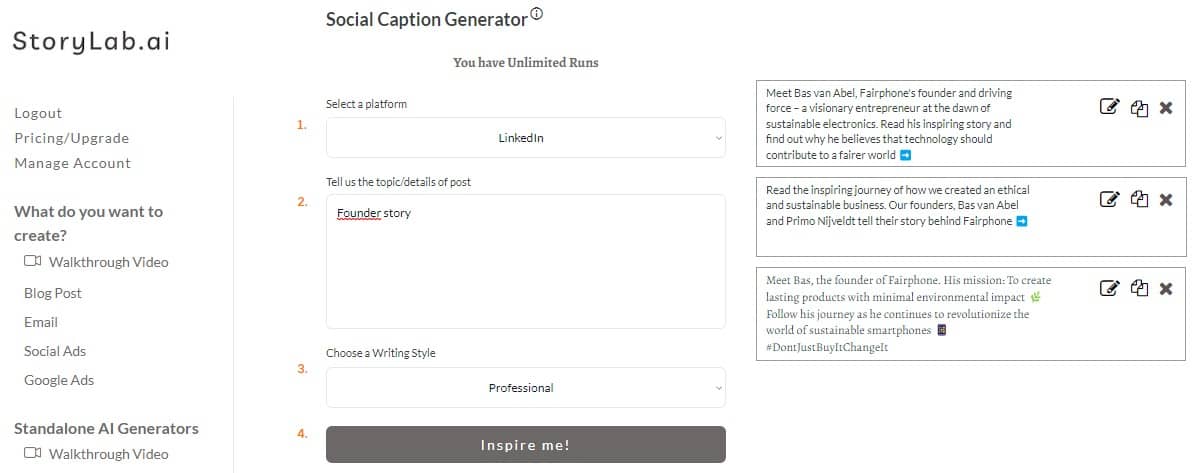
LinkedIn Ideas the AI Tool Generated for us:
- Meet Bas van Abel, Fairphone’s founder and driving force – a visionary entrepreneur at the dawn of sustainable electronics. Read his inspiring story and find out why he believes that technology should contribute to a fairer world ➡️
- Read the inspiring journey of how we created an ethical and sustainable business. Our founders, Bas van Abel and Primo Nijveldt tell their story behind Fairphone ➡️
- Meet Bas, the founder of Fairphone. His mission: To create lasting products with minimal environmental impact 🌿Follow his journey as he continues to revolutionize the world of sustainable smartphones 📱 #DontJustBuyItChangeIt
Re-run the AI Tool if you need more inspiration, or take one of the captions, add your unique human touch, perfect it, and post it.
Grab a couple of social media ideas below, throw them into the AI Generator, and build your social media content calendar in minutes.
Effective Social Media Content Ideas for Startups
- Share pictures of your office or workspace.
- Introduce your team members with short bios and pictures.
- Share behind-the-scenes photos of your product development process.
- Share sneak peeks of upcoming products or features.
- Share customer testimonials or success stories.
- Share interesting industry news or trends.
- Share tips for entrepreneurs or small business owners.
- Share your company’s mission or values.
- Share a “day in the life” of a team member.
- Share a personal story about the founding of your company.
- Share a blog post or article you wrote about your industry or product.
- Share information about upcoming events or conferences you will be attending or speaking at.
- Share information about awards or recognition your company has received.
- Share photos or videos from events you have hosted or attended.
- Share a quote that inspires you or your team.
- Share an interesting or inspiring story about a customer or user.
- Share a company milestone or achievement.
- Share a story about a challenge your company overcame.
- Share a photo or video of your product in action.
- Share a comparison of your product with a competitor’s product.
- Share a customer review or feedback.
- Share a survey or poll related to your product or industry.
- Share a tutorial or how-to guide related to your product or industry.
- Share a case study of how your product or service helped a customer.
- Share a funny or lighthearted meme or joke related to your industry or product.
- Share a before-and-after transformation of a customer or user.
- Share a video testimonial from a satisfied customer.
- Share a news article or blog post about your industry or product.
- Share a “did you know?” fact about your industry or product.
- Share a story about how your product or service is making a positive impact.
- Share a photo or video of your team volunteering or giving back to the community.
- Share a quote from a thought leader in your industry.
- Share a photo or video of a team-building activity or company outing.
- Share a blog post or article written by a team member or guest author.
- Share a photo or video of a team member’s pet.
- Share a photo or video of your company’s philanthropic efforts.
- Share a photo or video of a team member working remotely.
- Share a photo or video of your company’s environmental sustainability efforts.
- Share a photo or video of your team celebrating a company milestone.
- Share a photo or video of your team participating in a charity walk or run.
- Share a quote or tip from a book related to entrepreneurship or business.
- Share a photo or video of a team member’s side hustle or passion project.
- Share a photo or video of a team member’s hobby or interest.
- Share a photo or video of your company’s product in use by a celebrity or influencer.
- Share a photo or video of a team member’s work setup or desk.
- Share a photo or video of your company’s manufacturing or production process.
- Share a photo or video of your team members collaborating on a project.
- Share a photo or video of a team member’s favorite inspirational quote or saying.
- Share a photo or video of your company’s logo or branding.
- Share a photo or video of a team member’s favorite podcast or TED talk.
- Share a photo or video of your company’s booth at a trade show or conference.
- Share photos and videos of your team working on your product or service.
- Share news and updates about your startup’s progress and milestones.
- Share blog posts or articles that provide insights or advice related to your industry.
- Share industry news and trends that are relevant to your startup.
- Share testimonials or case studies from satisfied customers.
- Share quotes from industry leaders or inspirational figures.
- Share tips and tricks for other startups or entrepreneurs.
- Share behind-the-scenes glimpses of your office or workspace.
- Share infographics that explain complex industry concepts or data.
- Share memes or funny images related to your industry or startup culture.
- Share your startup’s mission statement or values.
- Share personal stories from your team members or founders.
- Share interesting facts or trivia related to your industry.
- Share educational content that teaches your audience about your industry or product/service.
- Share sneak peeks of upcoming products or services.
- Share giveaways or contests to encourage engagement with your brand.
- Share interviews with team members or industry experts.
- Share customer reviews or feedback.
- Share photos or videos of events your startup has participated in.
- Share behind-the-scenes footage of product development or production.
- Share user-generated content, such as photos or videos of customers using your product.
- Share infographics or charts that showcase your startup’s growth or success.
- Share podcasts or video content related to your industry.
- Share tutorials or how-to guides related to your product/service.
- Share inspirational quotes or messages to motivate your audience.
- Share news or updates related to funding or investment in your startup.
- Share team member profiles or introductions.
- Share job postings or opportunities to join your team.
- Share photos or videos of your startup’s culture or work-life balance.
- Share tips or resources for remote work or managing a startup team.
- Share photos or videos of your startup participating in community service or social responsibility efforts.
- Share infographics or data visualizations related to your industry or startup.
- Share user-generated content featuring your product or service.
- Share photos or videos of your startup at industry events or conferences.
- Share news or updates related to partnerships or collaborations.
- Share photos or videos of your startup’s office pets or furry mascots.
- Share information about your startup’s philanthropic efforts or charitable donations.
- Share behind-the-scenes footage of your startup’s advertising or marketing campaigns.
- Share information about your startup’s environmental sustainability efforts.
- Share photos or videos of your startup’s team building activities or retreats.
- Share news or updates related to product launches or updates.
- Share information about your startup’s customer support or service.
- Share photos or videos of your startup’s product being used in unexpected or creative ways.
- Share stories or anecdotes from your startup’s early days or founding.
- Share fun or creative ways to use your product or service.
- Share photos or videos of your startup’s team volunteering or giving back to the community.
- Share news or updates related to patents or intellectual property.
- Share photos or videos of your startup’s team celebrating milestones or achievements.
- Share information about your startup’s supply chain or production process.
- Share news or updates related to industry regulations or policies.
- Share photos or videos of your startup’s team participating in industry conferences or speaking engagements.
- Share information about your startup’s data privacy or security measures.
- Share photos or videos of your startup’s team participating in team building activities or challenges.
Social Media Tips for Startups
Startups can leverage social media not just for marketing, but as a powerful tool to build brand identity, engage with their target audience, and gain valuable market insights. When that grows beyond what a founder can run alone, the right marketing partner for startups can take over brand, website, and demand so the team stays on the product. Crafting a social media strategy that is both innovative and aligned with your startup’s ethos can propel your visibility and growth. Here are some bespoke social media tips for startups, infused with unique social media ideas, to help carve out a distinct presence in the digital ecosystem.
Tell Your Story
Startups have unique stories behind their creation, mission, and vision. Use social media to tell these stories, sharing the challenges, milestones, and behind-the-scenes moments of your journey. This narrative approach helps build an emotional connection with your audience.
Showcase Your Culture and Team
Highlight your startup’s culture and the team behind the scenes. Share posts about team events, achievements, or day-to-day operations to humanize your brand. This transparency fosters trust and shows potential customers and employees the human side of your startup.
Engage with Interactive Content
Create interactive content such as polls, quizzes, and contests to engage your audience. This could be as simple as asking for feedback on a new product feature or hosting a giveaway contest. Interactive content not only increases engagement rates but also makes your audience feel involved in your startup’s development process.
Leverage User-Generated Content
Encourage your customers or users to share their experiences with your product or service. Reposting this user-generated content provides social proof and can significantly enhance your credibility and reach. Make sure to acknowledge and thank users for their contributions to foster a sense of community.
Utilize Video Content
Videos can convey your message more dynamically and engagingly than text or images alone. Use video content to demonstrate your product, share insights from your team, or tell customer success stories. Live streaming product launches or Q&A sessions can also add a real-time engagement layer.
Offer Valuable Insights
Share valuable insights related to your industry, such as tips, trends, or how-to guides. This positions your startup as a thought leader and go-to resource in your field. It also adds value to your audience, encouraging shares and discussions.
Collaborate with Influencers and Brands
Partner with influencers and other brands that align with your startup’s values and audience. These collaborations can introduce your startup to new audiences and lend credibility to your brand. Choose partners carefully to ensure their audience is likely to be interested in your offering.
Highlight Customer Reviews and Testimonials
Positive reviews and testimonials are gold for startups. Share these accolades on your social media channels to build trust with your audience. Video testimonials or case studies can be particularly impactful.
Share Industry News and Trends
Keeping your audience informed about the latest industry news and trends not only adds value but also stimulates engagement and discussions. It shows that your startup is up-to-date and actively involved in the industry community.
Use Data to Refine Your Strategy
Regularly analyze your social media performance to understand what content resonates with your audience. Look at engagement rates, click-through rates, and conversion metrics to refine your strategy and focus on what works best.
By implementing these tailored social media tips and ideas, startups can create a dynamic and engaging online presence that resonates with their target audience. The key is to be authentic, responsive, and innovative, using social media not just to sell but to build lasting relationships and a loyal community around your brand.

How Startups Can Use These Social Media Content Ideas Better
A list of social media content ideas is useful.
But the list is not the strategy.
The real growth comes from choosing the right ideas, turning them into repeatable formats, publishing consistently, learning from the response, and improving the next batch.
Here is how startups can use the ideas above without turning their social feed into a messy collection of “we are excited to announce” posts.
Pick a Few Content Themes First
Do not try to post everything.
A startup can usually build a stronger presence by choosing a few content themes and repeating them in different ways.
For example:
| Content theme | What to post | Why it works |
|---|---|---|
| Founder story | Lessons, mistakes, decisions, early challenges, behind-the-scenes updates | Helps people understand the humans behind the company. |
| Product education | How it works, use cases, tutorials, feature explanations, before-and-after examples | Helps potential users understand why the product matters. |
| Customer insight | Questions, objections, testimonials, reviews, mini case studies | Turns real customer language into trust-building content. |
| Industry point of view | Trends, opinions, myths, changes, predictions, useful commentary | Positions the startup as a thoughtful voice in its category. |
| Progress and milestones | Launches, updates, team growth, funding, partnerships, learnings | Shows momentum without only posting self-promotion. |
This keeps your content focused. People should start recognizing what your startup talks about.
If every post feels like it came from a different company, your positioning is probably too loose.
Match the Idea to the Platform
The same idea can work on multiple platforms, but the format should change.
A startup milestone on LinkedIn may become a founder story.
On Instagram, it may become a carousel.
On TikTok, it may become a short behind-the-scenes video.
On X, it may become a short thread or sharp observation.
Use this simple platform fit table:
| Platform | What usually works better | Startup tip |
|---|---|---|
| Founder lessons, B2B insights, hiring updates, product lessons, customer stories | Write like a person with a point of view, not like a press release. | |
| Carousels, behind-the-scenes visuals, team culture, product visuals, short Reels | Make the message visual and easy to understand quickly. | |
| TikTok | Short videos, founder clips, product demos, reactions, relatable startup moments | Start with the problem or tension in the first seconds. |
| X | Sharp opinions, build-in-public updates, quick lessons, founder thoughts, threads | Be specific. Generic motivation disappears fast. |
| YouTube Shorts | Quick demos, lessons, tutorials, product tips, founder insights | Focus each short on one useful takeaway. |
| Community updates, founder stories, customer stories, local or niche audience content | Make posts conversational and easy to respond to. |
You do not need to be everywhere from day one.
For most startups, it is better to win on one or two platforms than to post weak content on six.
Turn One Idea Into Multiple Posts
A startup team is busy. Repurposing is not lazy. It is survival.
One strong idea can become several useful posts.
| Original idea | Repurposed version | How to make it feel fresh |
|---|---|---|
| Customer testimonial | LinkedIn post, Instagram carousel, short video, website quote | Focus each version on a different problem the customer solved. |
| Product update | Feature demo, founder note, email snippet, short tutorial | Explain why the update matters, not just what changed. |
| Founder lesson | Text post, short video, carousel, newsletter section | Turn the lesson into a practical takeaway for your audience. |
| Blog article | Social captions, short videos, quote posts, carousel slides | Pull out the strongest points instead of summarizing the whole article. |
| FAQ from a prospect | Educational post, video answer, carousel, sales follow-up content | Answer the question directly and remove one objection. |
The goal is not to copy and paste the same message everywhere.
The goal is to give one strong idea more chances to reach the right people.
Use AI to Draft, Then Add the Startup’s Real Voice
AI can help startups create posts faster. It can generate captions, hooks, variations, outlines, and repurposed content.
But do not publish the first draft without editing.
A good AI-assisted startup post should still include:
- A real opinion
- A specific customer problem
- A clear example
- A founder lesson
- A product detail
- A useful takeaway
- A sentence that sounds like your team
AI is useful for speed. Your voice is useful for trust.
Before posting, ask:
“Could any startup have published this?”
If the answer is yes, make it more specific.
Add what you learned, what you changed, what surprised you, what failed, what customers asked, or what you now believe because of real experience.
That is what makes the post feel alive.
Write Better Hooks
Most startup posts lose people in the first line.
A weak opening sounds like this:
“We are excited to share our latest update.”
That may be true. But it is also the social media equivalent of beige wallpaper.
Try opening with the reason the update matters:
| Weak opening | Stronger opening |
|---|---|
| We are excited to launch our new dashboard. | Our users kept asking one question: “Where do I see everything in one place?” So we built it. |
| Meet our new team member. | We hired someone to fix the one part of our product users kept getting stuck on. |
| Here is our latest blog post. | Most startups make this mistake when planning social media content. |
| We attended a great event. | We asked 20 founders the same question at this event. Their answers surprised us. |
| We released a new feature. | This feature exists because a customer found a painful workaround we could not ignore. |
A good hook does not need to be dramatic.
It needs to give people a reason to keep reading.
Show the Problem Before the Product
Many startups talk about their product too early.
People do not care about the feature until they understand the problem.
A better structure is:
- Name the problem.
- Show why it matters.
- Explain the old way.
- Show the better way.
- Introduce your product as the solution.
- End with the next step.
For example:
“Most small teams do not have a content problem. They have a content workflow problem. Ideas are scattered, drafts live in five places, approvals are slow, and nobody knows what to post next. That is why we built…”
This makes the product feel connected to a real pain point.
Do not just show what you built.
Show why it needed to exist.
Use Social Media as a Listening Tool
Startups should not only use social media to broadcast.
Use it to learn.
Pay attention to:
- What questions people ask in comments
- Which objections keep coming back
- Which posts get saved or shared
- Which phrases customers use
- Which product demos create interest
- Which founder stories create trust
- Which topics attract the wrong audience
- Which posts lead to website clicks, signups, demos, or DMs
This gives you better marketing language.
Sometimes the best copy does not come from a brainstorming session. It comes from a customer comment that says the problem better than your landing page does.
Balance Building in Public With Being Useful
Build-in-public content can work well for startups, but only when it gives the audience something useful.
Do not only post:
- We hit a milestone.
- We shipped a feature.
- We had a great week.
- We are growing fast.
- We are hiring.
- We raised money.
Add the lesson.
| Update | Make it more useful by adding |
|---|---|
| We launched a feature. | What customer problem led to it? |
| We got our first 100 users. | What channel worked and what did not? |
| We changed our pricing. | What did you learn from customer behavior? |
| We made a mistake. | What would you do differently next time? |
| We hired someone. | What gap were you trying to solve? |
People may celebrate your wins.
But they follow your lessons.
Create a Simple Weekly Workflow
Startups often fail at social media because every post feels like a separate creative project.
Make it simpler.
| Day | Action | What to create |
|---|---|---|
| Monday | Pick 2 or 3 content ideas from the list | Choose ideas that support one business goal. |
| Tuesday | Draft captions with AI | Create several hook and caption options. |
| Wednesday | Edit with human input | Add examples, product details, customer language, and founder voice. |
| Thursday | Create visuals or short videos | Use screenshots, team photos, demos, or simple graphics. |
| Friday | Publish, reply, and collect feedback | Respond to comments and save useful questions for future posts. |
You can change the days. The important part is separating the work.
Do not brainstorm, write, design, approve, and publish all in the same stressed 20 minutes.
That is how typos become brand personality.
Measure More Than Likes
Likes are easy to see. They are not always the best signal.
For startups, better metrics include:
| Goal | Metrics to watch |
|---|---|
| Build awareness | Reach, impressions, profile visits, follower growth |
| Build trust | Comments, saves, shares, replies, direct messages |
| Drive traffic | Link clicks, landing page visits, referral traffic |
| Generate demand | Demo requests, waitlist signups, trial starts, email subscribers |
| Improve content quality | Watch time, retention, saves, repeat engagement |
| Learn from the market | Questions, objections, comments, poll responses, customer language |
The best question is not:
“Did this post get likes?”
The better question is:
“Did this post help the right people understand, trust, remember, or act on what we do?”
Keep the Founder and Team Visible
People connect with people before they connect with a logo.
This does not mean every founder needs to become a full-time influencer. It means the startup should not hide behind polished brand posts all the time.
Use founder and team content to show:
- Why you started
- What you are learning
- What customers are teaching you
- What decisions you are making
- What trade-offs you face
- What you believe about the market
- What kind of company you are building
This is especially useful for early-stage startups that do not yet have huge case studies, big brand recognition, or a long track record.
Your story is an asset. Use it.
Make AI Content More Specific Before Publishing
AI can help you turn the ideas above into captions quickly, but generic prompts create generic posts.
Instead of asking:
“Write a social media post about our startup.”
Use a prompt like:
“Write 5 LinkedIn post options for a B2B SaaS startup that helps small marketing teams repurpose blog posts into social media content. The audience is founders and marketers who feel overwhelmed by content creation. Use a practical, direct tone. Start with a strong hook. Avoid hype. Include one clear CTA.”
Then edit the result.
Add your real product details, customer examples, and voice.
AI should help you move faster. It should not make your startup sound like every other startup using the same tool.
Startup Social Media Checklist
Before publishing, check:
| Checklist item | Question to ask |
|---|---|
| Audience | Is this clearly written for the people we want to reach? |
| Purpose | Does this post build awareness, trust, traffic, feedback, or demand? |
| Hook | Does the first line give people a reason to keep reading or watching? |
| Specificity | Does this include a real example, detail, lesson, or product insight? |
| Platform fit | Is the format right for the platform? |
| Human voice | Does it sound like us, or like generic AI content? |
| Visual clarity | Does the image, video, screenshot, or carousel support the message? |
| CTA | Is there a clear next step when needed? |
| Engagement | Does the post invite useful comments, questions, or replies? |
| Learning loop | Will we review what worked and use that insight next time? |
Final Tip: Do Not Post Like a Bigger Company Too Early
A lot of startups try to sound bigger than they are.
The result is polished, safe, forgettable content.
Early-stage startups have a different advantage. They can be closer to the customer. They can show the messy middle. They can explain what they are learning. They can move fast, respond quickly, and let people feel part of the journey.
Use that.
Do not just post announcements.
Post proof, lessons, stories, questions, demos, opinions, and customer moments.
That is how startup social media becomes more than a content calendar.
It becomes part of how people discover, understand, and trust what you are building.
FAQ
What should startups post on social media?
Startups should post content that helps people understand the problem, the product, the team, the market, and the story behind the company. Good startup posts include founder lessons, customer stories, product demos, educational tips, behind-the-scenes updates, milestone lessons, and useful industry commentary. The best posts are not random. They support a clear business goal.
How often should startups post on social media?
There is no perfect posting frequency for every startup. A better goal is to post consistently without lowering quality. LinkedIn’s creator guidance recommends focusing on originality, clarity, and consistency so your presence becomes more memorable over time. Source: LinkedIn content creator guidelines.
Which social media platform is best for startups?
The best platform depends on your audience and product. B2B startups often do well on LinkedIn because buyers, founders, partners, and industry professionals already spend time there. Consumer startups may get more traction on Instagram, TikTok, YouTube Shorts, or Facebook depending on the audience and content style. Start with the platform where your ideal customers already pay attention.
Should startups use AI for social media content?
Yes, startups can use AI to brainstorm ideas, write caption drafts, create hooks, repurpose content, and build a simple content calendar. But AI-assisted content should still be edited by a human. Add real examples, customer language, product details, and founder voice before publishing.
How can startups avoid sounding generic on social media?
Startups can avoid generic content by being specific. Share real lessons, real customer questions, real product decisions, real mistakes, and real examples. Meta says Pages and profiles should post content they originally produced or have the rights to publish for the best distribution.
Are behind-the-scenes posts useful for startups?
Yes. Behind-the-scenes posts can help startups build trust and make the company feel more human. They work best when they show a lesson, decision, problem, process, or moment of progress. A random desk photo may not say much. A desk photo with a story about what the team is building or learning is much stronger.
How can startups use social media to learn from customers?
Startups can use social media to collect comments, questions, objections, poll responses, DMs, and repeated phrases from their audience. These signals can improve product messaging, landing page copy, FAQ pages, sales conversations, and content ideas. Social media is not just a promotion channel. It is also a listening channel.
Should startups post product updates?
Yes, but product updates should explain why the update matters. Do not only say what changed. Explain which customer problem led to the update, how it improves the experience, and what users can now do better. This turns product news into useful content instead of a simple announcement.
How can startups make short videos better?
Startups should start short videos with the problem, show the product or lesson quickly, add captions or text overlays, and end with a clear next step. TikTok’s creative best practices recommend using captions or text overlays for context and guiding the audience with a strong CTA.
Should startups build in public?
Building in public can work well when the content gives the audience useful lessons, not just updates. Share what you are learning, what customers are asking, what failed, what changed, and what other founders or users can take away from the journey.
What metrics should startups track on social media?
Startups should track metrics based on the goal. For awareness, look at reach, impressions, profile visits, and follower growth. For trust, look at comments, shares, saves, replies, and DMs. For demand, track clicks, signups, demos, trials, or waitlist joins. Likes are useful, but they are not the whole story.
How can startups repurpose one post into more content?
Startups can turn one strong idea into a LinkedIn post, Instagram carousel, short video, X thread, email section, blog paragraph, or sales follow-up. Repurposing works best when each version is adapted to the platform instead of copied word for word.
Do startups need to disclose sponsored or influencer content?
Yes. If a startup works with creators, influencers, customers, or partners who have a material connection to the brand, that relationship should be clearly disclosed. The FTC says endorsement messages should make the relationship obvious when there is a material connection, such as payment, free products, employment, or a business relationship.
What is the biggest social media mistake startups make?
The biggest mistake is posting without a clear purpose. Social media should help the right people understand the startup, trust the team, learn from the product, and take the next step. Posting more is not always the answer. Posting more clearly is.
More Resources For Startup Content Creators
Social Media Ideas
Blog Titles
LinkedIn Ideas
LinkedIn Groups
Looking for more Social Media Content Ideas? Check out.
- Social Media Content Ideas for Accountants
- Airline Social Media Content Ideas
- Christmas Social Media Content Ideas for Companies
- Social Media Content Idea Automotive Brands
- Effective Crypto Social Media Content Ideas
- Effective B2B Social Media Content Ideas
- Electrician Social Media Content Ideas
- Gardening Social Media Content Ideas
- Banking Social Media Content Ideas
- Social Media Content Ideas for Businesses
- E-Commerce Social Media Content Ideas
- Effective Food Social Media Content Ideas
- Effective Fitness Social Media Content Ideas
- Real Estate Social Media Content Ideas
- Effective Startup Social Media Content Ideas
- Environmental Social Media Content Ideas
- Social Media Comtent Ideas for Landscapers
- Social Media Content Ideas for Roofers
- Effective Travel Social Media Content Ideas
- Pest Control Social Media Content Ideas
- Plumber Social Media Content Ideas
- Social Media Content Ideas for Nonprofits
Or, check out all other examples like Blog Intros, Google and Facebook ad copies, and more.
Write great Social Media Captions in half the time
There is nothing worse than staring at a blank piece of paper. StoryLab.ai’s Marketing Copy Generators help you to get new ideas and even complete copy with a click of a button.
Get inspired by how many different ways there are to describe your blog titles, Instagram captions, ad copy, and more. Next to generating new ideas and creating new copy, you can reword existing copy with our AI Paraphrase Generator, extend your copy with our AI Text Extender, and more.
Our Marketing Copy Generators run on GPT. Trained as the largest and qualitatively best Natural Language Processing model. Check out our resource hub and see how AI Marketing can help you reach your goals faster. The time to start using this new technology is now.
Master the Art of Video Marketing
AI-Powered Tools to Ideate, Optimize, and Amplify!
- Spark Creativity: Unleash the most effective video ideas, scripts, and engaging hooks with our AI Generators.
- Optimize Instantly: Elevate your YouTube presence by optimizing video Titles, Descriptions, and Tags in seconds.
- Amplify Your Reach: Effortlessly craft social media, email, and ad copy to maximize your video’s impact.