
Top Mobile Commerce Trends for Business Growth

Mobile commerce is no longer a side lane in ecommerce. For many brands, it is the main road.
People discover products on their phones, compare options on their phones, read reviews on their phones, and complete purchases on their phones. That shift has changed what customers expect from online shopping. They want speed. They want convenience. They want fewer steps between interest and checkout. And they do not have much patience for clunky mobile experiences.
That is why mobile commerce deserves more than a quick mention in your marketing strategy. It affects how people browse, how they pay, how they respond to product recommendations, and how likely they are to come back.
It’s your chance to be ahead of the game! Nowadays, mobile devices aren’t just for staying connected; they’ve become your customers’ virtual shopping hubs. As per Statista, e-commerce sales reached an impressive value of $2.2 trillion in 2023, and m-commerce growth is expected to reach a whopping $3.4 trillion by 2027.
So, as a business owner, it is nearly impossible to succeed in this competitive digital market without mobile commerce and marketing. So, if you want to stay ahead in the game, it’s crucial to know how you can begin optimizing for mobile sales.
And that’s what we are here for! Today, we will reveal some top mobile commerce trends for business owners.
So, let’s get started!
Chapters
Top Mobile Commerce Trends You Should Know About
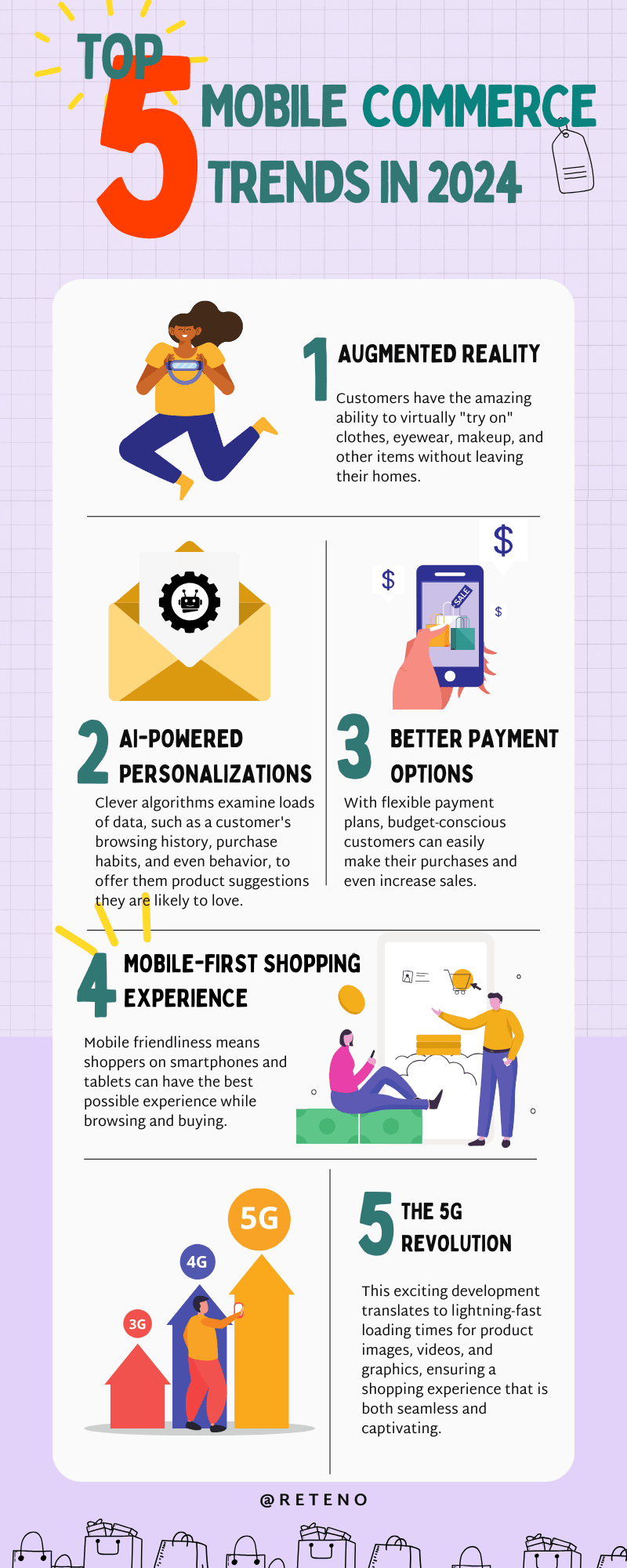
In our rapidly changing digital age, mobile devices have transformed from mere tools into full-fledged virtual shopping malls. This opens up incredible possibilities for businesses to engage with their customers in fresh and exciting ways.
Whether you’re a seasoned pro in the realm of e-commerce or just starting on your entrepreneurial journey, it’s essential to stay up-to-date on the latest mobile commerce trends. To help you navigate this dynamic landscape, here are the top five trends you should know about:
1. Augmented Reality
Augmented Reality (AR) is gearing up to become the next big thing in the world of mobile commerce. In fact, experts predict a whopping $198 billion in revenue by the year 2025. One aspect of AR, virtual try-ons, has proven to be especially effective in reducing returns and boosting customer happiness. It’s become an essential feature you can’t afford to miss out on!
Now, customers have the amazing ability to virtually “try on” clothes, eyewear, makeup, and other items without leaving their homes. With this awesome experience, customers can easily see how products will look on them, leading to fewer returns. This not only saves businesses from dealing with the hassle of processing returns but also leaves customers happier and more satisfied.
AR is creating a mobile retail revolution by changing the way we shop and bringing the in-store experience right to our homes. Now, with the help of AR, you can bring the excitement of browsing through furniture and home decor right into your own living room. It’s like having your own personal interior design assistant! This breakthrough is especially exciting for the furniture and interior design industries. It’s not just about making things easier; it’s about deepening that special connection you have with the products you’re interested in. It’s a game-changer that makes shopping so much easier and more enjoyable!
2. AI-Powered Personalizations
When it comes to mobile push notifications, AI-driven personalization is like having a super knowledgeable sales assistant at your side 24/7, making sure you have the best shopping experience tailored just for you.
AI-powered recommendation engines are the heart of personalization. These clever algorithms carefully examine loads of data, such as a customer’s browsing history, purchase habits, and even behavior, to offer them product suggestions they are likely to love. It’s like having a smart virtual personal shopper who truly understands your unique style and preferences. As a business owner, using AI in this manner can significantly enhance your sales by increasing the chances of recommending complementary products that customers are more likely to be interested in.
Chatbots and virtual assistants powered by AI are here to provide round-the-clock support, ensuring customers always have someone to turn to when they have questions and making their shopping experience extra convenient. On top of that, mobile push notifications allow businesses to proactively reach out to customers with personalized offers, updates, and reminders, ensuring they stay engaged and informed. Additionally, predictive analytics work their magic by offering insightful details on customer behavior, allowing businesses to stock their inventory smarter and meet customer demands like never before.
3. Better Payment Options
Digital wallets in eCommerce have gained massive popularity, and they will be in trend as well. Digital wallets provide a convenient and secure way for customers to carry out transactions, and integrating paddle billing can simplify payment processing for businesses operating across multiple regions. By supporting a range of digital wallet options, we aim to ensure inclusivity for all users. Further, there are several emerging mobile payment alternatives, like Google Pay, Apple Pay, etc., that users love to use.
The rise of the “Buy Now, Pay Later” (BNPL) trend is changing the game of online shopping! With flexible payment plans, budget-conscious customers can easily make their purchases and even increase sales. If you’re looking to embrace the future, accepting cryptocurrencies as a payment method is a fantastic way to connect with the thriving community of crypto enthusiasts while showcasing your commitment to innovation.
4. Mobile-First Shopping Experience

The mobile-first approach is now a must-have, not just an option. As more and more shoppers turn to their smartphones for online shopping, it’s absolutely essential to make sure your website is mobile-friendly. Customers want a smooth and enjoyable shopping experience right on their devices. By using responsive and adaptive design techniques, your website can automatically adapt its layout, content, and features to fit different screen sizes. This means shoppers on smartphones and tablets can have the best possible experience while browsing and buying.
Progressive Web Apps (PWAs) have become increasingly popular for their fantastic ability to offer app-like experiences without requiring installation. By removing this barrier, PWAs make it easier for users to engage with them, resulting in higher levels of engagement.
Additionally, voice search assistants are also gaining significant popularity. Among other e-commerce trends for small businesses, voice search optimization is a hot new trend right now, thanks to widespread voice-activated assistants like Siri, Alexa, and Google Assistant. Optimizing your apps for voice searches is like giving a fancy red-carpet treatment to potential customers who are using their voice to find products.
5. The 5G Revolution
With the advent of 5G, data transfer speed has taken a leap forward, leaving its predecessor, 4G, far behind. This exciting development translates to lightning-fast loading times for product images, videos, and graphics, ensuring a shopping experience that is both seamless and captivating. Mobile app KPIs such as page load time, conversion rate, and engagement metrics like session duration can greatly benefit from this technological advancement. Gone are the days of waiting for web pages to load. Now, users can enjoy instant access to high-quality visuals.
5G technology is designed to decrease latency, or the time it takes for data to travel between a user’s device and the server. With this reduced latency, users can enjoy real-time interactions, which is particularly beneficial for features like augmented reality (AR) shopping. By leveraging such responsive technology, users can virtually try on clothes, visualize furniture in their homes, and receive instant feedback on their choices.
Businesses should also get ready to embrace the possibilities of high-definition video streaming, interactive 3D product demos, and immersive augmented reality (AR) experiences becoming the new norm. Brace yourself for an enhanced shopping experience that goes beyond limits while also opening up exciting new avenues for businesses to connect with customers in groundbreaking ways.
Why is Mobile Commerce Important for Business Owners?

Mobile commerce (m-commerce) is rapidly becoming a crucial part of business success. The rise of eSIM technology is also accelerating m-commerce growth by enabling users to instantly activate mobile data plans on their devices, making online shopping and payments even more seamless while traveling or switching networks. In this article, we’ll explore why mobile commerce is important for business owners and how it can significantly impact business growth.
Increased Customer Reach and Accessibility
Mobile commerce allows businesses to reach a larger audience by providing customers with the convenience of shopping anytime, anywhere. As more consumers use their mobile devices for shopping, businesses that optimize for mobile can tap into this growing market. M-commerce makes it easy for customers to browse products, read reviews, and make purchases directly from their phones, enhancing the overall shopping experience.
In fact, mobile devices now account for more than half of all web traffic globally, and that trend continues to grow. By ensuring that your website or app is mobile-friendly, you make your business more accessible to potential customers, driving more traffic and increasing conversion rates.
Improved Customer Experience
Customer experience is a critical factor in building brand loyalty and driving sales. Mobile commerce enhances customer satisfaction by offering a seamless and convenient shopping experience. Features like one-click purchasing, mobile payment options, and easy navigation on mobile devices ensure that customers can complete transactions quickly and effortlessly.
Additionally, many businesses incorporate personalized experiences in their mobile commerce platforms, such as personalized product recommendations, push notifications, and tailored promotions. These personalized touches not only improve the customer experience but also encourage repeat purchases and brand loyalty.
Higher Conversion Rates
A significant benefit of mobile commerce is its ability to drive higher conversion rates. Mobile apps and websites are designed to make the purchasing process as simple and user-friendly as possible. Features like simplified checkout processes, mobile wallet integration (such as Apple Pay or Google Pay), and auto-fill forms streamline the transaction process, reducing cart abandonment rates.
Moreover, push notifications and in-app promotions can remind customers about products they’ve viewed or encourage them to complete a purchase, further boosting conversion rates. Businesses that invest in optimizing their mobile platforms are likely to see increased sales and customer retention.
Better Data Collection and Insights
Mobile commerce provides businesses with valuable insights into customer behavior and preferences. Mobile apps and websites allow for the collection of detailed data, including browsing patterns, purchase history, and customer preferences. With this data, businesses can make informed decisions about marketing strategies, product offerings, and customer engagement.
By leveraging data analytics, business owners can:
- Identify trends and preferences that inform product development
- Optimize marketing campaigns based on customer behavior
- Improve inventory management by tracking demand
This data-driven approach helps businesses stay competitive and responsive to changing market dynamics.
Enhanced Brand Engagement and Loyalty
Mobile commerce offers numerous opportunities for businesses to engage with their customers and build lasting relationships. Mobile apps, in particular, offer a direct line of communication between the business and the customer. Features like push notifications, exclusive in-app offers, and loyalty programs can drive ongoing engagement.
Moreover, mobile platforms allow businesses to interact with customers on social media, share updates, and receive feedback in real time. This constant interaction helps foster stronger relationships, build trust, and improve customer loyalty, all of which are essential for long-term business success.
Competitive Advantage
In an increasingly competitive marketplace, businesses that embrace mobile commerce gain a significant edge over those that do not. Mobile commerce is no longer a luxury but a necessity for companies that want to stay relevant and competitive. Customers expect businesses to offer mobile-friendly shopping experiences, and those that fail to do so risk losing out to competitors.
By offering a seamless mobile commerce platform, businesses can stand out from competitors, attract more customers, and increase brand visibility. A well-designed mobile presence can also enhance credibility and trust, positioning your business as modern and customer-focused.
Scalability and Growth Opportunities
Mobile commerce offers businesses the ability to scale their operations quickly and efficiently. With m-commerce, businesses are not limited by physical locations or store hours, allowing them to expand their reach beyond local markets. Whether you’re a small business or a large enterprise, mobile commerce enables you to target customers globally and grow your brand at a faster pace.
Additionally, mobile commerce platforms are easily adaptable to accommodate new features, products, or services. This flexibility allows businesses to evolve with changing customer needs and market conditions, providing a scalable solution for long-term growth.
Cost-Effective Marketing and Advertising
Mobile commerce offers numerous cost-effective marketing opportunities. Businesses can use mobile marketing strategies such as push notifications, in-app ads, and SMS campaigns to reach customers directly on their mobile devices. These methods are not only cost-effective but also highly targeted, ensuring that the right customers receive the right message at the right time.
Mobile apps and websites also integrate seamlessly with social media platforms, allowing businesses to run highly targeted ads on Facebook, Instagram, Twitter, and more. With advanced targeting options based on customer data, businesses can optimize their ad spend and achieve better returns on investment (ROI).
Seamless Payment Options
Mobile commerce simplifies the payment process by offering multiple payment options, including mobile wallets (such as Apple Pay and Google Pay), credit/debit card payments, and other digital payment solutions. The integration of these payment methods ensures a smooth, secure, and fast checkout process for customers.
The ability to offer diverse payment options is crucial in today’s market, where customers value convenience and security. By providing secure and efficient payment methods, businesses can reduce cart abandonment rates and increase overall customer satisfaction.
Adaptability to Future Trends
The rapid evolution of technology means that businesses need to stay adaptable to remain competitive. Mobile commerce platforms are highly flexible and can easily incorporate new technologies such as voice search, augmented reality (AR), and artificial intelligence (AI). By staying at the forefront of technology, businesses can continue to meet customer expectations and offer innovative experiences that drive engagement.
For example, AR technology can allow customers to visualize products in their homes before purchasing, while AI-driven chatbots can provide instant customer service. These cutting-edge features enhance the mobile shopping experience and keep your business aligned with future trends.
Mobile commerce is essential for business owners who want to thrive in today’s digital landscape. From increasing customer reach to improving conversion rates, offering better customer experiences, and staying competitive, m-commerce provides numerous benefits that can drive business growth. By investing in mobile-friendly platforms, businesses can capitalize on the growing trend of mobile shopping, enhance customer engagement, and position themselves for long-term success.
If you haven’t already optimized your business for mobile commerce, now is the time to do so to stay ahead of the competition and meet the evolving needs of your customers.

Why mobile commerce matters more than ever
Mobile commerce matters because customer behavior has changed. Shoppers no longer wait until they are at a desk to research products or complete purchases. They move from discovery to decision throughout the day, often in short bursts while commuting, relaxing, or multitasking.
That means your mobile experience shapes more than just usability. It influences trust, product discovery, cart completion, and repeat purchases. If the journey feels slow or frustrating, customers can leave in seconds and buy somewhere else just as fast.
Businesses that treat mobile as a core commerce channel instead of a reduced desktop version are usually in a stronger position to capture demand when buying intent shows up.
AI personalization is changing the mobile shopping experience
AI is becoming a bigger part of mobile commerce because it helps businesses respond to customer behavior in real time. Instead of showing the same experience to every visitor, brands can tailor product recommendations, search results, promotions, and follow-up messages based on what shoppers actually do.
This matters on mobile because screen space is limited. You do not have room to throw everything at the visitor and hope something sticks. The more relevant the experience feels, the easier it becomes for shoppers to find what they want without endless tapping and scrolling.
Personalized product suggestions, smart search, behavior-based offers, and automated messaging can all help reduce friction. When shoppers feel like the store understands what they are looking for, the buying journey gets smoother.
Mobile wallets and faster checkout are becoming standard
One of the biggest reasons shoppers abandon mobile purchases is friction at checkout. Small screens make forms feel longer. Typing card details feels annoying. Extra steps give buyers more time to second-guess the purchase.
That is why mobile wallets have become such an important trend. Payment options like Apple Pay, Google Pay, and other digital wallets can make checkout much faster by reducing the number of fields shoppers need to complete.
The simpler the checkout flow, the less likely customers are to abandon their carts. Speed matters, but ease matters too. A checkout that feels effortless can lift conversions without changing anything about the product itself.
Social commerce keeps shortening the path to purchase
Social commerce has changed how people move from inspiration to transaction. Instead of discovering a product on social media and later visiting a site to buy it, shoppers can now move much more quickly from content to checkout.
This is especially important on mobile because social platforms are already built around mobile behavior. People scroll, tap, save, share, and buy from the same device in the same moment. That makes social commerce a natural extension of mobile commerce, not a separate trend.
For businesses, this means product pages, visuals, creator partnerships, and short-form content all play a bigger role in sales. The customer journey is getting shorter, and brands that understand this can reduce the gap between attention and action.
Mobile-first design is now a conversion issue, not just a design choice
A mobile-friendly site is no longer enough. Customers expect a mobile-first experience that feels easy from the first tap to the final purchase.
That includes readable text, clear product images, simple navigation, fast-loading pages, visible calls to action, and checkout flows that do not feel like a paperwork exercise. It also means product filters, menus, and search tools need to work just as well on a small screen as they do on desktop.
A lot of businesses still lose sales because their mobile sites technically function but feel annoying to use. Small frustrations stack up quickly. A cluttered layout, slow-loading image, or awkward button placement can quietly push people out of the funnel.
Progressive web apps are helping brands blend web and app advantages
Progressive web apps give businesses a way to create faster, smoother, more app-like experiences without asking users to download a separate app from an app store.
That can be a strong advantage for brands that want better performance, stronger engagement, and easier repeat visits without the cost and friction of a traditional app-only strategy. Features like faster load times, home screen access, and improved usability can help businesses create a more seamless mobile experience.
For shoppers, the experience feels lighter and more convenient. For businesses, it can improve engagement while keeping the path to purchase simple.
Voice search and conversational commerce are influencing discovery
More shoppers are using voice assistants and conversational search behavior when looking for products. That changes how businesses should think about mobile discovery.
Voice search queries are often longer and more natural than typed searches. Instead of typing two or three keywords, people ask fuller questions. That means product content, category pages, and FAQs need to reflect how real people speak when they are searching on mobile.
Conversational commerce also extends beyond voice. Messaging, chat support, and guided shopping tools are helping customers ask quick questions before buying. That can be especially useful on mobile, where shoppers often want fast answers without digging through multiple pages.
Augmented reality can reduce hesitation before purchase
Augmented reality is becoming more useful in mobile commerce because it helps customers picture products in real life before they buy. That can be especially valuable in categories where shoppers want more confidence about fit, size, color, or placement.
Furniture brands can help people visualize products in a room. Beauty brands can support virtual try-ons. Fashion and eyewear brands can give shoppers a better sense of how something may look before it arrives.
This kind of experience does more than create novelty. It can reduce uncertainty. And when buyers feel more certain, they are more likely to complete a purchase and less likely to regret it afterward.
What business owners should prioritize first
Not every business needs to chase every mobile commerce trend at once. The smartest move is to focus on the changes most likely to improve the customer journey and revenue in your situation.
For many businesses, that starts with faster mobile performance, simpler checkout, stronger product pages, and better payment options. After that, personalization, social commerce, and conversational features often become easier to layer in.
Trends matter, but execution matters more. A well-optimized mobile shopping experience with a clean checkout flow will usually do more for sales than adding flashy features to a weak foundation.
How to measure mobile commerce performance
Mobile commerce performance should be measured with more than just traffic. A lot of mobile visits do not mean much if people are bouncing, abandoning carts, or struggling to complete purchases.
Look at mobile conversion rate, cart abandonment rate, page speed, average order value, repeat purchase rate, and revenue by device. These metrics help you see whether your mobile experience is actually supporting business growth or simply attracting attention without results.
It also helps to review key pages on real phones. Analytics can tell you where problems exist, but direct experience often shows why they happen.
| Mobile Commerce Trend | Why It Matters | Business Benefit |
|---|---|---|
| AI personalization | Shows more relevant products and offers based on behavior | Improves engagement and can lift conversions |
| Digital wallets | Speeds up checkout and reduces form fatigue | Can lower cart abandonment |
| Social commerce | Shortens the path from discovery to purchase | Helps turn attention into sales faster |
| Mobile-first design | Makes shopping easier on smaller screens | Improves usability and customer trust |
| Progressive web apps | Creates app-like performance without requiring a download | Can increase engagement and repeat visits |
| Voice and conversational commerce | Matches how people increasingly search and ask questions | Supports product discovery and faster decisions |
| Augmented reality | Helps shoppers visualize products before buying | Can reduce hesitation and returns |
Wrapping Up
As you get ready for the exciting world of mobile commerce, keep in mind that your ability to adapt to these trends will make you stand out from the crowd. There are some awesome things you can do to make your mark. For example, you can create a shopping experience designed with mobile users in mind or use cool AR technology to let customers try things on virtually.
You can also consider incorporating AI to personalize the shopping journey, provide convenient payment options, and show your commitment to sustainability. These trends are like your trusty compass as you navigate the digital shopping landscape. By embracing them, you’re not just keeping up with the times; you’re also shaping the future of mobile commerce and making your customers super happy along the way.
FAQ
Why is mobile commerce important for businesses?
Mobile commerce is important because customers increasingly browse and buy from their phones. Businesses that make shopping easier on mobile can improve customer experience, reduce friction, and capture more sales during everyday moments of buying intent.
What are the top mobile commerce trends right now?
Some of the biggest mobile commerce trends include AI personalization, mobile wallets, social commerce, mobile-first design, progressive web apps, voice search, and augmented reality shopping experiences.
How do digital wallets help increase mobile sales?
Digital wallets help increase mobile sales by making checkout faster and easier. When shoppers can pay without entering long card details or billing forms on a small screen, they are less likely to abandon their carts.
What is social commerce?
Social commerce is the process of selling products directly through social media platforms or through shopping experiences closely connected to those platforms. It reduces the gap between product discovery and purchase.
Why does mobile-first design matter for ecommerce?
Mobile-first design matters because poor mobile usability can quickly lead to exits and abandoned carts. Shoppers expect product pages, navigation, and checkout to work smoothly on smaller screens without confusion or delay.
What is a progressive web app in ecommerce?
A progressive web app is a web experience that feels more like a mobile app. It can offer faster performance, smoother navigation, and app-like usability without requiring the customer to install a traditional app.
How can businesses measure mobile commerce performance?
Businesses can measure mobile commerce performance by tracking mobile conversion rate, cart abandonment rate, revenue by device, page speed, average order value, and repeat purchase behavior. These metrics show whether the mobile experience is helping customers move from browsing to buying.
What are mobile commerce trends?
Mobile commerce trends refer to the evolving patterns and behaviors in the use of mobile devices, such as smartphones and tablets, for conducting online transactions, shopping, and making purchases.
Why are mobile commerce trends important for businesses?
Mobile commerce trends are important for businesses because they reflect changing consumer preferences and behaviors, present opportunities for revenue growth and customer engagement, and require businesses to adapt their strategies to meet the demands of an increasingly mobile-centric market.
What are some key statistics or metrics that highlight current mobile commerce trends?
Key statistics or metrics that highlight current mobile commerce trends include the growth of mobile shopping app downloads, the percentage of online purchases made via mobile devices, the adoption rates of mobile payment methods, and the impact of mobile optimization on conversion rates and revenue.
How are advancements in technology shaping mobile commerce trends?
Advancements in technology such as augmented reality (AR), artificial intelligence (AI), and progressive web apps (PWAs) are shaping mobile commerce trends by enhancing the mobile shopping experience, personalizing recommendations, simplifying checkout processes, and facilitating seamless integration with social media platforms.
What role does social commerce play in current mobile commerce trends?
Social commerce plays a significant role in current mobile commerce trends by enabling businesses to sell products directly through social media platforms, leveraging user-generated content and influencer marketing, and providing interactive shopping experiences that drive engagement and conversions.
How are mobile wallets and contactless payment methods influencing mobile commerce trends?
Mobile wallets and contactless payment methods are influencing mobile commerce trends by providing convenient and secure payment options for consumers, accelerating the adoption of mobile payments, and fueling the growth of in-app purchases and mobile-first shopping experiences.
What impact does the rise of mobile-first design and optimization have on mobile commerce trends?
The rise of mobile-first design and optimization has a significant impact on mobile commerce trends by prioritizing user experience on mobile devices, improving page load times, reducing bounce rates, and increasing conversion rates for mobile shoppers.
How are subscription-based services and recurring billing models contributing to mobile commerce trends?
Subscription-based services and recurring billing models are contributing to mobile commerce trends by offering convenience and value to consumers, fostering customer loyalty and retention, and providing businesses with predictable revenue streams and opportunities for upselling and cross-selling.
What are some emerging trends or innovations in mobile commerce that businesses should be aware of?
Emerging trends or innovations in mobile commerce that businesses should be aware of include the integration of voice commerce and virtual assistants, the growth of mobile gamification and loyalty programs, the adoption of 5G technology for faster mobile connectivity, and the expansion of mobile commerce into new industries such as healthcare and automotive.
How can businesses leverage mobile commerce trends to stay competitive and drive growth?
Businesses can leverage mobile commerce trends to stay competitive and drive growth by investing in mobile-friendly website design and optimization, developing mobile apps with enhanced features and functionality, embracing omnichannel strategies that seamlessly integrate mobile and offline channels, and continuously monitoring and adapting to evolving consumer preferences and behaviors in the mobile marketplace.
How are augmented reality (AR) and virtual reality (VR) influencing mobile commerce trends?
AR and VR are influencing mobile commerce trends by enabling immersive shopping experiences, allowing consumers to visualize products in real-world settings before making purchase decisions, and enhancing engagement and conversion rates for mobile shopping apps.
What impact does user-generated content (UGC) have on mobile commerce trends?
User-generated content (UGC) has a significant impact on mobile commerce trends by providing authentic social proof and product recommendations, fostering community engagement and trust, and driving user-generated sales through peer-to-peer sharing and influencer marketing.
How is the rise of voice search and smart speakers shaping mobile commerce trends?
The rise of voice search and smart speakers is shaping mobile commerce trends by changing the way consumers search for and discover products, driving demand for voice-activated shopping experiences, and creating opportunities for voice-driven marketing and personalized recommendations.
What role does personalization play in current mobile commerce trends?
Personalization plays a crucial role in current mobile commerce trends by tailoring product recommendations, offers, and content to individual consumer preferences and behavior, increasing engagement, and conversion rates, and fostering long-term customer loyalty and retention.
How are micro-moments influencing mobile commerce trends?
Micro-moments, or brief moments when consumers turn to their mobile devices to fulfill immediate needs, are influencing mobile commerce trends by creating opportunities for businesses to deliver relevant and timely messages, offers, and solutions that meet consumers’ on-the-go demands.
What impact does sustainability and ethical consumption have on mobile commerce trends?
Sustainability and ethical consumption have a growing impact on mobile commerce trends by driving demand for eco-friendly and socially responsible products, influencing purchasing decisions among environmentally conscious consumers, and shaping brand perceptions and loyalty in the mobile marketplace.
How are social shopping features such as live streaming and shoppable posts reshaping mobile commerce trends?
Social shopping features such as live streaming and shoppable posts are reshaping mobile commerce trends by blurring the lines between social media and e-commerce, creating seamless shopping experiences within social platforms, and driving impulse purchases and social sharing among mobile users.
What role do mobile loyalty programs and rewards play in driving mobile commerce trends?
Mobile loyalty programs and rewards play a significant role in driving mobile commerce trends by incentivizing repeat purchases, encouraging customer engagement and referrals, and providing personalized offers and discounts that drive conversion and retention rates for mobile shoppers.
How are emerging technologies like blockchain and cryptocurrency impacting mobile commerce trends?
Emerging technologies like blockchain and cryptocurrency are impacting mobile commerce trends by providing secure and transparent payment solutions, reducing transaction costs and processing times, and opening up new opportunities for cross-border commerce and peer-to-peer transactions on mobile platforms.
What challenges and opportunities do businesses face in adapting to evolving mobile commerce trends?
Businesses face challenges and opportunities in adapting to evolving mobile commerce trends such as balancing privacy concerns with personalized marketing, optimizing mobile site speed and performance, keeping up with changing consumer preferences and technological advancements, and leveraging data analytics to drive insights and decision-making in the mobile marketplace.
Writer bio
Polina Kulish
SEO Outreach Marketer at Reteno. I have a passion for coffee with milk, meaningful communication and applicable ideas. LinkedIn
Master the Art of Video Marketing
AI-Powered Tools to Ideate, Optimize, and Amplify!
- Spark Creativity: Unleash the most effective video ideas, scripts, and engaging hooks with our AI Generators.
- Optimize Instantly: Elevate your YouTube presence by optimizing video Titles, Descriptions, and Tags in seconds.
- Amplify Your Reach: Effortlessly craft social media, email, and ad copy to maximize your video’s impact.