
Brand Guidelines Examples for Better Marketing

A brand style guide should answer questions before they turn into long email threads.
Which logo belongs on a dark background? Can social media captions use humor? Is the company name written with a capital letter? Which shade of green is the correct green? Can an AI writing tool use emojis when creating campaign copy?
Without clear guidelines, every designer, writer, agency, freelancer, and enthusiastic colleague is left to make an educated guess.
Those guesses add up.
The logo starts appearing in five slightly different forms. Marketing emails sound as if they were written by unrelated companies. Social posts swing between formal corporate announcements and jokes that belong in a group chat. AI-generated content makes the problem even more visible because inconsistent instructions can produce inconsistent content at scale.
A strong brand style guide gives people practical rules, examples, assets, and templates for presenting the brand correctly. It covers how the brand looks, how it sounds, and how it behaves across websites, advertisements, emails, presentations, videos, social media, products, and AI-assisted marketing.
Below are 12 public brand style guide examples worth studying. We will look at what each guide does well, what your business can borrow from it, and how to turn those lessons into guidelines your team will actually use.
For many companies, written messaging, the building blocks for internal and external brand perception, is not tightly controlled in the way that visual assets are.
You’d be hard pressed to find a designer who doesn’t know where to find the correct hex codes and SVG files for their brand. So why do companies post on social media or send out emails without knowing and using consistent vocabulary to describe their offerings?
This is what a brand style guide is for. As a content marketer, communications professional, or someone else who works closely with your company’s brand, creating and using a style guide for your messaging is paramount.
A brand style guide provides the language, unique tone of voice, and various other rules associated with your brand. It is a reference for you as a writer to stay consistent, and a tool to help you ensure your entire organization speaks with a unified voice.
But creating one can seem daunting.
Below, we’ve compiled great examples of public brand style guides for you to draw on for inspiration.
StoryLab.ai also created a resource to help you create your own Brand Style Guidelines.
Chapters
- Awesome Brand Style Guide Examples you should copy
- What Is a Brand Style Guide?
- Brand Style Guide vs. Brand Guidelines vs. Design System
- What Should a Brand Style Guide Include?
- Foleon’s Interactive Brand Style Guide
- Shopify’s Brand Style Guide Example
- APA’s Brand Style Guide Example
- Don’t Use Me Brand Style Guide Example
- GitHub Brand Toolkit
- Mailchimp Content Style Guide
- Starbucks Creative Expression
- IBM Design Language
- Dropbox Brand Guidelines
- Shopify Polaris
- Netflix Brand Site
- 8. Spotify Design and Branding Guidelines
- Slack Media Kit and Brand Guidelines
- Rotary Brand Center
- Visa Product Design System
- How to Create a Brand Style Guide
- How to Use a Brand Style Guide With AI Marketing Tools
- Brand Voice Examples for Different Situations
- Make Your Brand Style Guide Accessible
- Digital Brand Style Guide or PDF?
- Common Brand Style Guide Mistakes
- Conclusion
- FAQ
- Author bio

Awesome Brand Style Guide Examples you should copy
While the following guides are perfect for gathering ideas and gaining an understanding of what a style guide should contain, keep in mind that each is specific to the brand they support, and you must find your own unique style.
Don’t forget to check out the social media accounts for these brands and observe how the guidelines found in these style guides are applied to brand messaging across different platforms.
What Is a Brand Style Guide?
A brand style guide is a central reference that explains how an organization should present itself visually and verbally.
It commonly contains rules for:
- Logo use
- Brand colors
- Typography
- Photography
- Illustrations
- Icons
- Voice and tone
- Grammar and terminology
- Social media
- Presentations
- Video and motion
- Accessibility
- Partnerships and co-branding
- AI-generated marketing content
The guide may be a document, presentation, shared workspace, online portal, or complete design system.
The format matters less than usability. People should be able to find the correct rule, asset, or example without hunting through a 90-page PDF named “Final_Brand_Guide_V7_REALLY_FINAL.pdf.”
Brand Style Guide vs. Brand Guidelines vs. Design System
These terms are often used interchangeably, but they can describe different levels of guidance.
A small business may combine everything into one straightforward guide. A larger organization may have separate brand, writing, social media, product design, accessibility, and partner guidelines.
What Should a Brand Style Guide Include?
The contents should reflect how your organization communicates.
A local service business may not need motion-design standards. A video platform probably does. A global company may need detailed translation rules, while a small startup may initially need a logo folder, color codes, writing principles, and social media examples.
Foleon’s Interactive Brand Style Guide
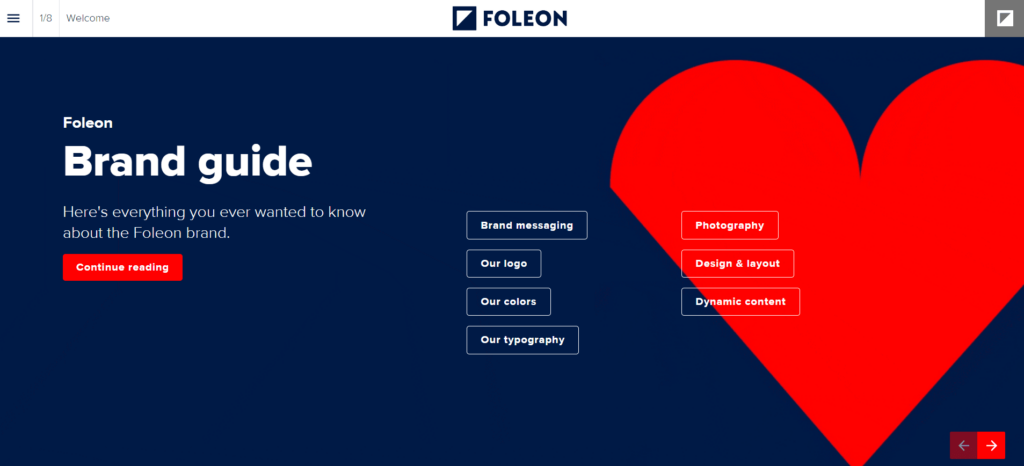
We’d be remiss to not include our own style guide in this list! In addition to addressing questions of grammar and vocabulary, we include a couple of other elements in our style guide worth pointing out like our core messaging, our brand story, and our company values.
StoryLab.ai note:
Notice that Foleon has created their Brand Style Guidelines in a Foleon Doc instead of a PDF. This means that whenever they make a change in their guidelines, everyone knows about it and everyone uses the same guidelines at any given moment. If their style guide would have been created in a PDF, they would need to email the new version each and every time they made a change and hope everyone would use the latest version. If you Google a style guide of a big brand, you’ll probably find different versions. That’s not great for any brand. Opt-in for creating an interactive style guide.
MailChimp’s Web-Based Brand Style Guide
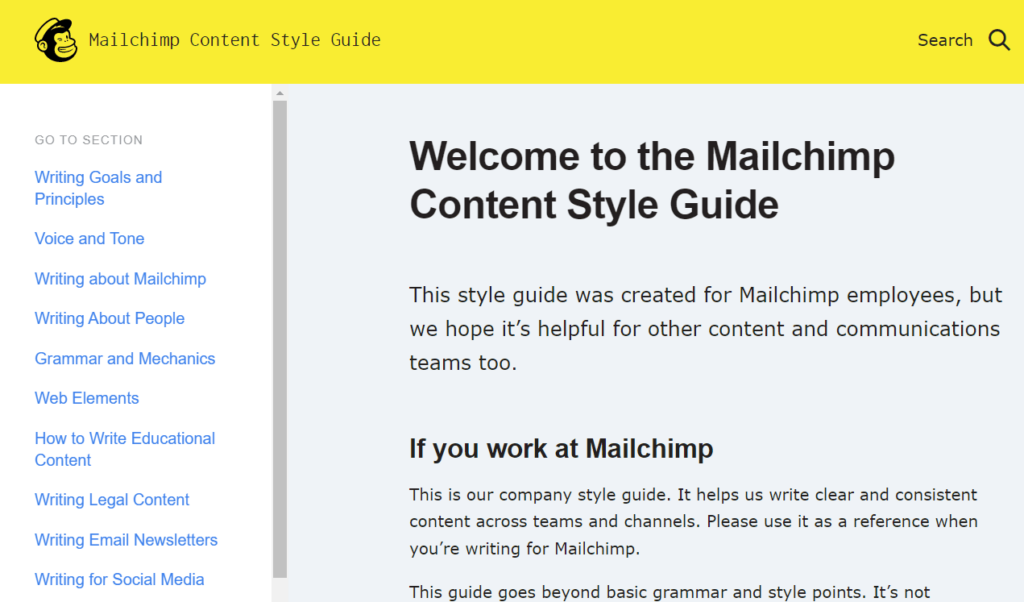
MailChimp’s style guide is one of the best references on this list, as you’d expect from a company whose business is communication.
This style guide is very thorough, including sections on how to write for many different media. They cover social media, email, technical and legal writing, translation, and more. Plus, the sidebar index makes it easy to find any relevant topic.
StoryLab.ai note:
Notice that they are using a web-based format for their brand style guide. This also means that every change they make in their guidelines will be seen by everyone. No old versions hanging around on the internet or people’s desktop.
Shopify’s Brand Style Guide Example
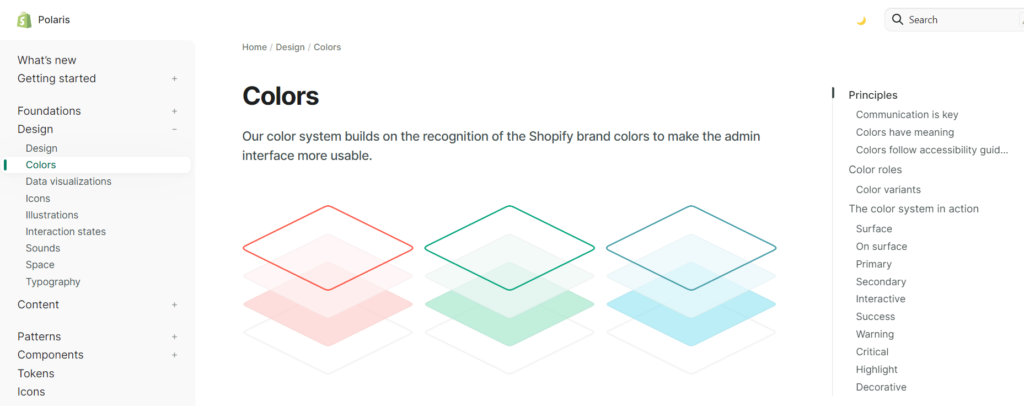
Shopify is another great guide worth looking through, alongside MailChimp. They have the same great user experience, with their index sidebar. However, whereas MailChimp emphasizes verbal branding, Shopify emphasizes visual.
Shopify’s visual guidelines are as thorough as MailChimp’s verbal guidelines. They cover topics such as typography, illustrations, sounds, data visualizations, and more.
APA’s Brand Style Guide Example
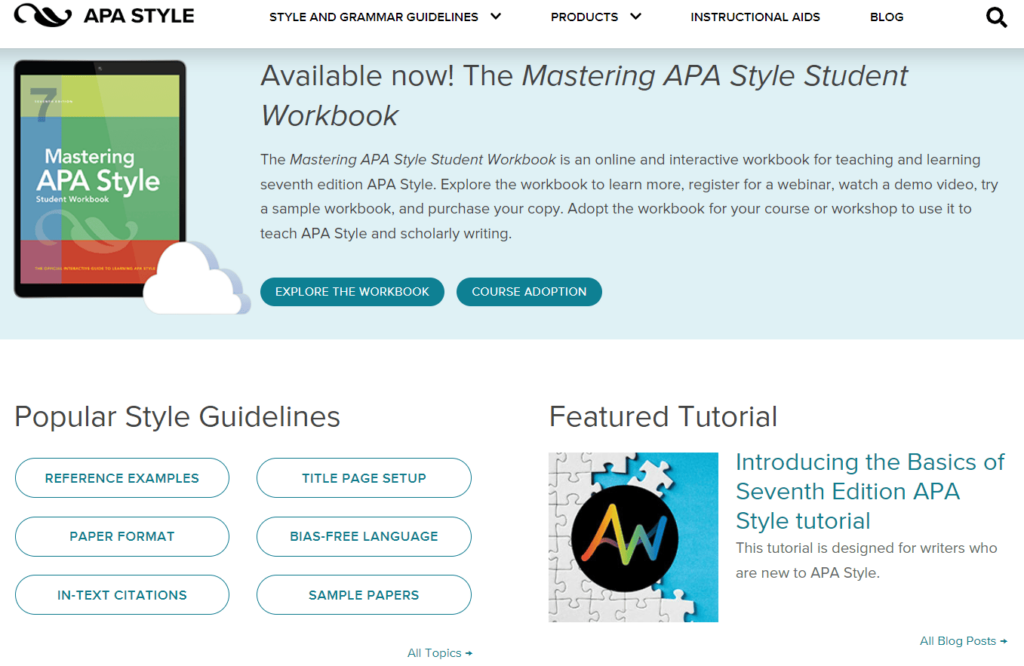
The APA style guide is one of the golden standards for English language style guides, alongside MLA, Chicago, Turabian, and others. These style guides are probably familiar to you from school, where you likely had to reference them when citing your sources in a paper or essay.
These differ slightly from brand style guides. Because they aren’t specific to any company or brand, they don’t take into account values or a mission statement. That does make these academic style guides slightly less relevant to the instructions above. However, they have a far broader scope than any brand style guide when it comes to grammar and usage. That makes them a valuable reference for any grammatical questions you’re not able to answer with the brand style guides posted here.
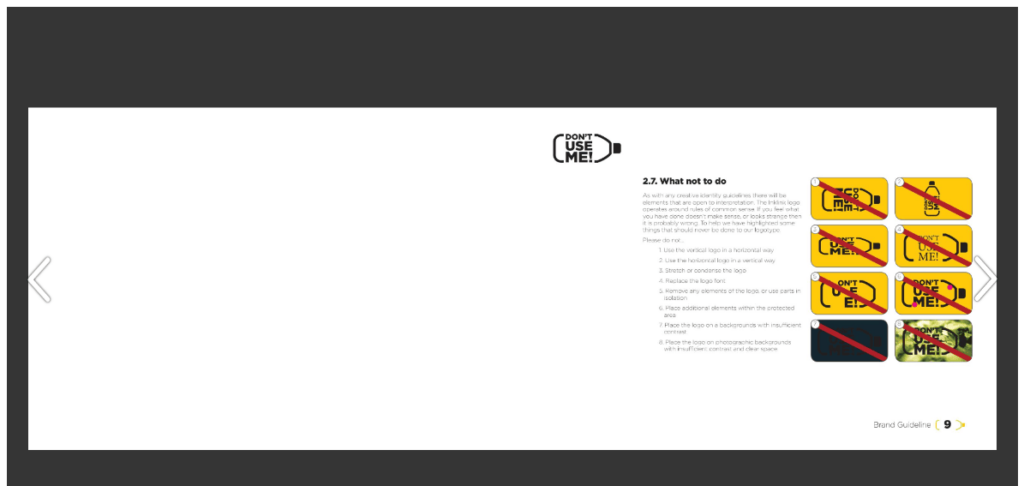
Don’t Use Me Brand Style Guide Example
No one said building your style guide shouldn’t be fun. The final example on our list, Don’t Use Me, highlights all the ways not to use brand assets. The style guide is gorgeously designed, but unfortunately, the browsable PDF type is not responsive.
GitHub Brand Toolkit
GitHub’s Brand Toolkit is one of the strongest examples of a digital-first brand resource.
It goes far beyond basic logo and color rules. The toolkit includes brand attributes, voice and tone, accessibility, typography, illustrations, diagrams, mascots, social media, presentations, web design, motion, events, and product interfaces.
A particularly useful feature is the “brand in action” section. It shows how the identity should appear in real marketing materials rather than leaving users to interpret abstract rules.
What to learn from GitHub
- Organize guidelines around tasks people perform.
- Show completed examples for social posts, presentations, events, and websites.
- Connect brand strategy with practical execution.
- Include motion and product interfaces when digital experiences are central to the brand.
- Make important assets easy to download.
Mailchimp Content Style Guide
Mailchimp provides one of the clearest examples of a verbal brand guide.
It covers writing goals, voice and tone, grammar, mechanics, terminology, social media, newsletters, educational content, legal content, accessibility, translation, structured content, trademarks, and preferred words.
The guide also explains how tone should change based on the reader’s emotional state. A cheerful campaign-completion message should not sound the same as an error message sent to someone who is already frustrated.
What to learn from Mailchimp
- Define voice as a consistent personality.
- Define tone as a response to the reader’s situation.
- Include examples for different channels and content types.
- Create a searchable list of approved terminology.
- Cover accessibility and translation, not only marketing copy.
Starbucks Creative Expression
Starbucks presents its visual identity as a connected expression rather than a folder of isolated design assets.
The public guide introduces the theory behind the brand before explaining logos, colors, typography, illustration, photography, and voice.
The photography and illustration sections help users understand the intended feeling of the brand. This is more helpful than simply sharing image dimensions and file formats.
What to learn from Starbucks
- Explain the thinking behind visual decisions.
- Show how colors, photography, typography, and illustration work together.
- Provide enough freedom for campaigns to feel fresh.
- Include voice alongside visual identity.
- Use the style guide itself as an example of the brand experience.
IBM Design Language
IBM shows how brand guidelines can develop into a complete design language.
Its resources cover philosophy, typography, color, layout, grids, logos, icons, illustrations, photography, animation, diagrams, infographics, and data visualization.
This breadth is particularly valuable for large organizations. A company that publishes research, software interfaces, presentations, event materials, videos, and technical diagrams needs more than a logo page.
What to learn from IBM
- Add guidelines for charts and data visualization.
- Connect every design decision with wider brand principles.
- Provide downloadable templates and starter resources.
- Document layouts and grids, not only individual assets.
- Maintain a visible record of updates.
Dropbox Brand Guidelines
Dropbox combines clear rules with creative freedom.
Its guidelines cover strategy, voice and tone, logo, typography, iconography, colors, imagery, and motion. The guide feels expressive while remaining practical.
This balance matters. Overly rigid rules can make every campaign look identical. Guidelines should protect recognition without turning the design team into a photocopier.
What to learn from Dropbox
- Provide a foundation rather than prescribing every decision.
- Let the design of the guide demonstrate the brand personality.
- Include motion when animation is part of digital communication.
- Treat voice and visuals as parts of the same identity.
- Give creators room to experiment within defined boundaries.
Shopify Polaris
Shopify Polaris sits closer to a design system than a traditional brand book.
It helps designers, developers, and content professionals create consistent product experiences. The system includes design foundations, interface components, patterns, content guidance, and accessibility considerations.
This is useful for companies whose product is one of their most important brand touchpoints.
What to learn from Shopify
- Extend brand rules into product experiences.
- Document buttons, forms, navigation, notifications, and interface language.
- Include developers and content designers in brand governance.
- Define patterns for recurring customer interactions.
- Treat usability as part of the brand.
Netflix Brand Site
Netflix’s public brand site focuses heavily on asset control and partner use.
Users can access logo guidance, while other materials may require approved access. This is a useful reminder that not every part of a brand guide needs to be public.
Companies can provide simple public instructions for media, partners, and press while keeping internal campaign templates and strategic information restricted.
What to learn from Netflix
- Separate public assets from restricted internal materials.
- Explain which logo version partners should use.
- Include co-branding guidance.
- Show incorrect logo applications.
- Connect asset access with clear legal terms.
8. Spotify Design and Branding Guidelines
Spotify’s guidelines are designed for developers and partners that integrate Spotify content into other products.
They explain attribution, artwork use, metadata, playback experiences, logos, colors, naming restrictions, and fonts.
The guide is highly situational. It does not merely say, “Do not distort the logo.” It explains how Spotify content should appear inside real interfaces.
What to learn from Spotify
- Create guidelines for partners and integrations.
- Include exact instructions for displaying third-party content.
- Explain when the full logo or icon should be used.
- Cover metadata and naming, not only visual assets.
- Show clear yes-and-no examples.
Slack Media Kit and Brand Guidelines
Slack’s public resources bring together logos, product screenshots, trademark requirements, and brand usage rules.
The guide is particularly helpful for external users who need to mention Slack in articles, integrations, events, or partnership materials.
What to learn from Slack
- Make frequently requested assets easy to find.
- Combine visual rules with trademark guidance.
- Explain when approval is required.
- Provide product screenshots for media and partners.
- Use straightforward examples of permitted and prohibited use.
Rotary Brand Center
Rotary is a useful example for associations, nonprofits, franchises, and other organizations with many local groups.
Its Brand Center gives clubs and districts approved logos, templates, campaign resources, colors, and practical usage guidance.
Local groups can create materials relevant to their communities while remaining visibly connected to the wider organization.
What to learn from Rotary
- Create editable templates for local teams.
- Define how local names connect with the main brand.
- Provide ready-to-use campaign materials.
- Show common mistakes through visual examples.
- Make assets usable by people who are not professional designers.
Visa Product Design System
Visa’s Product Design System demonstrates how brand consistency, usability, and accessibility can work together.
It includes content standards, inclusive design, typography, colors, components, interaction patterns, design tokens, data visualization, and accessibility requirements.
This example is particularly useful for businesses building websites, applications, dashboards, and other digital products.
What to learn from Visa
Add accessibility requirements directly to design guidance.
Include voice and content rules inside the product system.
Provide reusable components and patterns.
Define how the system works across devices and frameworks.
Treat inclusive design as a core requirement rather than an appendix.
Official guide:
https://design.visa.com/
12. Foleon Interactive Brand Guide
Foleon’s example demonstrates the advantages of publishing brand guidelines online.
A digital guide can be updated centrally, searched, shared, and viewed on different devices. This reduces the risk of employees and agencies continuing to use an outdated PDF saved several years ago.
What to learn from Foleon
Use a web-based guide when guidelines change regularly.
Include brand story, company values, and core messaging.
Give everyone access to the same current version.
Link directly to approved assets and templates.
Make navigation simple enough for quick questions.
Official guide:
https://brand.foleon.com/
How to Create a Brand Style Guide
How to Create a Brand Style Guide
Looking at inspiring examples is helpful. Copying another company’s identity is not.
Your guide should reflect your audience, strategy, team, channels, and operating reality.
Define the brand foundation
Start with the questions behind the visuals:
- Why does the organization exist?
- Who does it serve?
- Which problem does it solve?
- What should people associate with it?
- How is it different from alternatives?
- Which values guide its decisions?
- Which personality traits should communication express?
Keep this section practical. A long paragraph about “transforming tomorrow through innovation” will not help a social media manager decide how to write Tuesday’s post.
Audit existing materials
Collect examples from:
- The website
- Social media
- Email campaigns
- Advertisements
- Presentations
- Sales materials
- Videos
- Printed materials
- Product interfaces
- Customer-support messages
Identify elements that already feel consistent and areas where the brand appears fragmented.
Document the visual identity
Define the approved logo variations, colors, fonts, photography, illustrations, icons, layouts, and templates.
Show each rule in action.
Do not merely write, “Do not distort the logo.” Show what distortion looks like. Visual examples remove doubt much faster than another paragraph.
Define the brand voice
Choose three to five traits that describe the brand’s communication.
For example:
- Clear, not simplistic
- Warm, not overly familiar
- Confident, not arrogant
- Helpful, not pushy
- Playful, not childish
Explain the boundary for every trait. “Friendly” can mean almost anything until you show people where friendly becomes unprofessional.
Add channel-specific examples
A brand may sound consistent without sounding identical everywhere.
Show how the voice changes across:
- Website pages
- Blog articles
- Advertisements
- Video scripts
- Customer support
- Error messages
- Press releases
- Internal communication
A short Instagram caption and a response to a customer complaint should share a personality, not the same mood.
Include accessibility standards
Document accessible color combinations, minimum text sizes, caption requirements, alternative-text principles, link wording, heading structure, and inclusive language.
Do not approve a color pairing merely because it looks attractive on the designer’s screen.
Create templates and downloadable assets
Provide templates for materials people create regularly, such as:
- Social media posts
- Presentations
- Reports
- Email headers
- Advertisements
- Blog graphics
- Video thumbnails
- Proposals
- Documents
- Event materials
The easier the correct option is to use, the less often someone will invent a creative alternative at 4:55 p.m.
Test the guide with real users
Ask an employee, freelancer, agency partner, or new team member to complete several common tasks using the guide.
Watch where they become confused.
The test may reveal that a rule is missing, an asset is difficult to find, or the navigation makes sense only to the person who created it.
Assign ownership
Name the person or team responsible for:
- Approving changes
- Answering questions
- Managing assets
- Reviewing exceptions
- Updating examples
- Communicating new versions
A style guide without an owner slowly becomes a museum.
How to Use a Brand Style Guide With AI Marketing Tools
AI tools can produce dozens of titles, captions, advertisements, emails, and video scripts in minutes.
That speed is helpful only when the output still sounds like your brand.
A short instruction such as “make it professional” is usually not enough. The AI needs practical context, boundaries, examples, and a clear task.
Add an AI content section to your brand guide
Document:
- Approved brand description
- Target audiences
- Voice traits
- Tone variations
- Preferred vocabulary
- Terms to avoid
- Sentence and paragraph preferences
- Reading level
- Formatting rules
- Channel differences
- Claims that require sources
- Prohibited claims
- Confidential information that must not be entered
- Human review requirements
- Examples of approved content
- Examples of content that misses the voice
- Brand voice prompt template
Use this prompt as a starting point when working with StoryLab.ai or another AI marketing platform:
Brand background
We are [company name]. We help [audience] achieve [result] by [product, service, or approach].
Audience
Write for [audience description]. They care about [needs, goals, concerns, and level of knowledge].
Brand voice
Our voice is:
[Trait 1], but not [unwanted extreme] [Trait 2], but not [unwanted extreme] [Trait 3], but not [unwanted extreme]
Writing preferences
Use clear, direct language.
Prefer short sentences.
Use active voice.
Explain technical terms in plain language.
Avoid unnecessary superlatives.
Do not use [words, phrases, claims, or stylistic habits].
Use [preferred terminology].
Channel
Create content for [channel]. Adapt the length, opening, formatting, and call to action for that channel.
Task
Create [content type] about [topic].
The purpose is to [marketing goal].
The reader should understand [main message] and take this action: [desired action].
Source material
Use only the following approved information:
[Insert facts, product details, research, campaign brief, or source material.]
Do not invent statistics, customer results, features, quotes, or guarantees.
Examples
Here is an example that matches our voice:
[Insert approved example.]
Here is an example that does not match our voice:
[Insert off-brand example and explain why.]
Review AI content before publishing
Check:
Is every factual claim correct?
Does it sound like the brand?
Is the content genuinely useful?
Has the tool invented a feature, quote, or statistic?
Does the tone fit the reader’s situation?
Are confidential details removed?
Does the final content add original insight?
Has a qualified person reviewed sensitive claims?
A detailed brand prompt can improve the first draft. It does not turn the first draft into the final draft.
Brand Voice Examples for Different Situations
A brand voice remains stable, but its tone should respond to context.
These examples should be adapted to the company’s actual personality. The purpose is to show writers how the same voice responds differently to different moments.
Make Your Brand Style Guide Accessible
Accessibility should shape the brand system from the beginning.
Color contrast
List approved combinations for text, backgrounds, buttons, charts, and interface components.
Do not rely on color alone to communicate meaning. An error state can use red, but it should also include text or an icon that explains the problem.
Typography
Choose fonts that remain readable at practical sizes.
Document:
Minimum body-text size
Line height
Paragraph width
Heading hierarchy
Letter spacing
Fallback fonts
Rules for text placed over images
Images and video
Provide guidance for:
Alternative text
Captions
Transcripts
Text embedded in images
Flashing content
Thumbnail readability
Descriptive link text
Plain language
Clear language helps everyone, including readers with cognitive disabilities, people reading in a second language, and customers trying to understand a message quickly.
Brand personality should never make the meaning harder to find.
Digital Brand Style Guide or PDF?
Both formats can work, but they solve different problems.
For most growing organizations, an online source of truth with downloadable quick-reference materials offers the best balance.
Common Brand Style Guide Mistakes
Focusing only on the logo
A logo guide is useful, but it will not tell a copywriter how the brand should sound or help a social media manager respond to criticism.
Include verbal and behavioral guidance alongside visual rules.
Using vague voice descriptions
Words such as “professional,” “human,” and “bold” are open to interpretation.
Pair each trait with:
A definition
A boundary
On-brand examples
Off-brand examples
Channel-specific applications
Creating a beautiful guide nobody can navigate
The guide should work as a reference.
Use clear headings, search, a table of contents, direct asset links, and short practical explanations.
Providing rules without examples
People learn faster when they can see the expected outcome.
Show finished social posts, emails, presentations, advertisements, videos, product screens, and partner materials.
Ignoring AI-generated content
Teams may already be using AI writing and image tools, even when no formal process exists.
Add guidance before inconsistent outputs spread across your marketing.
Making every rule absolute
Some situations require flexibility.
Explain which rules protect essential brand recognition and which elements can adapt to campaigns, audiences, or local markets.
Forgetting external partners
Agencies, freelancers, sponsors, distributors, developers, and event partners may use the brand more frequently than some employees.
Provide a version designed around their common tasks.
Failing to update the guide
Add a version number, last-reviewed date, owner, and update log.
Archive old assets and notify regular users when an important rule changes.
Conclusion
Brand Style guides influence the internal and external perception of your company and products more than you may realize. That’s why tightening control over how people write about your company is so important. Whether it is crypto brand design or a full identity system for a funded startup, having a specialized agency in your corner makes that consistency far easier to achieve. Remember, even if you know exactly what vocabulary to use, your colleagues might not.
Luckily, the example brand style guides above should give you plenty of inspiration to get started with creating your own.
FAQ
What is a brand style guide?
A brand style guide is a document that outlines the visual and written elements of a brand, including its logo usage, color palette, typography, imagery guidelines, voice and tone, and other brand assets. It serves as a reference tool to ensure consistency and cohesion in all brand communications.
Why is a brand style guide important?
A brand style guide is important because it helps maintain consistency and coherence in how a brand presents itself to its audience across different channels and touchpoints. It ensures that all brand communications reflect the brand’s values, personality, and visual identity accurately.
What elements are typically included in a brand style guide?
Elements typically included in a brand style guide include the brand’s logo usage guidelines, color palette with specific color codes, typography guidelines specifying font choices and usage, imagery guidelines dictating the types of visuals that align with the brand, and voice and tone guidelines for written communication.
How does a brand style guide help maintain brand consistency?
A brand style guide helps maintain brand consistency by providing clear and specific guidelines on how to use brand assets and communicate brand messages effectively. It ensures that all stakeholders understand and adhere to the brand’s visual and verbal identity standards, regardless of their role or location.
How can a brand style guide benefit a company’s marketing efforts?
A brand style guide can benefit a company’s marketing efforts by streamlining the creation of marketing materials, ensuring that all materials align with the brand’s identity and messaging, and enhancing brand recognition and memorability among the target audience through consistent and cohesive branding.
Who should have access to a brand style guide within an organization?
A brand style guide should be accessible to all stakeholders within an organization who are involved in creating or managing brand communications, including marketing teams, design teams, content creators, sales teams, and external partners or agencies working on behalf of the brand.
How often should a brand style guide be updated?
A brand style guide should be updated whenever there are significant changes to the brand’s identity, such as a rebranding initiative or the introduction of new brand assets or guidelines. It’s also important to review and update the style guide regularly to ensure that it remains relevant and reflects any evolving brand standards.
What are some common mistakes to avoid when creating a brand style guide?
Common mistakes to avoid when creating a brand style guide include being too rigid or prescriptive, neglecting to provide rationale or context for guidelines, overlooking mobile and digital applications, and failing to involve key stakeholders in the development process.
How can a brand style guide help maintain brand integrity in external communications?
A brand style guide helps maintain brand integrity in external communications by providing clear instructions on how to represent the brand consistently and authentically across all channels and touchpoints. It ensures that external partners, vendors, and agencies understand and adhere to the brand’s visual and verbal identity standards.
What are some examples of well-known brand style guides?
Some examples of well-known brand style guides include those of companies like Apple, Nike, Starbucks, and Google. These style guides typically include comprehensive guidelines for logo usage, color palettes, typography, imagery, and brand voice, reflecting each brand’s unique identity and values.
What are the benefits of having a comprehensive brand style guide?
A comprehensive brand style guide offers numerous benefits, including ensuring consistent brand representation across all platforms, strengthening brand recognition, facilitating brand communication, streamlining design and marketing processes, and empowering teams with clear guidelines for creating cohesive brand experiences.
How does a brand style guide help new employees or external partners understand a brand’s identity?
A brand style guide serves as a valuable resource for new employees or external partners by providing them with clear guidelines on how to accurately represent the brand’s identity, including its visual elements, messaging, and tone. This helps ensure alignment and consistency in all brand communications.
Can a brand style guide evolve over time?
Yes, a brand style guide can evolve over time to adapt to changes in the market, audience preferences, or the brand’s strategic direction. Regular reviews and updates ensure that the style guide remains relevant and effective in guiding brand communication efforts.
How can a brand style guide help maintain consistency in global branding efforts?
A brand style guide provides a standardized set of guidelines that can be applied consistently across different regions and cultures, ensuring that the brand’s identity remains cohesive and recognizable regardless of geographic location. This helps maintain brand consistency in global branding efforts.
What role does accessibility play in a brand style guide?
Accessibility considerations, such as color contrast ratios, font legibility, and alternative text for images, should be included in a brand style guide to ensure that all audiences, including those with disabilities, can access and engage with the brand’s content in a meaningful way.
How can a brand style guide be used to enforce trademark and copyright guidelines?
A brand style guide can include specific guidelines for the proper use of trademarks, logos, and copyrighted materials, helping to protect the brand’s intellectual property rights and maintain legal compliance. This ensures that external parties adhere to usage restrictions and licensing requirements.
What steps should be taken to ensure that a brand style guide is easily accessible to all relevant stakeholders?
To ensure accessibility, a brand style guide should be stored in a central location that is easily accessible to all relevant stakeholders, such as a shared drive or online collaboration platform. Regular communication and training can also help ensure that all team members are aware of and have access to the style guide.
How can a brand style guide help maintain consistency across different marketing channels?
A brand style guide provides guidelines for consistent use of brand assets, messaging, and design elements across different marketing channels, such as social media, print, web, and email. This ensures that the brand’s identity remains cohesive and recognizable across all touchpoints.
What are some common challenges in implementing a brand style guide?
Common challenges in implementing a brand style guide include resistance to change from stakeholders, difficulty in ensuring compliance with guidelines, inconsistency in application across different teams or regions, and the need for ongoing education and training to reinforce the importance of brand consistency.
How can a brand style guide contribute to building brand trust and loyalty?
A brand style guide contributes to building brand trust and loyalty by fostering consistency and reliability in brand communication, which in turn helps build familiarity and trust with audiences over time. Consistent branding reinforces the brand’s values and promises, ultimately leading to stronger connections and loyalty from customers.
Top AI Marketing Generators
Author bio
 Ritesh is a digital marketing manager with years of experience in driving growth. He’s currently the director of inbound marketing at Foleon. You can find more about him on his LinkedIn profile.
Master the Art of Video Marketing
AI-Powered Tools to Ideate, Optimize, and Amplify!
- Spark Creativity: Unleash the most effective video ideas, scripts, and engaging hooks with our AI Generators.
- Optimize Instantly: Elevate your YouTube presence by optimizing video Titles, Descriptions, and Tags in seconds.
- Amplify Your Reach: Effortlessly craft social media, email, and ad copy to maximize your video’s impact.