
Examples of Great Accounting Blog Post Titles That Will Inspire You

Great accounting blog titles do more than fill an editorial calendar.
They help potential clients understand what you can help them with, why your advice matters, and whether your firm is the right fit. A title like “Tax Tips for Small Businesses” is fine, but it is also easy to ignore. A title like “7 Tax Deductions Small Business Owners Often Miss” is clearer, more specific, and much easier to click.
Accounting firms, CPAs, bookkeepers, and financial advisors can use blog titles to answer real client questions, explain complex topics in plain language, and build trust before someone books a call.
Below, you’ll find accounting blog post title examples you can use for inspiration, plus tips for using AI to create stronger content ideas faster.
In this article
- Examples of Great Accounting Blog Post Titles
- Why Accounting Firms should run a Blog
- Top Digital Marketing Tools for Accounting Firms
- How Accounting Blogs Can Stand Our With Great Blog Titles
- How AI Helps Accounting Firms Create Better Blog Titles
- Accounting Blog Title Formulas That Work Well
- Blog Title Ideas by Accounting Service
- AI Prompts for Creating Accounting Blog Titles
- FAQ
Are you an accountant or running an accounting website or blog? You probably want to create some great content to build your (personal) brand, get more traffic and clients.
Focusing on your blog post titles helps to stand out in search engines and on social media.
Check out some examples of great accounting blog post titles below.
We’ve used our Blog Title Generator to create a nice list of Blog Title Examples for Accounting Websites. Check them out below and start creating your own with our free generator.
In the image below, you can see how easy it is to use our tool. Enjoy!
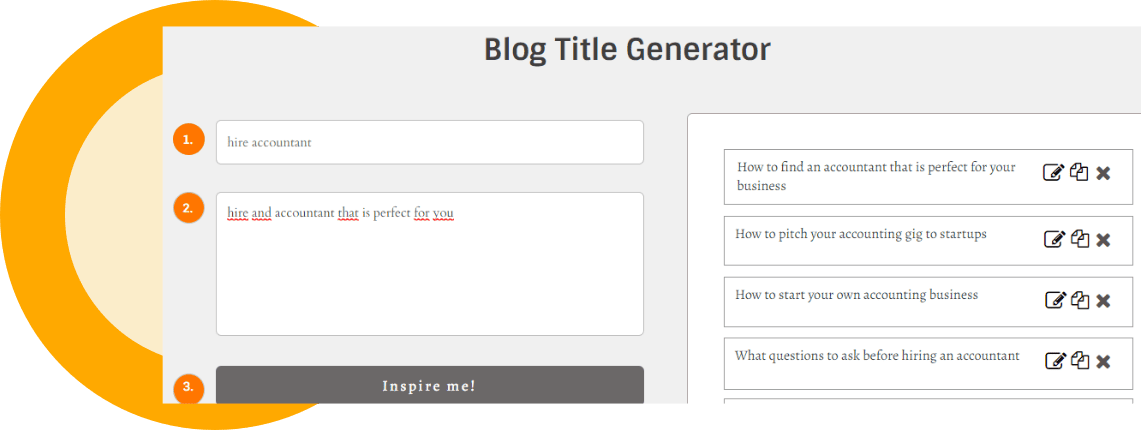
Examples of Great Accounting Blog Post Titles
- 7 pitfalls of offshore accounting
- How to pitch your accounting gig to startups
- 13 Tips to understand the tax code for businesses
- How to start your own accounting business
- Difference between cash basis accounting and accrual based accounting
- Difference between financial accounting and management accounting
- 21 accounting terms your need to know
- How to find clients for your accounting business
- What you need to know about dividend accounting
- History of accounting in the USA
- How to find an accountant that is perfect for your business
- What questions to ask before hiring an accountant
- Find out what kind of accountant is perfect for your startup
- A personal checklist for tax day
- A business checklist for tax day
- Life of an accountant. Behind the scenes
- 11 tips for getting your personal finances in order
- How an accountant can help avoid bankruptcy
- Tax exemption for nonprofits
- How to find the perfect accountant for your nonprofit
- How an accountant can help with crypto and taxes
- Ultimate guide to a successful financial audit
- Top accounting software for startups
- Top accounting tools for everyday people
- 11 tips to create cash flow as an individual
- How an accountant can help with economic changes
- How compounded interest works for you
- The Top 10 Mistakes Accountants Make (And How to Avoid Them)
- The 5 Most Common Tax Myths Debunked
- The Ultimate Guide to Tax Planning for Small Business Owners
- 7 Tips for Better Budgeting in Your Business
- The Benefits of Hiring an Accountant for Your Small Business
- The Pros and Cons of Filing Your Taxes Early
- How to Save Money on Your Taxes: 10 Simple Tips
- Accounting for Small Businesses: A Beginner’s Guide
- How to Choose the Right Accounting Software for Your Business
- Understanding the Basics of Bookkeeping
- The Importance of Accurate Financial Statements for Your Business
- How to Effectively Manage Your Business Finances
- The Impact of the New Tax Law on Small Businesses
- The Top 5 Tax Deductions for Small Business Owners
- The Ultimate Guide to Business Taxes
- How to Avoid Common Accounting Mistakes
- Tax Planning Strategies for High Net Worth Individuals
- The Benefits of Outsourcing Your Accounting Services
- The Ultimate Guide to Choosing an Accountant
- The Pros and Cons of Using Cloud-Based Accounting Software
- The Top 5 Accounting Software Programs for Small Businesses
- How to Prepare Your Business for Tax Season
- The Top 10 Tax Tips for Self-Employed Individuals
- How to Save Money on Your Business Taxes
- The Importance of Keeping Good Financial Records
- The Top 5 Tips for Managing Your Business Cash Flow
- The Benefits of Hiring a Virtual Bookkeeper
- How to Choose the Right Accounting Services for Your Business
- The Top 5 Tax Deductions for Sole Proprietors
- How to Create a Successful Budget for Your Business
- The Pros and Cons of DIY Bookkeeping
- The Ultimate Guide to Hiring an Accountant for Your Business
- How to Avoid Accounting Fraud in Your Business
- The Top 5 Accounting Challenges for Small Businesses
- The Benefits of Hiring an Accountant for Your Personal Taxes
- The Top 5 Accounting Tips for Nonprofits
- How to Keep Your Business Finances Organized
- The Pros and Cons of Using a Tax Preparer
- The Top 10 Tax Tips for Small Business Owners
- How to Handle Accounting Disputes
- The Benefits of Using an Online Accounting Service
- The Top 5 Accounting Tips for Freelancers
- The Ultimate Guide to Filing Your Business Taxes
- The Pros and Cons of Using an In-House Bookkeeper
- The Top 5 Tax Deductions for Home-Based Businesses
- How to Avoid Tax Penalties for Late Filing
- The Importance of Professional Liability Insurance for Accountants
- The Top 5 Accounting Tips for Startups
- The Benefits of Using an Accountant for Your Estate Planning
- The Ultimate Guide to Business Valuation
- The Pros and Cons of Using QuickBooks for Your Business
- The Top 5 Accounting Tips for Restaurants
- How to Manage Your Business Finances During a Crisis
- The Benefits of Using an Accountant for Your Investment Portfolio
- The Ultimate Guide to Tax Deductions for Small Business Owners
- The Pros and Cons of Using a CPA for Your Business
- The Top 5 Accounting Tips for E-Commerce Businesses
- How to Avoid Common Payroll Mistakes
- The Benefits of Outsourcing Your Payroll Services
- The Ultimate Guide to Accounting for Non-Account
Generate your own Accounting Blog Title Examples with our A.I. Generator for free.
Why Accounting Firms should run a Blog
Running a blog can bring numerous benefits to accounting firms. Here are some reasons why accounting firms should consider having a blog:
- Establishing thought leadership: Blogging can help accounting firms showcase their expertise and knowledge in the field. By sharing valuable insights, tips, and industry trends, they can establish themselves as thought leaders in the accounting industry.
- Boosting online presence: Blogging can help accounting firms improve their online visibility and attract more website traffic. This can lead to increased brand recognition and potential clients.
- Improving SEO: Search engines love fresh, relevant content. Blogging can help accounting firms improve their search engine rankings and attract more organic traffic to their website.
- Engaging with clients and prospects: Blogging provides an opportunity for accounting firms to engage with their clients and prospects. By creating a two-way conversation, they can build relationships and establish trust with their audience.
- Showcasing company culture: Blogging can give accounting firms a platform to showcase their company culture, values, and mission. This can help attract like-minded clients and potential employees.
In summary, running a blog can be a valuable tool for accounting firms to establish thought leadership, boost online presence, improve SEO, engage with clients and prospects, and showcase their company culture.
Top Digital Marketing Tools for Accounting Firms
As an accounting firm, blogging is probably not your first priority. Let’s have a look at some Digital Marketing Tools that can help you achieve great results with less effort.
1. StoryLab.ai
As mentioned at the start of this article, StoryLab.ai can help you create great Blog Post Titles for your Accounting Blog in seconds, but it can do more than that.
StoryLab.ai is an online platform that generates content ideas for you. Create more and better content faster than ever before with our AI-Powered Content Creation Platform.
Any time you’re stuck on what to write next, hop on to our platform and let our AI Marketing Copy Generators help you get unstuck.
No matter if you’re writing an article, social media caption, ad copy, YouTube description, our AI Buddy has your back whenever you need him.
2. Optimize your Accounting Blog Titles for SEO with Semrush
In addition to crafting an attention-grabbing blog post title, it is essential to incorporate the appropriate keywords and optimize it for search engine optimization (SEO). Ideally, you should place your primary keyword at the beginning of your H1 and Meta Title. In this particular article, we have included our main keyword, “Accounting Blog Post Title Examples,” at the start.
Avoid guessing the most suitable keywords to use. Instead, utilize tools such as SEMRush to determine the exact terms people are searching for. Enter your topic, access a wealth of data, and choose the best keyword based on volume and difficulty. Give it a try at no cost and get the data you need.
Semrush asks for a credit card when creating an account to be sure people don’t just create a new account every time the free trial has ended. You can cancel your subscription at any time within the free trial period and you won’t get charged. By creating an account via our link, you’ll get 14 days for free instead of the regular 7 days trial. Enjoy!
Check out the video tutorial and find out how to find hidden gems with Semrush’s keyword research tools.
Use our link and get a 14-day free Semrush trial instead of the normal 7-day trial.
How Accounting Blogs Can Stand Our With Great Blog Titles

Writing compelling blog titles is crucial for accounting blogs aiming to capture the attention of readers in a competitive niche. Here’s how to create standout titles that can draw more visitors:
- Include Key Terms: Use relevant accounting terms that potential readers might search for. Incorporate keywords naturally to improve SEO and align with the readers’ interests, such as “tax deductions,” “financial reporting,” or “audit compliance.”
- Highlight the Unique Value Proposition: Clearly convey what makes your content special. If your article offers exclusive insights or advice from industry experts, make sure the title reflects this value.
- Use Numbers and Lists: Titles with numbers often perform well because they imply a quick, easy-to-read format. For instance, “7 Common Tax Mistakes Small Businesses Make” clearly sets expectations.
- Ask Questions: Pose questions in your titles to engage curiosity and target reader pain points, such as “Are You Overlooking These Small Business Tax Exemptions?”
- Keep It Concise: Aim for brevity to ensure the title is impactful and memorable. A concise title is also more likely to display fully in search engine results and social media feeds.
- Use Action Words: Incorporate verbs that inspire action or suggest immediate benefit, like “Boost Your Financial Health with These 5 Steps.”
- Promise Practical Tips: Accountants and financial professionals love actionable advice. Titles that promise practical tips or how-to guides, like “How to Streamline Your Accounting Process Efficiently,” are very attractive.
- Create Urgency or Scarcity: Imply that the information might change or won’t be as relevant if the reader delays. For example, “Last Chance to Maximize Your IRA Contributions Before Year-End!”
- Leverage Current Events: Link content to recent news or updates in tax law, financial regulations, or economic shifts. Titles that connect with current events, like “New Tax Legislation: What It Means for Your Business,” can generate more clicks.
- Test and Refine: Use A/B testing to try different titles for the same blog post to see which one resonates more with your audience. Tools like Google Analytics can help track which titles perform best.
- Use Powerful Adjectives: Descriptive words can make titles more enticing. Words like “essential,” “critical,” or “ultimate” add weight and intrigue, as in “The Ultimate Guide to Navigating Business Audits.”
How AI Helps Accounting Firms Create Better Blog Titles
AI can help accounting firms move from generic topics to client-focused content ideas faster.
Instead of starting with a broad idea like “cash flow,” you can use AI to turn it into more specific angles, such as:
How to Improve Cash Flow Before Tax Season
Cash Flow Mistakes That Hurt Small Business Growth
What Your Cash Flow Statement Is Really Telling You
How Better Bookkeeping Can Help Prevent Cash Flow Problems
This is useful because most clients are not searching for accounting jargon. They are searching for help with a problem. AI can help you reframe technical expertise into titles that sound useful, timely, and easy to understand.
For best results, include details about your audience when using an AI title generator. A title for startup founders should sound different from a title for local restaurants, dentists, freelancers, nonprofits, or real estate investors.
Accounting Blog Title Formulas That Work Well
Strong accounting blog titles are usually clear, specific, and outcome-focused.
Here are simple formulas you can reuse:
How to [Solve a Financial Problem] Without [Common Fear]
Examples:
How to Prepare for Tax Season Without Last-Minute Stress
How to Improve Cash Flow Without Cutting Essential Costs
How to Understand Your Profit and Loss Statement Without Confusion
[number] [Accounting Mistakes] That [Audience] Should Avoid
Examples:
7 Bookkeeping Mistakes Small Businesses Should Avoid
5 Payroll Mistakes That Can Cost Employers More Than They Think
9 Tax Planning Mistakes Freelancers Often Make
What [Audience] Should Know About [Accounting Topic]
Examples:
What Small Business Owners Should Know About Quarterly Taxes
What Nonprofits Should Know About Restricted Funds
What Startups Should Know About Hiring Their First Accountant
[Topic] Checklist for [Audience]
Examples:
Year-End Tax Checklist for Small Business Owners
Monthly Bookkeeping Checklist for Busy Founders
Payroll Compliance Checklist for Growing Teams
Blog Title Ideas by Accounting Service
Tax Planning
Tax Planning Tips for Small Business Owners
How to Prepare for Tax Season Before It Gets Stressful
Common Tax Deductions Business Owners Forget to Track
What to Ask Your Accountant Before Filing Taxes
How Quarterly Tax Payments Work for Freelancers and Small Businesses
Bookkeeping
Bookkeeping Basics Every Business Owner Should Understand
How Clean Books Help You Make Better Business Decisions
Bookkeeping Mistakes That Make Tax Season Harder
Monthly Bookkeeping Tasks You Should Not Ignore
When Should You Outsource Your Bookkeeping?
Payroll
Payroll Mistakes That Can Create Big Problems for Small Businesses
How to Set Up Payroll When Hiring Your First Employee
What Employers Should Know About Payroll Taxes
Payroll Checklist for Small Business Owners
How Better Payroll Systems Save Time and Reduce Errors
Advisory Services
How an Accountant Can Help You Grow More Profitably
What Financial Reports Should Business Owners Review Every Month?
How to Use Accounting Data to Make Better Decisions
Signs Your Business Has Outgrown Basic Bookkeeping
How Advisory Accounting Helps You Plan Ahead
AI Prompts for Creating Accounting Blog Titles
Use these prompts to create better accounting blog titles with AI:
Create 20 blog post titles for an accounting firm that helps small business owners with tax planning, bookkeeping, payroll, and cash flow management. Make the titles clear, helpful, and easy to understand.
Create 15 blog title ideas for a CPA firm targeting dentists. Focus on tax planning, deductions, cash flow, and business growth.
Create 20 blog post titles for a bookkeeping firm that helps freelancers and solopreneurs stay organized and prepare for tax season.
Rewrite these accounting blog titles to make them more specific, benefit-driven, and easier to click: [paste titles].
Create accounting blog post titles for business owners who feel overwhelmed by financial reports and want simple explanations.
FAQ
What makes a good accounting blog title?
A good accounting blog title is clear, specific, and focused on a problem your ideal client wants to solve. Strong titles often mention the audience, the financial topic, and the benefit of reading the article.
How can accountants use AI for blog title ideas?
Accountants can use AI to turn broad topics like tax planning, bookkeeping, payroll, or cash flow into more specific blog titles for different client types. The best results come from adding details about the audience, service, pain point, and desired outcome.
What accounting blog topics attract clients?
Accounting blog topics that attract clients usually answer real business questions about taxes, bookkeeping, cash flow, payroll, financial reporting, and growth decisions. Practical, problem-solving content works better than vague educational posts.
Should accounting firms publish blog content regularly?
Yes. Regular blog content can help accounting firms build trust, improve search visibility, and answer common questions before a prospect books a consultation. Consistency matters most when the content is useful and relevant to the firm’s ideal clients.
How do you make accounting blog titles less boring?
Make accounting blog titles less boring by focusing on real outcomes, client fears, and specific situations. Instead of “Bookkeeping Tips,” use titles like “7 Bookkeeping Mistakes That Make Tax Season Harder.”
Master the Art of Video Marketing
AI-Powered Tools to Ideate, Optimize, and Amplify!
- Spark Creativity: Unleash the most effective video ideas, scripts, and engaging hooks with our AI Generators.
- Optimize Instantly: Elevate your YouTube presence by optimizing video Titles, Descriptions, and Tags in seconds.
- Amplify Your Reach: Effortlessly craft social media, email, and ad copy to maximize your video’s impact.
Looking for more Blog Post Title Examples? Check out.
- Examples of Business Blog Titles
- Gardening Blog Post Title Examples
- B2B Blog Post Title Examples
- Higher Education Blog Title Examples
- Accounting Blog Title Examples
- Crypto Blog Post Title Examples
- Examples of E-Commerce Blog Titles
- Banking Blog Post Title Examples
- Environmental Blog Post Title Examples
- Food Blog Post Title Examples
- Examples of Nonprofit Blog Post Titles
- Real Estate Blog Title Examples
- Examples of Startup Blog Post Titles
- Airline Blog Post Title Examples
- Technology Blog Post Title Examples
- Examples of Travel Blog Titles
- Examples of Fitness Blog Post Titles
- Automotive Blog Title Examples
- Examples of Vegan Blog Titles
Or, check out all other examples like Blog Intros, Google and Facebook ad copies and more.
Write great Marketing Copy in half the time
There is nothing worst than staring at a blank piece of paper. StoryLab.ai’s Marketing Copy Generators help you to get new ideas and even complete copy with a click of a button.
Get inspired by how many different ways there are to describe your blog titles, Instagram captions, ad copy and more. Next to generating new ideas and creating new copy, you can reword existing copy with our paraphrase generator.
Our Marketing Copy Generators run on GPT-5. Trained, as the largest and qualitatively best Natural Language Processing model. Check out our resource hub and see how AI Marketing can help you reach your goals faster. The time to start using this new technology is now.