
Examples of Great Fitness Blog Post Titles That Will Inspire You
Fitness blog titles can make the difference between a post that gets noticed and one that gets skipped. A strong headline helps readers quickly understand what the article is about, why it matters, and whether it is worth clicking. That matters even more in fitness content, where audiences often search for specific goals like weight loss, strength training, meal ideas, recovery, mobility, or workout plans.
The best fitness blog titles do more than sound motivating. They make the topic clear, match what readers are looking for, and set up useful content. AI can help speed up that process by generating more headline angles faster, but the strongest results still come from pairing AI support with clear audience intent and practical value.
We have compiled a list of great fitness blog post titles that you can use for your own blog to attract more visitors and give your blog a boost.
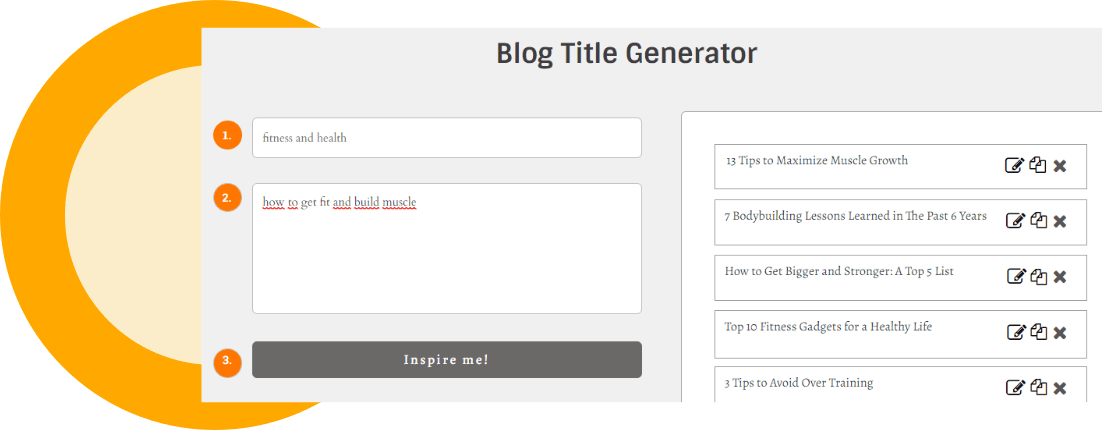
We’ve used our Blog Title Generator to create a nice list of Blog Title Examples for Fitness Websites. In the image below, you can see how easy it is to use our tool. You simply enter a topic, click the ‘inspire me’ button and see the magic happen.
Check out the examples below and start creating your own with our generator. Get 15 free credits each month.
Optimize your Fitness Blog Titles for SEO
In addition to crafting an attention-grabbing blog post title, it is essential to incorporate the appropriate keywords and optimize it for search engine optimization (SEO). Ideally, you should place your primary keyword at the beginning of your H1 and Meta Title. In this particular article, we have included our main keyword, “Fitness Blog Post Title Examples,” at the start.
Avoid guessing the most suitable keywords to use. Instead, utilize tools such as SEMRush to determine the exact terms people are searching for. Enter your topic, access a wealth of data, and choose the best keyword based on volume and difficulty. Give it a try at no cost and get the data you need.
Check out the video tutorial and find out how to find hidden gems with Semrush’s keyword research tools.
Use our link and get a 14-day free Semrush trial instead of the normal 7-day trial.
Examples of Great Fitness Blog Post Titles
- 7 Tips For Getting In Shape While Keeping Your Job
- How to Make Your Fitness Goals Come True in 2024
- 13 Tips to Maximize Muscle Growth
- The Importance Of Rest Days
- 21 Great Motivational Videos to Get You Pumped Up
- 7 Bodybuilding Lessons Learned in The Past 6 Years
- 11 Ways To Make Your Workouts More Effective
- How to Get Bigger and Stronger: A Top 5 List
- The 5 Best Exercises for Stronger Biceps
- Top 10 Fitness Gadgets for a Healthy Life
- 3 Tips to Avoid Over Training
- Top 7 Bodybuilding Tips to Help You Win a Competition
- How to Perform a Perfect Squat
- How to Stay in Shape With a Busy Lifestyle
- 7 Healthy and Easy Meals You can Eat Anytime of the Day!
- 33 Sneaky Ways to Lose Weight
- The 10 Best Home Gym Equipment for Your Fitness Routine
- 5 Reasons Why You Should Be Working Out
- Addicted to the Gym: Is it a Good Thing?
- Healthy recipes – The tastier, the better!
- 10 Must-Follow Fitness Bloggers on Twitter
- The Best 7 Exercises for Athletic Men
- 13 Workout Mistakes That You Should Avoid
- 5 Healthy Snacks for a Quick Energy Boost
- 10 Dumb Mistakes You Are Still Making at the Gym
- 10 Minute At-Home Workout Routines to Try Today
- The Science Behind Building Muscle Mass
- 5 Tips to Improve Your Running Form
- How to Get Motivated to Work Out: Tips from Fitness Experts
- The Top Fitness Trends of the Year
- How to Stay Fit While Traveling
- The Benefits of Strength Training for Women
- The Best Foods to Eat Before and After a Workout
- The Most Effective HIIT Workouts for Burning Calories
- The Top Yoga Poses for Stress Relief
- How to Get the Most Out of Your Cardio Workouts
- The Best Fitness Apps to Keep You on Track
- The Most Effective Ways to Build Endurance
- The Benefits of CrossFit Training
- The Top Fitness Influencers to Follow on Social Media
- How to Incorporate Stretching into Your Fitness Routine
- The Best Fitness Equipment for Home Workouts
- The Most Common Mistakes People Make at the Gym
- How to Set Realistic Fitness Goals and Achieve Them
- The Benefits of Group Fitness Classes
- The Top Fitness Retreats to Attend for a Healthy Getaway
- The Best Ways to Track Your Fitness Progress
- The Most Effective Ways to Improve Your Flexibility
- The Importance of Proper Nutrition for Fitness
- The Top Benefits of Walking for Fitness
- How to Stay Motivated on Your Fitness Journey
- The Best Supplements for Muscle Growth and Recovery
- The Most Effective Core Workouts for a Stronger Body
- The Top Fitness Challenges to Take on for a Healthier Lifestyle
- 10 Effective Home Workouts to Try Today
- The Science of Building Muscle: Tips and Techniques
- The Best Cardio Exercises to Boost Your Endurance
- How to Set Realistic Fitness Goals and Achieve Them
- The Benefits of Strength Training for Women
- The Top Fitness Trends to Watch Out for in 2023
- The Best Pre-Workout Foods for Optimal Performance
- How to Stay Motivated to Exercise: Tips and Tricks
- The Most Common Fitness Myths Debunked
- The Importance of Rest Days for Optimal Performance
- The Best Foods to Eat After a Workout for Muscle Recovery
- The Most Effective Stretching Exercises for Flexibility
- How to Create a Successful Workout Plan
- The Top Fitness Apps to Track Your Progress
- The Benefits of Yoga for Mind and Body
- The Best HIIT Workouts to Burn Fat Fast
- How to Overcome Plateaus in Your Fitness Journey
- The Most Inspiring Fitness Transformations of All Time
- The Best Supplements for Muscle Building and Recovery
- The Top Fitness Challenges to Push Your Limits
- The Importance of Proper Form in Your Workouts
- The Best Foods for Pre- and Post-Workout Nutrition
- The Most Effective Ab Workouts for a Strong Core
- The Best Ways to Stay Hydrated During Exercise
- How to Stay Fit and Healthy While Traveling
- The Benefits of Meditation for Fitness and Wellness
- The Best CrossFit Workouts to Test Your Limits
- The Most Inspiring Fitness Influencers to Follow on Social Media
- The Top Fitness Retreats to Recharge Your Body and Mind
- The Importance of Sleep for Optimal Performance and Recovery
- The Best Ways to Overcome Gym Anxiety
- The Most Effective Resistance Band Workouts for Strength and Tone
- The Top Fitness Myths About Women’s Bodies
- How to Create a Successful Fitness Routine
- The Best Ways to Prevent and Treat Exercise-Related Injuries
- The Benefits of High-Intensity Interval Training (HIIT)
- The Most Inspiring Fitness Stories of All Time
- The Top Fitness Gear and Apparel for Your Workouts
- The Importance of Warm-Up and Cool-Down Exercises
- The Best Foods for a Healthy, Balanced Diet
- The Most Effective Full-Body Workouts for Total Fitness
- The Best Foods to Fuel Your Workouts
- The Benefits of Swimming for Fitness and Wellness
- How to Stay on Track with Your Fitness Goals
- The Top Fitness Challenges for Couples and Friends
- The Most Effective Leg Workouts for Strength and Definition
- The Importance of Mindset for Fitness Success
- The Best Ways to Incorporate Yoga into Your Fitness Routine
- The Top Fitness Blogs and Websites for Inspiration and Advice
- The Benefits of Outdoor Workouts for Mental and Physical Health
- The Most Effective Arm Workouts for Toned, Defined Muscles
- The Best Post-Workout Stretches for Recovery and Flexibility
- The Top Fitness Podcasts to Inspire Your Journey
- The Importance of Tracking Your Progress and Results
Generate your own Fitness Blog Title Examples with our AI Generator for free.
How do you Write a Catchy Fitness Blog Post?

Identify Your Audience
Understand who you are writing for. Are they beginners, advanced fitness enthusiasts, or looking for specific advice like weight loss, muscle gain, or healthy living? Tailor your content to meet their needs and interests.
Choose an Engaging Topic
Pick a topic that resonates with your audience and addresses their pain points. Use keyword research, fitness trends, and audience feedback to identify compelling topics. Examples include “10-Minute Workouts for Busy Professionals” or “How to Build Muscle on a Plant-Based Diet.”
Craft a Compelling Title
Your title should be catchy, clear, and promise value. Incorporate strong action words and keywords. Examples: “Blast Fat Fast: 7 HIIT Workouts You Can Do Anywhere” or “Transform Your Core: The Ultimate Guide to Ab Workouts.”
Start with a Hook
Begin your post with an engaging hook that grabs attention. Use a surprising fact, a relatable story, or a provocative question. For example, “Did you know you can burn more calories in 10 minutes of HIIT than in 30 minutes of steady cardio?”
Provide Valuable Content
Ensure your content is well-researched, accurate, and provides real value. Use scientific evidence, expert quotes, and practical tips. Break down complex concepts into simple, actionable steps.
Use Clear and Structured Formatting
Organize your content with headings, subheadings, bullet points, and numbered lists. This makes your post easy to read and helps readers find key information quickly.
Include Engaging Visuals
Use high-quality images, infographics, and videos to illustrate your points. Visual content can make your post more appealing and help explain exercises or concepts more effectively.
Incorporate Personal Stories and Examples
Share personal anecdotes, success stories, or case studies to make your content relatable and inspiring. Readers often connect more deeply with real-life experiences.
Provide Actionable Takeaways
Give your readers practical advice they can implement immediately. Clear instructions, workout plans, meal ideas, or downloadable resources can add great value to your post.
Optimize for SEO
Use relevant keywords throughout your post, especially in the title, headings, and meta descriptions. Optimize images with alt text, and ensure your post is easy to read and mobile-friendly.
Include a Clear Call to Action (CTA)
Encourage your readers to take the next step, whether it’s subscribing to your newsletter, trying a workout plan, or following you on social media. Make your CTA specific and compelling.
Edit and Proofread
Review your post for clarity, coherence, and correctness. Check for grammar and spelling errors. Tools like Grammarly can be helpful. Reading your post out loud can also catch mistakes and improve flow.
Promote Your Post
Share your blog post on social media, in fitness forums, and through email newsletters. Engage with your audience by responding to comments and encouraging discussions.
Analyze and Improve
Use analytics to track your post’s performance. Monitor metrics like page views, engagement, and shares. Use this data to understand what resonates with your audience and refine your strategy for future posts.
| Formula | Structure | Example | Goal/Modality | Audience/Intent | Notes |
|---|---|---|---|---|---|
| Time-Boxed HIIT | [Minutes]-Minute HIIT: [Body Area/Outcome] | 15-Minute HIIT: Full-Body Burn at Home | HIIT/Conditioning | Quick, sweaty sessions | Include timer and rest intervals |
| Sets × Reps Strength | [Sets]×[Reps] [Lift] Plan for [Level] | 5×5 Barbell Plan for Beginners | Strength | Gym starters | List weekly progression |
| No-Equipment | No-Equipment [Modality]: [Minutes]/Day | No-Equipment Core: 10 Minutes/Day | Bodyweight | Home workouts | Add form cues and regressions |
| Single-Tool Focus | [Tool] Only: [Program Length] for [Outcome] | Dumbbells Only: 8-Week Hypertrophy Plan | Hypertrophy | Minimal gear | Provide weight selection guide |
| Mobility Flow | [Area] Mobility Flow: [Minutes] + [Benefit] | Hip Mobility Flow: 12 Minutes + Deeper Squats | Mobility | Lifters, runners | Show ROM tests before/after |
| Beginner On-Ramp | Beginner [Modality]: Week-by-Week On-Ramp | Beginner Running: Week-by-Week On-Ramp | Endurance | New trainees | Include walk/run ratios |
| Program Split | [Days]-Day Split: [Muscle Groups] Plan | 4-Day Split: Upper/Lower Hypertrophy Plan | Strength/Hypertrophy | Intermediate | Link exercise library |
| Goal + Constraint | [Goal] on [Constraint]: [Outcome] | Build Muscle on 3 Days/Week: Real Gains | Hypertrophy | Busy schedules | Prioritize compound lifts |
| Distance + Pace | [Distance] in [Time]: Training Plan | 5K in 8 Weeks: Training Plan | Running | Race prep | Offer pace charts (mi/km) |
| Recovery Guide | [Modality] Recovery: [Methods] That Work | Strength Recovery: Sleep, Protein, and Deloads | Recovery | All levels | Add sample deload week |
| Form Fix | Fix Your [Exercise]: [Cue/Drill] | Fix Your Deadlift: Hinge Cues That Stick | Technique | Lifters | Embed slow-mo and checkpoints |
| Superset/EMOM | [Protocol]: [N] Rounds for [Area/Outcome] | EMOM: 10 Rounds for Shoulders & Core | Conditioning/Strength | Time-efficient | Clarify work:rest ratio |
| Seasonal Block | [Season] Block: [Focus] for [Sport] | Winter Block: Base Miles for Cyclists | Periodization | Endurance athletes | Map meso/microcycles |
| Home Gym Setup | Home Gym on [Budget]: What to Buy First | Home Gym on $300: What to Buy First | Equipment | Beginners | Rank by impact per dollar |
| Quick Win | [Time] to [Outcome]: No Gym Required | 7 Minutes to Better Posture: No Gym Required | Posture/Mobility | Desk workers | Use before/after wall test |
| Challenge | [Days]-Day Challenge: [Focus] | 21-Day Core Challenge: Planks That Progress | General fitness | Community/consistency | Provide printable tracker |
| Nutrition Pairing | [Goal] Meal Guide: [Constraint] | Muscle Gain Meal Guide: High-Protein on a Budget | Nutrition | Lifters, athletes | Include grocery list and swaps |
| Age/Life Stage | [Age/Stage] Training: [Outcome] | 50+ Strength Training: Keep Muscle, Move Better | Strength/Longevity | Age-specific | Offer joint-friendly options |
| Pain-Safe Modifications | [Exercise] If [Pain/Limit]: Try This | Squats If Your Knees Hurt: Try This | Modifications | Returning trainees | Suggest ROM and tempo tweaks |
| Indoor Cardio | [Machine] Workout: [Minutes] + [Intervals] | Rowing Workout: 20 Minutes, Ladder Intervals | Cardio | Weather backup | Add stroke rate targets |
| Mind-Body | [Modality] for [Outcome]: [Timeframe] | Pilates for Back Health: 4-Week Plan | Pilates/Yoga | Wellness | List contraindications briefly |
| Sport-Specific | [Sport] Strength: [Areas] That Matter | Tennis Strength: Hips, Rotators, and Grip | Strength | Athletes | Connect drills to match play |
| Metric-Driven | Increase [Metric] by [Percent] in [Time] | Increase VO₂max by 6% in 8 Weeks | Endurance/Performance | Trackers/Structured plans | Explain testing protocol |
| Travel-Proof | Hotel Room Workouts: [Minutes] + [Tools] | Hotel Room Workouts: 20 Minutes, Bands Only | Bodyweight/Bands | Frequent travelers | Offer quiet, low-impact moves |
| Women’s Strength | Women’s [Modality]: [Outcome/Phase] | Women’s Strength: Hypertrophy After Newbie Gains | Strength | Women lifters | Address recovery and phases |
| Time-Crunched | [Minutes]-Minute [Modality]: Real Results | <20-Minute Kettlebell: Real Results | Kettlebell | Busy schedules | Use AMRAP or EMOM formats |
| Form Library | [N] Exercises You’re Doing Wrong (And Fixes) | 9 Squat Mistakes (And How to Fix Them) | Technique | All levels | Provide cues, regressions, progressions |
| Home vs Gym | Home vs Gym: Which Works for [Goal] | Home vs Gym: Which Works for Strength on a Budget | Strategy | Decision help | Offer hybrid templates |
| Deload/Plateau | Stuck? Try a [Deload/Protocol]: [Outcome] | Stuck? Try a Deload Week: Come Back Stronger | Recovery | Plateau breakers | Explain fatigue markers |
How AI can help create better fitness blog titles faster
AI is useful at the headline stage because it helps generate multiple directions around the same topic in seconds. Instead of settling for one generic title, you can create variations based on audience type, fitness goal, content format, or search intent.
That makes AI especially useful for fitness coaches, gyms, wellness brands, and content teams that publish often. One topic can become a beginner guide, a list post, a problem-solving article, a transformation story, or a niche advice post. The result is a faster workflow and more title options worth testing.
Fitness blog post title examples by content type
Different fitness articles need different headline styles. A workout guide needs clarity. A nutrition post often needs a practical promise. A motivational article may need a stronger emotional angle. A mistakes post should make the problem obvious right away.
Examples for workout posts:
- How to Start Strength Training at Home
- The Best Beginner Workout Plan for Busy Weeks
- How to Build a Simple Weekly Fitness Routine
- At-Home Workouts That Still Feel Challenging
Examples for nutrition posts:
- High-Protein Meal Ideas for Busy People
- What to Eat Before and After a Workout
- Simple Healthy Eating Tips That Actually Fit Real Life
- How to Meal Prep Without Getting Bored
Examples for problem-solving posts:
- Why Your Workout Routine Stops Working
- Why You Are Training Hard But Not Seeing Results
- The Most Common Fitness Mistakes Beginners Make
- What to Do When Motivation Drops
Examples for recovery and mobility posts:
- How to Recover Faster After Hard Workouts
- Mobility Exercises That Help You Feel Better Daily
- Why Recovery Matters More Than You Think
- Simple Stretching Routines for Tight Muscles
AI-focused fitness blog title examples
AI is becoming part of how fitness brands, coaches, and marketers plan and scale content. That makes AI-focused title examples especially useful for building authority around modern fitness marketing and content creation.
Examples:
- How Fitness Brands Can Use AI to Create Better Content
- Best AI Fitness Blog Title Ideas for Faster Content Planning
- How to Use AI to Generate Fitness Content Ideas
- AI Content Workflows for Fitness Coaches
- How Gyms Can Use AI to Improve Content Marketing
- Smarter Fitness Blogging With AI
- How AI Can Help Personal Trainers Create More Content
- AI Fitness Marketing Ideas for Busy Teams
What makes a fitness blog title more clickable
The best fitness blog titles are usually specific, clear, and focused on a real outcome. Readers want to know what the post will help them do, fix, learn, or understand. Titles that are too broad often feel weak because they do not promise enough value.
A better title usually includes one strong angle. That could be a result, a problem, a timeframe, a specific audience, or a simple promise. Instead of a vague headline like Fitness Tips for Everyone, a more useful option would be Strength Training Tips for Beginners Who Feel Intimidated by the Gym.
How to use AI title generators without creating generic fitness headlines
AI can save a lot of time, but better prompts create better titles. A vague prompt gives you repetitive headline ideas. A more detailed prompt gives you stronger options with more relevance and personality.
Instead of asking for fitness blog titles, ask for fitness blog titles for women over 40 starting strength training, or fitness blog titles for busy parents who want short home workouts. That kind of direction helps the output feel more specific and more useful. The headline becomes easier to match to real audience needs.
Fitness blog title formulas worth testing
Title formulas can make ideation faster without making every article feel the same. They are useful when you want repeatable headline structures that can still be customized for different fitness topics.
Useful formulas include:
- How to [Achieve Fitness Goal] Without [Common Friction]
- [Number] Fitness Mistakes to Avoid
- The Beginner’s Guide to [Fitness Topic]
- How to Build a Better [Workout, Habit, Routine]
- What to Know Before Starting [Fitness Goal or Method]
- [Number] Ways to Improve [Fitness Outcome]
- Why [Fitness Problem] Happens and How to Fix It
- How AI Can Help [Fitness Audience] Create Better Content
Why fitness blog titles should connect to a larger content workflow
A strong blog title should do more than support one article. It should also help shape a wider content workflow. One good fitness topic can become a blog post, email, short video, social post, downloadable guide, or landing page section.
AI makes that easier by helping turn one headline angle into multiple related content ideas. Once the core topic is clear, it becomes much easier to expand it into a full content cluster. That helps fitness brands publish more consistently without starting from zero every time.
Why fitness blog titles now need to work for both search and AI discovery
Fitness content is now discovered in more places than traditional search alone. People may find content through search engines, AI-assisted answers, newsletters, social content, and recommendation feeds. That makes clarity even more important.
The best fitness blog titles are easy to understand at a glance. They tell readers what the post is about, who it is for, and why it matters. That makes them stronger not only for search visibility but also for broader content discovery and engagement.
FAQ: Fitness Blog Post Title Examples
What makes a good fitness blog post title?
A good fitness blog post title is clear, specific, and gives readers a reason to click. It should show the topic quickly and hint at the value of the post.
Can AI help write better fitness blog titles?
Yes. AI can generate multiple title variations quickly, which makes it easier to test different angles, formats, and audience-specific approaches.
Should fitness blog titles be optimized for SEO?
Yes. Strong fitness blog titles help readers understand the topic quickly and can improve how clearly the content matches search intent.
What fitness blog title formats work well?
Popular formats include how-to titles, beginner guides, list posts, mistakes-to-avoid headlines, problem-solving titles, and AI-focused strategy titles.
How can fitness brands use AI for headline creation?
Fitness brands can use AI to brainstorm title variations, adapt headlines for different audiences, and speed up content planning across larger workflows.
What types of fitness blog titles get more clicks?
Titles that are clear, specific, and focused on a real outcome usually perform better than vague or overly broad headlines.
What title length works best for fitness posts?
Aim for 50–65 characters and 6–12 words. That’s scannable and tends to display well in search.
Should I put the workout type in the title?
Yes. Lead with the modality if it’s the star: HIIT, Strength, Pilates, Mobility, Running, Cycling.
Do numbers boost click-through in fitness?
Often. Sets, reps, time blocks, distances, or days make value feel concrete.
Where should the primary keyword go?
Close to the front, as long as the title still reads naturally.
Should I include the target level (Beginner, Intermediate, Advanced)?
If programming is level-specific, call it out. It reduces bounce and improves satisfaction.
Is it smart to mention equipment in the title?
Yes. “No Equipment,” “Dumbbells Only,” “Resistance Bands,” or “Kettlebell” helps intent match.
When should I add the year or season?
Use it for plans that change with trends or events: “Marathon Training Plan 2025,” “Winter Home Workout Plan.”
Do brackets help fitness titles?
Use sparingly: [PDF], [Video], [Playlist], [Timer], [With Form Tips].
Should I use calorie numbers in titles?
Only if you can back them up with method and assumptions inside the post.
Are question titles effective for fitness readers?
Yes, when the post answers quickly and shows a plan or science-backed explanation.
Can I use “fat loss,” “muscle gain,” and similar outcomes safely?
Stay accurate, responsible, and respectful. Don’t overpromise. Focus on habits and sustainable progress.
Is emoji OK in titles?
Fine for social; skip them in title tags. Keep H1 clean or lightly styled.
How do I write for different goals on one site?
Segment titles by goal: Strength, Hypertrophy, Mobility, Endurance, General Health.
Should I localize measurements (kg/lb, km/mi)?
If your audience is mixed, consider adding both or clarify in brackets.
What common mistakes should I avoid?
Vague promises, hidden prerequisites, unrealistic timelines, and titles that don’t match the program or guide.
Looking for more Blog Post Title Examples? Check out.
- Examples of Business Blog Titles
- Gardening Blog Post Title Examples
- B2B Blog Post Title Examples
- Higher Education Blog Title Examples
- Accounting Blog Title Examples
- Crypto Blog Post Title Examples
- Examples of E-Commerce Blog Titles
- Banking Blog Post Title Examples
- Environmental Blog Post Title Examples
- Food Blog Post Title Examples
- Examples of Nonprofit Blog Post Titles
- Real Estate Blog Title Examples
- Examples of Startup Blog Post Titles
- Airline Blog Post Title Examples
- Technology Blog Post Title Examples
- Examples of Travel Blog Titles
- Examples of Fitness Blog Post Titles
- Automotive Blog Title Examples
- Examples of Vegan Blog Titles
Or, check out all other examples like Blog Intros, Google and Facebook ad copies and more.
Write great Marketing Copy in half the time
There is nothing worst than staring at a blank piece of paper. StoryLab.ai’s Marketing Copy Generators help you to get new ideas and even complete copy with a click of a button.
Get inspired by how many different ways there are to describe your blog titles, Instagram captions, ad copy and more. Next to generating new ideas and creating new copy, you can reword existing copy with our paraphrase generator.
Our Marketing Copy Generators run on GPT-5. Trained, as the largest and qualitatively best Natural Language Processing model. Check out our resource hub and see how AI Marketing can help you reach your goals faster. The time to start using this new technology is now.
More Resources For Fitness Content Creators
Blog Titles
AI Art
eBook Ideas
YouTube Titles
Master the Art of Video Marketing
AI-Powered Tools to Ideate, Optimize, and Amplify!
- Spark Creativity: Unleash the most effective video ideas, scripts, and engaging hooks with our AI Generators.
- Optimize Instantly: Elevate your YouTube presence by optimizing video Titles, Descriptions, and Tags in seconds.
- Amplify Your Reach: Effortlessly craft social media, email, and ad copy to maximize your video’s impact.