
Examples of Great Business Blog Post Titles That Will Inspire You

Are you running a business blog and looking for inspiration on what to write next or do you just want a couple of examples of well written Business Blog Titles? We’ve got you covered.
We’ve used our Blog Title Generator to create a list of Blog Title Examples for Business Blogs. In the image below you can see how easy it is to insert a keyword and get new blog title examples in seconds.
Check out the examples below and start creating your own with our free generator.
Business blog titles shape whether your content gets ignored or opened. A strong headline helps readers understand what the article is about, gives them a reason to click, and sets expectations before they read a single paragraph. StoryLab.ai already gives readers a useful starting point with business blog post title inspiration and AI-powered headline generation.
The strongest business blog titles do more than sound good. They match search intent, make the topic clear, and support helpful content. Google recommends creating people-first content, and its guidance on title links also emphasizes clarity and making the main title obvious.
In this article
- Examples of Great Business Blog Post Titles
- Why should Businesses use Digital Marketing Tools
- Top Digital Marketing Tools for Businesses
- How do you write a good business blog post?
- How AI can help create better business blog titles faster
- Business blog post title examples by content type
- AI-focused business blog title examples
- What makes a business blog title more clickable
- How to use AI title generators without creating generic headlines
- Business blog title formulas worth testing
- Why business blog titles now need to work for both search and AI discovery
- FAQ: Business Blog Post Title Examples
- More Resources For Business Content Creators
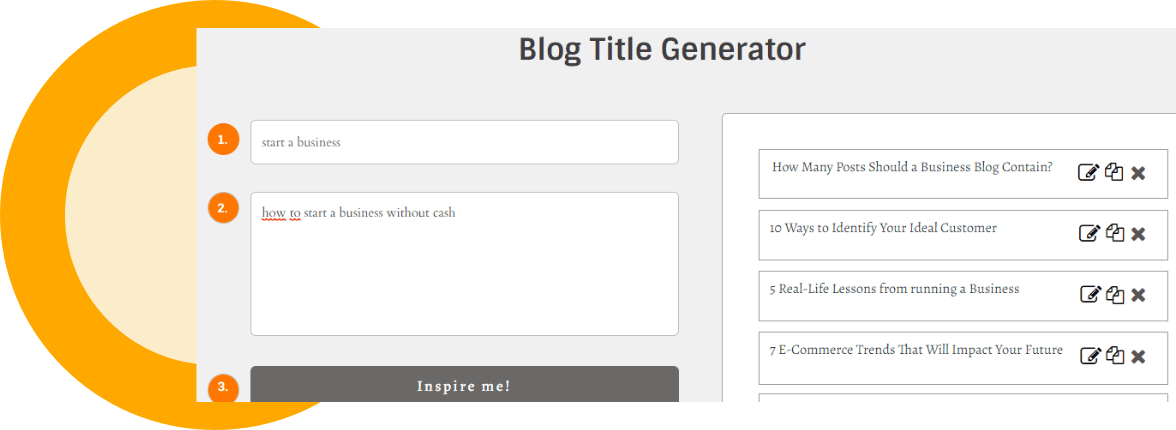
Examples of Great Business Blog Post Titles
- 5 Signs Your Business Idea is Worth Pursuing
- The Absolute Best Way to Run a Small Business
- What You Should Focus on when Improving your Business
- How to Generate 25 New Blog Post Ideas in 10 Minutes
- Top 11 Tech tips for business owners
- How to Start a Business by Selling Your Crafts
- 5 Real-Life Lessons from running a Business
- 5 E-Commerce Trends That Will Impact Your Future
- 7 Proven Methods For Growing Your Business
- 11 Mistakes Most People Make When Starting Their First Business
- 7 Secrets To Business Success
- The Ultimate Guide To Thriving While Running A Business
- How To Grow Your Business Like Elon Musk
- 10 Ways to Manage Your Time while running a business
- How We Got Our First 1000 Paying Customers In 2 months
- Imagine Getting Your First 1000 Paying Customers In 2 months
- How to Become an Entrepreneur
- How to Write a Business Plan in 5 Steps
- We Analysed 110 Businesses And Here’s What We Found
- No, You Don’t Need To Work Long Hours To Grow Your Business
- QUIZ: What Type Of Entrepreneur Are You?
- Can You Spot These Problems With Growing A Business?
- My Digital Product Business Journey—Lessons Learned
- 11 Steps To Successfully Launching A Business
- 5 Ways to Move a Business from Idea to Prototype
- How to Start a Business With No Funding
- How to Market a Small Startup Business
- Product Listing: 25 Ways to Make Your Listings Stand Out
- Best Productivity Tools for Entrepreneurs
- 11 Often Made Business Mistakes to Avoid
- Top 7 Ways You’re Sabotaging Your Small Business
- 5 Tips to Make Your Business Thrive in 2023
- How to Start a Side Hustle for Extra Cash
- 5 Ways to Cultivate and Build a Business Community
- The 5 Worst Mistakes Made by New Entrepreneurs
- 4 Reasons Why You Should Give Your Business a Nickname
- How to Build your First Mobile App In a Week
- 10 Tips for Successful Business Networking
- The Pros and Cons of Starting a Business
- How to Build a Strong Company Culture
- The Top Business Trends to Watch Out for in the Coming Year
- The Power of Storytelling in Business
- The Importance of Personal Branding for Business Professionals
- How to Create an Effective Marketing Strategy
- The Most Common Mistakes Small Business Owners Make
- The Top Skills Every Business Leader Needs to Succeed
- How to Build a Strong Online Presence for Your Business
- The Most Innovative Companies to Watch Out for in 2023
- The Best Ways to Grow Your Business in a Competitive Market
- The Importance of Emotional Intelligence in Business
- How to Overcome Failure and Bounce Back Stronger
- The Most Effective Ways to Manage Remote Teams
- The Top Business Podcasts Every Entrepreneur Should Listen To
- How to Create a Successful Social Media Strategy
- The Most Inspiring Business Books of All Time
- The Best Ways to Develop a Growth Mindset for Business Success
- The Top Business Models for Sustainable Growth
- The Importance of Diversity and Inclusion in the Workplace
- How to Use Data Analytics to Improve Your Business
- The Most Successful Female Entrepreneurs of All Time
- The Top Business Conferences to Attend in 2023
- The Best Ways to Motivate Your Employees
- The Most Common Challenges Faced by Small Business Owners
- How to Create a Successful E-commerce Strategy
- The Most Creative Marketing Campaigns of All Time
- The Importance of Customer Relationship Management for Small Businesses
- The Top Business Tools to Streamline Your Workflow
- How to Build a Successful Sales Funnel
- The Most Successful Shark Tank Pitches of All Time
- The Best Ways to Improve Your Business Writing Skills
- The Top Business Leaders to Follow on Social Media
- The Most Common Marketing Mistakes Small Businesses Make
- How to Use SEO to Boost Your Online Visibility
- The Most Successful Startups of the Past Decade
- The Top Business Podcasts for Women Entrepreneurs
- The Importance of Building Strong Relationships with Your Clients
- The Best Ways to Conduct Market Research for Your Business
- The Top Business Quotes to Inspire Your Success
- The Most Successful Crowdfunding Campaigns of All Time
- How to Build a Strong Brand Identity
- The Best Ways to Conduct A/B Testing for Your Business
- The Top Business Coaches to Help You Achieve Your Goals
- The Most Successful Social Media Influencers of All Time
- The Importance of Networking for Business Success
- How to Use Content Marketing to Grow Your Business
- The Most Innovative Technologies for Small Businesses
- The Top Business Trends for 2023 and Beyond
- The Best Ways to Improve Your Time Management Skills
- The Most Successful Entrepreneurial Couples of All Time
- How to Build a Strong Email Marketing Campaign
- The Top Business Blogs to Follow for Inspiration and Advice
- The Importance of Branding in a Digital Age
- The Best Ways to Improve Your Customer Service Skills
- The Most Successful Business Partnerships of All Time
Generate your own Business Blog Title Examples with our AI Generator for free.
Why should Businesses use Digital Marketing Tools
Businesses should use digital marketing tools because it offers a cost-effective way to reach a larger audience, create brand awareness, increase customer engagement, and drive sales.
Here are some of the benefits of using digital marketing tools for businesses:
- Reach a larger audience: With digital marketing tools, businesses can reach a larger audience through social media, search engines, email marketing, and other online channels. This helps to increase brand awareness and attract new customers.
- Cost-effective: Compared to traditional marketing methods, digital marketing tools are relatively cost-effective. Businesses can use online advertising, email marketing, and social media marketing to reach their target audience without spending a lot of money.
- Better targeting: Digital marketing tools allow businesses to target their advertising and marketing campaigns to specific demographics and customer groups. This helps to increase the effectiveness of their marketing efforts and drive more sales.
- Measurable results: Digital marketing tools provide businesses with real-time data and analytics, which can help them measure the success of their marketing campaigns. This helps businesses to refine their marketing strategies and improve their ROI.
- Increased engagement: Digital marketing tools can help businesses to increase customer engagement through social media, email marketing, and other online channels. This can help to build brand loyalty and increase customer retention.
Overall, digital marketing tools provide businesses with a powerful set of tools to reach a larger audience, increase customer engagement, and drive sales. By leveraging these tools, businesses can stay ahead of the competition and achieve their marketing goals more effectively.
Top Digital Marketing Tools for Businesses
Let’s have a look at some Digital Marketing Tools that can help you grow your business with less effort.
1. StoryLab.ai
As mentioned at the start of this article, StoryLab.ai can help you create great Blog Post Titles for your Business Blog in seconds, but it can do more than that.
StoryLab.ai is an online platform that generates content ideas for you. Create more and better content faster than ever before with our AI-Powered Content Creation Platform.
Any time you’re stuck on what to write next, hop on to our platform and let our AI Marketing Copy Generators help you get unstuck.
No matter if you’re writing an article, social media caption, ad copy, YouTube description, our AI Buddy has your back whenever you need him.
2. Optimize your Business Blog Titles for SEO with Semrush
In addition to crafting an attention-grabbing blog post title, it is essential to incorporate the appropriate keywords and optimize it for search engine optimization (SEO). Ideally, you should place your primary keyword at the beginning of your H1 and Meta Title. In this particular article, we have included our main keyword, “Business Blog Post Title Examples,” at the start.
Avoid guessing the most suitable keywords to use. Instead, utilize tools such as SEMRush to determine the exact terms people are searching for. Enter your topic, access a wealth of data, and choose the best keyword based on volume and difficulty. Give it a try at no cost and get the data you need.
Semrush asks for a credit card when creating an account to be sure people don’t just create a new account every time the free trial has ended. You can cancel your subscription at any time within the free trial period and you won’t get charged. By creating an account via our link, you’ll get 14 days for free instead of the regular 7 days trial. Enjoy!
Check out the video tutorial and find out how to find hidden gems with Semrush’s keyword research tools.
Use our link and get a 14-day free Semrush trial instead of the normal 7-day trial.
How do you write a good business blog post?

Choose a Relevant Topic
Identify topics that are relevant to your industry, audience, and business objectives. Use keyword research, customer feedback, and industry trends to find compelling subjects. Aim for topics that solve problems, answer questions, or provide valuable insights.
Craft a Catchy and Informative Title
Your title should grab attention and give readers a clear idea of what to expect. Use strong, action-oriented words, and incorporate keywords for SEO. For example, “10 Proven Strategies to Boost Your Small Business Growth” is engaging and informative.
Start with a Strong Introduction
Your introduction should hook readers and make them want to read more. Start with a compelling anecdote, statistic, or question. Clearly state what the post will cover and how it will benefit the reader.
Provide Valuable and Well-Researched Content
Ensure your content is informative, accurate, and provides real value. Use data, statistics, case studies, and expert quotes to back up your points. Aim to educate, inform, and offer actionable insights.
Organize Your Content
Break your content into clear, digestible sections using subheadings, bullet points, and numbered lists. This makes it easier for readers to scan and find the information they need.
Use Engaging Visuals
Include images, infographics, charts, and videos to complement your text and make your post more engaging. Visuals can help illustrate your points, break up the text, and keep readers interested.
Incorporate SEO Best Practices
Optimize your post for search engines by using relevant keywords naturally throughout the text. Include keywords in the title, headings, meta description, and image alt tags. Ensure your post is well-structured with proper headings and short paragraphs.
Add a Clear Call to Action (CTA)
Guide your readers on what to do next by including a clear and compelling CTA. Whether it’s signing up for a newsletter, downloading a resource, or contacting your business, make sure your CTA is straightforward and aligned with your goals.
Edit and Proofread
Review your post for clarity, coherence, and conciseness. Check for grammar and spelling errors. Consider using tools like Grammarly or Hemingway App to help with editing. Reading your post out loud can also help catch mistakes and improve flow.
Promote Your Post
Once published, promote your blog post through various channels such as social media, email newsletters, and industry forums. Engage with your audience by responding to comments and encouraging shares.
Analyze and Refine
Use analytics tools to track the performance of your blog post. Monitor metrics such as page views, time on page, bounce rate, and social shares. Use this data to understand what works and refine your strategy for future posts.
How AI can help create better business blog titles faster
AI is useful at the headline stage because it helps generate multiple angles around the same topic in seconds. Instead of settling for the first title that comes to mind, you can create variations based on search intent, audience, funnel stage, or content format.
That makes AI especially helpful for content teams publishing at scale. One topic can become several headline options, including list posts, how-to articles, comparison pieces, beginner guides, trend posts, and problem-solving headlines. The result is a faster workflow and a better chance of finding a title people actually want to click.
Business blog post title examples by content type
Different business articles need different headline styles. A how-to article needs clarity. A thought leadership post often needs a stronger point of view. A list post should promise useful takeaways. A comparison article should make the angle obvious right away.
Examples for how-to posts:
- How to Build a Business Blog Strategy That Drives Leads
- How to Create Better Content Without Publishing More
- How to Turn Blog Traffic Into Qualified Business Leads
- How to Use AI to Speed Up Business Content Creation
Examples for list posts:
- 10 Business Blog Ideas Your Audience Will Actually Read
- 7 Content Marketing Mistakes Business Blogs Still Make
- 12 Blog Post Formats That Work for B2B Brands
- 9 Ways to Improve Business Blog Performance
Examples for problem-solving posts:
- Why Your Business Blog Is Not Getting Traffic
- Why Great Blog Content Still Fails to Convert
- What to Do When Your Business Blog Feels Stuck
- Why Publishing More Content Is Not Always the Answer
Examples for trend and strategy posts:
- How AI Is Changing Business Blogging
- What Business Blogs Need to Do to Stay Visible in AI Search
- The New Rules of Content Marketing for Business Blogs
- Why Smarter Content Workflows Matter More Than More Content
AI-focused business blog title examples
AI is changing how marketers plan, draft, test, and scale blog content. That makes AI-focused title examples especially useful for business blogs that want to stay current and build stronger authority around AI marketing.
Examples:
- How AI Can Help Businesses Create Better Blog Content
- Best AI Blog Title Ideas for Business Marketers
- How to Use AI to Generate Business Blog Topics Faster
- AI Content Workflows for Smarter Business Blogging
- Why AI Is Becoming Part of Every Content Marketing Stack
- How Businesses Can Use AI to Repurpose Blog Content
- AI Blog Writing Tips for B2B Content Teams
- How to Build a Faster Business Blogging Workflow With AI
What makes a business blog title more clickable
The best business blog titles are usually specific, clear, and outcome-driven. Readers want to know what the article is about and what they will get from it. Titles that are too broad often underperform because they do not give enough reason to click.
It also helps to place the main topic near the beginning when possible. Semrush recommends aligning title tags with search intent and making the subject clear for users and search engines. That same principle works well for business blog headlines too.
How to use AI title generators without creating generic headlines
AI can save time, but better prompts produce better results. A vague request gives vague titles. A sharper prompt gives stronger, more usable options. Instead of asking for “business blog titles,” ask for “business blog titles for B2B SaaS marketers focused on lead generation, AI content workflows, and SEO.”
That level of direction helps generate titles with more relevance and stronger positioning. Google’s guidance on generative AI content also makes it clear that using AI at scale without adding value can become a problem. AI should speed up ideation, not replace useful thinking.
Business blog title formulas worth testing
Formulas can make title creation faster without making every post sound the same. They are useful when you want repeatable structures that can still be adapted to a specific topic or audience.
Useful formulas include:
- How to [Achieve Outcome] in [Timeframe or Context]
- Why [Problem] Happens and How to Fix It
- [Number] Ways to Improve [Business Outcome]
- What [Audience] Needs to Know About [Topic]
- How AI Can Help [Audience] Do [Task] Better
- The Beginner’s Guide to [Business Topic]
- [Number] Mistakes Businesses Make With [Topic]
- How to Build a Smarter [Workflow or Strategy]
Why business blog titles now need to work for both search and AI discovery
Titles still matter in traditional search, but they also help AI systems understand what a page covers. Clear, descriptive headlines make it easier for search engines and AI-driven search experiences to interpret the topic and connect it with the right audience. Google’s documentation on AI features and title links both support the value of clarity and topical alignment.
That is why the best business blog titles balance clarity, relevance, and click appeal. They should work for people first while still giving strong signals about the topic, audience, and value of the page.
FAQ: Business Blog Post Title Examples
What makes a good business blog post title?
A good business blog post title is clear, specific, and gives readers a reason to click. It should match the topic closely and make the value of the post obvious.
Can AI help write better business blog titles?
Yes. AI can generate multiple headline variations quickly, which helps marketers test different angles, formats, and audience-specific approaches.
Should business blog titles be optimized for SEO?
Yes. Strong business blog titles help readers and search engines understand the topic quickly, which can improve relevance and click potential.
Does Google allow AI-generated blog titles and content?
Google focuses on content quality and usefulness, not whether AI was used. AI can support the workflow, but low-value scaled content can violate spam policies.
What business blog title formats work well?
Popular formats include how-to titles, list posts, problem-solving headlines, beginner guides, comparison titles, and AI-focused strategy headlines.
How can businesses use AI for headline creation?
Businesses can use AI to brainstorm title variations, adapt headlines to different audience segments, and speed up content planning across larger editorial workflows.
What title length works best for business content?
Aim for 50–65 characters and 6–12 words. That’s readable, scannable, and fits most SERP displays.
Where should I place the primary keyword?
Near the front, as long as the sentence still reads naturally.
Should I include numbers or metrics in titles?
Yes. Concrete numbers (7, 11, 30%, 90 days) increase credibility and click-through.
Is it helpful to name the business function (Finance, HR, Ops) in the title?
If the post is function-specific, call it out. It attracts the right audience faster.
When should I add the year?
Use it for topics that change with time—benchmarks, budgets, regulations, tech stacks. Refresh yearly.
Are brackets useful in professional titles?
Sparingly: [Template], [Checklist], [Case Study], [Data], [2025]. One set is usually enough.
How do I keep titles from sounding like clickbait?
Promise one clear outcome and deliver it quickly in the post. Trim hype; keep specifics.
Can I use acronyms like OKRs, KPIs, CAC, LTV?
Yes, if your readers know them. For broader audiences, spell out on first use in the post.
Should I put the audience in the title (SMB, Enterprise, SaaS)?
Yes. “For SMBs” or “For Enterprise” improves relevance and reduces bounce.
What’s a good way to convey authority without jargon?
Pair a precise term with a plain-English benefit: “Zero-Based Budgeting: Cut Waste Without Slowing Growth.”
Do question titles work for business readers?
They do when the post answers fast and shows the math or framework.
How can I test title ideas?
Try them as email subject lines or social headlines. Compare CTR, time on page, and downstream conversions (demo, trial, lead).
Where does the brand name belong?
Usually at the end of the meta title. Lead with topic + benefit.
Is it ok to mention time-to-value (e.g., “in 30 days”)?
Yes, if you can support it with steps, examples, or a case study.
What common mistakes should I avoid?
Vague promises, keyword stuffing, burying the outcome, and titles that don’t match the post’s content.
| Formula | Structure | Example | Function | Audience/Intent | Notes |
|---|---|---|---|---|---|
| Outcome + Metric | [Verb] [Outcome] by [Metric] in [Time] | Reduce Churn by 18% in 60 Days With One Play | Growth/CS | Executives, operators | Show baseline, method, and caveats |
| Playbook | [Goal] Playbook: [3–5 Levers] | Pricing Playbook: Monetize Usage Without Backlash | Product/Revenue | How-to, frameworks | Promise steps; deliver diagrams |
| Benchmark | [Year] [Topic] Benchmarks: [Segments] | 2025 B2B SaaS Benchmarks: CAC, LTV, Payback | Finance | Decision support | Define data source and sample size |
| From → To Journey | From [State A] to [State B]: [Key Lever] | From Ad Hoc Deals to Repeatable Sales: MEDDICC in Practice | Sales | Transformation story | Include before/after dashboards |
| Question Hook | [Question] [Audience/Constraint] | Do You Need SDRs Below $1M ARR | Sales | Opinion + data | Answer in the intro; show evidence |
| Template/Kit | [Asset] Template: [Use Case] [Bracket] | Board Deck Template: What Investors Expect [Free] | Exec/Finance | Lead magnet | Link to Google Slides + examples |
| Case Study | [Company/Segment]: [Outcome] in [Time] | Mid-Market SaaS: 32% Faster Sales Cycles in 90 Days | Sales/Ops | Proof, social proof | Include team size, ACV, region |
| Compliance Update | [Rule/Standard] in [Year]: What Changes | ISO 27001 in 2025: What Changes for SMBs | Security/Legal | Risk reduction | List effective dates and scope |
| Versus | [A] vs [B]: Which Wins for [Goal] | PLG vs SLG: Which Wins for $10k–$50k ACV | Strategy | Evaluation | Close with a decision matrix |
| Framework | [Name] Framework: [Outcome] in [Steps] | FOCUS Framework: Cut Burn Without Killing Growth | Finance/Ops | Operational play | Summarize on one slide |
| Operating Rhythm | [Cadence] Review: [KPI/Outcome] | Weekly Pipeline Review: Forecast Accuracy That Holds | RevOps | Process adoption | Share agenda + owner roles |
| Cost/Pricing | [Change]: Impact on [Metric] | Usage-Based Pricing: Impact on Net Revenue Retention | Pricing | Monetization insights | Show cohorts and ranges |
| Change Management | Rolling Out [Tool/Process]: Lessons From [Period] | Rolling Out OKRs: Lessons From the First 2 Quarters | People/Ops | Internal adoption | Include mistakes and fixes |
| Hiring Signal | How We Hire [Role]: [Signals/Bar] | How We Hire PMs: Signals We Trust at Interview | People | Talent brand | Add rubric and take-home policy |
| Play vs. Constraint | [Play] on [Budget/Timeline]: [Outcome] | Account-Based Marketing on $5k: Pipeline That Converts | Marketing | Scrappy tactics | Break down spend by channel |
| Data Drop | [N Findings] From [Sample/Period] | 11 Findings From 90 Days of Pricing Experiments | Product/Rev | Research summary | Call out sample size and bias |
| Play Teardown | [Company] Teardown: [Loop/Mechanism] | Zapier Teardown: Integrations as a Growth Loop | Strategy/Product | Learning from leaders | Use diagrams for loops |
| Risk/Security | [Risk] Without [Common Trade-off] | Cut Vendor Risk Without Slowing Procurement | Legal/Sec/Ops | Control + speed | Offer a checklist |
| Team Enablement | [Role] Playbook: [Outcome] | CSM Playbook: Save Renewals Before They Slip | CS/People | Skill building | Provide talk tracks + templates |
| Budgeting | [Method] Budget: [Goal] in [Time] | Zero-Based Budget: Trim 12% OpEx in a Quarter | Finance | Planning season | Include categories and guardrails |
| Onboarding | [Audience] Onboarding: [Outcome] | New Manager Onboarding: Faster Time to Impact | People/Ops | Internal play | Share 30-60-90 plan |
| Customer Story | [ICP] Wins: [Outcome] with [Approach] | Fintech Wins: 25% More Demos with Problem-Led Pages | Marketing | Social proof | Include vertical, region, ACV |
| Tool Stack | [Team] Stack in [Year]: [Theme] | RevOps Stack in 2025: Clean Data, Fewer Tools | Ops/IT | Evaluation | Map integrations and costs |
| Meeting Fix | Fixing [Meeting Type]: [Outcome] | Fixing Standups: Fewer Words, Better Next Steps | Ops/People | Efficiency | Provide agenda and timebox |
| Lead Gen | [Channel]: [Outcome] Without [Obstacle] | Webinars: Qualified Pipeline Without Heavy Prep | Marketing | Acquisition | Share templates + promo timeline |
More Resources For Business Content Creators
Social Media Ideas
Blog Titles
LinkedIn ideas
eBook Ideas
Looking for more Blog Post Title Examples? Check out.
- Examples of Business Blog Titles
- Gardening Blog Post Title Examples
- B2B Blog Post Title Examples
- Higher Education Blog Title Examples
- Accounting Blog Title Examples
- Crypto Blog Post Title Examples
- Examples of E-Commerce Blog Titles
- Banking Blog Post Title Examples
- Environmental Blog Post Title Examples
- Food Blog Post Title Examples
- Examples of Nonprofit Blog Post Titles
- Real Estate Blog Title Examples
- Examples of Startup Blog Post Titles
- Airline Blog Post Title Examples
- Technology Blog Post Title Examples
- Examples of Travel Blog Titles
- Examples of Fitness Blog Post Titles
- Automotive Blog Title Examples
- Examples of Vegan Blog Titles
Or, check out all other examples like Blog Intros, Google and Facebook ad copies and more.
Write great Marketing Copy in half the time
There is nothing worst than staring at a blank piece of paper. StoryLab.ai’s Marketing Copy Generators help you to get new ideas and even complete copy with a click of a button.
Get inspired by how many different ways there are to describe your blog titles, Instagram captions, ad copy and more. Next to generating new ideas and creating new copy, you can reword existing copy with our paraphrase generator.
Our Marketing Copy Generators run on GPT-5. Trained, as the largest and qualitatively best Natural Language Processing model. Check out our resource hub and see how AI Marketing can help you reach your goals faster. The time to start using this new technology is now.
Master the Art of Video Marketing
AI-Powered Tools to Ideate, Optimize, and Amplify!
- Spark Creativity: Unleash the most effective video ideas, scripts, and engaging hooks with our AI Generators.
- Optimize Instantly: Elevate your YouTube presence by optimizing video Titles, Descriptions, and Tags in seconds.
- Amplify Your Reach: Effortlessly craft social media, email, and ad copy to maximize your video’s impact.