
Examples of Great B2B Blog Post Titles That Will Inspire You

A good B2B blog post title has a big job.
It needs to attract the right reader, make the topic clear, support SEO, and promise a business outcome worth clicking on. That is not always easy when your audience includes busy founders, marketers, sales leaders, HR teams, finance teams, operations managers, consultants, and decision-makers who do not have time for vague content.
B2B readers are not looking for cute headlines only. They want useful answers, smart ideas, practical examples, and content that helps them make better decisions.
That is why strong B2B blog titles usually focus on a clear problem, audience, result, use case, or question.
AI can help speed up the process. Instead of staring at a blank page, you can use AI to generate title angles, compare different versions, improve SEO phrasing, and adapt one content idea for different buyer stages.
Use the examples below to create better B2B blog post titles for SEO articles, thought leadership pieces, product education, comparison pages, industry guides, lead-generation content, and AI-powered marketing campaigns.
We understand that scaling content creation can be tough. That’s why we created StoryLab.ai to help you create more effective marketing copy and stories. Fast.
We’ve used our own Blog Title Generator to create this list of B2B blog title examples and added our human touch to perfect them. Check them out below and use our tool to create headlines that are perfect for your next article.
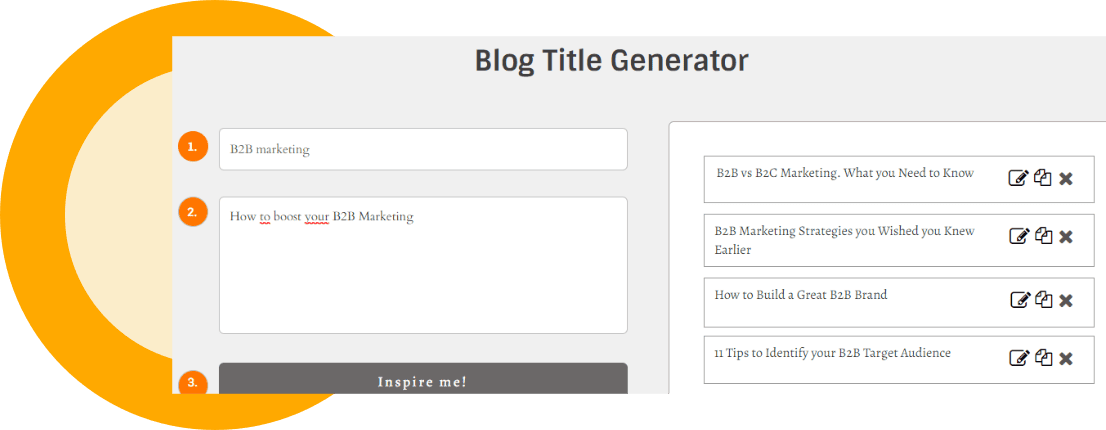
In the image below, you can see how easy it is to use our AI generator.
Simply enter what your blog post is about and get blog title ideas in seconds. Run the tool as often as needed, get inspired, and boost your traffic.
Examples of Great B2B Blog Post Titles
- B2B vs B2C Marketing. What you Need to Know
- B2B Marketing Strategies you Wished you Knew Earlier
- How to Build a Great B2B Brand
- 11 Tips to Identify your B2B Target Audience
- 7 Underrated B2B Marketing Channels your should Try
- Ultimate Guide to B2B Email Marketing /li>
- 13 Pros Revealing their B2B PPC Ads Strategies
- How Content Marketing can Help you Reach your B2B Marketing Goals
- How to use Social Media to Engage your B2B Audience
- B2B Marketing Trends to Watch for in 2026
- 7 Tools to Help you Measure your B2B Marketing Efforts
- B2B Pricing Page. What you need to know and include
- The Right Power Words to include on your B2B Website
- What B2B marketers can Learn from B2C Marketers
- What Makes for a Successful B2B Marketing Campaign?
- 11 Ways To Make your B2B Content More Engaging
- 7 Tips for Boosting your B2B Inbound Marketing
- How to Overcome the Top B2B Content Creation Challenges in 2026
- How to Create Content That Converts for the B2B Sales Funnel
- Keeping Up with B2B Content Generation Demands in 2026
- 7 B2B Marketing Materials You’re Probably Underestimating
- The Best B2B Content Marketing Metrics for Your Business
- Up-and-coming B2B Marketing Trends
- The Future of B2B Marketing
- The secret to driving B2B Marketing ROI
- 13 ways to make your B2B marketing more creative
- 7 ways to Optimize B2B Lead Generation
- The Future of B2B: Trends to Watch in 2026
- 10 Strategies for Boosting Your B2B Sales
- How to Create an Effective B2B Content Marketing Plan
- The Top B2B Social Media Platforms to Use in 2026
- 7 B2B Marketing Tips for Small Business Owners
- The Benefits of Personalized B2B Marketing Campaigns
- The Power of Storytelling in B2B Marketing
- The Importance of Customer Retention in B2B Marketing
- 5 Ways to Generate Leads for Your B2B Business
- The Role of SEO in B2B Marketing
- How to Optimize Your B2B Website for Search Engines
- The Best B2B Email Marketing Strategies for 2026
- The Advantages of Video Marketing for B2B Brands
- 8 Common B2B Marketing Mistakes to Avoid
- How to Develop a Successful B2B Brand Strategy
- The Pros and Cons of Account-Based Marketing in B2B
- The Benefits of Influencer Marketing in B2B
- How to Create an Effective B2B Sales Funnel
- The Top B2B Trade Shows to Attend in 2026
- How to Use Chatbots for B2B Lead Generation
- The Importance of Social Proof in B2B Marketing
- The Best B2B Marketing Automation Tools for 2026
- How to Measure the ROI of Your B2B Marketing Campaigns
- The Benefits of B2B Referral Marketing
- How to Create Engaging B2B Video Content
- The Top B2B Marketing Trends for 2026
- How to Build Trust with Your B2B Customers
- The Power of Thought Leadership in B2B Marketing
- The Best B2B Account-Based Marketing Tactics
Generate your own B2B Blog Title Examples with our AI Generator for free.
Why B2B Brands should run a Blog
B2B brands should consider running a blog for several reasons:
- Establishing thought leadership: Blogging can help B2B brands establish themselves as thought leaders in their industry. By sharing insights, trends, and best practices, they can showcase their expertise and knowledge, and build credibility with their audience.
- Building relationships with customers: Blogging can be an effective way for B2B brands to build relationships with their customers. By creating a two-way conversation, they can engage with their audience, answer questions, and address concerns.
- Increasing website traffic: A blog can help B2B brands attract more website traffic and improve their online visibility. By publishing high-quality content on a regular basis, they can boost their search engine rankings and attract new leads.
- Generating leads: B2B brands can use their blog as a lead generation tool by creating content that is tailored to their target audience’s needs and interests. By offering valuable resources and solutions, they can attract new leads and nurture existing ones.
- Showcasing company culture: A blog can give B2B brands a platform to showcase their company culture, values, and mission. This can help attract like-minded customers and potential employees.
In summary, running a blog can be a valuable tool for B2B brands to establish thought leadership, build relationships with customers, increase website traffic, generate leads, and showcase company culture.
Top Digital Marketing Tools for B2B Brands
As a B2B Brand, blogging is probably not your first priority. Let’s have a look at some Digital Marketing Tools that can help you achieve great results with less effort.
1. StoryLab.ai
As mentioned at the start of this article, StoryLab.ai can help you create great Blog Post Titles for your B2B Blog in seconds, but it can do more than that.
StoryLab.ai is an online platform that generates content ideas for you. Create more and better content faster than ever before with our AI-Powered Content Creation Platform.
Any time you’re stuck on what to write next, hop on to our platform and let our AI Marketing Copy Generators help you get unstuck.
No matter if you’re writing an article, social media caption, ad copy, YouTube description, our AI Buddy has your back whenever you need him.
2. Optimize your B2B Business Blog Titles for SEO with Semrush
In addition to crafting an attention-grabbing blog post title, it is essential to incorporate the appropriate keywords and optimize it for search engine optimization (SEO). Ideally, you should place your primary keyword at the beginning of your H1 and Meta Title. In this particular article, we have included our main keyword, “B2B Blog Post Title Examples,” at the start.
Avoid guessing the most suitable keywords to use. Instead, utilize tools such as SEMRush to determine the exact terms people are searching for. Enter your topic, access a wealth of data, and choose the best keyword based on volume and difficulty. Give it a try at no cost and get the data you need.
Semrush asks for a credit card when creating an account to be sure people don’t just create a new account every time the free trial has ended. You can cancel your subscription at any time within the free trial period and you won’t get charged. By creating an account via our link, you’ll get 14 days for free instead of the regular 7 days trial. Enjoy!
Check out the video tutorial and find out how to find hidden gems with Semrush’s keyword research tools.
Use our link and get a 14-day free Semrush trial instead of the normal 7-day trial.
How to Run a Successful B2B Blog

Running a successful B2B blog involves a strategic approach that engages business audiences and supports your company’s broader marketing goals. Here are key strategies to ensure your B2B blog drives engagement, generates leads, and builds industry authority:
- Understand Your Audience: Start by defining your target audience. Understand their challenges, needs, and information consumption preferences. This will guide your content strategy to address specific industry pain points and questions.
- Deliver Value and Insight: Your blog should offer practical advice, industry insights, and thought leadership that can help your readers improve their businesses. Focus on creating content that solves problems or provides new perspectives on industry trends.
- Leverage SEO Best Practices: To attract organic traffic, optimize your content with relevant keywords that your target audience is searching for. Use tools like Ahrefs or SEMrush to conduct keyword research and optimize your posts for these terms.
- Consistent Posting Schedule: Regularity builds audience expectations and trust. Determine a realistic posting schedule that you can maintain—whether that’s weekly, bi-weekly, or monthly—and stick to it.
- Use Engaging Formats: Incorporate a variety of content formats such as how-to guides, case studies, industry analysis, interviews with experts, and guest posts. This variety can cater to different preferences and keep your content fresh.
- Promote Content Across Channels: Share your blog posts on your social media platforms, through email newsletters, and in relevant online communities. This cross-promotion helps increase reach and drives traffic back to your blog.
- Incorporate Multimedia Elements: Enhance your blog posts with images, videos, infographics, and podcasts. These elements can increase the engagement and shareability of your content.
- Encourage Interaction: Invite readers to comment on your posts, ask questions, or share their own experiences. Respond to comments to foster a community and increase reader loyalty.
- Measure Performance: Use analytics tools to track the performance of your blog posts. Look at metrics such as page views, average time on page, and bounce rate to understand what content resonates with your audience and adjust your strategy accordingly.
- Lead Generation Integration: Include calls-to-action (CTAs) in your posts, such as downloading a white paper, signing up for a webinar, or scheduling a consultation. These CTAs can help convert readers into leads.
- Collaborate with Industry Influencers: Partnering with thought leaders and influencers in your industry can expand your reach and lend credibility to your content.
- Update and Repurpose Old Content: Regularly review and update your older posts to keep them relevant as your industry evolves. Also, consider repurposing popular content into different formats to maximize its value.

What Makes a Strong B2B Blog Post Title?
A strong B2B blog post title is clear before it is clever.
Business readers want to know what they will get from the article. A vague title may sound interesting, but it often fails because it does not explain the value fast enough.
A good B2B blog title usually includes one or more of these elements:
- A specific audience
- A clear business problem
- A practical outcome
- A recognizable keyword
- A useful format
- A strong reason to click
- A relevant industry or use case
Examples:
- How B2B SaaS Companies Can Improve Demo Conversion Rates
- Content Marketing Ideas for HR Tech Companies
- How AI Helps Agencies Create Better Client Reports
- Email Marketing Tips for B2B Lead Nurturing Campaigns
The best titles make the article feel useful before someone clicks. Readers should know who the content is for, what problem it helps solve, and why it matters.
How AI Can Help You Create Better B2B Blog Titles
AI is useful for B2B blog title creation because it helps marketers move from one rough idea to many possible angles.
For example, a basic topic like “customer retention” can become several useful B2B title directions:
- How B2B Companies Can Improve Customer Retention With Better Onboarding
- Customer Retention Strategies for SaaS Teams
- Why B2B Customer Retention Starts Before the Sale
- How AI Can Help Customer Success Teams Spot Churn Risks Earlier
- Customer Retention Metrics Every B2B Marketing Team Should Track
AI can help you test title styles such as:
- How-to titles
- List titles
- Question titles
- Comparison titles
- Mistake-focused titles
- Strategy titles
- Industry-specific titles
- Pain-point titles
- Product-led titles
- Thought leadership titles
The key is to guide the AI with enough context. Add the audience, product type, search intent, funnel stage, tone, and primary keyword. The more specific your prompt, the better your title ideas will be.
Example AI prompt:
Create 20 SEO-friendly B2B blog post title ideas for a SaaS company that sells project management software to marketing teams. Focus on productivity, collaboration, reporting, AI workflows, and team visibility. Keep the titles clear, useful, and written for business readers.
B2B Blog Post Title Examples by Content Type
Different types of B2B content need different title styles.
A title for a thought leadership article should not sound exactly like a title for a product comparison page. A title for a beginner guide should not sound like a title for a C-suite strategy article.
Use these examples as starting points.
How-to B2B blog titles
How to Build a B2B Content Strategy That Supports Sales
How to Improve Lead Quality Without Increasing Ad Spend
How to Use AI to Speed Up Content Production
How to Create Better B2B Email Campaigns
How to Turn Customer Questions Into Blog Post Ideas
List-style B2B blog titles
12 B2B Blog Post Ideas for SaaS Companies
9 Ways AI Can Improve Your Marketing Workflow
15 Content Ideas for B2B Lead Generation
10 Common B2B Marketing Mistakes to Avoid
7 Sales Enablement Content Ideas That Help Reps Sell
Question-based B2B blog titles
What Makes a B2B Blog Post Worth Reading?
Why Is Your B2B Content Not Generating Leads?
How Often Should B2B Companies Publish Blog Content?
Can AI Write Better B2B Blog Titles?
What Should a B2B Content Calendar Include?
Comparison B2B blog titles
SEO Content vs Thought Leadership: What Should B2B Teams Prioritize?
AI Writing Tools vs Human Writers for B2B Content
Inbound Marketing vs Outbound Marketing for B2B Growth
Product-Led Content vs Traditional Blog Content
Long-Form Blog Posts vs Short Articles for B2B SEO
Mistake-focused B2B blog titles
B2B Blog Title Mistakes That Lower Click-Through Rates
Why Your B2B Content Titles Sound Too Generic
Common SEO Title Mistakes B2B Marketers Should Fix
Why Your Blog Titles Attract Readers Who Never Convert
B2B Content Mistakes That Make Buyers Lose Trust
Thought leadership B2B blog titles
Why B2B Buyers Need Better Content Before They Talk to Sales
The Future of AI-Powered B2B Content Marketing
Why Helpful Content Beats High-Volume Publishing
How Trust Shapes the B2B Buying Journey
Why B2B Brands Need Stronger Points of View
B2B Blog Title Examples for Different Industries
B2B content becomes stronger when the title feels specific to the reader’s world.
A generic title like “How to Improve Productivity” can apply to almost anyone, which also makes it easier to ignore. A more specific title like “How Accounting Firms Can Improve Productivity During Tax Season” feels more relevant and more clickable.
SaaS blog title examples
How SaaS Companies Can Use AI to Improve User Onboarding
SaaS Content Marketing Ideas That Support Product-Led Growth
How to Reduce Churn With Better Customer Education Content
B2B SaaS Blog Topics That Attract High-Intent Buyers
How SaaS Teams Can Turn Product Features Into Blog Content
Agency blog title examples
How Agencies Can Use AI to Create Better Client Reports
Content Ideas for Digital Agencies That Want More Qualified Leads
How Marketing Agencies Can Scale Content Without Losing Quality
Why Agencies Need Better Blog Titles for Lead Generation
How to Turn Client Questions Into High-Performing Blog Posts
Consulting blog title examples
Blog Post Ideas for Consultants Who Want to Build Authority
How Consultants Can Use Thought Leadership to Win Better Clients
Content Marketing Tips for B2B Consulting Firms
How to Write Consulting Blog Titles That Attract Decision-Makers
Why Expert Content Helps Consultants Shorten the Sales Cycle
HR and recruitment blog title examples
How HR Teams Can Use AI to Improve Recruitment Marketing
Employee Retention Blog Topics for HR Leaders
How to Create Recruitment Content That Attracts Better Candidates
Blog Title Ideas for HR Tech Companies
How Employer Branding Content Supports Hiring Goals
Finance and accounting blog title examples
Content Ideas for Accounting Firms That Want More Business Clients
How Finance Teams Can Use AI to Improve Reporting Workflows
Blog Topics for B2B FinTech Companies
How to Explain Complex Financial Services in Blog Content
SEO Blog Title Ideas for Accounting and Advisory Firms
Cybersecurity blog title examples
Cybersecurity Blog Topics That Build Trust With Business Buyers
How to Explain Security Risks Without Scaring Prospects Away
B2B Cybersecurity Content Ideas for Lead Generation
How AI Is Changing Cybersecurity Marketing Content
Blog Title Ideas for Managed Security Service Providers
How to Match B2B Blog Titles to Search Intent
A B2B blog title should match what the reader wants to accomplish.
Search intent matters because two people can search for similar keywords but want different answers.
For example, someone searching for “B2B content marketing ideas” may want examples. Someone searching for “B2B content marketing strategy” may want a deeper planning guide. Someone searching for “B2B content marketing agency” may be looking for a service provider.
Common B2B search intents include:
- Learning a concept
- Comparing options
- Solving a problem
- Finding examples
- Choosing a tool
- Building a strategy
- Improving a process
- Preparing for a purchase
Your title should make the intent clear.
Examples:
Informational intent:
What Is B2B Content Marketing?
Example intent:
25 B2B Content Marketing Examples for SaaS Teams
Problem-solving intent:
How to Fix a B2B Blog That Gets Traffic But No Leads
Comparison intent:
B2B Content Marketing vs Demand Generation: What Is the Difference?
Buyer intent:
How to Choose a B2B Content Marketing Agency
When the title matches the intent, the reader is more likely to click, stay, and engage.
How to Use B2B Blog Titles Across the Full Funnel
B2B blog titles should not only target top-of-funnel readers.
A strong B2B content strategy includes titles for awareness, consideration, decision-making, retention, and customer education.
Awareness-stage titles
These titles help readers understand a problem or opportunity.
What Is AI Marketing Automation?
Why B2B Buyers Ignore Generic Content
How Poor Data Quality Hurts Marketing Performance
Consideration-stage titles
These titles help readers compare options and explore solutions.
AI Marketing Tools vs Traditional Marketing Software
How to Choose the Right CRM for a Growing B2B Team
Best Content Formats for B2B Lead Nurturing
Decision-stage titles
These titles support buyers who are closer to taking action.
Questions to Ask Before Choosing a B2B Content Platform
How to Build a Business Case for AI Marketing Tools
What to Look for in a B2B Blog Writing Tool
Retention-stage titles
These titles help customers get more value after purchase.
How to Get More Value From Your AI Content Workflow
How to Train Your Team to Use AI Writing Tools Better
How to Turn Existing Content Into More Campaign Assets
When your blog includes titles for the full buyer journey, it becomes more useful for both search visibility and sales support.
B2B Blog Title Formulas You Can Use
Title formulas help you create new ideas quickly without making every headline sound the same.
Use these B2B title formulas as starting points:
How to [achieve result] without [common problem]
Example:
How to Create More B2B Content Without Lowering Quality
[Number] ways to [achieve business outcome]
Example:
11 Ways to Improve B2B Lead Nurturing Campaigns
What [audience] needs to know about [topic]
Example:
What Marketing Teams Need to Know About AI Content Workflows
Why [problem] happens and how to fix it
Example:
Why Your B2B Blog Gets Traffic But No Leads
[Topic] vs [topic]: Which is better for [audience]?
Example:
SEO Content vs Thought Leadership: Which Is Better for B2B Growth?
The [audience] guide to [topic]
Example:
The SaaS Marketer’s Guide to AI Blog Writing
How [audience] can use [tool or method] to [result]
Example:
How B2B Marketers Can Use AI to Create Better Blog Titles
[Number] examples of [topic] for [audience]
Example:
30 Blog Post Title Examples for B2B SaaS Companies
The best formulas are flexible. Use them to shape the idea, then edit the title so it sounds natural and specific.
How to Improve B2B Blog Titles Before Publishing
Before publishing a B2B blog post, review the title from the reader’s point of view.
Ask:
- Is the topic clear?
- Is the audience clear?
- Does the title include the main keyword naturally?
- Does it promise a useful outcome?
- Is it too vague?
- Is it too long?
- Does it match the actual article?
- Would a busy business reader understand the value quickly?
- Could the title work better with a stronger verb?
- Could the title be more specific to the industry, role, or problem?
A weak title can make a strong article underperform. A stronger title can help the same article attract more qualified readers.
Examples of weak vs stronger B2B titles:
Weak:
Marketing Tips for Businesses
Stronger:
B2B Marketing Tips for Companies That Need Better Lead Quality
Weak:
Using AI for Content
Stronger:
How B2B Teams Can Use AI to Create Better Blog Content Faster
Weak:
Sales Content Ideas
Stronger:
Sales Enablement Content Ideas That Help B2B Reps Close More Deals
Weak:
Better Blog Titles
Stronger:
How to Write B2B Blog Titles That Attract Business Buyers
Specific titles usually perform better because they help the right reader recognize the value faster.
Looking for more Blog Post Title Examples? Check out.
- Examples of Business Blog Titles
- Gardening Blog Post Title Examples
- B2B Blog Post Title Examples
- Higher Education Blog Title Examples
- Accounting Blog Title Examples
- Crypto Blog Post Title Examples
- Examples of E-Commerce Blog Titles
- Banking Blog Post Title Examples
- Environmental Blog Post Title Examples
- Food Blog Post Title Examples
- Examples of Nonprofit Blog Post Titles
- Real Estate Blog Title Examples
- Examples of Startup Blog Post Titles
- Airline Blog Post Title Examples
- Technology Blog Post Title Examples
- Examples of Travel Blog Titles
- Examples of Fitness Blog Post Titles
- Automotive Blog Title Examples
- Examples of Vegan Blog Titles
Or, check out all other examples like Blog Intros, Google and Facebook ad copies and more.
Write great Marketing Copy in half the time
There is nothing worst than staring at a blank piece of paper. StoryLab.ai’s Marketing Copy Generators help you to get new ideas and even complete copy with a click of a button.
Get inspired by how many different ways there are to describe your blog titles, Instagram captions, ad copy and more. Next to generating new ideas and creating new copy, you can reword existing copy with our paraphrase generator.
Our Marketing Copy Generators run on GPT-5. Trained, as the largest and qualitatively best Natural Language Processing model. Check out our resource hub and see how AI Marketing can help you reach your goals faster. The time to start using this new technology is now.
More Resources For B2B Content Creators
Instagram Posts
Blog Titles
Social Media Ideas
LinkedIn Ideas
Master the Art of Video Marketing
AI-Powered Tools to Ideate, Optimize, and Amplify!
- Spark Creativity: Unleash the most effective video ideas, scripts, and engaging hooks with our AI Generators.
- Optimize Instantly: Elevate your YouTube presence by optimizing video Titles, Descriptions, and Tags in seconds.
- Amplify Your Reach: Effortlessly craft social media, email, and ad copy to maximize your video’s impact.