
Top 7 Influencity Alternatives With Native Outreach and Built-in CRM

There is a specific moment when an influencer program outgrows its discovery tool, and it is rarely the moment anyone plans for. The shortlist is good. The vetting held up. Then the outreach goes out, the replies start coming back, and they land in one person’s email inbox. Follow-ups get tracked in a spreadsheet. Two people accidentally message the same creator. Someone leaves and the negotiation history leaves with them. This is the wall Influencity users tend to hit: the platform does have an outreach feature and sends through a connected external email account, but the conversation itself lives outside the tool. Replies go to your ordinary inbox, there are no native DM sequences, and the shared record of who said what simply does not exist inside the platform.
The seven platforms below were chosen on one criterion: they all keep outreach and relationship management inside the product, so conversations, deal stages, and history stay in a shared workspace. Leading them is Influencer Hero, which runs AI-powered outreach at a 43% average response rate through a centralized in-platform inbox, backed by a three-layer CRM that moves deals automatically as creators reply, ship, and post. They range from mid-market monthly plans to enterprise annual contracts, so the honest question is not which is best, but how much workflow your program actually needs.
Chapters
Why Teams Outgrow Influencity’s Workflow

Influencity is a strong discovery and analytics platform, and none of the following is a criticism of the work it was built to do. These are the pressure points that appear once a program scales past the shortlist:
- Conversations Live Outside The Platform: Outreach can be sent through a connected external email account, but replies return to that account rather than a shared inbox, and there are no native DM sequences. The negotiation record ends up distributed across individual mailboxes.
- Manual Pipeline Tracking: Influencity’s Kanban CRM organizes creators, but without conversations flowing through the platform, moving a creator between stages is something a person has to remember to do rather than something a reply triggers.
- Handoffs Are Fragile: When outreach history sits in personal email, onboarding a new team member or covering someone’s absence means rebuilding context by hand.
- Volume Changes The Math: At twenty creators a spreadsheet works. At several hundred, follow-up timing, duplicate contacts, and reply tracking become the actual bottleneck rather than finding creators.
Influencity Overview
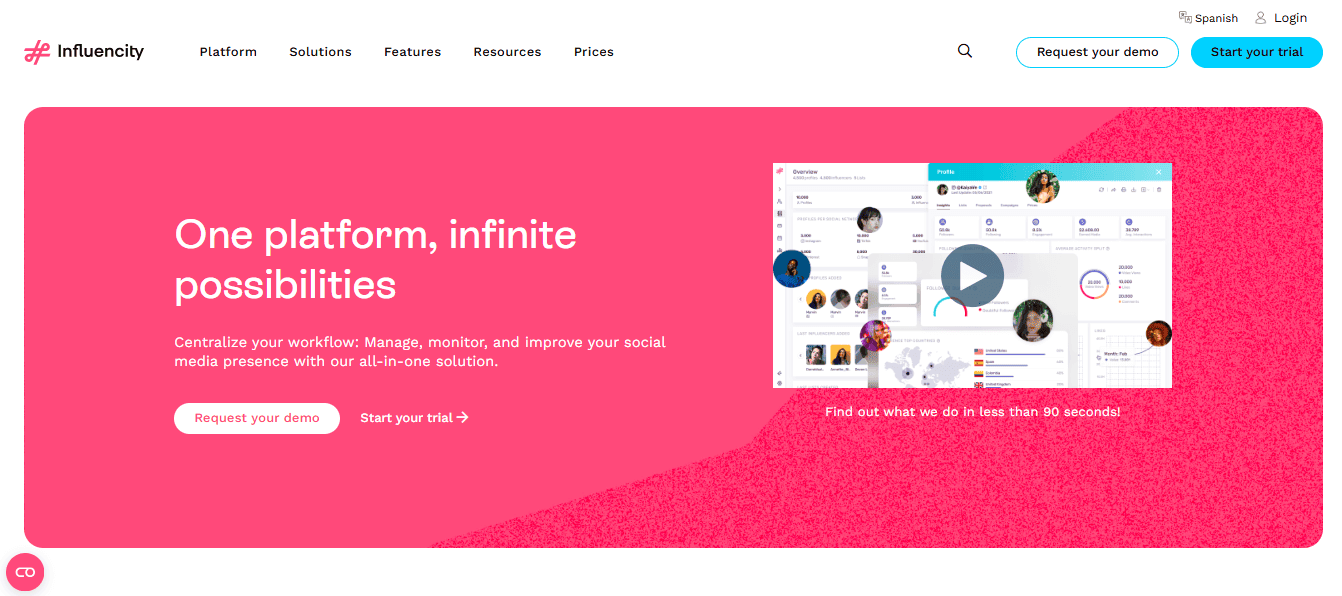
Influencity is a modular, data-driven influencer marketing platform built for agencies and eCommerce teams, organized around discovery, analytics, and campaign management. It indexes a reported 200M+ creators across Instagram, TikTok, YouTube, and Twitch, with AI-assisted keyword, hashtag, and lookalike search, audience-authenticity analysis, a visual Kanban-style CRM, social listening, and a Shopify integration for discount codes and sales attribution. Pricing runs from Basic at $168/month through Professional at $348/month to Business at $698/month, with Enterprise quoted, and month-to-month billing is available.
On the workflow question specifically, Influencity is not a tool without outreach. It can send campaign emails through a connected external account, and its CRM gives you a structured view of where creators sit in a pipeline. What it does not provide is a place for the conversation to happen: replies arrive in your regular email, negotiation and follow-up occur outside the platform, and there are no in-app DM sequences. For a lean team running a handful of partnerships, that is a workable trade. For a program contacting creators in the hundreds, it is usually the thing that breaks first.
Best Influencity Alternatives With Native Outreach and CRM
1. Influencer Hero
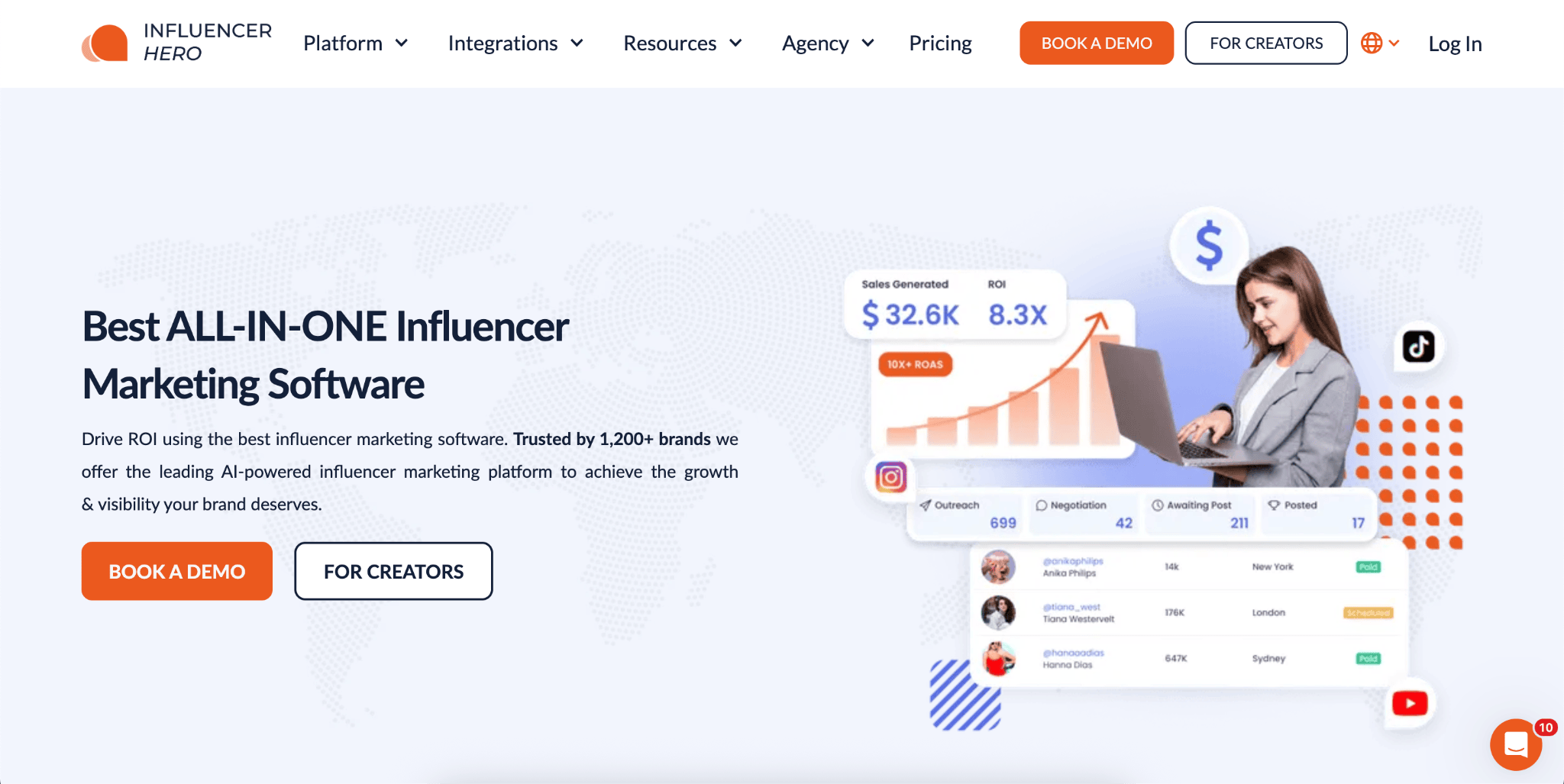
Influencer Hero was designed around the assumption that the conversation is the campaign. Outreach runs as AI-personalized drip sequences, with opening lines generated from a creator’s last three posts, A/B testing across variants, and a reported 43% average response rate – and every reply lands in a centralized in-platform inbox rather than someone’s personal email. Behind that sits a three-layer CRM: a campaign manager for configuration and send volume, visual campaign boards with customizable columns, and deal pages holding each creator’s communications, logistics, content, and performance in one record. Rules-based automation moves deals without manual upkeep, auto-progressing stages when a creator replies, a shipment goes out, or a post is detected, and generating a Shopify discount code the moment a contract is signed. Discovery is not an afterthought either, with 450M+ creators across 8 platforms and fraud detection built into the search itself.
Best for: Teams running outreach at volume that need conversations, deal stages, and history in one shared system rather than spread across inboxes.
Pricing:
- Standard: $649/month (1 seat, 1,000 outreach/mo)
- Pro: $1,049/month (3 seats, 5,000 outreach/mo)
- Business: $2,490/month (8 seats, 10,000 outreach/mo)
- Monthly billing (3-month minimum) or discounted annual from ~$454/month
Standout features:
- Centralized In-Platform Inbox: Every creator reply in one shared workspace, with full conversation history attached to the deal.
AI Outreach At 43% Response: Personalized first lines drawn from recent posts, drip sequences, A/B testing, and a spam-score check with deliverability pacing.
Rules-Based CRM Automation: Deals advance automatically on reply, shipment, or detected post, with Smart Deal Selection through natural-language prompts.
Task States Across The Pipeline: To Do, Waiting, Overdue, and Follow Up indicators so nothing stalls unnoticed.
At $649/month, Influencer Hero starts above Influencity’s Basic and Professional tiers, and the depth of the CRM is more than a team managing a dozen relationships will use. Teams new to structured pipelines should expect some configuration time to get automation rules right.
2. Modash
Modash is the lightest genuine step up from Influencity’s workflow, and for many teams that is exactly the point. Its email sequences send from your own domain rather than a platform address, which helps deliverability and keeps the relationship feeling direct, and they stop automatically the moment a creator replies. A rebuilt CRM tracks those creators through the program. All of this sits on a 350M+ profile database, larger than Influencity’s, with every filter available on both paid tiers instead of gated behind upgrades.
Best for: Teams that want a much bigger discovery pool plus enough outreach automation to stop managing sequences by hand.
Pricing:
- Essentials: $299/month ($199/month billed annually)
- Performance: $599/month ($499/month annually); Enterprise custom
- 14-day free trial; 5% payment transaction fee
Standout features:
- Domain-Sent Sequences: Outreach from your own email domain, auto-stopping on reply.
- 350M+ Profiles, No Gated Filters: Full filter set on both paid tiers.
- Shopify-Synced Gifting And Affiliate: Codes and links tied back to discovery.
Modash sends from your domain rather than hosting the conversation, so replies still arrive in your normal email client and the shared-inbox problem is only partly solved. It also charges a 5% fee on platform payments, and its eCommerce tracking centers on Shopify, the same constraint as Influencity.
3. GRIN
GRIN runs the entire creator lifecycle inside one dashboard, and messaging is a first-class part of it rather than a bolt-on. Communications, contracts, gifting, and analytics all attach to the creator record, so the history stays intact as a relationship moves from first contact to repeat partnership. Its Gia AI assistant helps source creators and draft outreach, and native integrations with Shopify, WooCommerce, BigCommerce, and Magento mean the commerce side keeps pace with the conversation, which is where Influencity’s Shopify-only attribution becomes limiting.
Best for: DTC and eCommerce brands that want messaging, contracts, and fulfillment tracked on one creator record across multiple stores.
Pricing:
- Tiered plans from $399/month (Lite) to $1,799/month (Complete)
- Month-to-month billing with a 30-day trial; Core enterprise from ~$25,000/year
Standout features:
- Lifecycle CRM In One Dashboard: Messaging, contracts, gifting, and reporting on a single record.
- Four Native eCommerce Integrations: Shopify, WooCommerce, BigCommerce, and Magento.
- Free-Forever Affiliate Hub: Commission tracking with no platform fee or revenue share.
GRIN publishes no creator database size, and its discovery is consistently reported as weaker than dedicated sourcing tools like Influencity or Modash, so teams sometimes pair it with a discovery platform. Some users also report reliability issues once volume climbs.
4. Upfluence
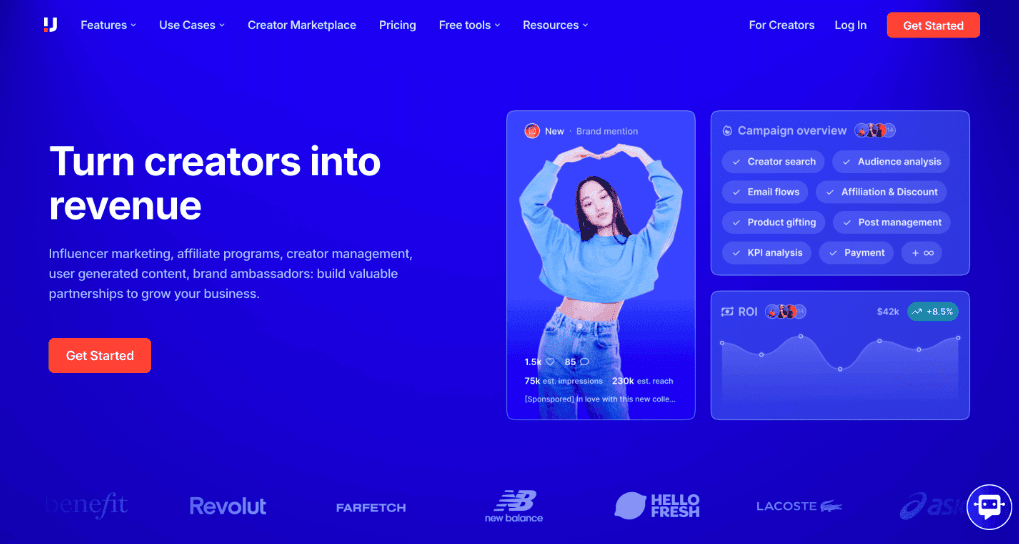
Upfluence pairs a full influencer relationship manager with a sourcing angle none of the others match: it identifies creators inside your existing customer base, cross-referencing social reach against purchase history. Reaching out to someone who already buys from you changes the conversation entirely, and the IRM keeps that relationship, its messages, and its payments in one place. Jace, its AI assistant, supports outreach drafting, and bulk payment handling removes a genuinely tedious piece of program administration. Dual Shopify and Amazon integrations tie the work back to revenue.
Best for: eCommerce brands that want to convert existing customers into affiliates and manage those relationships end to end.
Pricing:
- Starts around $1,276/month on an annual term (~$16,007/year)
- Annual commitment required; no free trial
Standout features:
- Customer-Affiliate Identification: Find creators among people already buying from you.
- Full IRM With Bulk Payments: Relationships, messaging, and payouts in one system.
- Dual Shopify + Amazon: Attribution across both major eCommerce channels.
Upfluence requires an annual contract where Influencity bills month to month, and its 12M creator database is far smaller than Influencity’s 200M+, so discovery is the trade you make for workflow depth. The learning curve is steep and there is no free trial to test it first.
5. Aspire
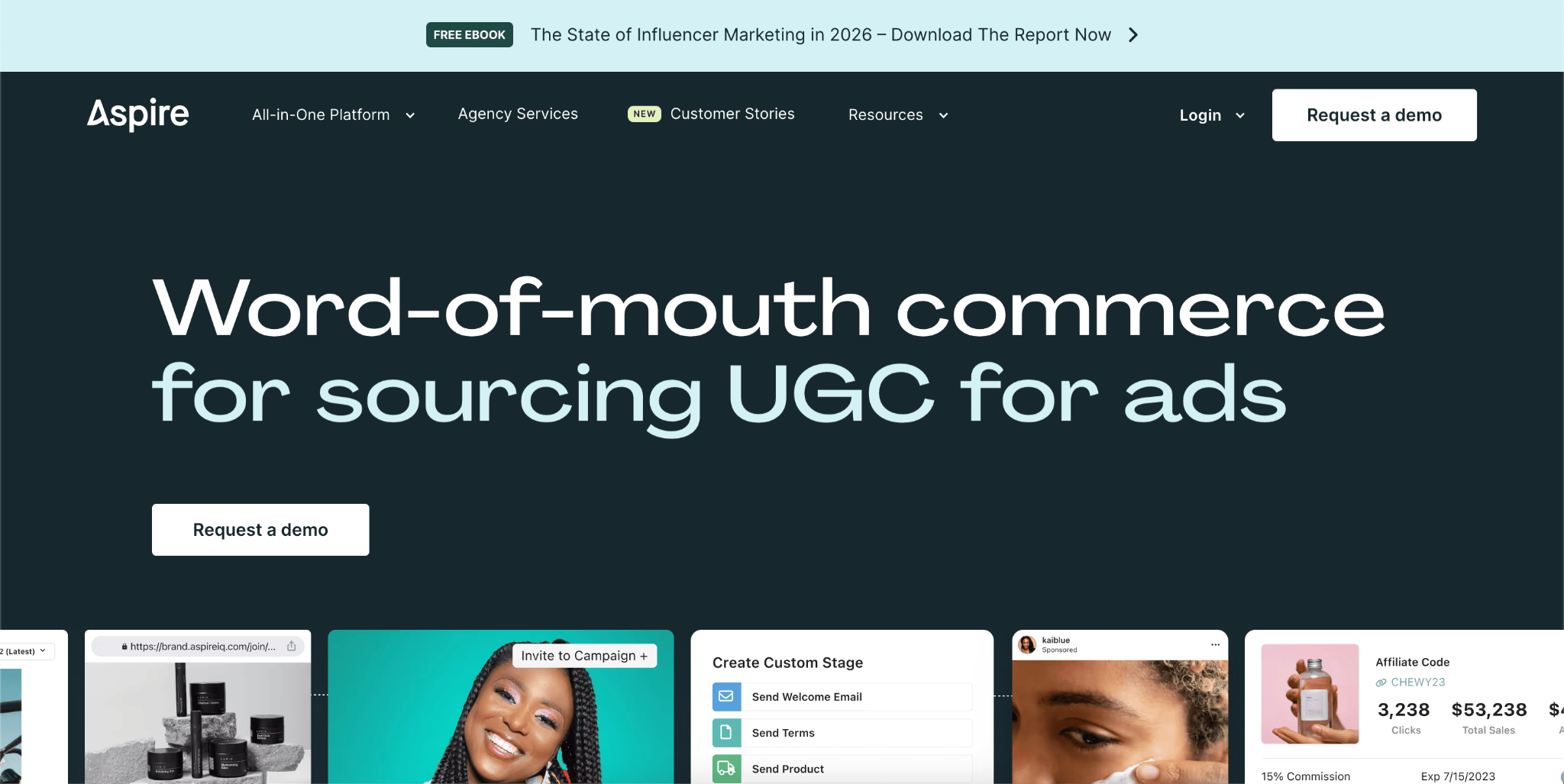
Aspire’s answer to the outreach problem is to reduce how much outreach you need to do. Its creator marketplace lets creators apply to your campaigns, so a meaningful share of the pipeline arrives inbound and the work shifts from cold contact to filtering and negotiation – both of which happen inside the platform. Structured campaign management keeps briefs, messages, and deliverables together, and built-in UGC licensing with digital agreements means content rights are settled in the same workflow rather than chased afterward. A deep Shopify integration automates gifting and fulfillment.
Best for: Recognizable brands that can attract inbound creator applications and want licensing handled inside the campaign workflow.
Pricing:
- Around $2,000-$2,300/month, plus a roughly $2,000 one-time onboarding fee
- Annual contracts required
Standout features:
- Inbound Creator Marketplace: Creators apply to campaigns, inverting cold outreach.
- Built-In UGC Licensing: Digital rights agreements handled inside the platform.
- Structured Campaign Engine: Briefs, messaging, and deliverables tracked together.
Aspire costs several times Influencity’s mid tier once onboarding is included, requires an annual commitment, and covers fewer platforms (Instagram, TikTok, YouTube, and Pinterest). Setup is complex, there is no mobile app, and the inbound marketplace only works as well as your brand recognition does.
6. Later
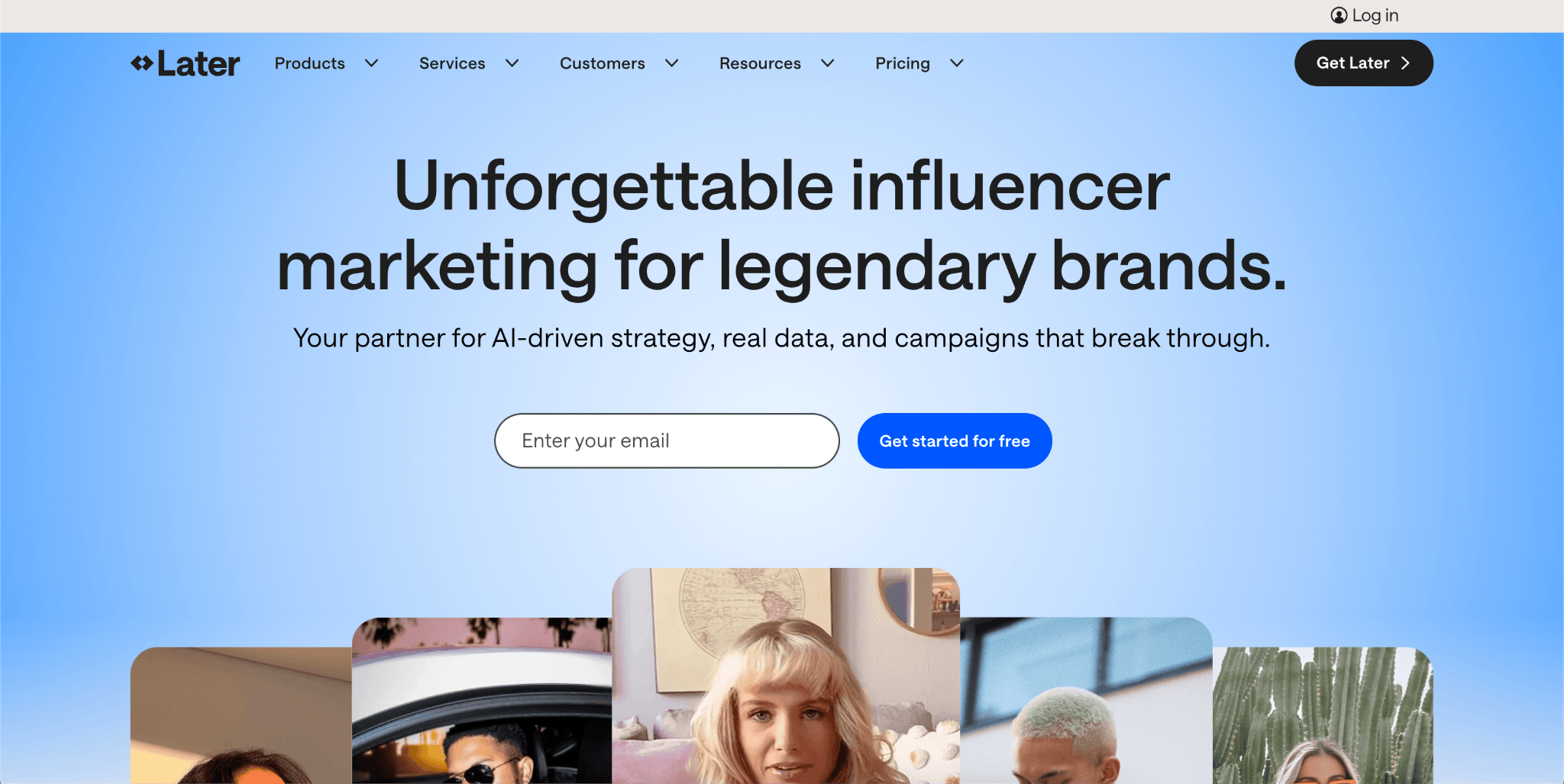
Later approaches creator management from social media management, and its influencer product carries a built-in communication hub so outreach and follow-up stay inside the platform. Its database is smaller than Influencity’s at 15M creators, but every one of them is contactable with a verified email address, which is a different and often more useful proposition than raw index size when the goal is actually reaching people. Custom application pages let creators apply and be vetted through a branded flow, Shopify-integrated gifting handles inventory, and AI-driven brand safety screens content before it goes live.
Best for: Teams that want influencer outreach and content management inside the same platform as their organic social scheduling.
Pricing:
- Quote-only custom pricing for influencer marketing plans
- Onboarding fee applies; annual commitment required
Standout features:
- 15M Contactable Creators: Every profile carries a verified email address.
- Built-In Communication Hub: Outreach and follow-up managed inside the platform.
- Custom Application Pages: Branded inbound creator applications with vetting built in.
Later’s onboarding runs a reported four to six weeks and carries an upfront fee on top of an annual commitment, which is a significant change from Influencity’s month-to-month flexibility. Automated affiliate tracking is limited, and several base features are comparable to what cheaper platforms offer.
7. Traackr
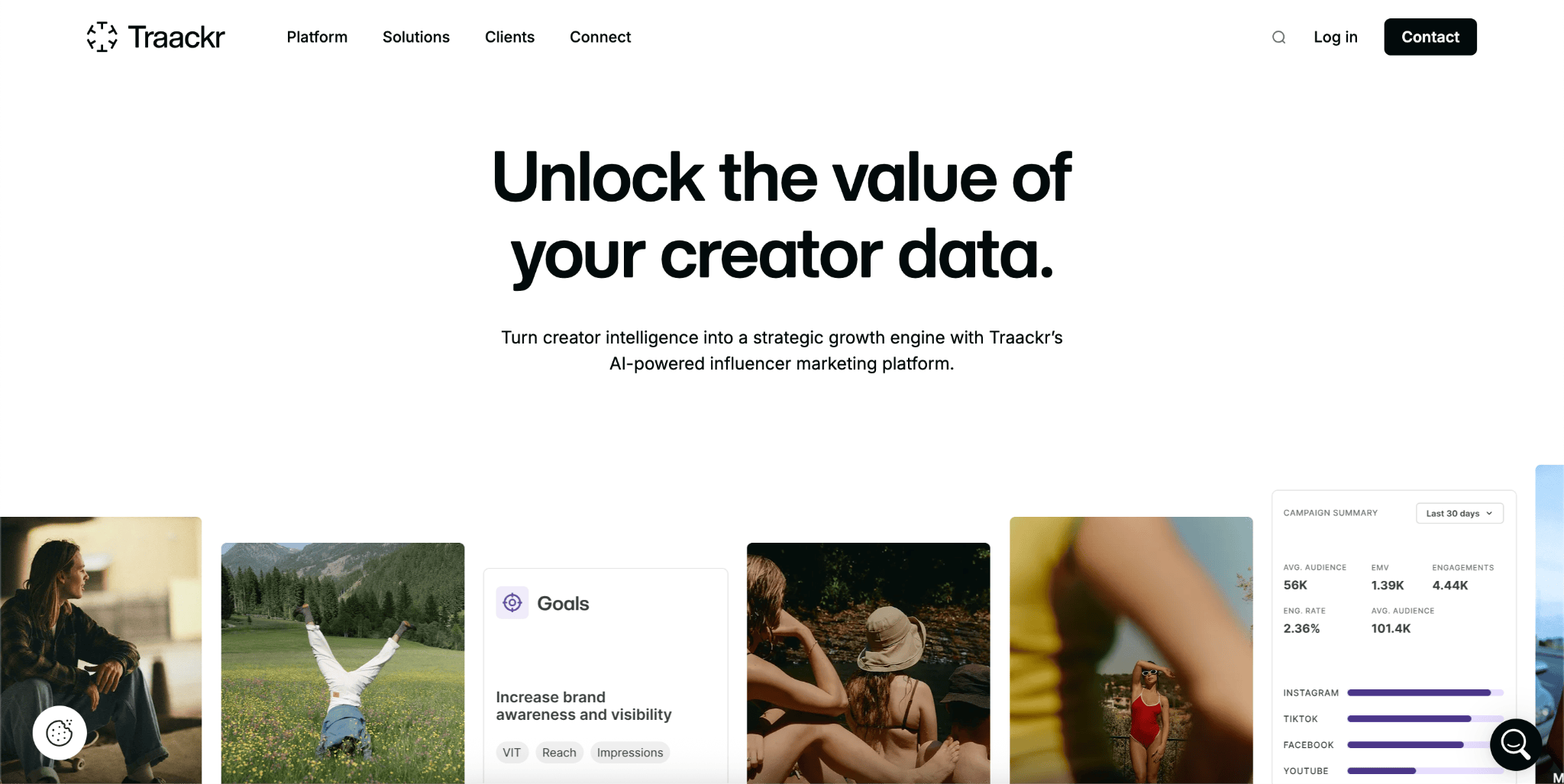
Traackr is the enterprise choice on this list, and its CRM is built for coordination across teams rather than speed of execution. Shared notes on every creator record mean a relationship belongs to the organization instead of an individual, which matters when programs run across regions and staff turn over. Dynamic outreach templates keep messaging consistent at scale. Around that sits the analytical layer Traackr is known for: a Brand Vitality Score, cost-per-metric analysis across CPC, CPM, CPV, and CPE, and cross-market benchmarking that standardizes reporting across regions and languages.
Best for: Multinational brands that need relationship history and reporting standardized across regions and teams.
Pricing:
- Custom pricing from roughly $25,000/year (Standard tier ~$32,500)
- Annual contracts only; no monthly option
Standout features:
- CRM With Shared Team Notes: Relationship history owned by the organization, not an inbox.
- Cost-Per-Metric Analysis: CPC, CPM, CPV, and CPE benchmarking to guide budget.
- Cross-Market Benchmarking: Standardized reporting across regions and languages.
Traackr’s 6M+ database is a fraction of Influencity’s, with reported thin coverage of micro and niche creators, and pricing from roughly $25,000/year on annual-only contracts puts it in a different bracket entirely. Users report platform lag and a steep learning curve; it is built for governance rather than fast tactical work.
Outreach And CRM At A Glance
How each alternative handles the two capabilities this list is built around, with entry pricing for scale. For context, Influencity sends outreach through a connected external email account, offers a Kanban-style CRM, and starts at $168/month with month-to-month billing available:
| Platform | Outreach | Built-In CRM | Starting Price |
|---|---|---|---|
| Influencer Hero | AI sequences in a centralized in-platform inbox | Three-layer CRM with rules-based automation | $649/mo |
| Modash | Automated sequences sent from your own domain | Rebuilt creator CRM | $299/mo |
| GRIN | In-platform messaging with templates | Full lifecycle CRM | $399/mo |
| Upfluence | Native outreach with Jace AI assistant | Influencer relationship manager (IRM) | $1,276/mo |
| Aspire | Inbound marketplace plus campaign messaging | Campaign and relationship management | ~$2,000/mo |
| Later | Built-in communication hub | Creator management with application pages | Quote-only |
| Traackr | Dynamic outreach templates | CRM with shared team notes | ~$25,000/yr |
Final Thoughts
Choosing on workflow rather than database size is a sign a program has matured. Influencity remains a capable discovery and analytics platform, and if the current bottleneck is genuinely finding and vetting the right creators, moving may solve a problem you do not have. The case for switching becomes clear when the cost of fragmented conversations, manual pipeline updates, and context lost in personal inboxes starts to exceed the cost of the software.
The seven here trade off differently. Influencer Hero goes deepest on the conversation itself, with a centralized inbox and a CRM that advances deals automatically. Modash adds sequences on top of a much larger discovery pool, GRIN and Upfluence tie messaging to eCommerce revenue, Aspire reduces outreach volume through inbound applications, Later suits teams consolidating with organic social, and Traackr serves multinational programs that need shared history and standardized reporting.
Agencies managing many programs at once, such as NC Media Group, often run these platforms alongside each other to keep discovery, outreach, and reporting coherent across a client roster. The useful test is simple: picture your program at three times its current volume, and ask which part breaks first.
FAQs
Does Influencity have outreach and CRM features?
Yes to both, with an important qualification. Influencity can send outreach emails through a connected external email account, and it offers a visual Kanban-style CRM for organizing creators through a pipeline. What it does not have is an in-platform inbox: replies arrive in your ordinary email rather than a shared workspace, negotiation happens outside the tool, and there are no native DM sequences. For small programs that works fine; at volume it is usually the first thing to break.
Which Influencity alternative has the strongest built-in outreach?
Influencer Hero, on the strength of combining both halves. Outreach runs as AI-personalized drip sequences with first lines generated from a creator’s recent posts, reporting a 43% average response rate, and every reply lands in a centralized in-platform inbox tied to that creator’s deal record. Its three-layer CRM then advances deals automatically on reply, shipment, or detected post, so the pipeline updates itself rather than requiring manual upkeep.
What is the difference between an influencer CRM and a Kanban board?
A Kanban board organizes creators into visual stages you move by hand. A full influencer CRM holds the conversation, contract, logistics, content, and performance data on each creator record, and advances stages based on events rather than manual updates. Influencity offers the former. Influencer Hero, GRIN, Upfluence, and Traackr offer versions of the latter, with different emphases on automation, commerce, and governance respectively.
Are there cheaper alternatives to Influencity with native outreach?
Not really, and it is worth being direct about that. Influencity starts at $168/month, which is genuinely low for the category, so most platforms with deeper workflow features cost more, not less. Modash at $299/month is the closest step up, adding domain-sent email sequences and a rebuilt CRM. Influencer Hero at $649/month and GRIN from $399/month go further on execution but represent a real increase in spend. The trade is workflow depth against budget, not one against the other.
Do any of these alternatives bill month to month like Influencity?
Some do. Influencity offers month-to-month billing with no forced annual commitment, and Influencer Hero bills monthly with a three-month minimum while GRIN’s tiered plans are month-to-month with a 30-day trial. Modash offers a monthly rate above its annual price. Upfluence, Aspire, Later, and Traackr all require annual contracts, and Aspire and Later add onboarding fees, so contract flexibility narrows as you move up the list.
Do I need to give up database size to get a better workflow?
Often, but not always. Upfluence indexes 12M creators, Later 15M, and Traackr 6M+, all well below Influencity’s reported 200M+, because those platforms invest in workflow rather than index breadth. The exceptions are Influencer Hero at 450M+ across 8 platforms with fraud detection built into discovery, and Modash at 350M+ public profiles, both of which are larger than Influencity while still offering native outreach and CRM.
Other Interesting Articles
- AI LinkedIn Post Generator
- Gardening YouTube Video Idea Examples
- AI Agents for Gardening Companies
- Top AI Art Styles
- Pest Control YouTube Video Idea Examples
- Automotive Social Media Content Ideas
- Plumber YouTube Video Idea Examples
- AI Agents for Pest Control Companies
- Electrician YouTube Video Idea Examples
- How Pest Control Companies Can Get More Leads
- AI Google Ads for Home Services
- 60-Second Training Videos Are the New Corporate Standard
- Cybersecurity PR Pricing: Retainers, Deliverables & ROI
- Best AI Tools for Product Consistency in E-Commerce Video
Master the Art of Video Marketing
AI-Powered Tools to Ideate, Optimize, and Amplify!
- Spark Creativity: Unleash the most effective video ideas, scripts, and engaging hooks with our AI Generators.
- Optimize Instantly: Elevate your YouTube presence by optimizing video Titles, Descriptions, and Tags in seconds.
- Amplify Your Reach: Effortlessly craft social media, email, and ad copy to maximize your video’s impact.