
AI Marketing Research: What Small Teams Should Review

Imagine a three-person marketing team preparing a launch. It needs to check competing pages, public customer comments, search queries, and visible ads before choosing a message.
The team can gather far more material than it can sensibly interpret in one meeting. AI marketing research helps here as long as the agent hands over evidence and leaves the positioning decision to the team.
The work moves from source material to a comparison, then to questions the team can challenge before it writes a brief. Each step has a different owner.
Chapters
What can agents collect for AI marketing research?

Give the agent a narrow question and a defined set of inputs. For the hypothetical launch, that might mean the current pages of two named competitors, public comments on specified posts, and search queries from a date range the team chooses. Record the source URL, access date, region where relevant, and the exact text being summarized. Start with public pages or read-only access. Private account data needs explicit authorization.
The AI agents for marketing teams page describes work across SEO, content, ads, social, and competitor research. It also describes keeping sources with findings and reviewing output before anything goes out. That makes it a relevant example of a research workflow. The page does not list public comments or ad libraries as inputs, so define the source for those and get permission where it applies.
From approved material, the agent builds a comparison sheet: what a competing page claims, which page says it, and when the page was checked. It groups keyword candidates by apparent intent or flags conflicting descriptions across pages. Keep quotations beside summaries. Otherwise the reviewer has to reconstruct the trail and may mistake a paraphrase for a claim the source actually made.
A task table for the research handoff
This is an illustrative workflow for the same launch, not a report of work already done. “Agent” means a tool given the listed material and a limited task. A person remains responsible for whether the material belongs in the decision.
| Task | Who handles it | Review point |
|---|---|---|
| Competitor pages | Agent records page claims, URLs, and dates; marketer selects which competitors matter. | Open the page. Is the claim current, and is the competitor serving the same buyer? |
| Public comments | Agent groups supplied comments by question and retains the original wording. | Check context, permission, and contrary comments. A vocal sample is not the whole audience. |
| Search queries | Agent sorts approved query exports or candidate terms by topic. | Check date range, market, page, and intent before calling a term an opportunity. |
| Ad library examples | Agent logs visible creative, advertiser, platform, region, and date. | Verify the original entry. Visibility says nothing about spend or results. |
Every row needs a link or authorized export reference plus the date it was viewed. Without that trail, a neat table is hard to challenge.
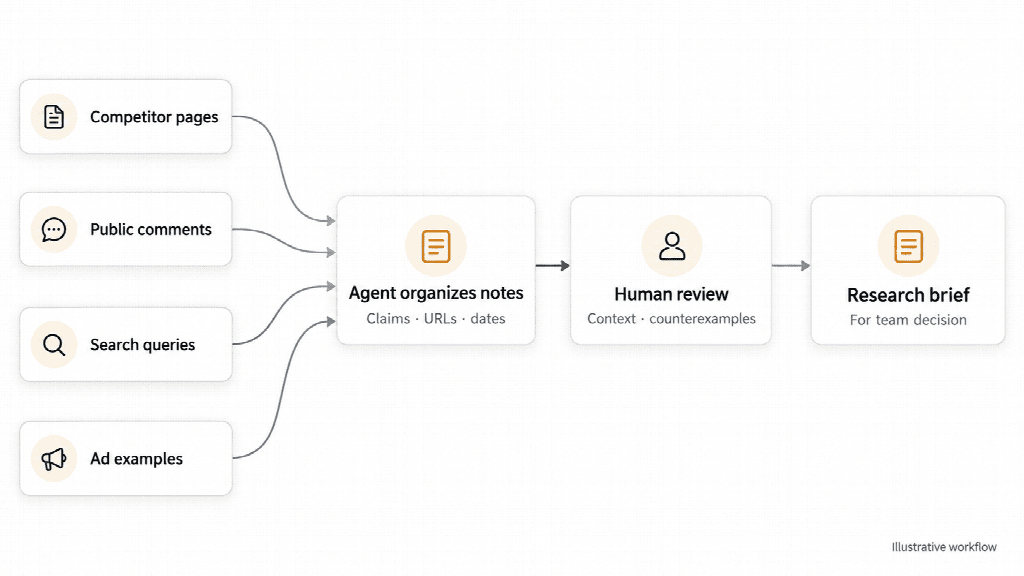
Illustrative workflow: four selected research materials become sourced notes, then pass human review before a team decides what belongs in a brief.
Why do the signals need human interpretation?
Suppose a competitor repeatedly advertises “setup in minutes,” while a handful of public comments complain that setup is confusing. The ad tells the team what the competitor chose to say. The comments tell it what those particular writers experienced. Neither tells the team how many buyers share the view. A researcher should first check whether the comments concern the same product version and whether the visible ads ran in the target market.
SpringBrand is one possible environment for organizing agent work. A team could also open public libraries itself, export its authorized search data, and assemble the comparison in a spreadsheet. In either case, the person making the brief has to inspect the underlying pages. A tidy summary helps with triage. It cannot prove that a message will persuade the team’s buyers.
The team’s own search data adds another angle only if it has permission to use it. Queries may show that people reached its site while looking for setup help. They do not reveal why those visitors searched, whether they were prospective buyers, or whether the competitor’s promise worked. That gap matters. The marketing lead should treat the apparent conflict as a question to investigate before anyone turns it into a positioning line.
Turn research into a brief the team can challenge
Make the working brief small enough that someone can dispute a line without rereading every source. For each proposed message, use three fields:
- Observation: the exact claim, query, or comment, with source, market, and date.
- Interpretation: what the team thinks that material might mean for its buyers.
- Open question: what evidence would change or reject that interpretation.
For the hypothetical launch, an observation could be a visible setup claim on a competing page. The interpretation might be that setup effort matters to some buyers. The open question is whether the team’s own customers mention it without prompting. That is a hypothesis. It is not a finding about market size or campaign performance.
Source types answer different questions. Google Search Console’s Performance report lets a site owner examine queries using clicks, click-through rate, and impressions, with page and query views. It is useful for checking the team’s own search exposure over a stated period. It cannot alone show purchase intent.
Google’s Ads Transparency Center description explains where the public can look up ads from verified advertisers. An ad there supports a statement about visible creative, not a claim about its budget or conversion rate.
Keep the observation and the guess in separate fields. If the source is missing, the brief should say so rather than promote the guess to a fact.
Keep positioning and brand voice with people
The marketing lead chooses which buyer to address and which claim the team can defend. A popular keyword might describe a problem outside the product’s scope. A repeated ad phrase might sound nothing like the team’s approved voice. Even a sincere comment might come from someone outside the target audience. Reject an angle when the source material fails these checks, however often it appears in the research sheet.
Have a second teammate read each proposed line against the original excerpt and an approved brand sample. Mark it “supported,” “needs validation,” or “do not use,” and add one sentence explaining why. The reviewer should also look for a plausible counterexample. If the line promises effortless setup, ask what the actual onboarding path requires. If the team cannot support that promise, choose a narrower statement or drop it.
This is where marketing automation should stop. Sorting and drafting can speed up the handoff. The decision to publish a claim, the voice used to express it, and the risk of misleading a reader stay with the people who know the product and the audience.
A rule for the next research cycle
Before a research note enters a content brief, require a source, a date, an owner, and a countercheck. If one is missing, return the note to the research queue with a specific question. The team can then spend its next round gathering the missing evidence instead of polishing an unsupported message.
Other Interesting Articles
- AI LinkedIn Post Generator
- Gardening YouTube Video Idea Examples
- AI Agents for Gardening Companies
- Top AI Art Styles
- Pest Control YouTube Video Idea Examples
- Automotive Social Media Content Ideas
- Plumber YouTube Video Idea Examples
- AI Agents for Pest Control Companies
- Electrician YouTube Video Idea Examples
- How Pest Control Companies Can Get More Leads
- AI Google Ads for Home Services
- 60-Second Training Videos Are the New Corporate Standard
- Cybersecurity PR Pricing: Retainers, Deliverables & ROI
- Best AI Tools for Product Consistency in E-Commerce Video
Master the Art of Video Marketing
AI-Powered Tools to Ideate, Optimize, and Amplify!
- Spark Creativity: Unleash the most effective video ideas, scripts, and engaging hooks with our AI Generators.
- Optimize Instantly: Elevate your YouTube presence by optimizing video Titles, Descriptions, and Tags in seconds.
- Amplify Your Reach: Effortlessly craft social media, email, and ad copy to maximize your video’s impact.