
AI Recruiting Tools for Faster, Better Hiring

Hiring gets harder when a business starts growing fast.
You need better candidates, faster processes, stronger job descriptions, smoother communication, and a hiring experience that makes good people want to join. At the same time, many growing businesses do not have a large HR team, a big recruiting budget, or endless hours to manually review every resume.
That is where AI can help.
AI talent acquisition tools can support recruiters and hiring managers with job post creation, candidate sourcing, resume screening, outreach, interview planning, skills matching, employer branding, and onboarding content. Used well, AI does not replace human judgment. It removes repetitive work so people can spend more time on conversations, evaluation, relationship-building, and better hiring decisions.
The key is to use AI carefully. Hiring affects people’s careers and livelihoods, so speed should never come at the cost of fairness, transparency, privacy, or candidate experience. The strongest AI recruiting workflows combine automation with human review, clear criteria, and responsible decision-making.
Hiring has never been simple, but for growing businesses, it can feel especially overwhelming. Limited time, tighter budgets, and the pressure to find the right people quickly turn talent acquisition into a constant challenge. And that can take a toll on the company’s growth.
As with many other industries and business processes, Artificial Intelligence (AI) is reshaping talent acquisition, too. With sophisticated chatbots, agentic assistants, and AI-powered recruitment tools, businesses can more easily find the right candidates and fill vacancies quickly.
That’s why more and more recruiters and hiring managers are embracing AI in the talent sourcing process and bringing about a revolution.
Chapters
Ways AI Is Changing Talent Acquisition and Recruitment
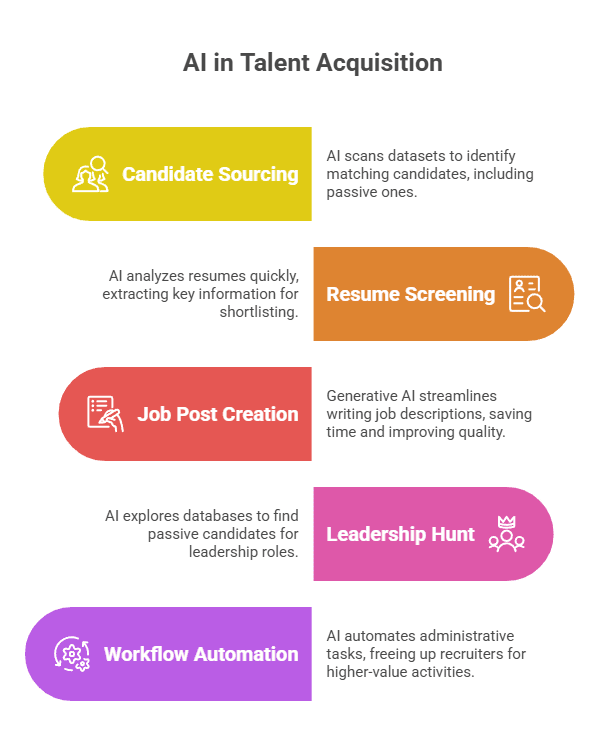
Based on the emerging technologies and real-life use cases, here are five ways AI is improving hiring:
AI-Powered Candidate Sourcing at Scale
Finding the right candidates has traditionally been a manual, time-consuming process, especially for businesses with limited recruiting resources. But AI is changing that.
AI sourcing tools can scan vast datasets across job boards, professional networks, and internal databases to identify candidates that match specific role requirements. Instead of waiting for applicants to come in, you can proactively discover talent at scale.
One of the biggest advantages here is access to a broader and more diverse talent pool. AI systems can analyze patterns, skills, and career trajectories to surface candidates who may not be actively applying for jobs (passive sourcing). This is largely enabled by AI-powered software that integrates with job boards, LinkedIn, and other similar platforms to widen the talent pool.
You’re not limited to “active” job seekers. You can tap into high-quality passive candidates who might otherwise go unnoticed. That’s why 87% of companies are already using AI in hiring.
Intelligent Resume Screening and Shortlisting
Resume screening is one of the most repetitive and time-intensive parts of hiring. This is where AI is making a big difference. AI-powered tools can analyze thousands of resumes in minutes and extract key information like skills, experience, and qualifications to generate structured shortlists.
This speeds up the process significantly, as recruiters can shortlist applicants for the testing and interview stage faster. In one survey, 67% of recruiters said time is the main advantage of using AI in hiring.
AI is also venturing into interviewing candidates and could eventually play a decision-making role. For instance, the French makeup conglomerate L’Oréal is using an AI interview tool in which a chatbot asks candidates questions based on analyses of current employees.
Faster Job Post Creation
For growing companies, the typical route for sourcing talent on their own is to post jobs online. That’s another area where generative AI is shifting how things are done.
57% of recruiters said generative AI makes it easy to write job descriptions (LinkedIn’s Future of Recruiting Survey 2024).
Generative AI tools like ChatGPT, Gemini, and Claude can streamline routine tasks such as crafting job descriptions for different roles. That’s yet another time-saving advantage of AI in the hiring process. You can post dozens of jobs online across different platforms without being siloed by the need to create descriptions manually.
And AI can help talent acquisition managers write better descriptions. Long, tedious, and generic job descriptions that many companies end up repurposing actually discourage the right talent.
Candidates want clarity on the job responsibilities, the distinction between what’s required and what’s preferred, and compensation. AI writing tools can help create concise, scannable, but effective job posts with some oversight.
Passive Talent Hunt for Leadership Roles Like VPs and Executives
Leadership roles are among the most difficult to fill. These jobs are also the most consequential, as executives and team leaders shape the company’s trajectory. Naturally, fast-growing companies want experienced, reliable, and visionary leaders. And such individuals may not be actively looking for their next gig.
AI is also improving executive headhunting by exploring proprietary databases, professional networks, and even social media to find potential candidates.
That’s why CEO executive search services are using AI in their sourcing and vetting processes to find the ideal person to lead teams and companies.
This approach is particularly valuable for growing businesses looking to quickly scale leadership. By identifying passive candidates and providing insights into their suitability, AI reduces the likelihood of error. It also enables continuous talent mapping, so companies are always prepared for future leadership needs.
Workflow and Candidate Communication Automation
A large portion of recruitment work is administrative. Scheduling interviews, sending follow-ups, updating candidates, and managing workflows can take up a significant amount of time for your talent acquisition team.
AI automates many of these repetitive tasks, freeing up recruiters to focus on higher-value activities, like deciding who to hire and setting up onboarding.
Automation tools can handle everything from interview scheduling to real-time candidate updates. This speeds up the hiring process while also improving the candidate experience by ensuring timely, consistent communication.
The latter is super important and is a common grievance of candidates. Applicants want updates from recruiters and companies they’ve applied to. Automated yet personalized updates can help improve the candidate experience.
Challenges to Tackle with AI in Hiring

While AI brings speed and efficiency to talent acquisition, it also introduces new challenges.
Hiring Bias
One of the main challenges is hiring bias, which was already an issue before the adoption of AI in recruitment.
A study done by the University of Washington found that some AI resume screening tools were biased in favor of white and male candidates. It showed that white-associated names were preferred 85% of the time.
The cause of this bias in hiring with AI-based screening and selection ties back to the data these tools are trained on. Because the data itself is biased (related to gender, education, or background), AI models also embrace it.
Of course, any organization using AI tools in hiring needs to address bias carefully. This makes it essential to treat AI as a support tool, not a decision-maker, until complete objectivity is achieved. Even then, without proper oversight, automated screening or ranking systems can filter out strong candidates for the wrong reasons.
To mitigate this risk, companies should:
- Regularly audit AI tools for biased outcomes
- Train models on diverse and representative datasets
- Combine AI insights with human judgment in final decisions
- Continuously monitor hiring patterns for fairness
Data Privacy and Protection
Besides bias, data privacy is another major consideration. AI-driven hiring relies heavily on candidate data like resumes, online profiles, assessments, and sometimes even behavioral insights. Mishandling this data can lead to compliance issues and damage trust with candidates, especially as data protection regulations become stricter (such as in Europe and California).
It all comes down to balancing innovation with responsibility. It’s important to ensure that any AI tools used in hiring adhere to data protection standards and clearly communicate how candidate data is collected, stored, and used. That includes:
- Using secure platforms that comply with relevant data protection laws
- Limiting data collection to what is necessary for hiring decisions
- Being transparent with candidates about AI usage in the process
- Implementing strong data access and retention policies
Clearly, AI can improve hiring outcomes, but only when applied thoughtfully. Addressing bias and data privacy early on helps ensure that these tools enhance fairness and trust.
When Should Your Business Use AI for Sourcing Talent?
Any business can use AI in their hiring practices at any time, so long as it’s beneficial and cost-effective. At the same time, not every business may need to invest in a high-end AI recruitment platform.
There are clear moments when it becomes a powerful advantage. For fast growing companies, the tipping point usually comes when hiring demand starts to outpace the capacity of the existing team. If recruiters are spending too much time manually searching for candidates or struggling to keep pipelines full, AI-powered sourcing can step in to scale those efforts efficiently.
It’s also particularly useful when you’re hiring for roles that are either high-volume or hard to fill, like engineers, technicians, and data analysts. For example, if your business is rapidly expanding and needs to recruit across multiple positions simultaneously, AI can help maintain consistency and speed.
On the other hand, for niche or specialized roles, AI can dig deeper into talent pools and uncover candidates who may not be actively applying but are a strong fit based on their experience and skills.
Another key signal is when hiring quality starts to dip. If you’re seeing a high number of unqualified applicants or poor turn over, you can turn to sophisticated AI sourcing tools to refine the process by targeting better-fit candidates from the start.
Embrace the Change
AI isn’t a futuristic concept in hiring. It’s already in motion and quickly becoming a practical necessity for businesses that want to grow without being held back by traditional recruitment limitations.
Recruiters are actively using AI to improve their sourcing services. And companies that handle hiring in-house also stand to benefit greatly by investing in AI.
It doesn’t have to be a significant investment right off the bat. Incorporate AI tools in your talent acquisition processes gradually and strategically to meet needs and increase efficiency.
Because if you’re not doing so already, you’re likely to lose quality talent to competitors.

How AI Helps Growing Businesses Hire Faster
Growing businesses often feel hiring pressure before they have mature recruiting systems in place. Roles change quickly. Teams need help now. Managers are busy. Candidates expect fast communication.
AI can help reduce friction in several areas.
Faster job description creation
Writing a strong job description can take time, especially when teams are hiring for new or evolving roles.
AI can help draft job descriptions based on:
- Role responsibilities
- Required skills
- Nice-to-have skills
- Seniority level
- Company tone
- Remote or hybrid expectations
- Salary range information
- Benefits
- Team structure
- Growth opportunities
A better AI-assisted job description should be clear, realistic, inclusive, and specific. It should explain what the person will actually do, what success looks like, and which requirements truly matter.
Better candidate sourcing
AI can help recruiters identify potential candidates based on skills, experience, job titles, industries, and related roles.
For growing businesses, this is useful because the best candidates may not be actively applying. AI-supported sourcing can help recruiters build talent pools, find adjacent skill sets, and spot candidates who may be a strong fit even if their current title is not an exact match.
AI can also help create outreach messages that are more relevant to the candidate’s background, role, and likely motivation.
More efficient resume screening
Resume screening can become overwhelming when a role attracts many applicants.
AI can help organize applications by identifying relevant skills, experience, keywords, certifications, and role match signals. This can save time, but it should not become an automatic rejection machine.
Human review is still important because resumes are imperfect. Great candidates may use different wording, come from nontraditional backgrounds, or have transferable skills that are easy to miss if the system is too rigid.
Better candidate communication
Slow communication hurts hiring. Candidates may lose interest, accept another offer, or form a negative impression of the company.
AI can help draft:
- Application confirmation emails
- Interview invitations
- Follow-up messages
- Candidate updates
- Rejection emails
- Offer process communication
- Talent pool nurture emails
The best communication still feels human. AI can help with speed, but messages should be reviewed for tone, empathy, accuracy, and personalization.
Stronger interview preparation
AI can help hiring teams prepare better interviews by generating structured questions based on the role, required skills, and evaluation criteria.
Useful AI outputs include:
- Role-specific interview questions
- Scorecard criteria
- Skills-based assessments
- Behavioral questions
- Follow-up questions
- Interview debrief templates
- Candidate comparison summaries
Structured interviews help teams stay consistent and focused. They also reduce the risk of relying only on gut feeling.
AI Talent Acquisition Use Cases Across the Hiring Funnel
AI can support many parts of the recruiting funnel. The best use cases depend on where your team currently loses the most time or candidates.
Workforce planning
AI can help summarize hiring needs, analyze team capacity, and turn manager notes into clearer role requirements.
Example use cases:
- Drafting role intake documents
- Summarizing hiring manager requirements
- Identifying skills needed for a growing team
- Turning business goals into hiring priorities
- Creating headcount planning notes
Employer branding
Growing businesses often need to explain why candidates should join before they are widely known in the market.
AI can help create:
- Career page copy
- Employee story questions
- LinkedIn hiring posts
- Recruitment campaign ideas
- Job ad variations
- Candidate FAQs
- Culture content
- Interview preparation pages
Employer branding should still be grounded in reality. Do not let AI create a polished version of your culture that candidates will not experience after joining.
Candidate sourcing
AI can support sourcing by helping recruiters find role-adjacent profiles, write Boolean search strings, create outreach templates, and summarize candidate backgrounds.
Example use cases:
- Creating sourcing keyword lists
- Writing LinkedIn outreach messages
- Building talent pool segments
- Suggesting related job titles
- Creating referral campaign copy
- Drafting follow-up sequences
Screening and shortlisting
AI can help sort and summarize applications, but human oversight matters most here.
Example use cases:
- Summarizing resumes
- Matching applications to stated criteria
- Highlighting missing information
- Creating interview notes
- Grouping candidates by experience area
- Flagging skills for human review
Any screening system should be monitored for fairness, consistency, and possible adverse impact.
Interviews and assessment
AI can help teams create more structured and relevant interview processes.
Example use cases:
- Generating interview questions
- Creating scorecards
- Drafting practical work sample exercises
- Summarizing interview notes
- Preparing debrief templates
- Creating consistent evaluation criteria
Onboarding
Talent acquisition does not end when a candidate accepts the offer. AI can help create smoother onboarding content so new hires start with clarity.
Example use cases:
- Welcome emails
- First-week checklists
- Role-specific onboarding plans
- Manager preparation notes
- Training content outlines
- New hire FAQs
AI Recruiting Prompts for Growing Businesses
Prompt for writing a job description
Write a clear job description for a [role title] at a growing [company type]. The role reports to [manager or department]. Responsibilities include [responsibilities]. Required skills include [skills]. Nice-to-have skills include [skills]. Keep the tone clear, inclusive, and practical. Avoid unrealistic requirements.
Prompt for improving a job description
Rewrite this job description to make it clearer, more candidate-friendly, and easier to scan. Remove vague language, separate required and preferred qualifications, and make the role expectations more specific.
[paste job description]
Prompt for sourcing candidates
Create a sourcing plan for a [role title]. Include related job titles, useful keywords, skills to search for, industries to consider, outreach angles, and candidate profile types that may be a strong fit.
Prompt for candidate outreach
Write three personalized outreach message templates for candidates who may be a fit for [role title]. Keep the tone warm, direct, and respectful. Mention the role, why it may be relevant, and a low-pressure call to action.
Prompt for interview questions
Create structured interview questions for a [role title]. Focus on [skills]. Include behavioral questions, skills-based questions, follow-up questions, and a simple evaluation scorecard.
Prompt for candidate communication
Write a clear and respectful candidate update email for someone who completed a first interview. Let them know the team is reviewing next steps and will follow up soon. Keep it warm, concise, and professional.
How to Use AI Without Hurting Candidate Experience
AI can improve recruiting speed, but candidates should never feel like they are being pushed through a faceless system.
A better AI-assisted hiring experience includes:
- Clear job descriptions
- Fast response times
- Transparent steps
- Respectful communication
- Human contact at important moments
- Consistent interview expectations
- Clear feedback when possible
- Accessible application processes
- Reasonable assessments
- Privacy-aware data use
Candidates want to know what the role is, what the process looks like, what is expected of them, and whether the company respects their time.
AI can help with communication and organization, but empathy still needs to come from the people behind the process.
Responsible AI in Talent Acquisition
AI hiring tools need careful governance because they can affect who gets seen, shortlisted, interviewed, or hired.
Growing businesses should pay attention to:
- Bias and adverse impact
- Data privacy
- Candidate consent
- Accessibility
- Disability accommodations
- Transparency
- Human oversight
- Tool vendor claims
- Auditability
- Legal and compliance requirements
- Clear evaluation criteria
The EEOC has warned that employers can be responsible for discriminatory outcomes when AI or algorithmic tools are used in employment decisions, including hiring, promotion, and other selection procedures.
AI can support hiring, but it should not be treated as neutral by default. Review how tools work, what data they use, how candidates are evaluated, and whether the process may disadvantage certain groups.
Building an AI Talent Acquisition Workflow
A growing business does not need to automate everything at once. Start with the parts of hiring that are slow, repetitive, or inconsistent.
Step 1: Map your current hiring process
List each step from role intake to onboarding.
Look for bottlenecks such as:
- Slow job description writing
- Too many unqualified applications
- Weak candidate outreach
- Inconsistent interview questions
- Poor follow-up communication
- Unclear hiring manager feedback
- Long time-to-hire
- Low offer acceptance
Step 2: Choose one AI use case
Start small. For example:
- AI-assisted job descriptions
- AI-generated interview questions
- Candidate outreach drafts
- Resume summarization
- Recruiting content ideas
- Onboarding checklists
One focused use case is easier to test, improve, and govern than a full hiring automation project.
Step 3: Keep humans in control
AI should assist decisions, not quietly make them.
Use humans to:
- Approve job descriptions
- Review screening criteria
- Check candidate communications
- Validate shortlists
- Conduct interviews
- Make final hiring decisions
- Review fairness and consistency
Step 4: Measure what improves
Track whether AI is actually helping.
Useful metrics include:
- Time-to-post
- Time-to-first-response
- Time-to-interview
- Candidate response rate
- Qualified candidate rate
- Interview-to-offer rate
- Offer acceptance rate
- Candidate satisfaction
- Hiring manager satisfaction
- New hire performance indicators
Step 5: Create clear AI hiring guidelines
Document how your team is allowed to use AI in recruiting.
Your guidelines can cover:
- Which tools are approved
- What data can be entered
- Which tasks AI can support
- Which decisions require human review
- How candidate privacy is protected
- How outputs are checked
- How bias concerns are handled
- Who owns final decisions
Clear rules make AI more useful and safer for growing teams.
About the Author (Jake Jorgovan)
Jake is the COO of AAG, with vast experience as a creative strategist, industry analyst, and serial entrepreneur who thrives at the crossroads of business and creativity as a musician, visual artist, and creative technologist.
Other Interesting Articles
- AI LinkedIn Post Generator
- Gardening YouTube Video Idea Examples
- AI Agents for Gardening Companies
- Top AI Art Styles
- Pest Control YouTube Video Idea Examples
- Automotive Social Media Content Ideas
- Plumber YouTube Video Idea Examples
- AI Agents for Pest Control Companies
- Electrician YouTube Video Idea Examples
- How Pest Control Companies Can Get More Leads
- AI Google Ads for Home Services
- 60-Second Training Videos Are the New Corporate Standard
- Cybersecurity PR Pricing: Retainers, Deliverables & ROI
- Best AI Tools for Product Consistency in E-Commerce Video
Master the Art of Video Marketing
AI-Powered Tools to Ideate, Optimize, and Amplify!
- Spark Creativity: Unleash the most effective video ideas, scripts, and engaging hooks with our AI Generators.
- Optimize Instantly: Elevate your YouTube presence by optimizing video Titles, Descriptions, and Tags in seconds.
- Amplify Your Reach: Effortlessly craft social media, email, and ad copy to maximize your video’s impact.