
Choosing a B2B Ecommerce Agency: Complete Guide

Choosing a B2B ecommerce agency is not the same as hiring someone to redesign an online store.
A business buyer may need:
- negotiated pricing;
- custom catalogs;
- multiple company locations;
- purchase orders;
- payment terms;
- approval workflows;
- bulk ordering;
- quick reordering;
- tax exemptions;
- ERP-connected inventory;
- account-specific shipping rules.
Get one of those wrong and the problem is not that the website looks slightly less attractive.
The wrong customer might see the wrong price.
Inventory can disagree with the ERP.
A purchasing manager might be unable to approve an order.
A long-standing account might suddenly be asked to pay by credit card instead of using negotiated payment terms.
And these systems increasingly matter to revenue.
McKinsey’s Global B2B Pulse research found that 71% of B2B companies offer ecommerce. Among companies selling online, approximately one-third of revenue now flows through ecommerce.
B2B buyers also use an average of 10 channels during the buying journey.
The right B2B ecommerce agency therefore needs to understand more than UX and development.
It needs to understand how your company actually sells.
This guide helps manufacturers, wholesalers, distributors, and other B2B sellers compare agencies based on the problems they need to solve rather than the size of the agency’s pitch deck.
Chapters
- What Should a B2B Ecommerce Agency Be Able to Solve?
- How the Agencies Were Evaluated
- B2B Ecommerce Agencies at a Glance
- Match the Partner to the Problem
- Warning Signs in an Agency Proposal
- Questions to Ask Every Agency
- Choosing by Service, Platform, and Location
- Final Thoughts
- FAQs About B2B Ecommerce Agencies
B2B Ecommerce Statistics Buyers and Sellers Should Know

B2B ecommerce has moved from an optional digital channel to a core part of how companies buy and sell.
71% of B2B companies offer ecommerce
McKinsey reports that 71% of surveyed B2B organizations now provide an ecommerce channel.
Among those companies, approximately one-third of revenue flows through ecommerce.
B2B buyers use an average of 10 channels
A B2B customer journey is rarely:
Google → Website → Checkout
McKinsey found that buyers use an average of 10 channels during the purchasing process.
Those channels can include:
- supplier websites;
- ecommerce;
- search;
- sales representatives;
- video meetings;
- marketplaces;
- email;
- AI;
- customer portals;
- in-person interactions.
That makes ecommerce an important part of a wider commercial system rather than a standalone website project.
What Should a B2B Ecommerce Agency Be Able to Solve?
A qualified agency should be able to work across at least one of five operational layers.
1. Commercial rules
This includes customer-specific pricing, volume discounts, credit limits, tax exemptions, payment terms, quotes, purchase orders, account roles, and internal approval paths.
2. Business data
Product information, inventory, pricing, customer records, order history, invoices, and fulfillment status must move accurately between the storefront and systems such as an ERP, CRM, PIM, or order management platform.
3. Buyer workflow
Business buyers need to find products quickly, order by SKU, upload order lists, request quotes, repeat previous purchases, check invoices, and manage several users under one company account.
4. Customer acquisition
The company must attract the right purchasing teams through search, paid media, email, account-based marketing, content, and other channels without evaluating every visitor as though they have equal commercial value.
5. Digital adoption
Launching a portal is not the same as getting customers to use it. Sales representatives, customer service teams, and buyers need a reason to move away from phone calls, spreadsheets, emails, and legacy ordering processes.
Few agencies are equally strong across all five layers. That is why the initial diagnosis matters more than the size of the agency’s pitch deck.
How the Agencies Were Evaluated
The agencies in this guide were selected using the following criteria:
- A current, publicly documented B2B commerce capability
- Experience relevant to manufacturers, wholesalers, distributors, or complex business sellers
- A distinguishable strength in marketing, integration, platform development, product data, strategy, or buyer experience
- Evidence of support for business purchasing workflows rather than standard consumer checkout alone
- Enough specialization to explain when the agency should, and should not, be shortlisted
The list is organized by business problem rather than by an arbitrary overall score. Publicly available capabilities were reviewed in July 2026. Companies should still verify all agency claims through technical discovery, client references, and conversations with the proposed delivery team.
B2B Ecommerce Agencies at a Glance
| Agency | Strongest Fit | Principal Capability | Important Point to Verify |
|---|---|---|---|
| SeedX | Companies with unclear marketing profitability | Acquisition, CRM, account data, retention, and reporting | Depth of custom ERP engineering |
| Smith | Large manufacturers and distributors | End-to-end commerce, customer experience, marketing, and data | Delivery model and program scope |
| Americaneagle.com | Industrial companies with custom systems | Development, ERP and PIM integration, portals, and marketing | Experience with the exact ERP and platform |
| Xngage | Manufacturers, distributors, and wholesalers | B2B strategy, implementation, UX, PIM, and digital growth | Relevant platform and integration references |
| Rixxo | Businesses still selecting a platform | Assessment, platform selection, integration, training, and adoption | Where advisory work ends and implementation begins |
| Charle Agency | Shopify Plus wholesale and hybrid brands | Shopify B2B implementation and wholesale experience | Suitability for unusually complex procurement rules |
| i95Dev | Companies with disconnected ERP and storefront data | Ecommerce-to-ERP integration and B2B portal connectivity | Front-end design and acquisition scope |
| Web Solutions NYC | Adobe Commerce and Magento environments | Complex B2B functionality and custom platform engineering | Long-term platform ownership requirements |
| 5874 Commerce | BigCommerce, Shopify Plus, PIM, and headless projects | Commerce, integration, product data, UX, and support | Which services are included in the core team |
| Fluid Commerce | B2B sellers combining platform work and marketing | Adobe Commerce, Magento, Shopify, portals, PPC, and SEO | Capacity for highly distributed global programs |
SeedX
Best for connecting customer acquisition with account-level revenue
Many B2B ecommerce companies have plenty of marketing activity but very little commercial clarity.
Paid campaigns report conversions. The CRM reports opportunities. The ecommerce platform reports orders. The finance team reports revenue and margin. Unfortunately, these systems often disagree about which activities created the customer and whether that customer is actually profitable.
SeedX is a B2B ecommerce agency built for companies that need to connect acquisition activity with customer behavior, account value, reordering, and revenue reporting.
Its published capabilities include SEO, lifecycle email, account-based marketing, HubSpot, Salesforce, CRM integration, data warehousing, performance reporting, and strategies for improving visibility across AI-assisted search experiences. SeedX positions its work at the system level, connecting marketing with ecommerce, operations, fulfillment, and customer data rather than evaluating each channel in isolation.
This approach is particularly useful when the storefront already functions but management cannot confidently answer questions such as:
- Which campaigns are creating high-value business accounts?
- Which customer segments are reordering?
- How much does it cost to acquire an account rather than a lead?
- Which products and customers contribute healthy margins?
- Where are prospects disappearing between marketing and sales?
Best fit: A B2B seller with active acquisition channels, CRM data, and online orders but no unified view of performance.
Important limitation to investigate: A growth and data partner should not automatically be treated as a replacement for a specialized ERP engineering company. If the primary problem is highly customized pricing or inventory logic, ask for technically comparable integration examples before defining the scope.
Folio3 Ecommerce
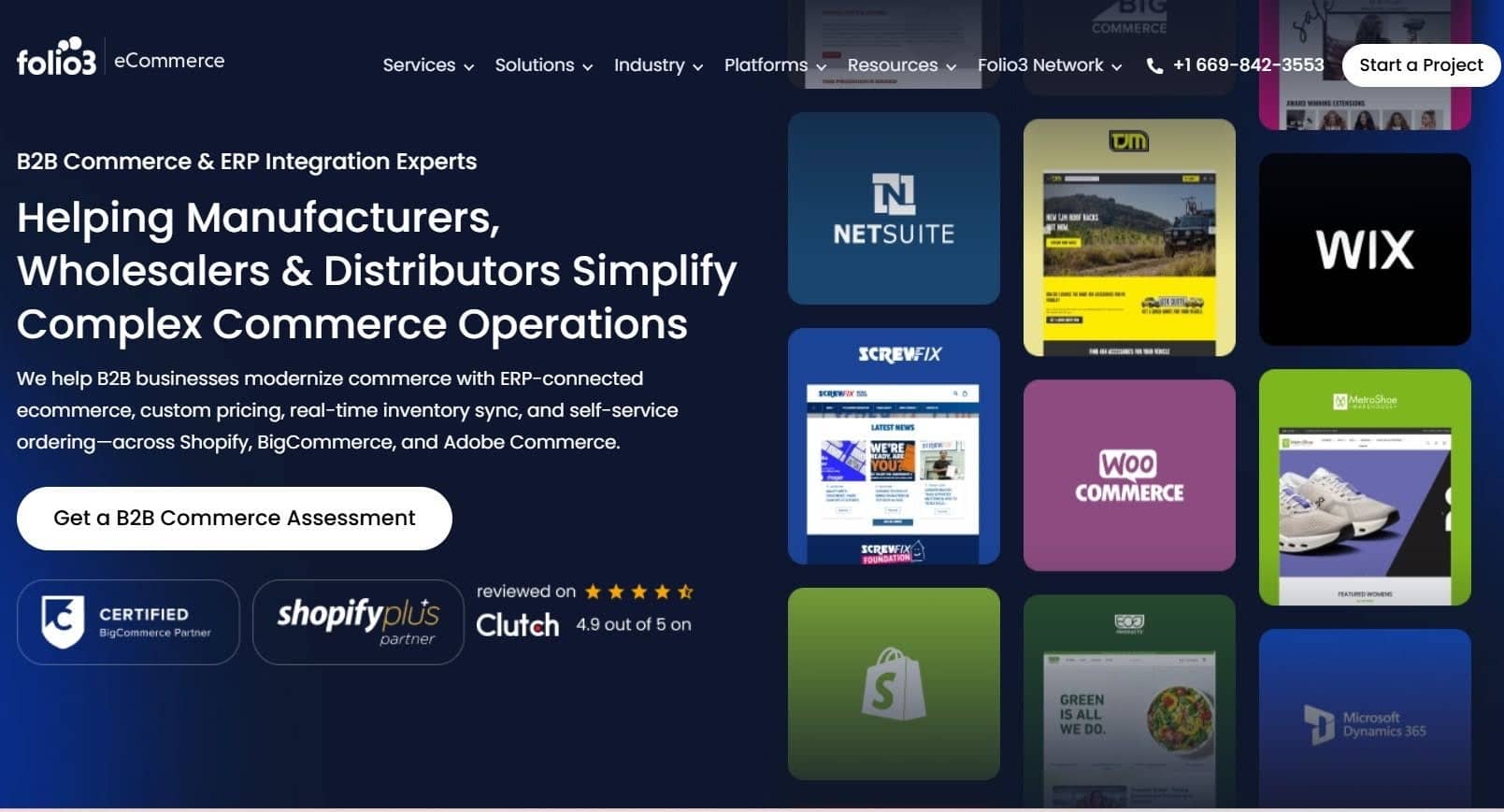
Best for certified Shopify Plus and BigCommerce builds with native ERP connectivity
Folio3 Ecommerce is a certified Shopify Plus and BigCommerce partner specializing in B2B ecommerce development, platform migrations, custom app development, and ERP integrations for manufacturers, distributors, and wholesale businesses.
Its published capabilities cover Shopify Plus B2B implementations including company accounts, customer-specific pricing, wholesale checkout, and multi-store setups, alongside BigCommerce B2B Edition deployments with account hierarchies, price lists, quoting, and approval workflows. The company also describes native integration support for ERP environments including NetSuite, SAP, and Microsoft Dynamics, as well as CRM connectivity and custom app development for stores requiring functionality beyond standard platform features.
Folio3 Ecommerce serves merchants in North America, Australia, and Europe and positions its work at the intersection of platform implementation and back-office data accuracy. Its migration practice covers moves from Magento, WooCommerce, and BigCommerce to Shopify, as well as BigCommerce replatforming from older systems.
This combination is most relevant when a B2B seller needs a single partner to handle the storefront, the integration layer, and the custom development work together rather than coordinating three separate vendors.
Best fit: A manufacturer, distributor, or wholesale brand evaluating b2b ecommerce development services with certified Shopify Plus or BigCommerce expertise and native ERP integration from one partner.
Important limitation to investigate: Confirm which ERP version and integration architecture the proposed team has delivered in comparable projects. Ask for a reference involving a similar catalog size, pricing model, and account structure to the one you are operating.
Smith
Best for large companies that need commerce, marketing, and data under one program
Smith describes itself as a performance commerce agency. Its capabilities span customer experience, commerce technology, digital marketing, and data and AI, with dedicated work in manufacturing and distribution.
The agency also lists partnerships involving SAP, commercetools, and Kibo. That breadth makes it a relevant option when a company does not want platform development, customer experience, marketing, and analytics managed by unrelated vendors.
Smith’s model is most useful when ecommerce is already a meaningful revenue channel or is expected to become one. A manufacturer may need to modernize the transaction platform, improve product discovery, increase portal adoption, optimize media, and introduce better reporting at the same time.
The advantage is coordination. The risk is scope complexity.
Best fit: An established manufacturer or distributor seeking a broad transformation partner rather than a narrow implementation shop.
Important limitation to investigate: Ask which team will own the architecture, which team will own acquisition, and how the two groups will make decisions together. A broad agency relationship only creates value when responsibilities remain clear.
Americaneagle.com
Best for industrial companies with complicated operational systems
Americaneagle.com combines custom development and digital marketing for manufacturers and distributors.
Its published industrial practice covers ERP, PIM, supply-chain, and ecommerce integration. The company also describes support for negotiated pricing, customer-specific catalogs, purchase orders, approval workflows, PunchOut, multi-location inventory, buyer portals, order history, warranty information, quoting, and digital marketing. It identifies experience with systems such as Prophet 21, Epicor, Infor, NetSuite, SAP, and proprietary business software.
This breadth makes Americaneagle.com relevant for companies whose ecommerce project crosses several internal departments. The marketing team may need better lead generation while operations needs accurate inventory, IT needs manageable integrations, and customer service needs a self-service portal that reduces routine requests.
Best fit: A manufacturer or distributor that needs custom development, industrial system integration, and ongoing marketing support from one large provider.
Important limitation to investigate: “ERP experience” is too broad to be meaningful on its own. Ask for a reference involving the exact ERP version, ecommerce platform, pricing model, catalog size, and order workflow used by your organization.
Xngage
Best for manufacturers and distributors seeking a focused B2B specialist
Xngage concentrates on ecommerce for manufacturers, distributors, and wholesalers. Its services include B2B strategy, platform implementation, user experience, PIM implementation, process improvement, and digital growth.
The company is based in Cleveland and presents a portfolio centered on established distribution and industrial organizations rather than primarily consumer retail brands.
That industry focus can reduce the amount of time spent explaining why business buyers need capabilities such as product lists, branch inventory, account pricing, technical search, and repeat ordering.
It can also help when internal teams need a partner that understands ecommerce as an operating channel, not just a web property.
Best fit: North American manufacturers, wholesalers, and distributors that want a partner familiar with established B2B processes and digital transformation.
Important limitation to investigate: Confirm the agency’s practical experience with your selected platform, ERP, search technology, and PIM. Industry familiarity is valuable, but the proposed technical team must still match the actual stack.
Rixxo
Best for companies that have not yet chosen the right platform
A surprising number of ecommerce projects begin with a platform decision that has already been made.
The company selects software after a demonstration, hires an agency to implement it, and only later discovers that the platform cannot support a critical pricing rule or purchasing workflow without expensive customization.
Rixxo takes a more advisory-led position. Its current services cover business assessment, platform selection, platform validation, strategy, integrations, automation, implementation, training, adoption, optimization, and internal team development. The agency’s focus includes manufacturers, wholesalers, distributors, building-material businesses, and automotive-parts companies.
Rixxo is therefore worth considering before issuing a platform-specific request for proposal. Its greatest value may be helping a company determine whether it needs a replatform at all.
Best fit: A B2B company that understands its commercial goals but remains uncertain about platform selection, internal readiness, or the right sequence of investment.
Important limitation to investigate: Clarify which implementation work Rixxo will deliver directly, which work may involve technology partners, and who remains accountable after the strategy phase.
Charle Agency
Best for Shopify Plus wholesale and hybrid B2B-DTC businesses
Charle Agency is a Shopify specialist with a dedicated B2B and wholesale practice.
Its published services cover Shopify and Shopify Plus implementations for brands selling to both consumers and business accounts. The agency works with Shopify’s native B2B capabilities, custom Shopify architecture, wholesale applications, and tools such as SparkLayer.
This makes Charle particularly relevant to a brand that has already committed to Shopify and wants to operate retail and wholesale commerce within a coordinated environment.
The agency should be able to help determine whether the company needs a blended storefront, a separate B2B experience, or additional applications layered onto Shopify’s native features.
Best fit: A wholesale or hybrid brand that has selected Shopify Plus and needs implementation, design, customization, and post-launch growth support.
Important limitation to investigate: Do not assume every B2B requirement can be handled through a standard app. Ask the agency to demonstrate how it would support your account hierarchy, contract pricing, payment terms, tax rules, ERP, quoting process, and product data.
i95Dev
Best for repairing ecommerce and ERP communication
When the storefront shows the wrong information, the problem may not be the storefront.
It may be an integration that updates inventory too slowly, fails to recognize an account’s price list, drops an order field, or cannot reconcile offline and online purchasing history.
i95Dev specializes in connecting ecommerce and ERP systems. Its current offering supports platforms including Adobe Commerce, Shopify, and BigCommerce, alongside ERP environments such as Microsoft Dynamics, SAP Business One, and NetSuite. It also publishes support for custom fields, customer pricing, complex B2B workflows, portals, marketplaces, and wider CRM and PIM connectivity.
This integration-first approach is useful when the company wants to preserve its existing storefront while fixing the flow of pricing, inventory, customer, and order data.
Best fit: A manufacturer, distributor, or hybrid seller whose customer experience is being undermined by disconnected back-office systems.
Important limitation to investigate: Integration expertise does not necessarily include brand strategy, demand generation, or extensive front-end experience design. Establish whether those areas require a second partner.
Web Solutions NYC
Best for complex Adobe Commerce and Magento implementations
Adobe Commerce remains a common choice for B2B businesses that need extensive customization and detailed account workflows.
Web Solutions NYC focuses on Adobe Commerce and Magento development for enterprise and B2B environments. Its published capabilities reference company accounts, account hierarchies, approval workflows, customer-specific pricing, negotiated quotes, requisition lists, purchase-order payments, and net terms. It also identifies experience across manufacturing, wholesale distribution, industrial equipment, and related complex sectors.
This makes the agency relevant when standard SaaS functionality cannot comfortably support the company’s pricing rules, buyer structures, or transactional requirements.
Best fit: A business already running Adobe Commerce or selecting it because its B2B model requires substantial customization.
Important limitation to investigate: Adobe Commerce provides flexibility, but that flexibility brings operational responsibility. Confirm hosting, upgrades, security, extension management, quality assurance, monitoring, and long-term maintenance before approving the architecture.
5874 Commerce
Best for BigCommerce, Shopify Plus, product data, and connected architecture
5874 Commerce works across B2B, direct-to-consumer, and headless commerce, with capabilities in platform strategy, integration, product data, user experience, conversion optimization, and ongoing support.
The agency identifies platform expertise across BigCommerce and Shopify Plus and describes connecting commerce with ERP and PIM environments. Its B2B services include portals, complex procurement, custom pricing, system architecture, and continuous optimization.
This combination is useful when the business needs more than a front-end implementation. Large catalogs often require better product information management, while business workflows require reliable middleware and integration architecture.
Best fit: A B2B seller evaluating BigCommerce, Shopify Plus, headless commerce, PIM, or an interconnected technology stack.
Important limitation to investigate: The agency covers several disciplines. Confirm which specialists are included in the proposed account team and whether marketing, product data, integration, and development are all part of the contracted scope.
Fluid Commerce
Best for combining B2B platform work with ecommerce marketing
Fluid Commerce supports B2B customer portals and ecommerce websites on Adobe Commerce, Magento Open Source, Shopify, and Hyvä.
Its service offering covers ERP integrations, self-service account functionality, platform development, support, PPC, paid social, and SEO for manufacturers, wholesalers, distributors, and suppliers. Fluid also offers a Magento-based B2B portal product for companies seeking common wholesale features without moving to a larger Adobe Commerce implementation.
This creates a practical middle ground for companies that need technical implementation and post-launch customer acquisition but do not want to coordinate a development agency and a separate performance-marketing firm.
Best fit: A mid-market B2B seller that needs Adobe Commerce, Magento, or Shopify expertise alongside ongoing search and paid-media support.
Important limitation to investigate: Organizations managing many countries, business units, languages, and enterprise systems should confirm that the proposed team has the capacity and governance experience required for the full program.
Match the Partner to the Problem

The most expensive agency mistake is choosing a partner for the project you think you need instead of the problem you actually have.
Your storefront works, but acquisition performance is unclear
Begin with SeedX. The priority is not a replatform. It is connecting customer acquisition, CRM activity, online orders, retention, and financial performance.
You need a broad enterprise transformation
Evaluate Smith or Americaneagle.com. Both are better suited to programs that span technology, customer experience, operations, and growth.
You want an industry-focused partner for manufacturing or distribution
Xngage belongs on the shortlist, particularly when the company values a team centered on industrial and distribution use cases.
You are uncertain which platform to buy
Start with Rixxo before issuing a platform-specific request for proposal. A neutral assessment can prevent years of customization around the wrong software.
Shopify Plus has already been selected
Charle Agency is the most platform-focused candidate in this list for Shopify B2B and wholesale implementations.
Pricing, inventory, and account data do not synchronize
Talk to i95Dev before replacing the entire storefront. The primary requirement may be integration rather than redesign.
Adobe Commerce or Magento is central to the roadmap
Web Solutions NYC and Fluid Commerce are the most relevant options in this list. The better choice depends on whether the priority is deep platform engineering or a combination of development and marketing.
BigCommerce, Shopify Plus, PIM, or headless architecture is under consideration
5874 Commerce may be a useful fit when platform implementation, product data, integrations, and ongoing optimization must work together.
Warning Signs in an Agency Proposal
A professional proposal should make a complicated project easier to understand. Be careful when it does the opposite.
The agency cannot identify the system of record
It should be clear whether the ERP, ecommerce platform, CRM, or another system controls pricing, inventory, customer status, product content, and order information.
The integration is described only as “seamless”
A credible scope explains which data objects move, in which direction, how frequently, through which technology, and what happens when a connection fails.
Success is defined entirely by traffic or ROAS
Channel metrics can help optimize campaigns, but they do not reveal whether marketing is creating valuable accounts, repeat orders, healthy margins, or qualified pipeline.
The agency recommends a replatform before completing discovery
A replatform may be necessary, but it should follow a documented assessment of the existing platform, integrations, data, workflows, and cost of ownership.
The customer-adoption plan is missing
A portal will not create value when buyers continue placing every order through email and sales representatives quietly discourage digital adoption.
The people presenting the proposal will not deliver the work
Meet the solution architect, project lead, integration lead, and marketing strategist who will be responsible after the contract is signed.
Questions to Ask Every Agency
Use the following questions during the final selection process:
- Which system will control customer pricing, inventory, credit limits, product content, and order status?
- Which information will move in real time, and which information will synchronize on a schedule?
- How will the platform support company accounts, user roles, spending limits, and approvals?
- Can buyers see orders placed through sales representatives or other offline channels?
- How will quotes, purchase orders, net terms, invoices, and tax exemptions be managed?
- What is the process for cleaning and migrating customer, product, and order data?
- How will the agency test pricing, inventory, permissions, and integrations before launch?
- What happens when the ERP or another critical service is unavailable?
- How will customers and sales teams be encouraged to adopt the new channel?
- How will acquisition costs be connected to account value, repeat orders, margin, and revenue?
- Who will monitor integrations and platform performance after launch?
- Which assumptions could materially change the budget or schedule?
Strong agencies will answer with diagrams, examples, responsibilities, and documented assumptions. Weak agencies will return to general language about innovation and seamless experiences.
Choosing by Service, Platform, and Location
A company searching for a b2b ecommerce marketing agency usually has a different problem from one seeking an integration specialist. The platform may already work, but the business needs qualified traffic, stronger account acquisition, improved attribution, and more repeat purchasing. The agency should report on account quality and commercial outcomes rather than stopping at form submissions.
A b2b ecommerce digital marketing agency should understand that the person clicking an advertisement may not be the final decision-maker. Campaign strategy should account for technical evaluators, procurement teams, finance stakeholders, sales representatives, and the length of the buying process. Content, SEO, paid media, email, CRM, and analytics must support the same account journey.
Location-based searches can be useful, but they should not control the decision. A search for a b2b ecommerce agency in boston, a b2b ecommerce agency cleveland, or a b2b ecommerce agency austin can help identify teams available for local workshops. The next step should still be evaluating platform experience, ERP familiarity, catalog complexity, buyer workflows, and the quality of the proposed delivery team. Xngage, for example, is based in Cleveland and specializes in manufacturers, distributors, and wholesalers, but a buyer should still verify technical fit.
A shopify b2b ecommerce agency should demonstrate more than theme development. Ask to see company accounts, customer-specific catalogs, wholesale pricing, payment terms, buyer permissions, blended B2B-DTC architecture, ERP integration, tax handling, and bulk-order workflows.
A bigcommerce b2b ecommerce agency should be able to show account hierarchies, price lists, quoting, invoice payments, reordering, approval rules, sales-representative involvement, ERP connectivity, and practical experience with BigCommerce B2B Edition. Partner status is useful, but a comparable implementation is stronger evidence.
What Does a B2B Ecommerce Agency Actually Do?
A B2B ecommerce agency helps translate your company’s commercial processes into a digital buying environment.
That can include:
- ecommerce strategy;
- platform selection;
- UX and design;
- development;
- ERP integration;
- CRM integration;
- PIM integration;
- order management;
- product data;
- customer-specific catalogs;
- pricing logic;
- account hierarchies;
- quotes;
- purchase orders;
- payment terms;
- quick ordering;
- marketing;
- SEO;
- analytics;
- post-launch optimization.
The exact mix depends heavily on your business.
A manufacturer with 60,000 SKUs and SAP integration requirements has a very different project from a growing brand adding wholesale functionality to an existing Shopify store.
That is why “full-service ecommerce agency” tells you very little.
Ask:
Full service for what type of B2B commerce?
B2B Ecommerce Agency Evaluation Scorecard
Use the same evaluation criteria for every agency.
Otherwise, agency selection can quickly become:
Agency A gave the nicest presentation.
That is not particularly scientific.
| Evaluation Area | What to Evaluate | Suggested Weight |
|---|---|---|
| B2B Commerce Experience | Comparable B2B projects, buyer workflows and commercial complexity | 15% |
| ERP and Integration Expertise | Pricing, inventory, orders, customers, invoices and system ownership | 15% |
| Platform Expertise | Relevant experience with your existing or shortlisted platform | 10% |
| Buyer Experience | Accounts, permissions, bulk ordering, reorders, quotes and approvals | 10% |
| Product Data | Catalog structure, PIM, technical specifications and search | 10% |
| Discovery Process | Ability to understand business rules before development begins | 10% |
| Marketing and Growth | SEO, acquisition, CRM, analytics, conversion and retention | 10% |
| Technical Architecture | Scalability, APIs, security, performance and maintainability | 5% |
| Post-Launch Support | Monitoring, maintenance, optimization and roadmap support | 5% |
| Delivery Team | People who will actually work on the project | 5% |
| Commercial Fit | Scope clarity, assumptions, budget structure and change management | 5% |
Score every agency from 1 to 5 for each category.
Then multiply the score by the weighting.
The weighting should change according to the project.
If your biggest problem is an old ERP, integrations deserve more weight.
If your platform already works but ecommerce revenue is weak, acquisition, analytics, and conversion optimization deserve more attention.
Start With the Business Problem, Not the Platform
One of the most expensive mistakes is beginning with:
“We need Shopify.”
or:
“We need Adobe Commerce.”
before defining the actual buying requirements.
Start by documenting:
Customer Structure
Do customers have:
- one buyer;
- several buyers;
- several locations;
- departments;
- approval hierarchies?
Pricing
Do you use:
- contract pricing;
- customer-specific pricing;
- volume discounts;
- negotiated quotes;
- regional pricing?
Ordering
Do customers need:
- bulk ordering;
- SKU entry;
- CSV upload;
- saved lists;
- repeat ordering;
- purchase orders?
Payments
Do you support:
- credit cards;
- net terms;
- account credit;
- invoices;
- deposits;
- partial payments?
Product Data
Do buyers need:
- technical specifications;
- compatibility data;
- downloadable documents;
- certificates;
- dimensions;
- replacement parts?
Integrations
Which systems control:
- customer records;
- inventory;
- price;
- product data;
- order status;
- shipping;
- invoices?
Once these questions are clear, platform selection becomes considerably easier.
Shopify, BigCommerce or Adobe Commerce?
The platform should follow the business requirements.
| Platform | Strong Fit | Agency Experience to Verify |
|---|---|---|
| Shopify B2B | Companies wanting B2B and DTC in a modern commerce environment | Companies, catalogs, company locations, payment terms, ERP integrations and custom workflows |
| BigCommerce B2B | Mid-market and enterprise sellers needing strong B2B functionality and flexible integrations | Buyer portals, account structures, quoting, price lists, integrations and complex catalogs |
| Adobe Commerce | Complex B2B organizations needing deep account, quote, catalog and purchasing workflows | Company accounts, shared catalogs, quotes, purchase orders, requisition lists and integrations |
| Custom / Headless | Companies with unusual workflows or strong composable-commerce requirements | API architecture, frontend development, integration ownership and long-term maintenance |
Do not choose solely according to which platform has the longest feature list.
Choose based on how closely the platform matches your actual selling model.
Shopify B2B
Shopify supports B2B functionality including:
- companies;
- company locations;
- customer-specific catalogs;
- quantity rules;
- volume pricing;
- payment terms;
- account-specific settings.
The agency should still demonstrate that it understands your integrations and commercial rules.
Knowing how to build a Shopify theme is not enough.
Adobe Commerce
Adobe Commerce supports deeper B2B workflows including:
- company accounts;
- organizational structures;
- shared catalogs;
- customer-specific pricing;
- quick ordering;
- negotiated quotes;
- purchase orders;
- requisition lists.
Explore Adobe Commerce B2B features
For complex organizations, ask the agency to demonstrate these workflows rather than simply showing visually attractive ecommerce sites.
ERP Integration Should Be Discussed Before Design
In many B2B projects, the ERP is more important than the homepage.
It may control:
- pricing;
- inventory;
- customer status;
- credit;
- tax;
- orders;
- fulfillment;
- invoices.
Before development begins, document which system owns each field.
| Data | Possible System of Record | Question to Answer |
|---|---|---|
| Product Information | PIM / ERP | Where is the authoritative product record? |
| Inventory | ERP / WMS | How quickly must inventory synchronize? |
| Pricing | ERP / Ecommerce | Which system calculates customer-specific price? |
| Customer Accounts | ERP / CRM | Where are commercial terms managed? |
| Orders | Ecommerce / ERP | When does an online order become an ERP order? |
| Invoices | ERP | Can customers access invoice history online? |
| Shipping | ERP / WMS / Carrier | Which system returns delivery options? |
Final Thoughts
The best B2B ecommerce partner is not necessarily the agency with the largest development team, the most platform badges, or the most impressive design portfolio.
It is the agency that accurately identifies the constraint standing between your customers and a completed order.
For one company, that constraint is a broken ERP integration. For another, it is poor product data. For another, the technology works but marketing cannot distinguish valuable accounts from low-quality traffic. Some companies need a large transformation partner. Others need a narrow specialist to repair one critical layer without rebuilding everything around it.
Begin with the failure point.
Then choose the agency whose people, process, and technical experience are built around solving it.
FAQs About B2B Ecommerce Agencies
What is a B2B ecommerce agency?
A B2B ecommerce agency helps companies build, connect, market, and optimize digital purchasing channels used by other businesses. Its services may include ecommerce strategy, platform development, ERP and CRM integration, account-specific pricing, buyer portals, SEO, paid media, analytics, and customer adoption.
How is a b2b ecommerce marketing agency different from a development agency?
A b2b ecommerce marketing agency focuses on attracting qualified business accounts, improving attribution, increasing customer value, and encouraging repeat purchases. A development agency focuses primarily on platform functionality, performance, integrations, security, and technical maintenance. Some agencies provide both services, but their depth should be evaluated separately.
When should a company hire a b2b ecommerce digital marketing agency?
A company should hire a b2b ecommerce digital marketing agency when the platform is stable but the business lacks qualified demand, accurate attribution, account-level reporting, or a reliable retention program. Marketing investment should not be increased while buyers are still encountering inaccurate pricing, unavailable inventory, or broken purchasing workflows.
Is hiring a b2b ecommerce agency in boston better for a Boston company?
Hiring a b2b ecommerce agency in boston can make in-person workshops easier, but location does not prove relevant expertise. A Boston business should first evaluate industry experience, platform knowledge, ERP capability, delivery-team quality, and comparable client work.
What should I check when comparing a b2b ecommerce agency cleveland result?
When reviewing a b2b ecommerce agency cleveland result, confirm that the firm has genuine B2B commerce experience rather than general web-development capability. Ask for manufacturer or distributor references, platform credentials, integration examples, and evidence involving contract pricing, product data, buyer accounts, and repeat ordering.
How should I evaluate a b2b ecommerce agency austin search result?
A search for a b2b ecommerce agency austin may return development firms, consumer ecommerce agencies, consultants, and marketing companies. Classify each company by its real specialty before arranging calls. Determine whether your primary requirement is platform development, ERP integration, product data, digital marketing, or a coordinated combination.
What should a shopify b2b ecommerce agency provide?
A shopify b2b ecommerce agency should support Shopify Plus company accounts, catalogs, price lists, payment terms, user permissions, wholesale checkout, and B2B-DTC architecture. It should also be able to explain how Shopify will connect with the ERP, PIM, CRM, tax, inventory, and fulfillment systems.
What should a bigcommerce b2b ecommerce agency provide?
A bigcommerce b2b ecommerce agency should understand BigCommerce B2B Edition, account roles, customer pricing, quotes, purchase orders, invoices, approval processes, quick ordering, reordering, and backend integrations. Request a demonstration or case study involving a business with similar catalog and workflow complexity.
Should an agency manage both development and marketing?
One agency can manage both when its technical and marketing practices are sufficiently developed and operate under a shared measurement model. This arrangement reduces vendor coordination, but the company should meet the leaders of both teams and understand how platform priorities will be balanced against acquisition goals.
How much does a B2B ecommerce agency cost?
Cost depends on the platform, ERP, catalog size, data quality, custom workflows, number of markets, integrations, migration requirements, and support model. A buyer should request a phased estimate showing assumptions, exclusions, dependencies, third-party fees, and change-control rules rather than relying on one unexplained project total.
Other Interesting Articles
- AI LinkedIn Post Generator
- Gardening YouTube Video Idea Examples
- AI Agents for Gardening Companies
- Top AI Art Styles
- Pest Control YouTube Video Idea Examples
- Automotive Social Media Content Ideas
- Plumber YouTube Video Idea Examples
- AI Agents for Pest Control Companies
- Electrician YouTube Video Idea Examples
- How Pest Control Companies Can Get More Leads
- AI Google Ads for Home Services
- 60-Second Training Videos Are the New Corporate Standard
- Cybersecurity PR Pricing: Retainers, Deliverables & ROI
- Best AI Tools for Product Consistency in E-Commerce Video
Master the Art of Video Marketing
AI-Powered Tools to Ideate, Optimize, and Amplify!
- Spark Creativity: Unleash the most effective video ideas, scripts, and engaging hooks with our AI Generators.
- Optimize Instantly: Elevate your YouTube presence by optimizing video Titles, Descriptions, and Tags in seconds.
- Amplify Your Reach: Effortlessly craft social media, email, and ad copy to maximize your video’s impact.