
Best AI Humanizer Tools for Marketers and SEO Teams

If you have used AI for content marketing or SEO, you probably know the problem.
The draft is fast.
The structure is fine.
The grammar is clean.
And somehow, the whole thing still sounds like it was written by a very polite robot that just discovered LinkedIn.
That is why AI humanizer tools have become part of the content workflow for many marketers and SEO teams. They can help smooth awkward phrasing, add more natural rhythm, break up predictable sentence patterns, and make AI-assisted drafts feel less stiff.
But here is the important part: humanizing AI content is not only about swapping words.
A good human editing process protects meaning, improves clarity, adds real experience, checks facts, sharpens the point of view, and makes the final piece useful for the reader. The goal is not to “trick” tools or hide that AI helped. The goal is to publish better content.
That explains why AI humanizers are now part of the real workflow of many teams. But they are not all equally useful to marketers. Some are all surface word replacements. Others are designed as more one-off rewrites, not repeatable publishing work. And some end up adding another subscription to your stack without taking enough time off your editing plate.
The best tool for a marketer isn’t the one that makes the biggest claims, it’s the one that helps your team to work faster, preserve the original meaning and news budget of editing work before publishing.
If I was looking today for an in-house content team or an SEO agency, I would ask these questions: Does the output still have your voice? Can you turn to it when you need a hand with a draft? Is it just fine for articles, or is it good for long-form blog content, as well as landing page sections and emails? And if the need is an occasional one, do you actually have to pay for it?
Here is the shortlist I would look at in 2026.
Chapters
- What actually matters for marketers and SEO teams
- Walter Writes AI
- HumanizeAIText.io
- GPTHumanizer AI
- QuillBot AI Humanizer
- AISEO Humanizer
- Wordtune Humanize AI
- StealthWriter
- Which one would I actually choose?
- How to Use AI Humanizer Tools Successfully
- Final Tip: Humanized Content Should Be More Useful, Not Just Less Robotic
- FAQ
| Tool | Best for | Where it fits best | What marketers and SEO teams will like | Main limitation |
|---|---|---|---|---|
| Walter Writes AI | Teams producing AI-assisted content at volume | Blog posts, landing pages, SEO refreshes, email copy | Structural humanization, tone controls, built-in detector, 80+ languages | Less necessary for very short one-off edits |
| GPTHumanizer AI | Teams that want natural rewrites without setup friction | Blog drafts, landing pages, article updates, email copy | Free access, no sign-up, strong fit for real publishing workflows | Less necessary if you only want tiny sentence-level edits |
| QuillBot AI Humanizer | Editors working inside a broader writing stack | Cleanup, polishing, rewriting, grammar passes | Familiar interface and useful if your team already uses writing tools in one ecosystem | Better for polishing than deep reshaping |
| AISEO Humanizer | SEO-led teams | SEO blog workflows and optimization-driven content | More aligned with search-focused content production | Can feel heavier if you only want quick rewrites |
| Wordtune Humanize AI | Short-form marketers | Emails, ads, social copy, short website sections | Great for tone adjustment and fast copy refinement | Not my first pick for heavier long-form rewriting |
| StealthWriter | Quick testing and fast rewrites | Rapid before-and-after rewriting | Easy to try and useful for fast experiments | Not the tool I would build a serious editorial workflow around |
What actually matters for marketers and SEO teams

I think this is where a lot of listicles go wrong. They review AI humanizers as if every user has the same goal. That’s not the case.
A student looking for sentence variation is not the same as a content team trying to publish pages that still sound like the brand. A solo blogger is not the same as an SEO manager refreshing old articles at scale. For marketers the true test is whether it can elevate the quality of the draft without necessitating a second round of work that isn’t necessary.
What matters most to me is meaning retention. If a humanizer changes the claim, weakens the CTA, or softens the positioning, then it does more harm than good.
What matters next is rhythm. Good tools do more than swap words. They alter the flow of sentences, break predictable AI pacing, and make the writing feel less synthetic.
What matters after that is usability. Most teams don’t want another slow onboarding process. If a writer or editor needs help on one draft today, the best tool is one that they can simply open and get started.
And the last thing I care about is format flexibility. A good AI humanizer needs to help with blog intros, landing page copy, comparison sections, emails, and content refreshes. Marketers don’t work in a single content format.
Walter Writes AI
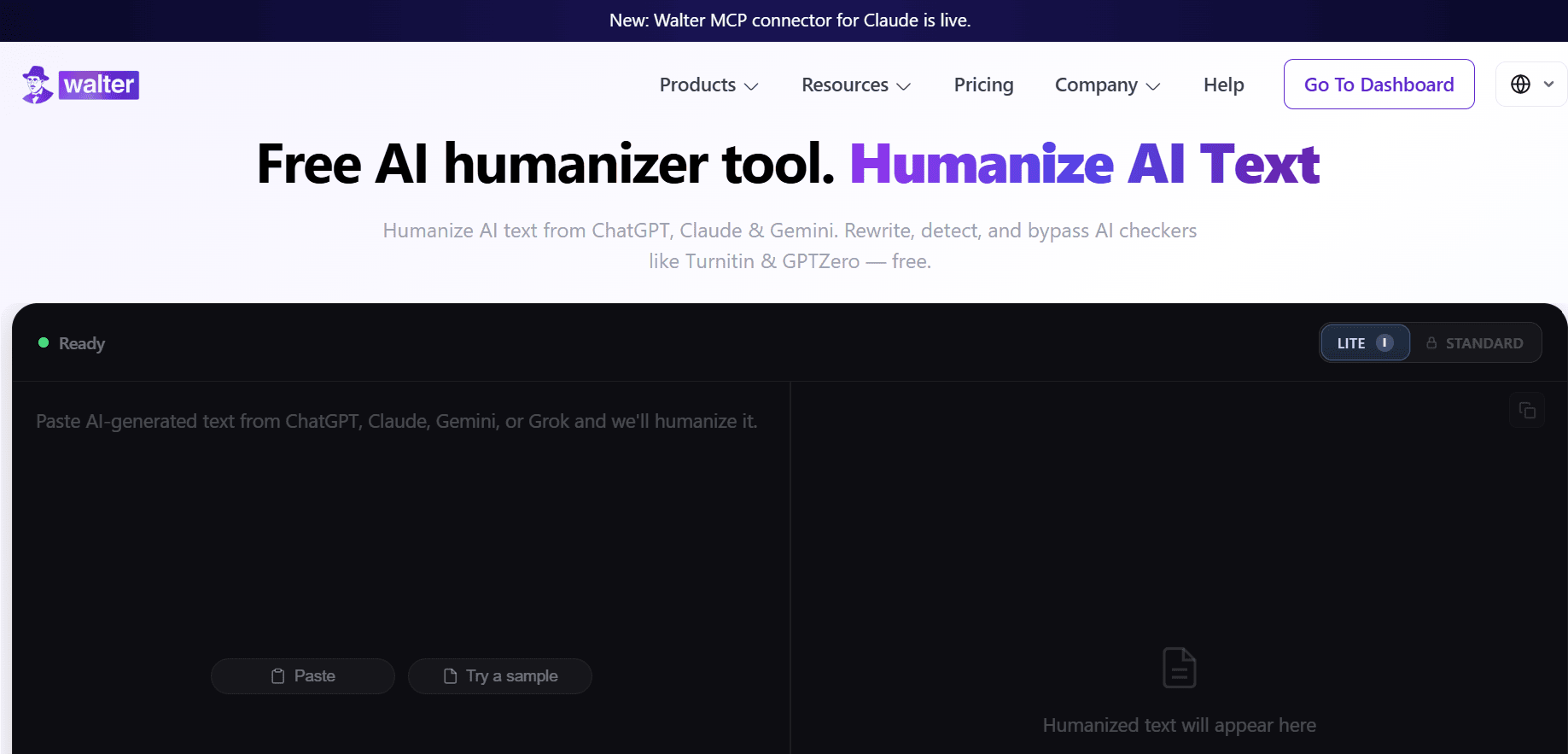
For marketing and SEO teams that need a reliable AI humanizer and not just a surface-level rewrite tool, Walter Writes AI is where I would start.
What separates it from most tools on this list is the depth of the rewrite. It does not just swap synonyms. It restructures how sentences connect and flow, which is the actual problem with most AI drafts. The rhythm is too predictable. Walter Writes AI breaks that pattern without stripping out meaning, positioning, or the details your editors worked to get right.
The use of professional, casual, and academic mode settings provide sufficient options to meet the variety of content type requirements for your team without requiring additional heavy post-processing. The integrated AI detection function eliminates another processing step from your workflow. Support for over 80 languages enables global teams generating content in multiple markets to utilize Walter Writes effectively.
My view: if AI drafts are still taking too long to clean up, Walter Writes AI is the most practical first stop on this list.
HumanizeAIText.io
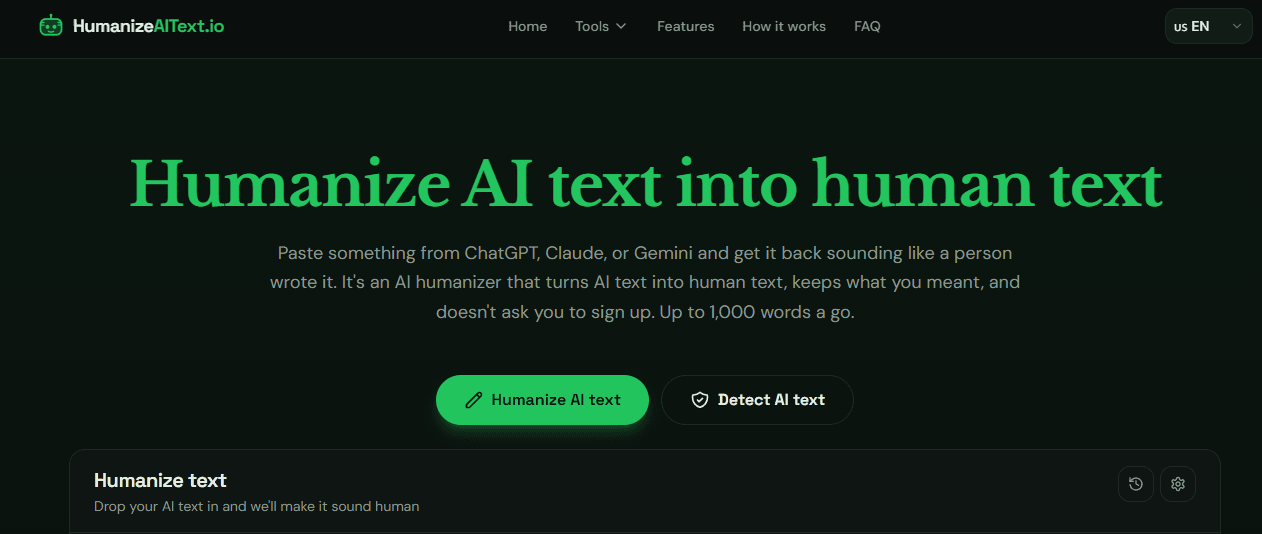
HumanizeAIText.io is another option worth considering if your main goal is to make AI-assisted content sound more natural without adding a complicated step to the editing process.
The appeal here is simplicity. Instead of treating humanization as a major editing project, HumanizeAIText.io can be used as a quick pass after generating an AI draft. That makes it useful for marketers, bloggers, and SEO teams who regularly work with AI-generated first drafts and want to improve the overall flow before moving into their normal editing process.
For SEO teams, this can be particularly useful when working across multiple content formats. Blog posts, landing page sections, supporting website copy, and other marketing content can all benefit from more natural phrasing and sentence flow.
I wouldn’t treat any AI humanizer as a replacement for an actual editor. The best workflow is still AI draft → humanization → human review → fact-checking → final optimization. HumanizeAIText.io can help with the rewriting stage, but your team should still make sure the final content reflects the brand’s voice, provides accurate information, and actually gives readers something useful.
My view: HumanizeAIText.io is worth considering if you want a straightforward AI humanizer that can fit into an existing content workflow without making the process unnecessarily complicated. For occasional users and teams looking for a quick way to improve the naturalness of AI-assisted drafts, it’s a practical option to test.
GPTHumanizer AI
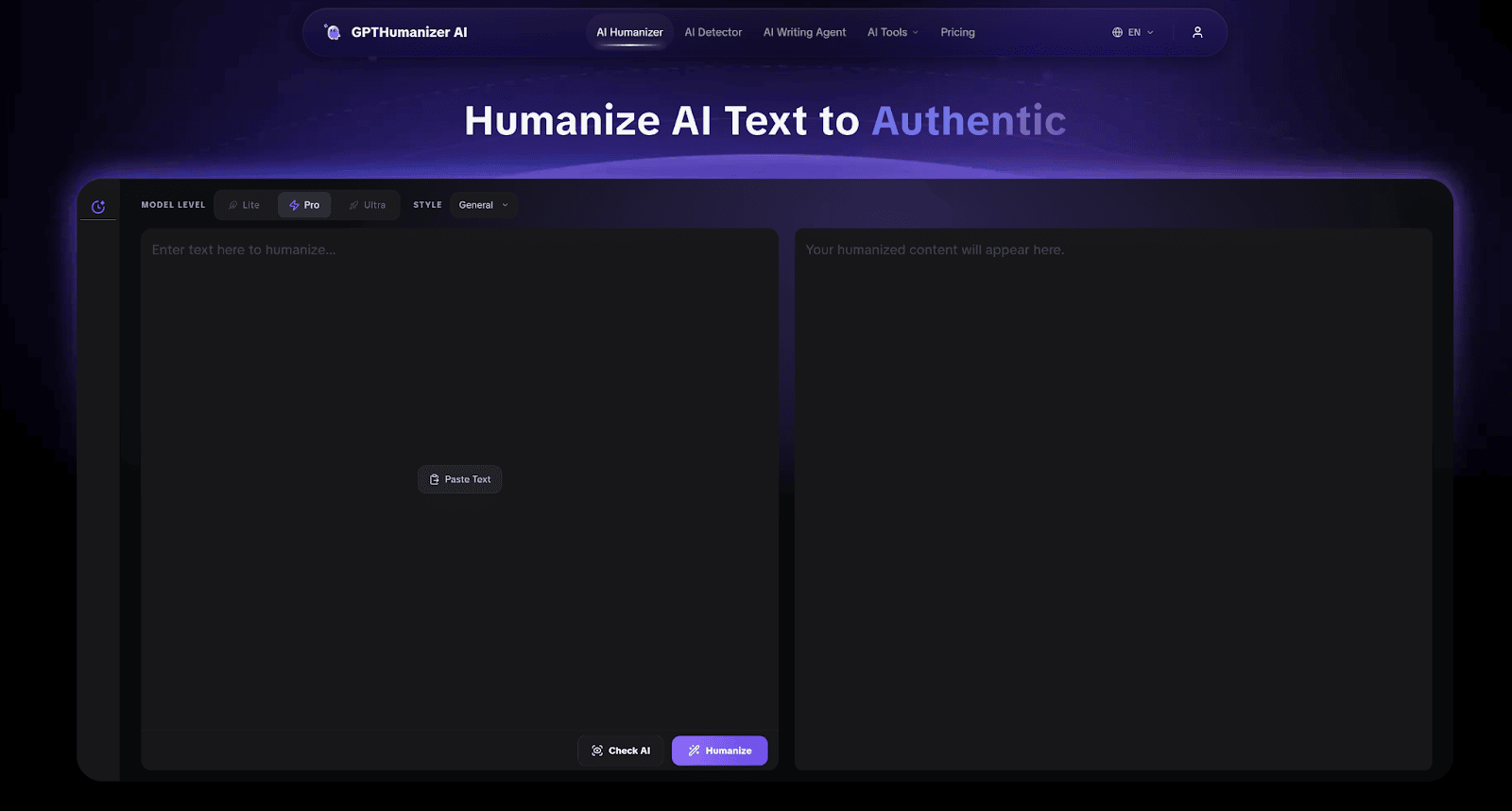
For most marketing teams, this is the one I would start with first.
What I like about GPTHumanizer AI is that it feels closer to a real publishing tool than a novelty rewrite tool. It is built around making AI-generated text sound more natural, readable, and usable in actual content workflows. That matters if your team is working on blog drafts, landing pages, comparison pages, email sequences, or old SEO articles that need a cleaner second pass.
The bigger advantage, though, is how easy it is to use in real life. If your team only has occasional rewriting needs, you may not need a paid plan at all. GPTHumanizer AI offers a free AI humanizer with unlimited use and no sign-up required, which means you can open it only when you need it and start working immediately. No login, no setup, no wasted time persuading the team to adopt another tool before they even know whether it helps.
That access model is more important than it sounds. A lot of content teams do not need another full subscription just to clean up a few AI-assisted drafts each week. Sometimes they just need to paste in a section, improve the flow, and move on.
My view: if your problem is that AI drafts still sound robotic even after editing, GPTHumanizer AI is one of the most practical starting points on this list.
QuillBot AI Humanizer
QuillBot makes sense for teams that already like working inside an editing ecosystem.
I do not think of QuillBot as the strongest option for deep transformation. I think of it as a dependable cleanup tool. If your writers are already using paraphrasing, grammar checks, or other editing features in the same stack, adding the humanizer can feel natural.
That is really its advantage for marketers. It is less about radical rewriting and more about fitting into an existing editorial routine. For teams with human editors already making the final calls, that can be enough. You do not always need a dramatic rewrite. Sometimes you just need an AI-heavy paragraph to sound less stiff and more readable.
My view: QuillBot is a solid choice if your process already includes hands-on editing and you want a broader writing toolkit around the humanizer itself.
AISEO Humanizer
AISEO is the most obviously SEO-oriented option in this group.
That makes it a reasonable fit for teams whose workflow is already driven by search intent, optimization, content briefs, and performance updates. If your content operation lives inside SEO planning, the appeal is clear: you are not just polishing copy, you are trying to improve readability while staying aligned with the page’s purpose.
What I like here is the fit for SEO-led teams rather than general-purpose writers. What I like less is that it can feel like more platform than you need if your main goal is simply to make a few drafts sound less machine-written.
My view: a good option for SEO teams that want the humanizing step to sit inside a more search-focused workflow.
Wordtune Humanize AI
Wordtune is the tool I would recommend more for marketers than for long-form SEO writers.
If your day is filled with short-form work like email copy, social posts, subheads, value props, ad variations, and hero text, Wordtune is useful because it is fast and naturally geared toward rewriting for tone and clarity.
That does not make it weak. It just makes it different. I would not reach for it first if I had a rough 1,500-word AI draft that needed structural cleanup. But I would absolutely use it for tightening messaging and improving short-form copy that still sounds too generic.
My view: very useful for day-to-day marketing refinement, especially when speed matters more than deep rewriting.
StealthWriter
StealthWriter is the one I would put in the quick-test category.
It is easy to see why people try it. The workflow is fast, the output is immediate, and it feels accessible for users who want to compare before-and-after versions quickly. That makes it attractive for fast experiments.
But if I were choosing for a real team workflow, I would be more cautious. Speed is nice, but speed alone is not the metric that matters most in a content operation. The bigger question is whether the final copy still feels trustworthy, stable, and brand-usable after the rewrite. For teams publishing at a high standard, that bar matters more than instant output.
My view: useful for quick experimentation, but not the first tool I would build a long-term editorial process around.
Which one would I actually choose?
If I had to simplify it for a real team, my picks would look like this:
- Best overall for marketers and SEO teams: GPTHumanizer AI
- Best if your team already lives in an editing suite: QuillBot AI Humanizer
- Best for SEO-led workflows: AISEO Humanizer
- Best for short-form marketing copy: Wordtune Humanize AI
- Best for quick testing: StealthWriter
My honest opinion is that you shouldn’t overthink it. I have said this a million times it’s the bottleneck not the hype.
If your problem is the AI drafts are still robotic and need too much clean up, go with the rewrite focused AI humanizer. If your problem is editors need a light polish layer embedded inside an existing stack, go with the tool that performs that task. If your team only needs it from time to time, don’t assume you need another paid subscription.
This is the practical framing I would use in 2026. Better rhythm. Better readability. Less clean up. Output your team can publish instead of fighting to the finish line.
How to Use AI Humanizer Tools Successfully
AI humanizer tools can help improve content, but they should not be the final step before publishing.
Think of them as a polishing layer.
They can improve flow, rhythm, and readability. They can make a stiff paragraph sound more natural. They can help turn a draft from “technically correct” into something people might actually want to read.
But they cannot replace strategy, expertise, fact-checking, examples, or your brand voice.
If the original draft is thin, generic, or inaccurate, a humanizer may only create smoother thin content. A free plagiarism checker can also help identify originality issues before publishing. That is like putting nice packaging around an empty box. Better looking, still disappointing.
Humanize the Idea Before You Humanize the Text
A lot of AI content sounds generic because the idea is generic.
Before rewriting the text, check the actual angle.
Ask:
Does this section say something useful?
Does it answer the reader’s real question?
Does it include a specific example?
Does it add anything beyond what ranking pages already say?
Does it reflect our experience, product, process, or opinion?
Would a reader trust this if they were comparing solutions?
If the idea is weak, fix that first.
A humanizer can improve the sentence, but it cannot magically create a stronger point of view.
Use AI Humanizers for Rhythm, Not Just Word Swaps
The biggest sign of AI writing is often rhythm.
AI drafts often have the same sentence shape over and over. They sound smooth, balanced, and strangely lifeless.
Human writing usually has more variation.
Short sentence. Longer explanation. A pause. A practical example. Maybe even a little tension.
When reviewing humanized output, look for:
| AI-heavy pattern | Better human edit |
|---|---|
| Every paragraph has the same length | Mix short paragraphs with fuller explanations. |
| Every sentence sounds polished but flat | Add contrast, opinion, or a real example. |
| The copy explains without showing | Include a mini scenario, mistake, or before-and-after. |
| The tone is neutral everywhere | Adjust tone based on the content type and audience. |
| The same phrases appear again and again | Remove repeated filler and vary the structure. |
Do not only ask, “Does this pass as human?”
Ask, “Would someone keep reading?”
That is the better standard.
Protect the Original Meaning
AI humanizers can sometimes change the meaning of a sentence while making it sound better.
That is dangerous for marketers and SEO teams.
A rewrite may soften a claim, overstate a benefit, change the target audience, remove an important qualifier, or make a product promise sound stronger than it should.
Check every humanized section for:
- Changed claims
- Removed caveats
- Overpromising
- Weaker calls to action
- New facts that were not in the original
- Missing product details
- Shifted audience intent
- Changed comparison points
- Legal or compliance risk
This matters most for pages about finance, health, legal, software security, product comparisons, pricing, reviews, and B2B buying decisions.
Readable is good. Accurate is non-negotiable.
Add Real Experience After the Humanizer Step
The best way to make AI-assisted content feel more human is not to add random slang.
It is to add real experience.
For SEO and marketing content, that can include:
- What your team has tested
- What your customers usually ask
- What mistakes you see often
- What changed after using a workflow
- What surprised you
- What you would avoid
- What screenshots, examples, or templates show
- What you would recommend based on actual use
Google’s people-first content guidance asks whether content demonstrates first-hand expertise and whether readers leave feeling they have learned enough to achieve their goal. That is a useful standard for AI-assisted content too.
Human content feels human because it contains judgment.
Not because it says “Hey there” at the start.
Keep Brand Voice Consistent
A humanizer can make text sound more natural, but it may not sound like your brand.
That is a problem if your website has a clear voice.
Before publishing, compare the output with your existing best-performing pages.
Ask:
| Brand voice check | Question to ask |
|---|---|
| Tone | Does this sound like our usual level of formality? |
| Clarity | Is the language simple enough for our audience? |
| Confidence | Are we direct without sounding exaggerated? |
| Humor | Does the humor feel natural or forced? |
| Examples | Are the examples relevant to our actual readers? |
| CTA | Does the call to action match the page goal? |
Do Not Build Your Workflow Around AI Detection
Some teams use humanizers only because they want to “pass” AI detectors.
That is a weak content strategy.
AI detection tools can be imperfect, and the bigger SEO question is not whether a tool thinks the text was written by AI. The better question is whether the content is helpful, accurate, original, and valuable for the reader.
Google says its focus is on content quality rather than how the content was produced. It also says using automation primarily to manipulate rankings violates spam policies.
So do not use humanizers as a disguise.
Use them as an editing aid.
That mindset leads to much better content.
Use a Human Editing Checklist Before Publishing
Every AI-assisted article should go through a final human review.
Here is a practical checklist:
| Review area | What to check |
|---|---|
| Search intent | Does the page answer what the reader actually searched for? |
| Original value | Does it add examples, analysis, experience, or a stronger framework? |
| Accuracy | Are claims, numbers, sources, and product details checked? |
| Meaning retention | Did the humanizer change any important claims? |
| Brand voice | Does it sound like the rest of your site? |
| Readability | Are paragraphs short, clear, and easy to scan? |
| Helpful structure | Are headings, tables, bullets, and examples useful? |
| CTA | Does the page guide the reader toward the next logical step? |
| Trust | Are sources, author expertise, and real examples visible? |
This is where most teams improve.
Not by finding the perfect humanizer.
By building a better editorial process around it.
Humanizing AI Content for SEO Teams
SEO teams should use AI humanizers differently than social media teams or email marketers.
For SEO content, the rewrite needs to support:
- Search intent
- Topic coverage
- Internal linking
- Clear headings
- Accurate claims
- Strong examples
- E-E-A-T signals
- Helpful tables
- Original analysis
- Better page experience
A humanizer should never strip away useful keywords, simplify headings too much, or turn a precise SEO section into vague “nice writing.”
The goal is not to make SEO content sound less optimized.
The goal is to make optimized content more readable, useful, and trustworthy.
Humanizing AI Content for Marketing Teams
Marketing teams often use AI for landing pages, emails, ads, product copy, campaign ideas, and social posts.
Here, humanizing means more than natural language.
It means stronger messaging.
Check if the content has:
- A clear audience
- A specific pain point
- A visible benefit
- A believable promise
- A sharper CTA
- A tone that matches the campaign
- Less filler
- More concrete language
- Better emotional pacing
For example, “Improve your productivity with our powerful solution” sounds like every software ad ever written.
A more human version would explain who it helps, what task gets easier, and what changes after using it.
Specific beats smooth.
Every time.
The Best Humanizer Is Still a Better Brief
If your AI content keeps coming out generic, the problem may not be the humanizer.
It may be the brief.
A better AI content brief includes:
| Brief element | What to include |
|---|---|
| Audience | Who is this for and what do they already know? |
| Search intent | What problem is the reader trying to solve? |
| Point of view | What do we believe that generic articles miss? |
| Examples | What real scenarios, workflows, or use cases should be included? |
| Sources | Which credible references should support the claims? |
| Brand voice | Should the tone be direct, friendly, expert, playful, or formal? |
| Conversion goal | What should the reader do next? |
Final Tip: Humanized Content Should Be More Useful, Not Just Less Robotic
A good AI humanizer can help.
But the real goal is not to make AI content invisible.
The goal is to make the final content more useful, more accurate, more readable, and more aligned with your brand.
- Use humanizers to improve rhythm.
- Use editors to protect quality.
- Use experience to add trust.
- Use strategy to make the page worth ranking.
That is how marketers and SEO teams should think about AI humanization.
FAQ
What is an AI humanizer tool?
An AI humanizer tool rewrites AI-assisted text to make it sound more natural, readable, and closer to human-written copy. It may adjust sentence rhythm, word choice, paragraph flow, tone, and structure. For marketers and SEO teams, the goal should be better readability and brand fit, not simply hiding that AI was used.
Are AI humanizer tools good for SEO?
AI humanizer tools can support SEO when they improve clarity, usefulness, readability, and brand voice. They do not replace search intent research, original examples, fact-checking, expert review, or strong page structure. Google says its systems aim to reward original, high-quality, people-first content that demonstrates E-E-A-T, regardless of how it was produced. Source: Google Search Central guidance on AI-generated content.
Does Google penalize AI-generated content?
Google does not say that AI-generated content is automatically penalized. Google’s guidance says the focus is content quality, not how content is produced. However, using automation, including AI, primarily to manipulate rankings violates Google’s spam policies. Source: Google Search Central guidance on AI-generated content.
What does Google say about using generative AI content on websites?
Google says generative AI can be useful for researching a topic and adding structure to original content. It also warns that using generative AI to create many pages without adding value may violate its scaled content abuse policy. Source: Google Search Central guidance on using generative AI content.
What is scaled content abuse?
Scaled content abuse is when many pages are generated mainly to manipulate search rankings and not help users. Google says this applies to large amounts of unoriginal content with little or no value, regardless of how the content is created. Source: Google Search spam policies.
Can AI humanizers help content pass AI detectors?
Some AI humanizers may change text patterns that AI detectors look for, but building a workflow around AI detection is risky. AI detection tools can be unreliable, and detection results do not prove quality, usefulness, or originality. The FTC has taken action against companies that made misleading AI detection accuracy claims, including a case involving an AI content detector that allegedly claimed 98% accuracy while independent testing found much lower accuracy on general-purpose content. Source: FTC Workado AI content detector case.
Should marketers use AI humanizers to hide AI content?
No. Marketers should use AI humanizers to improve readability, rhythm, clarity, and brand voice, not to mislead readers, clients, search engines, or compliance teams. The better question is not “Can we hide AI?” but “Is this content accurate, useful, original, and ready for readers?”
What makes AI content sound robotic?
AI content often sounds robotic because it uses predictable structure, generic claims, over-polished phrasing, repeated transitions, vague benefits, and little real experience. Humanizing AI content means adding sharper examples, stronger opinions, clearer audience context, varied rhythm, and actual expertise.
How can SEO teams humanize AI content properly?
SEO teams should start by checking search intent, content depth, accuracy, sources, headings, and original value. Then they can use an AI humanizer to improve flow and readability. After that, a human editor should add examples, verify claims, improve internal links, and make sure the page helps the reader achieve their goal.
How can marketers humanize AI-generated copy?
Marketers should add brand voice, customer language, product details, emotional context, specific benefits, and stronger calls to action. AI-generated marketing copy often becomes better when it includes a real pain point, a concrete use case, and a believable next step.
Is humanized AI content enough to rank?
No. Humanized AI content may read better, but ranking also depends on usefulness, search intent match, trust, originality, page experience, internal links, authority, and competition. Google’s people-first content guidance asks whether content provides original information, complete coverage, insightful analysis, and substantial value compared with other pages in search results. Source: Google Search Central people-first content guidance.
What should I check before publishing AI-assisted content?
Check accuracy, sources, search intent, originality, brand voice, examples, structure, readability, internal links, and whether the content demonstrates real expertise or experience. Google recommends evaluating whether content is helpful, reliable, people-first, and trustworthy. Source: Google Search Central people-first content guidance.
Can AI humanizer tools change the meaning of content?
Yes. Any rewriting tool can change meaning by softening claims, removing qualifiers, adding unsupported statements, or changing the audience focus. Marketers and SEO teams should compare the humanized version with the original draft before publishing.
Are AI-generated marketing claims risky?
They can be if the claims are misleading, exaggerated, or unsupported. The FTC has repeatedly warned that there is no AI exemption from existing laws against unfair or deceptive practices. Marketing teams should fact-check AI-generated claims before publishing. Source: FTC crackdown on deceptive AI claims.
What is the best way to use an AI humanizer tool?
The best way is to use it after the draft already has a clear angle, useful information, accurate claims, and a defined audience. Use the humanizer to improve rhythm and readability, then have a human editor review meaning, sources, tone, and usefulness before publishing.
Other Interesting Articles
- AI LinkedIn Post Generator
- Gardening YouTube Video Idea Examples
- AI Agents for Gardening Companies
- Top AI Art Styles
- Pest Control YouTube Video Idea Examples
- Automotive Social Media Content Ideas
- Plumber YouTube Video Idea Examples
- AI Agents for Pest Control Companies
- Electrician YouTube Video Idea Examples
- How Pest Control Companies Can Get More Leads
- AI Google Ads for Home Services
- 60-Second Training Videos Are the New Corporate Standard
- Cybersecurity PR Pricing: Retainers, Deliverables & ROI
- Best AI Tools for Product Consistency in E-Commerce Video
Master the Art of Video Marketing
AI-Powered Tools to Ideate, Optimize, and Amplify!
- Spark Creativity: Unleash the most effective video ideas, scripts, and engaging hooks with our AI Generators.
- Optimize Instantly: Elevate your YouTube presence by optimizing video Titles, Descriptions, and Tags in seconds.
- Amplify Your Reach: Effortlessly craft social media, email, and ad copy to maximize your video’s impact.