
How Does AI Content Detection Work?

AI detectors do not read your text for meaning or quality. They assign a probability score based on how predictable each word choice is and how much sentence length varies across a document.
This guide breaks down how the scoring works, where it falls short, and what you can do when a false positive puts your work at risk.
Chapters
What Are AI Detectors?
AI detectors are software systems that analyze text and assign a probability score. That score indicates how likely it is that a language model produced the content rather than a human. When platforms use them to detect AI writing or detect AI text in submissions, they do not read for meaning – they measure statistical properties of the text, primarily how predictable each word choice is relative to a trained language model, and how much sentence length varies across the document. Most tools express the result as a percentage and flag content above a set threshold.
The leading tools in this space include GPTZero, ZeroGPT, Copyleaks, and Originality.ai. Academic institutions, publishers, and content platforms use them to screen submissions at scale.
Types of content that AI detectors routinely screen:
- Academic essays and student submissions
- Blog posts and web articles
- Marketing copy and product descriptions
- News articles and press releases
- Professional reports and business documents
Why AI Detection Tools Emerged
The mass adoption of large language models created a specific problem: when millions of writers use the same underlying model, their output converges on the same statistical patterns. Instructors cannot distinguish individual student thinking. Editors cannot identify original analysis. Detection tools emerged to address that convergence at scale.
Turnitin released its AI detection module in April 2023. GPTZero scaled to millions of users within months of launch. The demand was immediate because the problem was structural, not stylistic: two documents written by different people using the same model can share nearly identical token-probability sequences even when the surface text looks different.
At a technical level, detectors measure two signals: perplexity (how predictable each word is) and burstiness (how much sentence length varies). AI models always pick the highest-probability next word, which produces low perplexity and low burstiness. If you want to bypass AI detection with text humanizer, you need to disrupt both signals.
A tool that lets you paraphrase your text to bypass AI detection rewrites at the structural level – not just the vocabulary level – and that is where the process starts.
Can Google Detect AI Content?
Google’s public position, confirmed by Google’s John Mueller, is that it does not penalize AI-generated content as a category. Google evaluates content quality through E-E-A-T signals – Experience, Expertise, Authoritativeness, and Trustworthiness – and through behavioral signals like dwell time, click-through rate, and bounce rate. Content that fails those signals ranks poorly, whether a human or a model wrote it.
That said, Google holds patents on techniques that identify machine-generated text, and its systems almost certainly recognize output-distribution patterns without a dedicated detection tool. Text that scores above 50% on GPTZero or ZeroGPT is statistically similar enough to known AI output that Google’s ranking systems may treat it as low-differentiation content, even without an explicit AI flag.
Think of it this way: Google does not run a detector. It runs a quality filter. The output patterns that make text detectable by GPTZero are often the same patterns that make it low-value to Google.
How to Bypass AI Detectors

Detectors measure perplexity, burstiness, and token-distribution similarity. If you change surface vocabulary without touching the statistical structure, the score barely moves. You need to address all three signals at once.
Restructure at the Sentence Level
Do not just swap synonyms. Synonym substitution preserves the underlying sentence structure and leaves the token-probability sequence nearly identical. Instead, change the syntactic architecture: split compound structures, convert passive constructions to active, reorder clauses, and introduce subordination where the original used coordination. This produces a genuinely different token sequence that falls outside the detector’s training distribution.
In academic contexts, this approach also satisfies citation standards. Guidance on academic paraphrasing makes clear that a proper paraphrase must reflect your own syntactic choices, not a word-for-word substitution. The same principle that satisfies academic integrity standards also reduces AI detection scores.
Vary Your Sentence Length Deliberately
Write a short sentence. Then follow it with a longer one that adds a specific detail or qualification and builds on the previous point. Then snap back. This directly attacks the burstiness signal. A document that moves between 6-word and 28-word sentences produces a variance that falls outside the narrow band AI models favor, and most detectors score it as more human.
Use a Dedicated AI Bypass Tool
A dedicated AI bypass tool addresses clause order, sentence boundaries, and token-choice distributions in a single pass. An AI humanizer goes further – it rewrites specifically to reduce the signals that detectors measure, not just to improve readability. When you humanize AI output with a tool built for this purpose, you disrupt all three detection signals at once rather than one at a time. The goal is to produce text that tools can no longer confidently detect as AI-generated. Review the output for grammar afterward – aggressive structural rewriting sometimes reduces sentence clarity. A two-pass workflow (bypass first, grammar review second) consistently produces the best results.
If you want to control this from the start, use an AI text generator that builds human-style variation into the first draft. This reduces the amount of post-processing you need to do.
Test Against Two Detectors Before You Publish
Independent research, including coverage in The New Yorker, confirms that different AI detectors regularly produce divergent results for the same text – a finding that underscores the inherent uncertainty of these systems. A text that clears GPTZero may score 60% on ZeroGPT. Run both. The detected AI-generated text percentage each tool returns tells you where you stand: if both return below 25%, you are in a statistically safe range for most publishing contexts.
The Reliability Problem with AI Detection
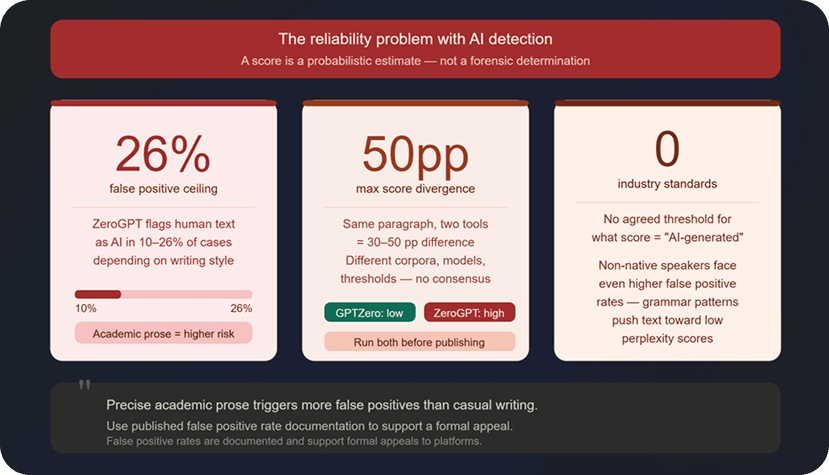
False positive rates are the most underdiscussed problem in this space. In independent evaluations, tools like ZeroGPT flag human-written text as AI at rates between 10% and 26% – depending on writing style. If you write in tightly controlled, precise academic prose, you are more likely to trigger a false positive than a casual writer.
Discussions in AI user communities regularly highlight concerns about false positives and the difficulty of reliably distinguishing human-written text from AI-generated content on linguistic patterns alone. Non-native English speakers face even higher false positive rates – grammatical consistency and limited vocabulary range push text toward lower perplexity scores.
Detector divergence compounds the problem. Two tools on the same paragraph regularly produce scores that differ by 30 to 50 percentage points. They use different training corpora, different reference models, and different threshold definitions. No industry standard exists for what score constitutes “AI-generated.” A score is a probabilistic estimate, not a forensic determination.
The Future of AI Detection Technology
Detection technology moves fast, and the next few years will change the rules significantly. Here are the four developments you need to watch.
| What is changing | What it means in practice | When to expect it |
|---|---|---|
| Newer AI models get harder to detect | Claude Fable 5 – launched June 9, 2026, and Anthropic’s most capable publicly released model to date – produces output distributions that current detectors were not trained to classify. Each new model generation shifts the statistical baseline, and detectors require time to catch up. That gap exists with every major release, not just this one. | Right now |
| Text watermarking | Google DeepMind and several research groups published methods for embedding invisible signatures into AI output at the token level. Once this scales, a matching detector identifies that text with near-certainty – no perplexity analysis needed. | 1–3 years |
| Behavioral detection | Future tools will cross-reference text with metadata: edit histories, cursor movement, and typing pace from platforms like Google Docs. You cannot replicate those signals by rewriting. This is the development that makes current bypass methods obsolete. | 2–5 years |
| Regulation | The EU AI Act entered into force in August 2024, but its AI content labeling requirements under Article 50 became enforceable in August 2026. The Fable 5 suspension under a US export control directive in June 2026 signals that governments are willing to intervene directly in model availability. Detection is becoming a legal compliance requirement, not just a quality check. | Active now, expanding |
The practical takeaway: the bypass techniques that work today will not work indefinitely. If you build your content strategy around substantive human contribution – original research, first-hand examples, genuine analysis – detection becomes a much smaller problem regardless of what tools emerge.
Conclusion
AI detection is not a solved problem – and the tools themselves prove it. False positive rates remain high, scores diverge widely for the same text, and every new model generation resets the detection baseline.
Three things determine how well you navigate this environment going forward:
- How well do you understand the measurement? Perplexity and burstiness are the two numbers that detectors optimize for. If you know what moves those numbers, you can target your edits at the right level instead of rewriting blindly.
- How well you document your process. If a platform flags your work, a writing sample produced under similar conditions is your strongest defense. False positive rates are published and well-documented – they support a formal appeal.
- How much original thinking do you contribute? Detection technology will keep advancing. Watermarking, behavioral signals, regulatory mandates – the bypass window narrows with each development. The content that holds its ground in any environment is the content that a model cannot replicate without direct access to your sources, your data, and your direct experience.
Detection is a moving target. The tools change, the thresholds shift, and new models reset the baseline every few months. What does not change is the advantage of understanding the mechanics – because that understanding transfers regardless of which detector or model comes next.
FAQ
What detection score is considered safe?
A score below 25% on both GPTZero and ZeroGPT puts your document in a reliably safe range for most publishing and academic contexts. Between 25% and 50% is a caution zone worth revising. Above 50% on either tool, you face meaningful risk where AI content faces active screening.
Do AI detectors work on languages other than English?
Current tools train primarily on English-language corpora and perform significantly worse on other languages. Non-English text often produces unreliable scores because the reference models used for perplexity measurement have fewer training examples in those languages. Treat detection accuracy for non-English content as experimental, not reliable.
Can heavily edited AI text still get flagged?
Yes. If you change vocabulary without restructuring syntax, the underlying token-probability patterns stay largely intact. Detectors measure sequence-level statistics, not individual word choices. Surface-level edits are not enough – you need to change clause order and sentence boundaries to move the score meaningfully.
What should you do if you get a false positive?
Request a manual review and provide a writing sample you produced under similar conditions. Most academic integrity policies now include provisions for contesting AI detection results, because false positive rates are well-documented. Run the document through a second detector. A score that differs by 30 or more points between two tools is strong evidence of a false positive, not AI generation.
Other Interesting Articles
- AI LinkedIn Post Generator
- Gardening YouTube Video Idea Examples
- AI Agents for Gardening Companies
- Top AI Art Styles
- Pest Control YouTube Video Idea Examples
- Automotive Social Media Content Ideas
- Plumber YouTube Video Idea Examples
- AI Agents for Pest Control Companies
- Electrician YouTube Video Idea Examples
- How Pest Control Companies Can Get More Leads
- AI Google Ads for Home Services
- 60-Second Training Videos Are the New Corporate Standard
- Cybersecurity PR Pricing: Retainers, Deliverables & ROI
- Best AI Tools for Product Consistency in E-Commerce Video
Master the Art of Video Marketing
AI-Powered Tools to Ideate, Optimize, and Amplify!
- Spark Creativity: Unleash the most effective video ideas, scripts, and engaging hooks with our AI Generators.
- Optimize Instantly: Elevate your YouTube presence by optimizing video Titles, Descriptions, and Tags in seconds.
- Amplify Your Reach: Effortlessly craft social media, email, and ad copy to maximize your video’s impact.