
How to Turn Your Written Content Into Short-Form Video With AI
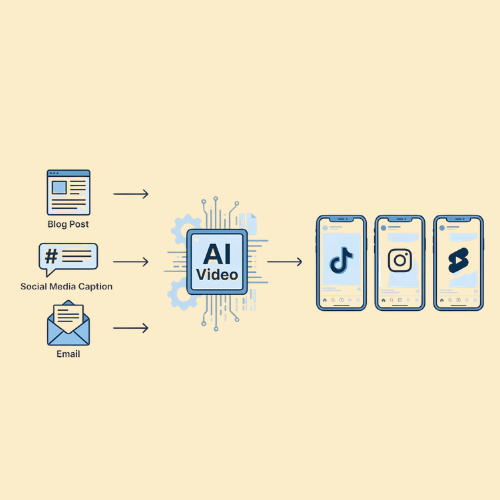
Most marketing teams already have more short-form video ideas than they realize.
They are sitting inside blog posts, newsletters, email sequences, social captions, case studies, product pages, FAQs, webinars, reports, and sales enablement content.
The problem is that this content usually stays trapped in written form.
- A blog post gets published once.
- A newsletter is sent and forgotten.
- A useful FAQ sits on a support page.
- A strong LinkedIn post disappears after a few days.
- A customer story becomes one case study and nothing else.
Short-form video gives those ideas a second life.
With AI, you no longer need to start every video from a blank page. You can take one useful written idea, turn it into a short script, add a hook, create a voiceover, generate visuals, add captions, and adapt the same idea for TikTok, Instagram Reels, YouTube Shorts, LinkedIn, or Facebook.
That does not mean every written asset should become a video.
Good short-form video needs one clear idea, a strong opening, simple structure, visual movement, readable captions, and a reason for people to keep watching.
AI can help with the heavy lifting.
It can summarize long articles, pull out the strongest points, write scripts, generate hooks, suggest visuals, create captions, and help repurpose the same idea for different platforms.
But the strategy still matters.
The best videos come from written content that already has value: a useful tip, a strong opinion, a common mistake, a practical framework, a before-and-after story, or an answer to a question your audience actually asks.
This guide explains how to turn written content into short-form video with AI, how to choose the right source material, how to structure scripts, and how to make sure your videos feel useful instead of generic.
Why Text-First Marketers Are Sitting on an Untapped Video Library
Every blog post, social caption, and email sequence you have already written contains the raw material for dozens of short-form videos. Most marketers treat written content and video content as separate workstreams, but in 2026 that separation is costing you reach.
YouTube Shorts now sees over 200 billion daily views. TikTok functions as a search engine for product reviews, how-to queries, and recommendations. Instagram Reels drive more profile visits than any other format on the platform. The audiences on these channels are not reading your blog. They are watching 30-to-60-second videos in a feed. If you only publish text, you are invisible to them.
The good news: you do not need to start from scratch. The frameworks, tips, and arguments in your existing written content are already structured for video. A listicle blog post maps directly to a motion graphics countdown. A social media tip thread becomes a text story video. A product FAQ page becomes a series of explainer clips. The content exists. The format needs to change.
And the format change no longer requires a camera, a microphone, or an editing suite. AI video generators can produce faceless short-form video from a script in minutes. Your written content is the script.
Chapters
- Three Written Content Types That Convert Directly to Short-Form Video
- What Makes AI-Generated Video Pass the Quality Bar in 2026
- Platform-Specific Tweaks for TikTok, Reels, and Shorts
- A Realistic Publishing Cadence for Teams Already Producing Written Content
- How to Choose Written Content Worth Turning Into Video
- Short-Form Video Script Template for Written Content
- AI Short-Form Video Quality Checklist
- How to Measure Repurposed Short-Form Video Performance
- Where to Start This Week
Three Written Content Types That Convert Directly to Short-Form Video
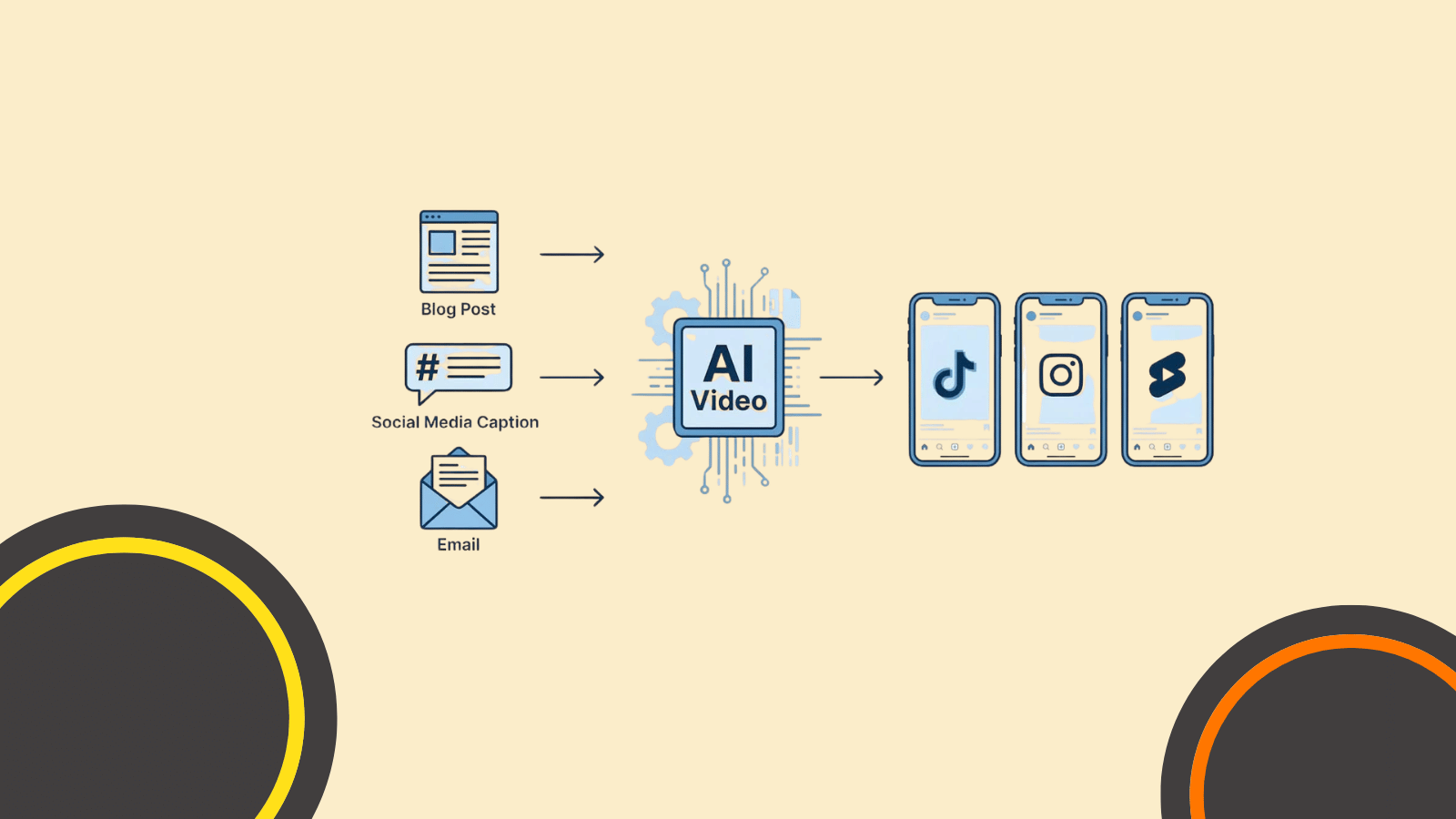
Blog posts with numbered tips or steps. A post titled “7 email subject line mistakes” becomes seven individual videos, each covering one mistake. One blog post, seven pieces of video content.
Social media captions with a hook and a takeaway. Any caption that opens with a question or bold claim and closes with advice is already a video script. The hook is your first two seconds. The takeaway is your closing frame.
FAQ or knowledge base articles. Each question-and-answer pair is a self-contained 20-to-40-second video. If you have 30 FAQs, you have 30 videos.
The pattern is the same in every case: written content that already has a clear structure (hook, body, conclusion) translates to video with minimal rewriting.
Content that rambles or lacks a single clear point will need more editing before it works as a script.
Here is how each written format maps to specific video styles and platforms:
| Written Format | Video Style | Best Platform | Videos per Source |
|---|---|---|---|
| Listicle blog post | Motion graphics countdown | YouTube Shorts | 5–10 per post |
| Social caption (tip) | Text story with voiceover | TikTok | 1 per caption |
| FAQ / knowledge base | Question-and-answer explainer | All platforms | 1 per FAQ |
| Email sequence | Tip series (episodic) | Instagram Reels | 1 per email |
| Case study | Before/after comparison | YouTube Shorts | 2–3 per study |
The Five-Step Process for Turning a Blog Post Into a Faceless Video
You do not need to rewrite your entire blog post as a script. You need to extract one idea and restructure it for a 30-to-60-second format. Here is the process.
Step 1: Pick one section, not the whole post. A 2,000-word blog post contains five to eight sections. Each section is a separate video. Choose the one with the clearest single takeaway.
Step 2: Write the hook from the section heading. Your H2 becomes the opening line. Rewrite it as a direct statement or a bold claim. “Three signs your email list is dying” works. “Email marketing tips” does not.
Step 3: Compress the body to three to five beats. Each beat is one sentence that delivers a single point. Cut all transitions, qualifications, and filler. If a sentence does not add new information, delete it.
Step 4: Add a closing CTA. Tell the viewer what to do: follow for more, visit your site, try a free tool. One action only.
Step 5: Feed the script to an AI video generator. AI video generators like SyncStudio handle rendering, voiceover, captions, and metadata in one pipeline, so you go from script to published video without touching an editing timeline.
The entire process takes 10 to 15 minutes per video once you have practised it twice. Batch five scripts in an hour, generate the videos, and schedule them across platforms.
What Makes AI-Generated Video Pass the Quality Bar in 2026

Voiceover quality has jumped. Text-to-speech engines from ElevenLabs, OpenAI, and Google now produce voices with natural pacing, breathing pauses, and tonal variation. The robotic monotone of 2023 TTS is gone.
Captions are table stakes. 85% of mobile video is watched on mute. AI video tools now bake captions directly into the render, which means every video is accessible and algorithm-friendly from the start.
Motion graphics hold attention. Faceless formats like animated text, data visualisations, and quiz overlays consistently match or outperform talking-head videos on completion rate. The viewer stays for the information, not the face. Newer models such as the wan 2.7 ai model have also closed the gap on motion smoothness in these short clips, which is part of why the “”AI-generated”” look has become harder to spot.
The gap between “AI-generated” and “professionally produced” has narrowed to the point where the script matters more than the production tool. If your writing is clear, specific, and structured, the video output will be too. For a complete breakdown of how AI video generation works for short-form content, the SyncStudio blog covers the full technology stack from scripting to rendering.
Platform-Specific Tweaks for TikTok, Reels, and Shorts
The same script does not perform identically on all three platforms. Small adjustments make a measurable difference to reach and completion rate.
TikTok: Lead with controversy or surprise. TikTok rewards videos that generate comments and shares. Reframe your written tip as a bold claim that invites disagreement. “Most email subject lines fail because they are too polite” will outperform “How to write better email subject lines” every time. Keep the video between 30 and 45 seconds. TikTok’s algorithm favours videos with a 70%+ completion rate, and shorter videos hit that threshold more consistently.
Instagram Reels: Optimise for saves and DM shares. Reels performs best when the content is useful enough to bookmark. Tactical, step-by-step tips drive saves. Frame your written content as “save this for later” material. Instagram’s Trial Reels feature lets you test content with non-followers first, so use it to validate which scripts connect before you push to your full audience.
YouTube Shorts: Write for search. Shorts appear in Google search results, which means your title and description matter more here than on TikTok or Reels. Use the same keyword research you apply to blog posts. A Short titled “How to fix low email open rates” can rank in Google and drive traffic to your site for months. Target 50 to 60 seconds for Shorts. YouTube data shows a 76% watch-through rate at that length.
A Realistic Publishing Cadence for Teams Already Producing Written Content
Start with three videos per week. One per platform. This is enough to signal consistency to the algorithm without overwhelming your workflow. Pull scripts from content you published in the last 30 days.
Batch production on a single day. Write five to eight scripts in one session. Generate the videos. Schedule them across the week. The scripting session takes one to two hours. Video generation adds 15 to 20 minutes for the batch.
Scale to daily once you have a library. After four weeks, you will have 12+ videos live and data on which formats and topics perform. Double down on what works. Drop what does not.
The constraint for most text-first teams is not ideas or scripts. It is video production time. AI generation removes that constraint entirely. See how content marketing teams use AI video to scale distribution without extra headcount for a detailed breakdown of the workflow.
How to Choose Written Content Worth Turning Into Video
Not every piece of written content deserves to become a video.
Start with content that already has a clear point.
Good source material includes:
- Blog posts with numbered tips
- How-to guides
- FAQ pages
- Email newsletters
- LinkedIn posts
- X threads
- Case studies
- Product comparisons
- Webinar summaries
- Podcast summaries
- Customer questions
- Sales objections
- Research reports
- Tutorial pages
- Checklists
- Mistake-based articles
The best written content for video usually has one of these qualities:
| Content quality | Why it works for short-form video | Example video angle |
|---|---|---|
| One clear takeaway | Short-form video works best when viewers can understand the point quickly | “Stop making this landing page mistake” |
| Step-by-step structure | Steps translate well into fast visual sequences | “3 steps to turn a blog post into a Reel” |
| Common mistake | Mistakes create strong hooks and useful teaching moments | “Why your AI videos feel generic” |
| Practical checklist | Checklists are easy to turn into text-on-screen videos | “Short-form video checklist before you post” |
| Strong opinion | Opinion-led content can create comments and saves | “You do not need more content ideas. You need more formats.” |
| FAQ answer | Each question can become one standalone video | “Can AI turn blog posts into videos?” |
| Before-and-after story | Transformation is easy to visualize | “Before AI repurposing vs. after AI repurposing” |
| Data point or insight | Numbers and trends can become simple explainer clips | “What this content metric really means” |
Avoid starting with long, vague, or overly complex content.
A 2,500-word article can become many videos, but only if you break it down.
Do not try to turn the whole article into one short-form video.
- Pick one section.
- Pick one idea.
- Pick one viewer problem.
- Make one video.
That is the cleanest workflow.
Short-Form Video Script Template for Written Content
A short-form video does not need a complicated script.
It needs momentum.
Use this structure:
1. Hook
The hook should make people stop scrolling.
Good hook formats:
- “Most people get this wrong…”
- “Here’s the fastest way to…”
- “Do this before you…”
- “If you already wrote a blog post, you already have…”
- “This is why your videos are taking too long…”
- “Turn one article into five videos like this…”
- “Do not turn your whole blog post into one video…”
The hook should be based on the strongest idea from the written content.
Do not use a vague intro like:
“Today we are going to talk about content repurposing.”
Start with the problem, mistake, result, or surprise.
2. Context
Give one sentence of context.
Example:
“You do not need a new video idea every day. You can repurpose one useful blog section into a short script.”
This helps the viewer understand why the hook matters.
3. Three beats
Turn the written content into three simple points.
Example:
“Pick one section.
Rewrite the heading as a hook.
Turn the main points into three short lines.”
Short beats are easier to watch, voice over, caption, and edit.
4. Payoff
Give the useful conclusion.
Example:
“That is how one blog post becomes a week of short-form video content.”
The payoff should make the video feel complete.
5. CTA
Use one CTA only.
Examples:
- “Follow for more content repurposing tips.”
- “Try this with your latest blog post.”
- “Save this before your next content batch.”
- “Use StoryLab.ai to turn your idea into a video script.”
- “Read the full guide on our blog.”
Do not overload the ending with five actions.
One video, one next step.
Example script
Hook:
Your blog post is not one piece of content.
Context:
It is a video library if you know how to break it apart.
Three beats:
Take one section.
Turn the heading into a hook.
Compress the advice into three short points.
Payoff:
Now your blog post can become a Reel, TikTok, Short, LinkedIn video, or email teaser.
CTA:
Start with one section today.
This structure works for faceless videos, talking-head videos, text-on-screen videos, and AI-generated videos.
AI Short-Form Video Quality Checklist
AI can help create videos quickly, but speed should not replace quality.
Before publishing, check every video.
| Check | Question | Why it matters |
|---|---|---|
| Single idea | Does the video focus on one clear point? | Short-form videos become confusing when they try to teach too much. |
| Hook | Does the first second give people a reason to keep watching? | The opening decides whether people stop scrolling. |
| Script length | Can the script be delivered without rushing? | A written paragraph often needs to be much shorter for video. |
| Visual match | Do the visuals support the message? | Generic visuals make AI videos feel empty. |
| Captions | Are captions accurate, readable, and not covering important visuals? | Many people watch short-form video with low sound or no sound. |
| Voiceover | Does the voice sound natural and easy to understand? | A robotic or rushed voiceover can reduce trust. |
| Brand fit | Does the video match your tone, colors, style, and message? | AI output should still feel like your brand. |
| Accuracy | Did the AI preserve the meaning of the original content? | Repurposing should not distort the original point. |
| Platform fit | Is the video formatted for the platform where it will be posted? | TikTok, Reels, Shorts, and LinkedIn videos may need different edits. |
| CTA | Is the next step clear? | Attention is more valuable when it leads somewhere useful. |
YouTube says Shorts can be square or vertical videos up to three minutes, TikTok recommends vertical videos and notes that captions can be important, and Meta positions Reels as a discovery format for businesses on Facebook and Instagram. Use those platform realities when formatting and editing your AI-generated videos.
How to Measure Repurposed Short-Form Video Performance
Do not measure AI short-form videos only by views.
Views are useful, but they do not always tell you whether the video helped your business.
Track different metrics based on the goal.
| Goal | Metrics to track | What to improve next |
|---|---|---|
| Reach | Views, reach, impressions, non-follower reach | Hook, topic, format, opening visual |
| Retention | Watch time, average view duration, completion rate, replays | Script pacing, visual movement, video length, clarity |
| Engagement | Likes, comments, saves, shares, replies | Usefulness, opinion strength, question, CTA, relevance |
| Traffic | Profile visits, link clicks, website sessions, UTM clicks | CTA, profile link, caption, pinned comment, landing page match |
| Lead generation | Form fills, downloads, signups, demo requests, email subscribers | Offer, landing page, audience fit, video promise |
| Content efficiency | Videos created per source asset, time saved, assets repurposed, cost per video | Batching workflow, templates, script reuse, AI prompts |
Review performance by source content too.
Ask:
- Which blog posts created the best videos?
- Which topics earned the most saves?
- Which hooks created the best retention?
- Which platforms performed best for each idea?
- Which videos sent people back to the website?
- Which written assets should become a full video series?
- Which formats should we stop making?
A useful AI repurposing workflow gets smarter over time.
You do not just create more videos.
You learn which written ideas deserve more distribution.
Written content is not the end of the content workflow.
It is the start of the repurposing workflow.
With AI, one blog post, newsletter, FAQ page, case study, or social caption can become a set of short-form videos for TikTok, Instagram Reels, YouTube Shorts, LinkedIn, and Facebook.
But the best results come from choosing the right source material.
Start with content that has one clear idea. Turn that idea into a short script. Add a strong hook. Keep the structure simple. Use AI to generate, edit, caption, and adapt the video. Then review everything for accuracy, brand fit, and platform fit before publishing.
The teams that win with short-form video will not always be the teams creating brand-new ideas every day.
They will be the teams that know how to extract more value from the ideas they already have.
Where to Start This Week
Pick one blog post you published in the last month. Choose the section with the strongest single takeaway. Rewrite it as a five-beat script: hook, three points, CTA. Generate the video with an AI tool. Post it to one platform.
That is the entire first step. One post, one section, one video, one platform. Do not try to build a multi-platform video empire in week one. Build the habit of extracting video from written content, and the volume will follow.
The marketers who will win the most attention in 2026 are not the ones who produce the most original content. They are the ones who distribute existing ideas across the most formats. You already have the ideas. The format gap is the only thing left to close.
Other Interesting Articles
- AI LinkedIn Post Generator
- Gardening YouTube Video Idea Examples
- AI Agents for Gardening Companies
- Top AI Art Styles
- Pest Control YouTube Video Idea Examples
- Automotive Social Media Content Ideas
- Plumber YouTube Video Idea Examples
- AI Agents for Pest Control Companies
- Electrician YouTube Video Idea Examples
- How Pest Control Companies Can Get More Leads
- AI Google Ads for Home Services
- 60-Second Training Videos Are the New Corporate Standard
- Cybersecurity PR Pricing: Retainers, Deliverables & ROI
- Best AI Tools for Product Consistency in E-Commerce Video
Master the Art of Video Marketing
AI-Powered Tools to Ideate, Optimize, and Amplify!
- Spark Creativity: Unleash the most effective video ideas, scripts, and engaging hooks with our AI Generators.
- Optimize Instantly: Elevate your YouTube presence by optimizing video Titles, Descriptions, and Tags in seconds.
- Amplify Your Reach: Effortlessly craft social media, email, and ad copy to maximize your video’s impact.