
How to Run a Content Agency Without Losing Money on Retainers

Retainers are supposed to be the stable part of agency life. Predictable revenue, a known client list, work you can plan around. Yet many content agencies discover the same uncomfortable truth at the end of the year: some of their most loyal retainer clients are also their least profitable ones, and a few actually cost money to keep.
The retainer isn’t the problem. The problem is running it on assumptions instead of numbers. Fixed fee on one side, variable delivery on the other, and nobody measuring the gap between them until it has already swallowed the margin.
This guide walks through where retainer money actually leaks, how to price and monitor agreements with real data, and how to keep delivery costs down without cutting the quality your clients signed up for.
Chapters
Where Retainer Money Actually Leaks

A retainer loses money in small, invisible increments. There’s rarely one disastrous decision to point at, which is exactly why the leaks survive year after year.
The usual suspects look like this:
- Scope drift. The agreement said four articles a month. Eighteen months later you also handle the newsletter, “quick” social captions, and a monthly reporting call nobody priced in.
- Revision spirals. Round one is in the budget. Round four, with a new stakeholder joining the thread each time, is not.
- Invisible work. Briefing calls, research, internal reviews, and project coordination are real delivery hours that rarely appear in anyone’s retainer math.
- Seniority mismatch. The quote assumed a mid-level writer. The client’s demands quietly pulled your most expensive editor into every deliverable.
- Zombie scope. Deliverables the client stopped caring about but the team still produces, month after month, because nobody re-checked the agreement.
Every one of these is manageable once it’s visible. None of them is manageable while the retainer runs on a flat fee and a feeling.
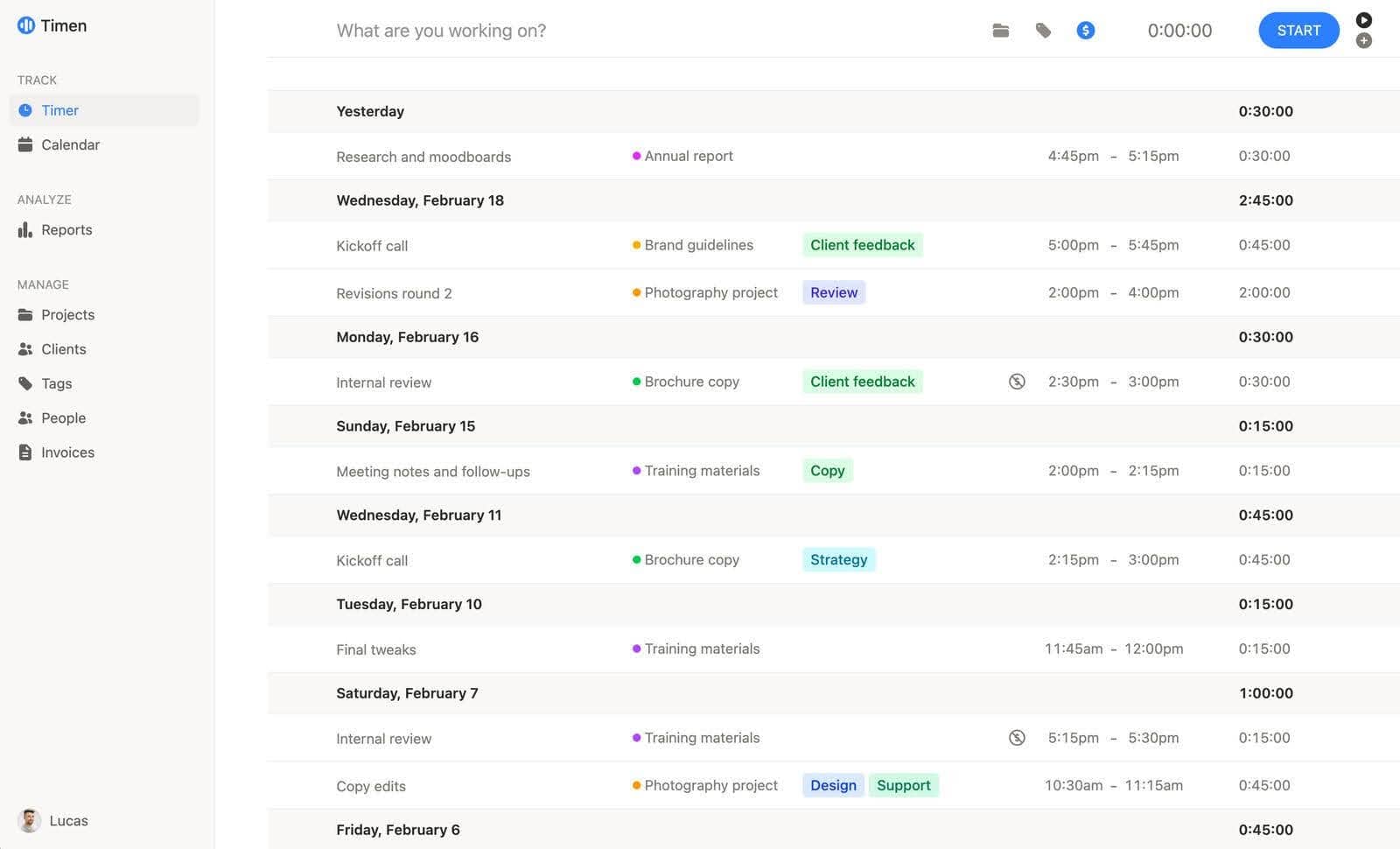
Visibility starts with logging hours as the work happens. Your team can record time by project, person, and client in free time tracking software for teams like Timen, with one-click timers and manual entries, and none of the surveillance baggage: no screenshots, no activity scores. Once a month of real hours sits next to each retainer fee, every leak above stops being a feeling and becomes a number.
Close the Billing Gap First
The fastest money to recover sits between delivery and getting paid. Hours tracked in one place, invoices built in another, and a manual reconciliation step in the middle where line items go missing and overages get forgiven by accident.
Closing that gap means invoicing from tracked time directly, so the hours your team logged become the line items the client sees, overages included, with nothing retyped and nothing silently dropped. Itemized invoices backed by real entries also end most billing disputes before they start, because the conversation shifts from “that feels high” to a shared look at the actual log.
Price the Retainer on Delivery Data, Not Hope
Most retainer prices are set in the sales conversation: the client names a budget range, the agency guesses what fits inside it, and everyone hopes the guess was right. A profitable retainer starts earlier than that, with an honest answer to one question: what does a month of this work actually cost us to deliver?
To answer it, you need three numbers per client:
- Hours delivered per month, split by type of work: writing, editing, strategy, meetings, admin.
- Cost per hour of the people doing each type of work, not a blended agency average that hides your expensive specialists.
- Effective hourly rate, which is simply the retainer fee divided by the hours it consumes.
Here’s the math on a realistic example. A client pays $4,000 a month. The team delivers 52 hours across writing, editing, two calls, and coordination. Effective hourly rate: $77. If your blended delivery cost for that mix of people is $55 an hour, the retainer earns a modest margin. If three of those hours belong to a senior editor at $120 and the revision rounds push total delivery to 65 hours, the effective rate drops to $61 and the margin is nearly gone. Same client, same fee, completely different business.
When agencies run this math for the first time, the ranking of “best clients” usually gets rewritten. The friendly client with the modest fee and endless small requests often lands at the bottom. The demanding client everyone complains about sometimes turns out to be the most profitable one on the books.
A useful target: know your effective hourly rate for every retainer client, every month. The moment it dips below your internal cost per hour, you’re paying for the privilege of working.
Track the Hours Before You Trust the Math
None of the math above works on estimates. Reconstructed hours are fiction with confidence, and they’re almost always reconstructed downward, which makes weak retainers look healthier than they are.
The fix is boring and effective: the team logs time as the work happens, against the client and the deliverable, every day. Logging has to be nearly effortless or it won’t survive the first busy week, which is why lightweight timers beat heavyweight systems: one click to start, a quick manual entry when the timer was forgotten, and back to the draft in seconds. The point is pricing data, not monitoring anyone.
Two habits make the data trustworthy:
- Log everything, not just billable work. The unbillable layer (briefings, coordination, internal review) is where most retainers quietly die. You can’t fix what never gets recorded.
- Close each day with a two-minute review. A quick end-of-day check fills the gaps while the day is still fresh. A timesheet rebuilt on Friday from memory is a work of creative writing.
Give it one full month and you’ll have the first honest picture of where your retainer hours actually go. Most agency owners find at least one surprise in the first report.
Review Burn Weekly, Not at Renewal
Annual retainer reviews catch problems eleven months too late. The agencies that protect their margins check burn weekly: fifteen minutes with a report of hours per client against each retainer’s monthly allowance.
The weekly check answers three questions:
- Which clients are on pace, and which have already burned 70% of their month by day ten?
- Whose requests this week fall outside the agreed scope?
- Where did senior hours go, and did they go to work that needed them?
When a client runs hot, you now have options while the month can still be saved: flag the overage, shift a deliverable to next month, or route the work to a less expensive teammate. Without the weekly view, the only option left is absorbing the loss and resenting the client.
This is also where scope conversations stop being awkward. “We’ve used 32 of the 40 hours and it’s the 15th, so let’s decide together what fits in the rest of the month” is a calm, factual sentence. It lands completely differently from a defensive end-of-quarter complaint, and clients respect it because it treats the retainer like the shared budget it is.
Renew From the Numbers
The numbers you collect all year do their best work at renewal. Walk into the conversation with twelve months of delivery data and the renewal stops being a negotiation about feelings:
- Show the hours delivered against the hours priced, month by month.
- Reprice the retainer on actuals, not on what the old guess assumed.
- Trade zombie deliverables for work the client now actually wants, at the same fee.
- Walk away from agreements the data says can’t be fixed, and do it without guilt.
Clients rarely leave over a data-backed repricing. They leave over surprises, and an agency that shows its numbers all year never has to deliver one.
Cut Delivery Cost Without Cutting Quality
The other half of retainer profitability is the cost side: delivering the same quality in fewer hours. For content agencies, the biggest wins hide in the unglamorous middle of production.
Ideation is a common sink. Teams burn hours in brainstorm meetings that a structured process could handle in minutes; running topics through a content idea generator before the meeting turns the brainstorm into a selection exercise instead of a staring contest. The meeting shrinks from an hour to fifteen minutes, and the saved time shows up directly in the client’s effective hourly rate.
First drafts are the second sink, and usually the bigger one. Watch where your writers’ logged hours actually go and you’ll find a surprising share spent producing the rough first version that nobody ever sees. An AI-powered content creation workflow that produces outlines, hooks, and rough drafts lets your team spend their expensive hours on the parts clients actually pay for: judgment, voice, and polish.
The goal isn’t replacing the team. It’s moving every hour you log up the value chain, so the tracked time behind each deliverable contains more editing and strategy and less mechanical typing. Agencies that pair honest time data with a faster content creation pipeline attack the margin problem from both ends at once: they know exactly what each retainer costs, and the cost keeps falling.
One warning: pass the saved hours through your own quality bar before they reach the client. Speed that produces revision spirals gives the margin right back.
The Retainer Should Fund the Agency, Not the Other Way Around
A content retainer is a simple promise: predictable work for predictable money. It breaks when only the money side stays predictable while the work side drifts, and it stays broken for exactly as long as nobody measures the drift.
The system that fixes it fits in a sentence. Price from real delivery costs, track every hour while it happens, review burn weekly, produce smarter, and bill and renew from the data. Run one month of honest tracking across your retainer clients and you’ll know precisely which agreements fund your agency and which ones feed on it. What you do with that knowledge is the easy part.
Other Interesting Articles
- AI LinkedIn Post Generator
- Gardening YouTube Video Idea Examples
- AI Agents for Gardening Companies
- Top AI Art Styles
- Pest Control YouTube Video Idea Examples
- Automotive Social Media Content Ideas
- Plumber YouTube Video Idea Examples
- AI Agents for Pest Control Companies
- Electrician YouTube Video Idea Examples
- How Pest Control Companies Can Get More Leads
- AI Google Ads for Home Services
- 60-Second Training Videos Are the New Corporate Standard
- Cybersecurity PR Pricing: Retainers, Deliverables & ROI
- Best AI Tools for Product Consistency in E-Commerce Video
Master the Art of Video Marketing
AI-Powered Tools to Ideate, Optimize, and Amplify!
- Spark Creativity: Unleash the most effective video ideas, scripts, and engaging hooks with our AI Generators.
- Optimize Instantly: Elevate your YouTube presence by optimizing video Titles, Descriptions, and Tags in seconds.
- Amplify Your Reach: Effortlessly craft social media, email, and ad copy to maximize your video’s impact.