
Top Email Verification Tools for AI-Ready Email Marketing Teams

Email verification tools matter more now because inbox providers are stricter, sender reputation is easier to damage, and even a small amount of bad data can hurt performance. Google’s sender guidelines require authentication and ongoing list quality standards, while deliverability guidance from HubSpot and Validity ties cleaner lists directly to fewer bounces and healthier sender reputation.
That is why top email verification tools are no longer just cleanup utilities. The best ones help marketers validate addresses before they enter the database, clean large lists before campaigns go out, connect to CRMs and ESPs, and support more automated workflows across modern email programs. Validity’s BriteVerify emphasizes bulk, real-time, and API-based verification, while ZeroBounce highlights automatic validation through integrations and ongoing list cleaning inside connected platforms.
For modern email marketing teams, that also creates a stronger AI angle. AI can help write and personalize emails faster, but better output still depends on reliable contact data. Recent email marketing trend coverage points to AI becoming a bigger part of campaign creation and optimization, which makes clean inputs even more important.
Email marketing is one of the most powerful ways to engage with your clients and keep them informed. However, maintaining a clean email list is crucial to avoid damaging your sender’s reputation, high bounce rates, and dreaded spam complaints.
Invalid email addresses can severely impact your deliverability and sabotage your marketing efforts. Keep your lists pristine for better results and more successful campaigns!
Email verification tools help you remove invalid, risky, or low-quality addresses before you send. That protects deliverability, reduces wasted spend, and helps you avoid reputation problems.
Two benchmarks that matter:
Chapters
Email Health Checker
List Hygiene & Tool Matcher
Find Your Solution
Select your primary goal to see the best tool.
--
--
--
Estimate Cleaning Costs
See how much you'd save by removing bad emails.
List Health Check
Are you at risk of being blocked?
--
What Are Email Verification Tools?

Software programs known as email verification tools verify that email addresses are legitimate before adding them to your mailing list. These tools employ several verification methods, such as:
- Syntax Checks: Verifies that the email address format follows accepted email conventions.
- Domain Verification: Verifies that the email domain is operational and exists.
- SMTP Authentication: SMTP authentication verifies that messages can reach the recipient’s email server.
- Spam Trap Detection: Finds phony or dormant email accounts that spam monitors utilize.
- Disposable Email Detection: Email addresses that are transitory or disposable are filtered out using disposable email detection.
Businesses may prevent wasting resources on invalid contacts and make sure their communications reach actual users by utilizing an email verification service.
Why Is Email Verification So Important?
Effective email marketing requires a clean email list. This is the reason:
- Reduces Bounce Rates: Bounces from invalid emails harm the sender’s reputation.
- Protects Sender Reputation: Email service providers (ESPs) monitor bounce rates to protect the sender’s reputation. Your emails may be marked as spam if the rate is high.
- Increases Deliverability: Emails that have been verified have a higher likelihood of arriving in the inboxes of recipients.
- Saves Money: Most ESPs bill according to the number of emails sent. Eliminating erroneous emails guarantees that you only pay for legitimate contacts.
- Enhances Engagement: Emails with real validity have more open, click-through, and conversion rates.
- Prevents Blacklisting: Email deliverability could be lowered should emails be delivered to spam-trapped or invalid addresses, therefore causing blacklisting.
How to choose the right email verifier (fast)
Choose based on your main use case:
- Newsletter / marketing list cleanup (bulk uploads, recurring cleaning)
- Cold outreach (high accuracy on business domains + handling “unknown/catch-all”)
- Signup protection (real-time API to block disposable/fake emails)
- Automated hygiene (continuous syncing with your ESP/CRM)
Quick selection table
| Your use case | What to prioritize | Tool types that fit best |
|---|---|---|
| Cold email | Accuracy on business domains, catch-all handling, clear “unknown” rules | Dedicated verifiers + tools that publish testing/benchmarks |
| Newsletter / eCommerce | Bulk speed, easy exports, ESP integrations, suppression workflows | Bulk verifiers + automated cleaning services |
| Signup forms | Real-time API, disposable detection, low latency | Email validation APIs |
| Ops at scale | Automation, logs, team access, governance | Verification + sync/monitoring platforms |
The Best Email Verification Tools
The top ten email verification tools for 2025 are listed here, each with special characteristics to assist companies in enhancing their email marketing campaigns.
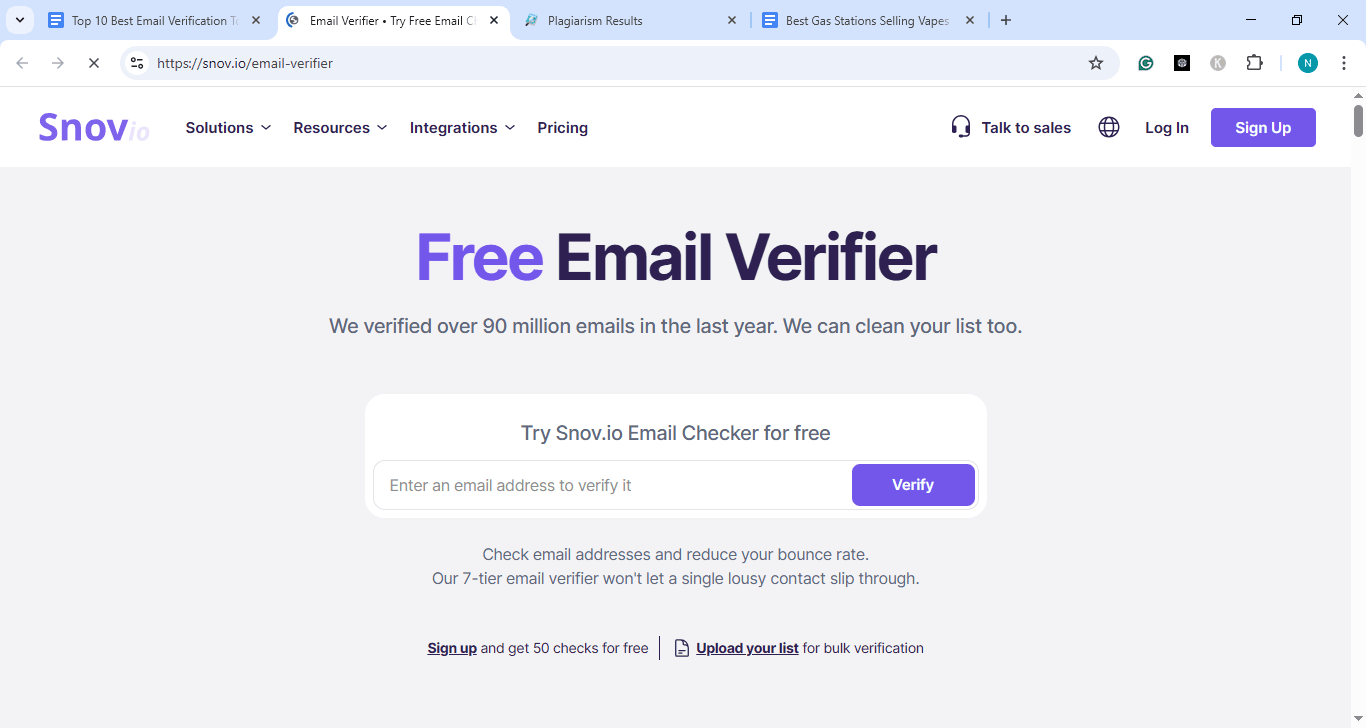
Snov.io
One of the top email verification tools, Snov.io, ensures high deliverability rates by offering real-time validation. It looks for mailbox existence, domain status, and syntax problems.
Key Features:
- Verification of emails in bulk
- Integration of real-time APIs
- Detection of disposable emails
- Verification of all emails
- Interface that is easy to use
- Connectivity to email marketing and CRM systems
Emailable
Emailable provides small and large organizations with trustworthy email verification services. It guarantees that lists have low bounce rates and stay current. By ensuring email accuracy, Emailable helps businesses maintain a strong sender reputation. It also integrates seamlessly with various marketing platforms for smooth workflow management.
Key Features:
- Fast verification
- Detection of spam and risk
- Smooth integration of APIs
- Email quality rating
- Interface that is easy to use
- Combining third-party apps
Lemlist
Although Lemlist’s primary function is email outreach, it also has an email verification capability to increase campaign effectiveness. Removing incorrect addresses assists users in maintaining a positive sender reputation. This feature helps reduce bounce rates and improves overall email deliverability. Accurate lists ensure messages reach the intended recipients.
Key Features:
- Warm-up and personalization emails
- Decrease in bounce rate
- Verification in real-time
- Connectivity to CRM tools
- Sophisticated email monitoring
Bouncer
Bouncer is a trustworthy solution for email verification that companies of any size can use. It lowers the possibility of large bounce rates by confirming that emails are legitimate before sending. Bouncer ensures accurate email lists, improving deliverability and overall campaign performance. It’s simple, reliable, and scalable.
Key Features:
- Excellent accuracy in identifying phony emails
- GDPR-compliant
- Real-time and bulk email verification
- Domain health assessment
- All-inclusive email detection
- Email quality rating
ZeroBounce
Marketers frequently choose ZeroBounce because of its high accuracy rate in verifying emails and enhancing overall data quality. It effectively checks email lists and has detailed analytics and other data enrichment features, making it a trusted solution for many.
Key Features:
- AI-driven email evaluation
- Elimination of spam traps
- sophisticated detection of email abuse
- Data enrichment for email addresses that comply with the CCPA and GDPR
Clearout
Clearout is an email verification solution that works well with marketing platforms and is quick and accurate. It helps companies increase deliverability rates and decrease email bounces. By ensuring only valid emails are sent it improves overall campaign performance. Clearout also offers real-time verification, making it an efficient tool for businesses of all sizes.
Key Features:
- Single and bulk email verification.
- Validation of real-time APIs
- All-inclusive email detection
- Integration with several ESPs and CRMs
- Simple dashboard
NeverBounce
NeverBounce’s enterprise-grade email verification services are well-known. Its sophisticated validation methods assist companies in maintaining high email deliverability rates. By filtering out invalid emails, NeverBounce ensures businesses avoid costly bouncebacks. It also provides real-time verification to support large-scale email marketing campaigns.
Key Features:
- A 99.9% accuracy guarantee.
- Bulk and real-time verification
- Cleaning up email lists
- API for automatic validation
- In-depth analysis
- Tools for customizable reporting
Hunter
Hunter has a large database of business email addresses and is a strong email verification tool. It facilitates the efficient discovery of new prospects and email verification. By ensuring the accuracy of email addresses, Hunter helps businesses improve outreach success. Additionally, it offers tools for managing and organizing verified leads effectively.
Key Features:
- Verifier and finder of email addresses
- Verification of emails in bulk
- Verification of domains
- Connectivity with well-known CRMs
- Features of cold email outreach
- Sophisticated tools for email scraping
Kickbox
Kickbox assists companies in keeping their email lists clean and preventing spam flags. It uses advanced validation techniques to ensure email accuracy and improve deliverability. Kickbox provides real-time verification, helping businesses maintain a strong sender reputation and optimize campaign performance.
Key Features:
- Instant email verification.
- Verifications of domain repute
- Connectivity to email marketing systems
- Real-time validation API
- Drag-and-drop uploading of lists
- Email segmentation and insights
Mailfloss
Email marketing systems may be easily integrated with Mailfloss, an automated email verification solution. For the best deliverability, it constantly checks and purifies email lists. Mailfloss helps businesses maintain a clean database by automatically removing invalid emails. This ensures improved campaign performance and a higher return on investment.
Key Features:
- Completely automated cleaning of email lists
- Connectivity with key ESPs
- More sophisticated filtering choices
- Adaptable cleaning guidelines
- Comprehensive data and analysis

Comparison table
| Tool | Best for | Bulk cleaning | Real-time API | Notable differentiator (with source) |
|---|---|---|---|---|
| Bouncer | All-round verification | Yes | Yes | GDPR compliance focus + EU data centers (vendor statement) :contentReference[oaicite:12]{index=12} |
| ZeroBounce | Advanced risk flags | Yes | Yes | API detects many types of problematic emails (vendor docs) :contentReference[oaicite:13]{index=13} |
| NeverBounce | Bulk + integrations | Yes | Yes | Widely used; claims vary, validate against benchmarks :contentReference[oaicite:14]{index=14} |
| Emailable | Clear deliverable/risky buckets | Yes | Yes | Disposable + accept-all + role detection documented :contentReference[oaicite:15]{index=15} |
| Kickbox | Signup validation + API | Yes | Yes | API libraries + common use cases documented :contentReference[oaicite:16]{index=16} |
| Hunter | Prospecting + verification | Yes | Yes | Published verifier comparison/methodology :contentReference[oaicite:17]{index=17} |
| Clearout | Bulk cleaning + integrations | Yes | Yes | Competitive positioning vs alternatives (vendor comparison) :contentReference[oaicite:18]{index=18} |
| Snov.io | Outreach stack consolidation | Yes | Yes | Prospecting + verification workflow (StoryLab list) :contentReference[oaicite:19]{index=19} |
| Lemlist | Cold email workflows | Limited | Varies | Verification inside outreach workflow (StoryLab list) :contentReference[oaicite:20]{index=20} |
| Mailfloss | Automated continuous cleaning | Yes | Varies | Automation-first hygiene approach (StoryLab list) :contentReference[oaicite:21]{index=21} |
Best practices: when and how often to verify
Verify at 3 moments:
- At signup (real-time API): block typos + disposable emails immediately.
- Before any big send: bulk verify imported lists or older segments.
- Ongoing hygiene: re-verify cold segments every 30–90 days.
Teams with older or underperforming contacts can use a free B2B email list audit to catch freshness issues and bounce-risk patterns before the next campaign.
Also: understand bounces.
A hard bounce is a permanent failure (often invalid address), and many ESPs suppress hard bounces automatically.
Why email verification tools matter more in modern email marketing
Email marketing has become less forgiving. Google says all senders to Gmail accounts must meet baseline requirements, and bulk senders must keep spam rates low while supporting unsubscribe and authentication standards. That means list quality is not a small technical issue anymore. It directly affects inbox placement and sending reliability.
This is where email verification tools earn their place. They help remove invalid addresses, reduce unnecessary bounces, and stop low-quality records from dragging down campaign performance. HubSpot warns that hard bounce rates at 1% or higher are a signal that your sender reputation may be suffering, and Validity links cleaner data to stronger deliverability.
What the best email verification tools actually do
The strongest email verification tools usually handle three core jobs. First, they clean existing lists in bulk. Second, they verify addresses at the point of capture so bad records do not enter your system. Third, they connect through APIs or integrations so verification can happen automatically inside your workflow. BriteVerify explicitly offers bulk, real-time, and API-based verification, and ZeroBounce offers auto-validation once new contacts are added through supported integrations.
That combination matters because list decay is ongoing. A one-time cleanup helps, but a better system keeps your database healthier over time. If your forms, CRM imports, and app signups are not being checked in real time, bad data can come back faster than you remove it.
Bulk verification versus real-time verification
Bulk verification is useful when you already have a list and want to clean it before sending. Real-time verification is more preventative because it checks the address while a person is entering it into a form, signup flow, or CRM. BriteVerify positions real-time verification as a way to prevent invalid customer information from entering your database in the first place.
For many teams, the strongest setup uses both. Bulk verification helps clean older data. Real-time verification protects future growth. That creates a healthier email program over time because the list is being maintained, not just repaired after the damage is done.
Why integrations matter when choosing an email verification tool
A top email verification tool should fit your workflow, not sit outside it. That is why integrations matter so much. If your verifier connects directly to your ESP, CRM, ecommerce platform, or marketing automation stack, it becomes easier to validate new contacts automatically and keep your database cleaner without manual effort. ZeroBounce highlights integrations with platforms such as HubSpot, Mailchimp, ActiveCampaign, Customer.io, MailerLite, and BigCommerce, while BriteVerify emphasizes integrations with Salesforce, Marketo, and other platforms.
This is where email verification starts to support broader AI marketing workflows too. If your campaigns, segmentation, and automations are becoming more AI-assisted, reliable contact data becomes even more valuable because it improves the quality of the system upstream.
What to look for in the top email verification tools to try
The best email verification tool is not always the one with the most branding or the longest feature list. It is the one that fits how your team collects, stores, and uses email addresses. Useful things to look for include bulk verification, real-time validation, API access, platform integrations, and workflow automation. Those are the capabilities emphasized across the official BriteVerify and ZeroBounce materials.
It also helps to look for a tool that supports list hygiene as part of deliverability, not just data cleanup. Validity connects verification to sender reputation and inbox placement, which is the right mindset for choosing a tool in 2026.
How AI changes the value of email verification tools
AI is speeding up email production, personalization, testing, and performance analysis. Litmus says marketers sharply increased genAI use for copy, images, personalization, and campaign analysis in 2025, and broader 2026 trend reporting also points to AI becoming more embedded in email workflows.
That makes verification more important, not less. The faster teams can create campaigns, the easier it becomes to scale bad sends if the underlying data is weak. Email verification acts like a quality filter for the contact layer. In AI-heavy workflows, that filter protects both performance and reputation.
Common mistakes to avoid when using email verification tools
One mistake is treating verification as a one-time cleanup task. Another is focusing only on invalid addresses while ignoring form quality, acquisition quality, and sender requirements. Google’s sender rules and deliverability reporting both make it clear that reputation depends on more than one metric.
A better approach is to use verification as part of a broader email health system. Clean the list in bulk, verify new records in real time, monitor bounce and complaint signals, and keep authentication and unsubscribe practices aligned with current sender requirements.
The Bottom Line
Ensuring real, interested receivers view your marketing ads depends on keeping a clean and healthy email list. This may be achieved by using the appropriate email verification service. Businesses risk high bounce rates, deliverability problems, and even being marked as spam if they don’t properly verify their emails. This can negatively affect the sender’s reputation.
In addition to improving email deliverability, tools like Snov.io, ZeroBounce, and NeverBounce assist companies in checking email addresses, finding spam traps, and erasing dormant accounts, guaranteeing dependable, high-accuracy solutions running as efficiently as possible.
Companies can gain from higher open rates, click-through rates, and conversions by including email verification in their approach. Higher engagement, more effective outreach programs, and a higher return on investment (ROI) correlate with a clean email list. Additionally, by cutting down on resources wasted on invalid or unresponsive contacts, adopting a verification tool can save businesses money.
Are you prepared to advance your email marketing efforts? Take advantage of better deliverability and engagement using tool to validate your email list right now!
FAQs
What is an email verification tool?
An email verification tool checks whether an email address is valid and safe to keep in your database. Depending on the platform, it may support bulk list cleaning, real-time form validation, and API-based verification.
Why should marketers use email verification tools?
Marketers use email verification tools to reduce bounces, protect sender reputation, and improve deliverability. Google’s sender guidance and deliverability resources from HubSpot and Validity all point to cleaner data as part of a healthier email program.
What is the difference between bulk and real-time email verification?
Bulk verification cleans existing lists before you send, while real-time verification checks addresses as they are submitted through forms, signups, or CRM workflows. Many teams benefit from both.
Which features matter most in a top email verification tool?
The most useful features are bulk cleaning, real-time validation, API access, and integrations with your CRM or ESP. Those features make it easier to keep list hygiene strong over time instead of relying on occasional manual cleanup.
Can email verification tools support AI-driven email marketing?
Yes. AI can speed up campaign creation and personalization, but verification helps make sure those campaigns are being sent to better-quality records. As AI use in email grows, clean contact data becomes even more important.
Sources:
Do email verification tools replace good deliverability practices?
No. Verification helps, but it should sit alongside authentication, unsubscribe compliance, spam complaint control, and good list acquisition practices. Google’s sender requirements make that clear.
What’s a “good” email bounce rate?
Many deliverability resources use <2% as a general healthy benchmark, but it depends on list source and email type.
Does email verification guarantee inbox placement?
No. Verification reduces invalid/risky addresses, but inbox placement also depends on authentication (SPF/DKIM/DMARC), content quality, complaints, and spam signals. Google specifically calls out monitoring spam rate and keeping it below 0.10%.
What’s the difference between “deliverable,” “risky,” and “unknown”?
Vendors define these slightly differently, but common patterns are:
- Deliverable: likely valid and reachable
- Risky: catch-all, role address, or low-confidence
- Unknown: server didn’t provide enough signal
Emailable describes these kinds of outcomes in its verifier FAQs.
Should I email “accept-all” / catch-all domains?
Carefully. Catch-all domains may accept verification checks but still bounce later. Many tools flag these as risky for that reason. Emailable explicitly documents accept-all detection.
What’s the best tool for real-time signup validation?
Look for a low-latency API + disposable detection. Kickbox and ZeroBounce both position their APIs for real-time validation use cases.
Other Interesting Articles
- AI LinkedIn Post Generator
- Gardening YouTube Video Idea Examples
- AI Agents for Gardening Companies
- Top AI Art Styles
- Pest Control YouTube Video Idea Examples
- Automotive Social Media Content Ideas
- Plumber YouTube Video Idea Examples
- AI Agents for Pest Control Companies
- Electrician YouTube Video Idea Examples
- How Pest Control Companies Can Get More Leads
- AI Google Ads for Home Services
- 60-Second Training Videos Are the New Corporate Standard
- Cybersecurity PR Pricing: Retainers, Deliverables & ROI
- Best AI Tools for Product Consistency in E-Commerce Video
Master the Art of Video Marketing
AI-Powered Tools to Ideate, Optimize, and Amplify!
- Spark Creativity: Unleash the most effective video ideas, scripts, and engaging hooks with our AI Generators.
- Optimize Instantly: Elevate your YouTube presence by optimizing video Titles, Descriptions, and Tags in seconds.
- Amplify Your Reach: Effortlessly craft social media, email, and ad copy to maximize your video’s impact.