
How to Use AI and Video Marketing to Grow Your Brand

To improve your online visibility, video marketing isn’t just a trend—it’s a necessity.
Small business owners, content creators, and marketing professionals must leverage this marketing strategy to stay competitive.
Video marketing is one of the most effective ways to make a brand easier to understand, remember, and trust.
A good video can explain a product faster than a long paragraph. It can show the people behind a brand, answer customer questions, demonstrate a service, tell a story, or turn one idea into content for YouTube, LinkedIn, Instagram, TikTok, email, ads, and landing pages.
But stronger video marketing is not about posting random videos and hoping something works. Each video should have a purpose. Some videos build awareness. Some educate. Some create trust. Some help viewers compare options. Some drive leads or sales.
AI is also changing video marketing workflows. Marketers can now use AI to brainstorm video ideas, write scripts, create hooks, generate voiceovers, repurpose long videos into short clips, and test different angles faster. The brands that benefit most are not the ones making the most videos. They are the ones creating useful, clear, relevant videos that match their audience and business goals.
Use the strategies below to build a stronger video marketing system for your brand.
Chapters

Start With a Clear Video Marketing Goal
Every video should have a job.
Before creating a script, choosing a platform, or filming content, decide what the video needs to achieve. A brand awareness video needs a different structure than a product demo. A customer testimonial needs a different tone than a short social media hook. A landing page video needs to support a conversion, not just entertain.
Common video marketing goals include:
- Build brand awareness
- Explain a product or service
- Generate leads
- Support sales conversations
- Educate customers
- Answer common questions
- Improve onboarding
- Increase social engagement
- Promote an event
- Retarget website visitors
- Drive traffic to a landing page
- Strengthen employer branding
Once the goal is clear, the creative decisions become easier. You can choose the right length, format, hook, call to action, platform, and success metric.
For example, a short awareness video may focus on emotion and recognition. A product demo should focus on clarity and usefulness. A customer story should focus on proof. A tutorial should focus on step-by-step value.
Strong video marketing starts with intent, not equipment.
Build Videos Around the Customer Journey
Different viewers need different videos depending on where they are in the customer journey.
Someone who has never heard of your brand does not need a detailed feature walkthrough yet. They need a reason to care. Someone comparing options may need proof, examples, and clear benefits. Someone who already bought may need onboarding content or product education.
A simple video funnel can include:
- Awareness videos that introduce the problem or opportunity
- Educational videos that answer common questions
- Explainer videos that show how your offer works
- Comparison videos that help viewers evaluate options
- Customer story videos that build trust
- Product demo videos that reduce uncertainty
- FAQ videos that remove objections
- Onboarding videos that help customers succeed
- Retention videos that support repeat purchases or renewals
For example, a SaaS brand could use short social videos to introduce a pain point, YouTube videos to educate the audience, product demos to support lead generation, and onboarding videos to help new users get results.
This makes video part of the full marketing system instead of a separate content activity.
Use Storytelling to Make Your Brand Easier to Remember
People remember stories better than generic claims.
A brand video should not only say what you offer. It should show why it matters. That can be done through customer stories, founder stories, behind-the-scenes videos, problem-solution narratives, product transformation videos, or mission-driven content.
A simple brand video story can follow this structure:
- The problem
- The frustration
- The turning point
- The solution
- The result
- The next step
For example, instead of saying, “Our software helps teams save time,” show a team struggling with manual work, then show how the product helps them create, organize, approve, and publish content faster.
Storytelling works because it gives the viewer a reason to keep watching. It also makes the message feel more human.
This matters even more when using AI video tools. AI can help create scripts and visuals, but the story still needs a clear emotional or practical reason to exist.
Create Strong Hooks for Short-Form Video
Short-form video depends on the first few seconds.
On platforms like YouTube Shorts, TikTok, Instagram Reels, and LinkedIn, viewers decide quickly whether to keep watching. A strong hook tells them why the video is worth their attention.
Good hooks can:
- Challenge a belief
- Ask a sharp question
- Start with a problem
- Show a surprising result
- Promise a quick lesson
- Call out a specific audience
- Open with a mistake to avoid
- Show the end result first
Examples:
- “Most brands make this video marketing mistake.”
- “Here’s why your product videos are not converting.”
- “Before you make another ad, fix this.”
- “This one video format can answer 10 customer questions.”
- “Your viewers do not need more content. They need a clearer reason to care.”
The hook should connect directly to the rest of the video. Do not trick viewers with a dramatic opening that leads to weak content. That may get attention once, but it will not build brand trust.
Use Product Videos to Remove Buyer Doubt
Product videos can help customers understand what they are buying before they take action.
This is especially useful for e-commerce, SaaS, apps, courses, services, tools, and complex products. A strong product video can show features, benefits, use cases, setup steps, results, and common questions in a way that text alone cannot.
Useful product video formats include:
- Product demos
- Feature walkthroughs
- Unboxing videos
- Before-and-after videos
- Use case videos
- Comparison videos
- Setup tutorials
- FAQ videos
- Customer review videos
- Product page videos
The best product videos are specific. Instead of saying, “This tool is easy to use,” show how quickly someone can complete a task. Instead of saying, “This product is high quality,” show the materials, details, fit, finish, or real usage.
Product videos should also have a clear next step. That might be “Shop now,” “Start a free trial,” “Book a demo,” “Download the guide,” or “Watch the full tutorial.”
Turn Customer Questions Into Video Content
Customer questions are one of the best sources of video ideas.
If people ask the same questions in sales calls, support tickets, emails, comments, reviews, or live chat, those questions can become useful videos. This type of content is helpful because it already matches real audience needs.
Video ideas can come from:
- Sales objections
- Support tickets
- Product reviews
- Social media comments
- Search queries
- Customer interviews
- Live chat logs
- FAQ pages
- Webinar questions
- Competitor comparison questions
Examples:
- “How does this product work?”
- “Who is this service best for?”
- “What makes this different?”
- “How long does setup take?”
- “What happens after I sign up?”
- “Can this work for small teams?”
- “How much does this cost?”
- “What should I do first?”
These videos can be used on landing pages, product pages, help centers, email campaigns, sales follow-ups, social media, and YouTube.
A brand that answers questions clearly builds trust faster.
Optimize Videos for Search and Discovery
Video SEO helps your videos get discovered on Google, YouTube, and other search platforms.
Video optimization starts with clarity. Search engines and video platforms need to understand what the video is about, who it helps, and why it is useful.
Important video SEO elements include:
- Clear video title
- Useful description
- Accurate thumbnail
- Relevant keywords
- Strong opening
- Captions or transcript
- Chapters or timestamps when useful
- Relevant tags where supported
- Embedded video on a relevant page
- Video structured data for eligible pages
- Fast-loading video experience
Google’s video best practices recommend making sure Google can find and fetch video files, using supported video formats, creating dedicated watch pages when relevant, and adding video structured data when appropriate.
YouTube also recommends titles, descriptions, and thumbnails that accurately reflect the video and help viewers understand what to expect.
Good video SEO is not about stuffing keywords. It is about making the video easy to understand, easy to find, and useful enough to watch.
Add Video to Landing Pages and Sales Pages
Video can make landing pages more persuasive when it helps explain the offer.
A landing page video should not distract from the main call to action. It should support the page by making the message clearer, more credible, or easier to understand.
Useful landing page video types include:
- Product explainer
- Founder message
- Customer testimonial
- Demo video
- Case study summary
- Offer walkthrough
- FAQ video
- Webinar preview
- Before-and-after story
Keep the video focused. A landing page visitor usually does not want a 10-minute brand documentary. They want to understand the offer, the result, the proof, and the next step.
Place the video near relevant copy. For example, a product demo belongs near the product explanation. A testimonial video belongs near proof points. A founder message may work well near the brand story or mission section.
The video should make the page easier to trust, not harder to scan.
Repurpose Long Videos Into Short Clips
One strong video can become many smaller assets.
A webinar, podcast, interview, product demo, tutorial, or customer story can be repurposed into short clips for social media, email, ads, and sales enablement.
For example, a 30-minute webinar can become:
- Short-form videos
- LinkedIn clips
- YouTube Shorts
- Instagram Reels
- TikTok videos
- Quote graphics
- Email snippets
- Blog sections
- FAQ answers
- Ad hooks
- Sales follow-up content
AI tools can help identify highlights, create summaries, draft captions, generate clip ideas, and turn long-form content into platform-specific scripts.
Repurposing works best when planned before recording. If you know you want short clips, ask sharper questions, create clear sections, and leave space for standalone moments.
This helps each long-form video create more value across your marketing channels.
Use AI to Speed Up Video Marketing Workflows
AI can help marketers create better videos faster.
It can support the full workflow, from planning to promotion. Instead of starting with a blank page, teams can use AI to brainstorm ideas, create outlines, write scripts, generate hooks, draft captions, create title options, summarize long videos, and repurpose content for different platforms.
AI can help with:
- Video topic ideas
- Audience research
- Script outlines
- Short-form hooks
- Voiceover drafts
- Storyboard ideas
- Ad variations
- YouTube descriptions
- Email copy
- Social captions
- Transcript summaries
- Clip repurposing
- FAQ extraction
Still, AI should not replace brand judgment. AI-generated scripts can sound generic if they do not include real examples, customer insights, product details, or a clear point of view.
Use AI to move faster, then improve the output with human editing, brand voice, proof, and specificity.
Build a Repeatable Video Content System
Video marketing becomes easier when you create a repeatable system.
Instead of treating every video as a one-off project, build a workflow your team can use again and again.
A simple video system can include:
- Audience and goal
- Video topic
- Platform
- Script or outline
- Hook
- Key points
- Visual plan
- Call to action
- Recording or production
- Editing
- Thumbnail
- Title and description
- Publishing
- Distribution
- Repurposing
- Performance review
Templates can help. Create reusable formats for tutorials, customer stories, product demos, social tips, founder updates, and comparison videos.
This makes video production faster and more consistent. It also helps your brand keep a recognizable style across channels.
Measure Video Marketing Performance by Goal
Not every video should be measured the same way.
An awareness video may be successful if it earns strong reach and watch time. A product demo may be successful if it increases trial signups or demo bookings. An onboarding video may be successful if it reduces support questions.
Useful video metrics include:
- Views
- Watch time
- Average view duration
- Completion rate
- Click-through rate
- Engagement rate
- Shares
- Comments
- Landing page conversions
- Lead form submissions
- Demo bookings
- Sales assisted
- Retention impact
- Support ticket reduction
The right metric depends on the video’s purpose.
Do not judge every video only by views. A niche video that helps a high-intent buyer understand your offer may be more valuable than a viral video that attracts the wrong audience.
Use Video to Build Trust in AI Marketing Content
As AI-generated content becomes more common, video can help brands feel more credible and human.
A blog post can explain an idea, but a video can show the person, process, product, customer, or result behind it. This is useful for brands publishing AI marketing content because trust matters. People want to know whether the advice is practical, tested, and grounded in real experience.
Video can support trust by showing:
- Product walkthroughs
- Behind-the-scenes workflows
- Expert explanations
- Customer interviews
- Real examples
- Screen recordings
- Campaign breakdowns
- Tool comparisons
- Live demos
AI can help create the script, but the video should still include real insight. A screen recording of an actual workflow, a customer example, or a practical breakdown is harder to replace than a generic AI-written article.
For AI marketing brands, video can turn expertise into proof.
Why Video Marketing Matters
In 2022, video accounted for 82% of all internet traffic, up from 73% before the pandemic.
In other words, people live and breathe video content. This trend is only going to continue rising in the future.
Moreover, 80% of people have bought a product or service after watching a video.
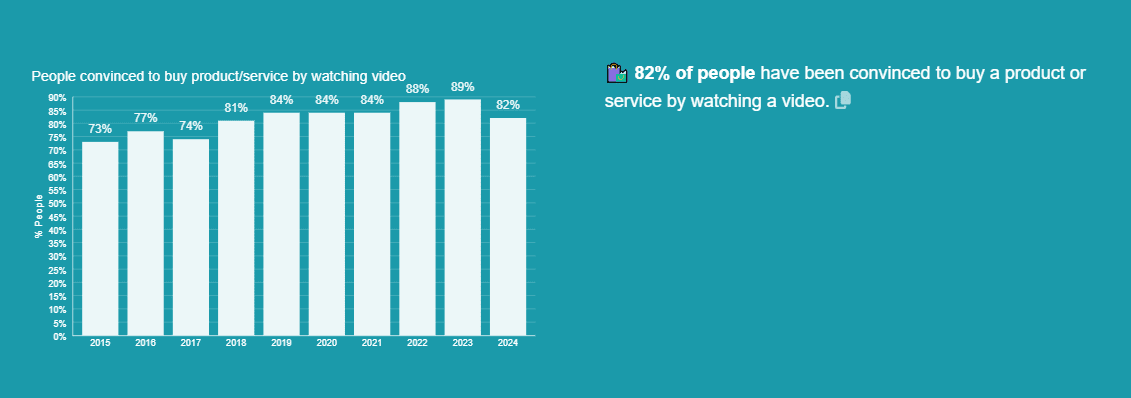
These statistics show that video marketing has become integral to any successful marketing strategy.
In short, videos capture attention in ways that text and images simply can’t. With the rise of platforms like YouTube, TikTok, and Instagram, video has become the king of content. Not only do videos increase engagement, but they also enhance brand recall and drive conversions.
Boosts Engagement
Studies show that viewers retain 95% of a message when they watch it in a video, compared to just 10% when reading it in text.
Videos are more engaging, making communicating complex ideas easier and keeping your audience interested.
Video content can significantly increase engagement levels, whether it’s a product demo or a behind-the-scenes look at your business.
Enhances Brand Recall
Videos help in embedding your brand’s message into the minds of consumers.
With visual and auditory stimuli working together, the chances of your audience remembering your brand increase substantially.
This is particularly important for small businesses looking to establish a strong brand presence.
Drives Conversions
According to a study by HubSpot, adding a video to your landing page can increase conversions by more than 80%.
Videos can effectively convey the benefits of your product or service, making it easier for potential customers to purchase.
The emotional connection that videos create can significantly enhance customer loyalty and encourage repeat business, which is particularly beneficial when utilizing Lead Generation Software.
But how can you make your videos stand out in a sea of online content?
Here are ten effective strategies to help boost your brand through video marketing.
Tell a Story
Humans love stories; it’s in our nature. From ancient cave paintings to modern-day films, storytelling is what captivates us and connects us emotionally.
When creating video content for your brand, don’t just focus on promoting your products or services. Instead, tell a story about your brand’s journey, its values, and the people behind it.
This approach will make your audience feel more connected to your brand, leading to higher engagement and conversion rates.
Some practical tips for incorporating storytelling into your brand’s videos include:
- Utilizing real-life customer testimonials and success stories
- Sharing personal anecdotes from employees or customers about their experience with your brand
- Creating a series of videos that tell a larger, overarching story about your brand or industry.
- Using emotional storytelling techniques, such as humor, nostalgia, or empathy.
For example, Nike’s “Dream Crazy” ad featuring Colin Kaepernick not only promotes their products but also tells a powerful story that resonates with their target audience.
Keep it Short and Sweet
To keep your audience engaged, it’s essential to keep your videos short and to the point.
Avoid overwhelming your viewers with long-winded content. A concise video ensures that your key messages are communicated effectively without losing your audience’s interest. Using video interview software can enhance this process by providing streamlined and engaging content delivery.
Prioritize clarity and brevity by focusing on the essential points you want to convey. For example, highlight the primary benefits of your product or share a quick tutorial demonstrating its use.
The goal is to captivate and inform your audience efficiently, leaving them with a lasting impression and a clear understanding of your message.
Here are some quick tips for keeping your videos short and engaging:
- Keep your video under 2 minutes, unless it’s a tutorial or instructional video.
- Use concise and straightforward language.
- Make every second count by incorporating visuals, animations, or music to keep the viewer engaged.
In the end, adding a call to action that directs viewers to your website or social media pages can help drive conversions and increase brand visibility.
Optimize for Mobile Viewing
With the majority of people watching videos on their mobile devices, it’s crucial to optimize your content accordingly.
This includes using vertical or square formats and incorporating subtitles for viewers who watch without sound.
Additionally, make sure that your website is mobile-friendly and can easily load and play your videos without any issues. It’s essential to use the right hosting for your needs.
By optimizing for mobile viewing, you can reach a larger audience and improve the overall user experience.
Consider this when creating videos for your brand:
- Choose a format that works for both desktop and mobile viewing.
- Include subtitles or captions in your videos to cater to viewers who watch without sound.
- Test your website’s video playback on different devices to ensure a smooth viewing experience.
Utilize User-generated Content
User-generated content, or UGC, refers to any content created by consumers about your brand. This could include reviews, testimonials, photos, or videos.
Incorporating UGC into your video marketing strategy can be incredibly powerful. It not only adds authenticity but also creates a sense of community around your brand.
You can collect UGC through social media campaigns, contests, or by simply asking your audience to share their experiences with your brand.
By showcasing real customers and their positive experiences with your brand, you can build trust and credibility with potential customers.
To increase UGC for your brand, try these tactics:
- Create a branded hashtag and encourage customers to share their experiences on social media.
- Run a contest or giveaway that requires participants to create video content related to your brand.
- Partner with influencers or satisfied customers to create video testimonials.
Incorporate Humor
Laughter is universal, and everyone loves a good joke. Adding humor to your videos can make them more enjoyable and memorable for viewers.
A well-placed joke or funny scene can also break up the seriousness of your message, making it easier for viewers to absorb and remember.
However, make sure the humor aligns with your brand’s tone and message. Avoid using jokes that could be offensive or inappropriate.
Here are some tips for incorporating humor into your videos:
- Use relatable situations or common experiences to create a sense of connection with viewers.
- Keep it light-hearted and avoid controversial topics.
- Highlight the humorous aspects of your brand or product without being too promotional.
One great example of a brand effectively using humor in its video marketing is Old Spice. Their iconic “The Man Your Man Could Smell Like” campaign used humor to create a memorable and successful marketing strategy.
Consider SEO
Don’t forget to incorporate SEO (Search Engine Optimization) into your video marketing strategy.
Including relevant keywords in your video titles, descriptions, and tags can help your videos rank higher in search results.
Additionally, make sure to share your videos on multiple platforms and include links back to your website or social media pages.
By optimizing videos for SEO, you can increase the reach and visibility of your brand’s videos.
Here are some practical tips:
- Conduct keyword research to determine the most relevant and popular terms related to your brand.
- Include these keywords in your video titles, descriptions, and tags.
- Share your videos on multiple platforms and include links back to your website or social media pages.
Analyze and Repeat
As with any marketing strategy, it’s crucial to analyze the success of your video content and make adjustments as needed.
Utilize analytics tools to track metrics such as views, engagement, and conversions.
Based on this data, you can determine which videos perform well and which ones may need some tweaking.
Don’t be afraid to experiment with different types of videos and topics to see what resonates best with your audience.
By continually analyzing and refining your video marketing strategy, you can improve its effectiveness and drive better results for your brand.
To do this, you can use some video marketing tools like Google Analytics, YouTube Analytics, or social media platform insights.
Takeaways
In summary, video marketing can be a powerful tool for brands to reach and engage with their audience. By creating short, engaging videos that are optimized for mobile viewing and incorporating elements such as humor and user-generated content, you can captivate your audience and drive conversions.
Don’t forget to keep an eye on analytics and continuously refine your strategy to ensure its effectiveness.
With these tips in mind, start incorporating video into your marketing efforts and see the impact it can have on your brand’s success.
About the Author
Erik Emanuelli has been in the online marketing game since 2010. He’s now sharing what he has learned about SEO and blogging on his website.
FAQ
What is video marketing?
Video marketing is the use of video content to promote a brand, explain products, educate audiences, build trust, generate leads, and support sales. It can include social videos, YouTube videos, ads, tutorials, product demos, webinars, testimonials, and landing page videos.
Why is video marketing important for brands?
Video marketing helps brands communicate faster, show products clearly, build trust, and reach audiences across search, social media, email, websites, and ads. Many businesses use video because it can support awareness, engagement, education, and conversions.
What types of videos work best for marketing?
Useful marketing video formats include product demos, explainer videos, customer testimonials, tutorials, behind-the-scenes videos, short-form social clips, webinars, FAQ videos, comparison videos, and onboarding videos.
How can brands improve video SEO?
Brands can improve video SEO by using clear titles, helpful descriptions, accurate thumbnails, captions, transcripts, relevant embedded pages, and video structured data where appropriate. Google also recommends making sure video files can be discovered and fetched.
How can AI help with video marketing?
AI can help with video marketing by generating ideas, scripts, hooks, voiceovers, captions, titles, descriptions, summaries, ad variations, and repurposed clips. AI should be used with human editing so the final video stays accurate, useful, and on-brand.
How long should a marketing video be?
The best video length depends on the goal and platform. Short-form videos should usually get to the point quickly, while tutorials, webinars, and demos can be longer if they provide real value. The key is to match the length to the viewer’s intent.
Should landing pages include video?
Landing pages can include video when it helps explain the offer, build trust, show a product, answer objections, or support the call to action. The video should be focused and placed near the copy it supports.
How do you measure video marketing success?
Video marketing success should be measured by the goal of the video. Useful metrics include views, watch time, completion rate, engagement, click-through rate, leads, demo bookings, sales, and customer support impact.
Other Interesting Articles
- AI LinkedIn Post Generator
- Gardening YouTube Video Idea Examples
- AI Agents for Gardening Companies
- Top AI Art Styles
- Pest Control YouTube Video Idea Examples
- Automotive Social Media Content Ideas
- Plumber YouTube Video Idea Examples
- AI Agents for Pest Control Companies
- Electrician YouTube Video Idea Examples
- How Pest Control Companies Can Get More Leads
- AI Google Ads for Home Services
- 60-Second Training Videos Are the New Corporate Standard
- Cybersecurity PR Pricing: Retainers, Deliverables & ROI
- Best AI Tools for Product Consistency in E-Commerce Video
Master the Art of Video Marketing
AI-Powered Tools to Ideate, Optimize, and Amplify!
- Spark Creativity: Unleash the most effective video ideas, scripts, and engaging hooks with our AI Generators.
- Optimize Instantly: Elevate your YouTube presence by optimizing video Titles, Descriptions, and Tags in seconds.
- Amplify Your Reach: Effortlessly craft social media, email, and ad copy to maximize your video’s impact.