
Top Virtual Assistant Providers: Compare Services & Fit

Hiring a virtual assistant can create more room for customer relationships, business development, and focused work. The challenge is finding support that takes ownership of recurring tasks without creating an equally demanding management workload.
Virtual assistant providers differ in how they recruit, supervise, and support their assistants. Some help you hire directly, while others provide an ongoing managed service. Working hours, specialist experience, replacement arrangements, and communication expectations can be just as important as the advertised price.
This guide compares virtual assistant providers and explains how to evaluate the working relationship behind each offer. A clear task brief, realistic onboarding plan, and practical performance measures can help you choose support that fits your business.
Chapters
Virtual Assistant Hiring Statistics: The Workload Behind Delegation
80% of respondents reported lacking enough time or energy to do their work. Microsoft’s 2025 Work Trend Index drew on a survey of 31,000 knowledge workers across 31 markets, alongside other research inputs. This finding provides context for capacity challenges; it does not establish how much time a virtual assistant will save.
53% of leaders said productivity needed to increase. The same report highlights the tension between business expectations and available capacity. Before hiring support, identify which responsibilities can genuinely move to another person and which still require your decisions.
The average worker in Microsoft’s analyzed usage data received 117 emails daily. Its June 2025 report used aggregated, anonymized Microsoft 365 activity to describe communication workloads. This is a finding about the analyzed environment, rather than a universal average for every business owner.
48% of employees and 52% of leaders described their work as chaotic and fragmented. Microsoft reported these survey results alongside its usage analysis. They reinforce the importance of designing clear responsibilities and communication routines when bringing in support. They are not measurements of virtual assistant performance.
Remote Leverage
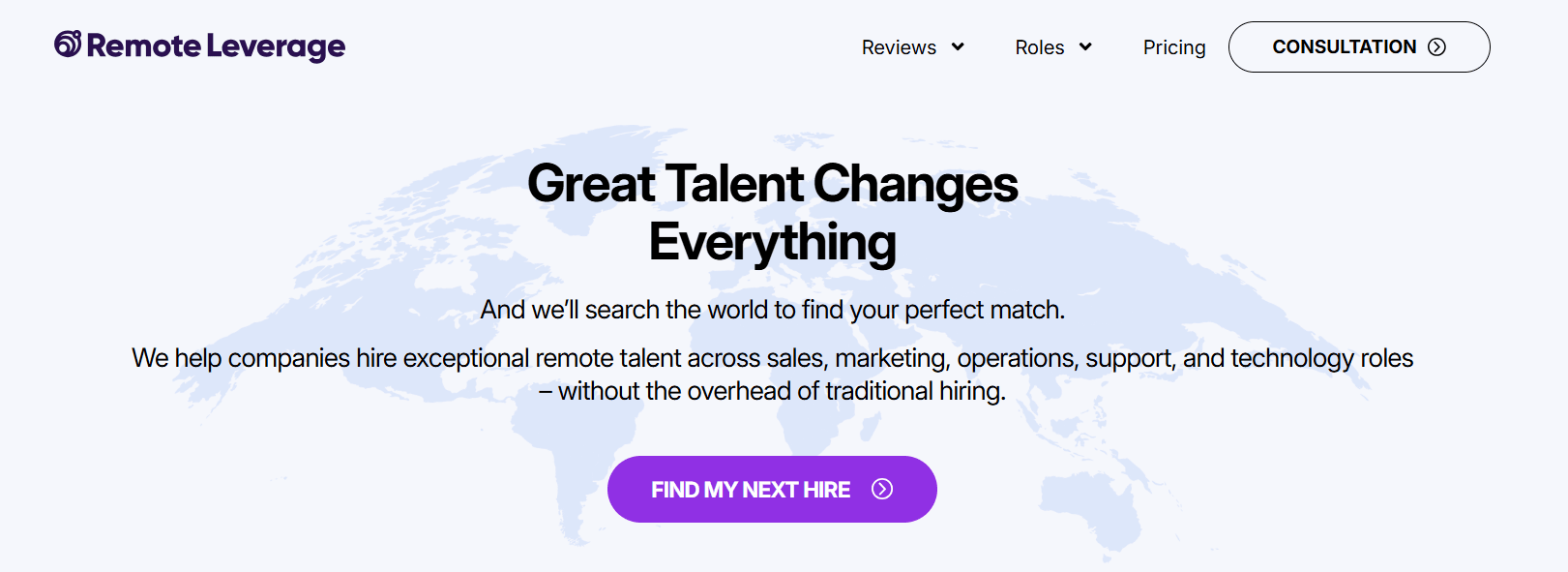
If the thing standing between you and delegating is the monthly subscription, Remote Leverage removes it entirely. It is a recruiting agency rather than a staffing agency, which sounds like a technicality until you see what it does to the maths. You hire the assistant directly, they receive every dollar you pay them, and the agency charges one flat fee after you make the hire.
What Makes Them Different
Almost every company on this list sits between you and the person doing the work, taking a monthly cut of what you pay. Remote Leverage does not. Whatever hourly rate you agree goes straight to your assistant, and the company is paid once, as a flat fee, only after you decide to hire someone.
That structure has a knock-on effect the company is direct about. Skilled assistants tend to avoid arrangements where an agency keeps a large share of their earnings, so removing the ongoing markup widens the pool of people willing to apply.
Sourcing runs across Latin America and the Caribbean, the Philippines, South Africa and Egypt, with Latin American candidates the most popular among US businesses for the time zone overlap and English fluency. Every applicant submits an English voice recording, and the team reviews hundreds of applications daily before shortlisting.
Speed is the other differentiator. You receive four to six pre-vetted candidates within 48 to 72 hours, interview as many as you like at no cost, and can be onboarded in around four days. The company has placed more than 2,500 assistants and worked with over 2,000 businesses, including Coldwell Banker, RE/MAX, Realty One Group and Chick-fil-A franchises.
What They Offer
Administrative support covers recurring admin duties, calendar management, phone and email handling, invoicing and payment tracking, and data entry with CRM management. The wider bench spans more than 50 specialised roles across executive assistance, customer support, sales, lead generation, marketing, graphic design, bookkeeping, and medical, legal, insurance and real estate work.
Rates run $6 to $10 an hour for most administrative, support, sales and marketing roles, rising to $11 to $15 for highly experienced hires, which the company frames as roughly 70 per cent below the equivalent US cost. The minimum engagement is 20 hours a week, and part-time or full-time both work.
Payroll, tax compliance and international payment regulations are handled by a partner company across 170-plus countries. Every hire carries a 12-month replacement guarantee at no extra cost, plus a dedicated Customer Success Manager for performance reviews and training guidance, and a 30 per cent discount on subsequent hires.
Best For: businesses that want to own the hiring relationship outright, avoid recurring agency markups, and pay the assistant directly rather than funding a middleman every month.
50hrs.com

50hrs.com takes a premium, fractional approach to executive assistance, pairing each client with two dedicated US or Canadian assistants. That built-in redundancy means work can continue when one assistant is unavailable, rather than leaving the client to recruit and retrain from scratch.
What Makes Them Different
The service is designed for complex operational work—not just routine admin. Assistants can support email, calendar management, operations, research, content, data, compliance, travel and other personal or business tasks, with the 50hrs.com team handling recruiting, onboarding, training and ongoing management.
What They Offer
Fractional, month-to-month pricing lets businesses scale support up or down without a long-term contract. The model is a fit for founders and executives who want to hand off substantial recurring work to North American talent while keeping flexibility as their needs change.
Best For: founders and executives who need reliable support for complex workflows, want backup coverage built in, and prefer flexible fractional assistance without a contract.
Wishup
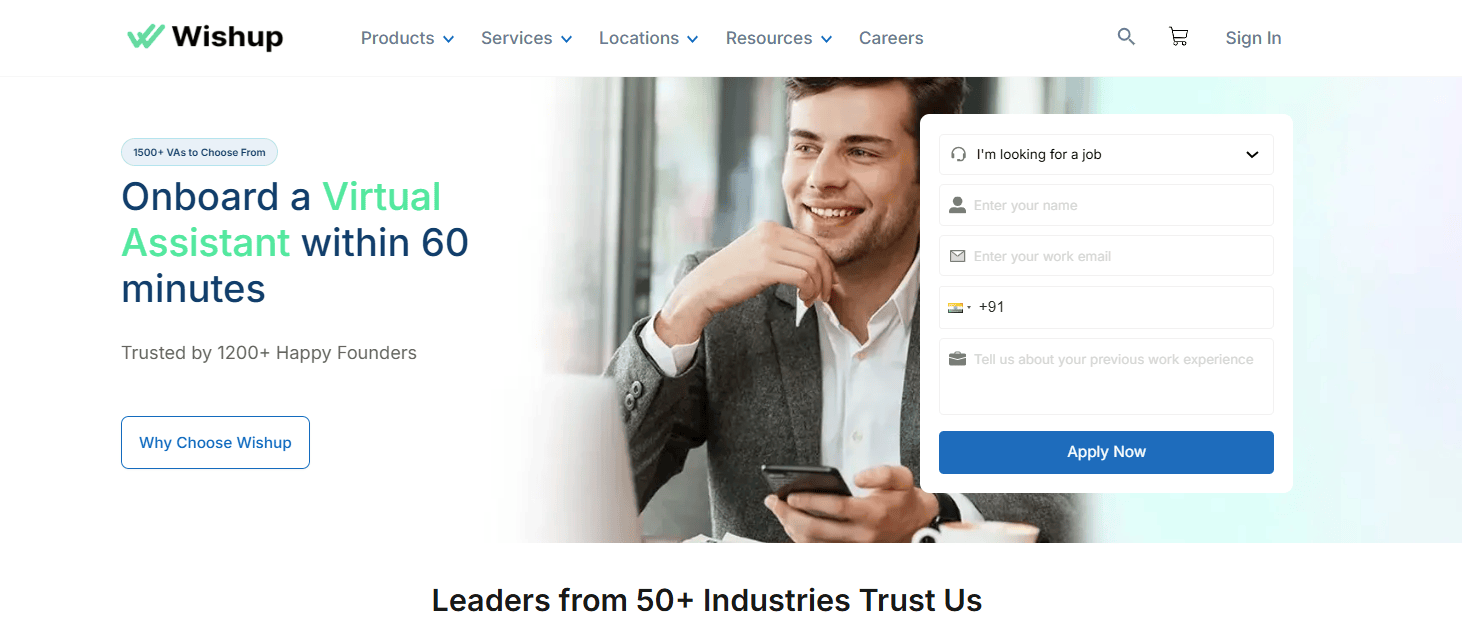
Wishup built its reputation on onboarding speed, and the claim is unusually specific: a matched assistant in as little as 60 minutes. For a founder who has already lost a week to the decision itself, that is a meaningful proposition. More than 1,200 founders across 50-plus industries have used the platform.
What Makes Them Different
The filter is the story here. Applicants go through a six-step vetting process and an eight-week training programme, with only the top 0.1 per cent making it through. That is a genuinely narrow gate rather than a marketing number.
Assistants are trained across more than 120 AI and no-code tools, which pushes them beyond basic admin into automation, workflow building and CRM configuration. The platform covers over 200 skill sets across more than 50 industries including healthcare, real estate, e-commerce and startups.
Future Market Insights names the company in its Global Virtual Assistant Services Market report as a key player, citing its focus on startups and SMBs through subscription pricing and specialised assistants.
What They Offer
Services span executive assistance, virtual personal assistants, general admin, bookkeeping, social media management, inbox and calendar management, CRM administration, phone answering and workflow automation. Plans start at around $1,299 a month, and clients also get free access to an in-built employee management app for task assignment and real-time visibility.
Best For: founders and growing teams who want an AI-literate assistant productive almost immediately, and who are comfortable with a subscription model.
BELAY

Operating since 2010 and headquartered in Atlanta, BELAY works with close to 2,000 professionals across 48 US states. Every assistant is US-based and engaged as an independent contractor, which is the entire proposition for clients who care about time zone alignment and shared business culture.
What Makes Them Different
BELAY accepts a little over 3 per cent of applicants, a comparison the company likes to make against Harvard admissions. Placed assistants typically hold a bachelor’s degree or higher and arrive with years of professional experience already behind them.
The matching process is handled by a person rather than an algorithm. Someone on the team learns your requirements and communication style before proposing a candidate, and the company reports a 93 per cent first-match success rate. It has also pushed assistants toward AI fluency in recent years.
What They Offer
Coverage runs from executive and personal assistance through marketing support, bookkeeping, payroll and social media management, extending to fractional CFO and fractional controller engagements for clients who need finance leadership without a full-time hire.
BELAY does not publish pricing, so a figure requires a consultation. Third-party reports put the effective rate in the $42 to $50 an hour range, which is unverified by the company.
Best For: executives who specifically require a US-based assistant and accept the premium that comes with it.
Boldly
Boldly runs a premium subscription staffing model, and one structural detail separates it from most of this list: assistants are W2 employees rather than contractors. For US businesses nervous about 1099 classification rules, that removes a genuine compliance worry.
What Makes Them Different
Assistants are based in the US and UK, and many arrive with Fortune 500 experience. These are not generalists learning your business alongside you but experienced professionals capable of anticipating what comes next and owning complex work outright.
Bilingual support is available in French, German and Spanish, which matters for businesses with clients outside the English-speaking market.
What They Offer
Executive and personal assistance, project management, bookkeeping, social media and marketing support. Plans begin at around $2,600 a month for 40 hours, roughly $65 an hour, scaling to about $6,500 for 100 hours. That 40-hour minimum suits fractional part-time support rather than a full-time seat, and specialised work such as web design or technical builds is billed separately at $79 an hour.
Best For: senior leaders wanting one experienced long-term assistant, with a budget that matches the positioning.
MyOutDesk
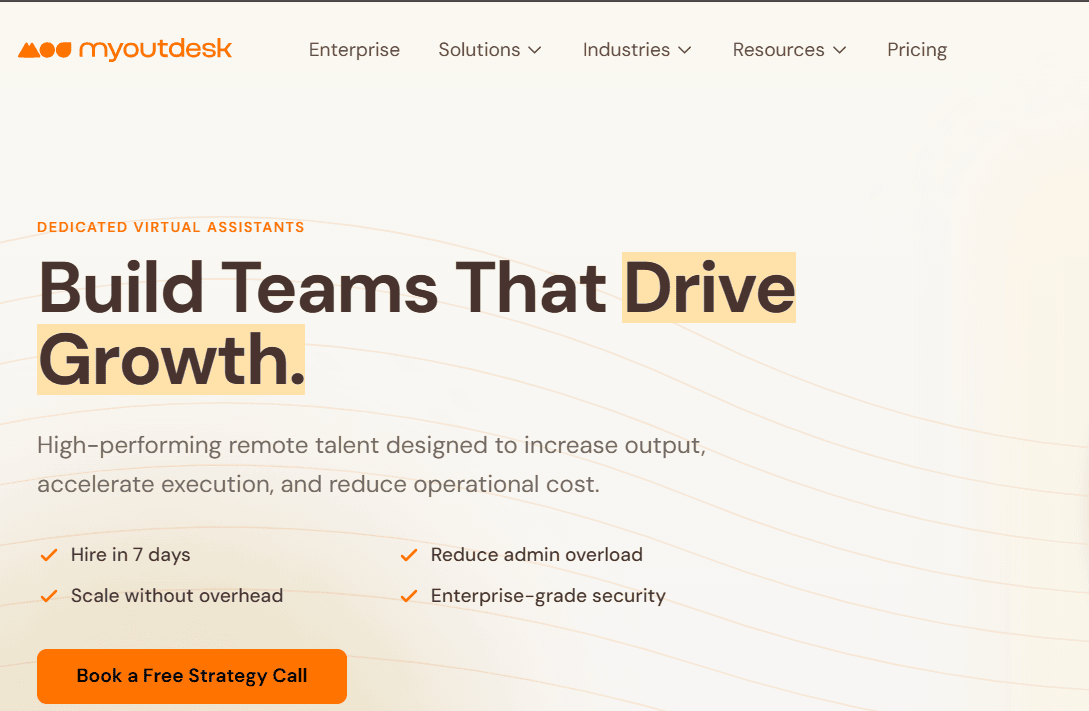
Founded in 2008 during the financial crisis, MyOutDesk is among the longest-running names in the category. Daniel Ramsey built it to let businesses keep growing without carrying full-time payroll, and it has become particularly established in real estate.
What Makes Them Different
Acceptance sits around 0.7 per cent of applicants, with background checks and structured training before any client match. The company optimises for long working relationships rather than quick placements, and there are no lock-up periods, so cancellation carries no penalty.
What They Offer
Real estate remains the strongest suit, but the company also serves healthcare, e-commerce and general business operations. Services include admin support, customer service, digital marketing, social media, SEO and Google advertising, with integrations into common project management tools. The company reports client savings of up to 70 per cent against in-house hiring, since recruiting, background checks, payroll and benefits are handled for you.
Best For: real estate professionals and established businesses wanting full-time dedicated support at a predictable monthly rate.
Time Etc
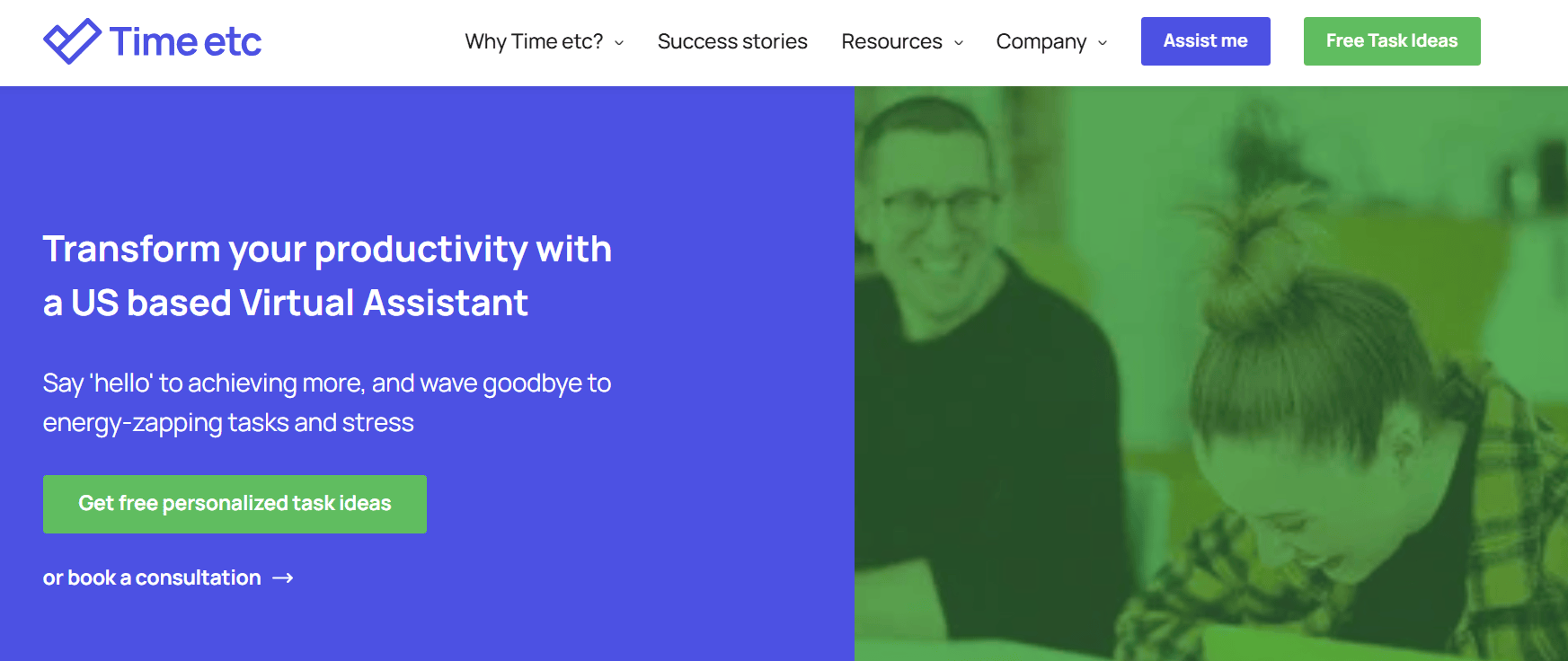
Time Etc has operated since 2007, hiring college-educated assistants from the US and UK. If the aim is to offload everyday admin without a significant financial commitment, this is the most straightforward entry point on the list.
What Makes Them Different
The commercial terms are the draw. You buy a monthly bundle of hours with no long-term contract, no notice period to cancel, and the ability to switch plans whenever you like. Pricing is transparent with no hidden fees and no setup charge.
Billing runs by the second rather than the hour, so there is no rounding up and no paying for a fifteen-minute block that took four minutes.
What They Offer
Email management, scheduling, data entry, expense tracking, social media updates, document formatting, research and recurring administrative work, handled through a dashboard and mobile app. Plans run from around $390 a month for 10 hours up to $2,160 for 60 hours, working out at roughly $36 to $39 an hour, with unused hours rolling over on the 20-hour plan and above. Additional users and assistants can be added to an account at no extra cost, which makes it one of the few options here that works across a small team rather than a single person.
Best For: solo founders, freelancers and small businesses needing flexible part-time admin help with no contract.
Wing Assistant
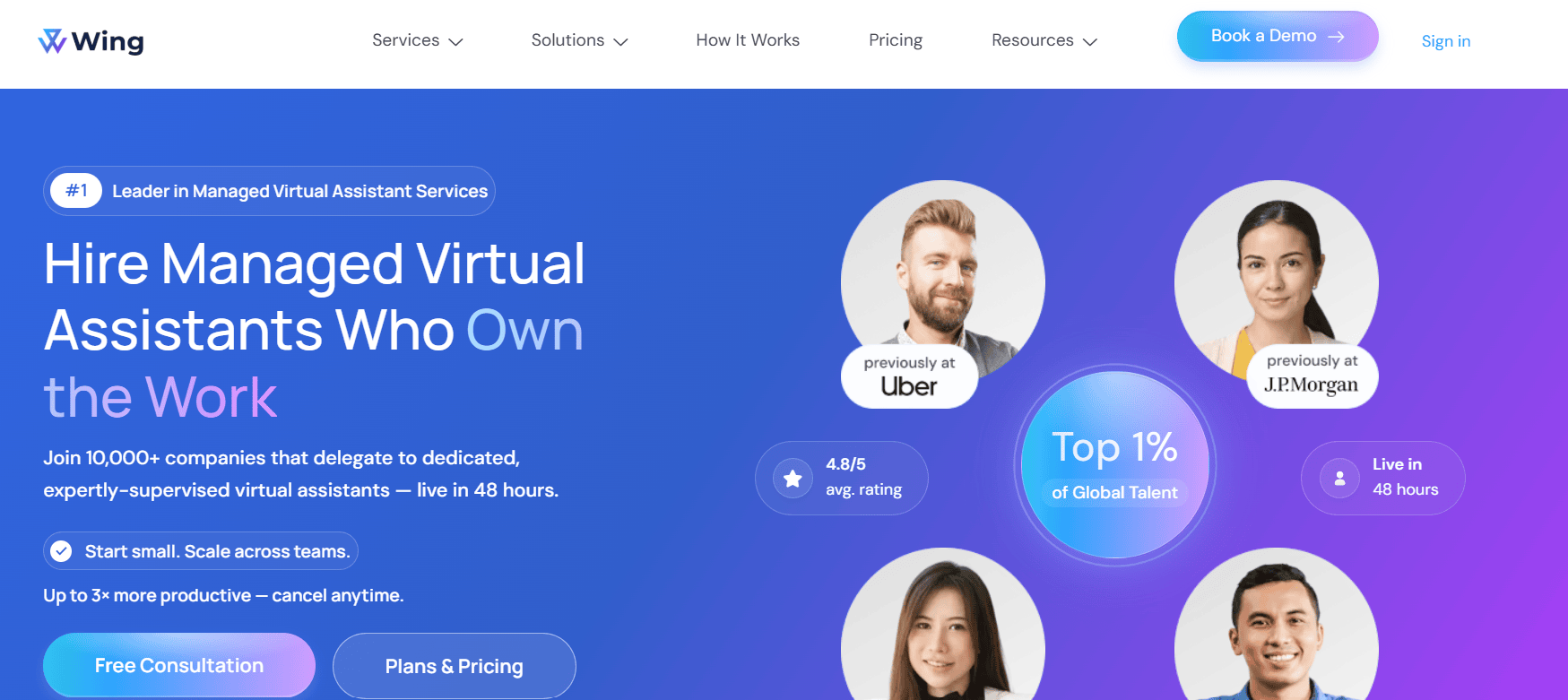
Wing Assistant has scaled quickly and now serves more than 3,000 businesses worldwide. Flat monthly pricing starts from around $699 for part-time at four hours a day, with full-time at eight hours priced higher and specialist roles carrying a premium, across more than 25 distinct roles spanning sales, marketing, customer service and operations.
What Makes Them Different
Your assistant does not work alone. Wing builds a management and supervision layer into the service, which is what keeps output steady when someone is having a difficult week. The company also commits to a three-minute response time during working hours, which is an unusually hard operational promise.
All plans include the Wing Assistant app for task management and communication at no extra cost.
What They Offer
General admin, executive assistance, customer service, real estate operations, Amazon store management, sales support, CRM and social media management, plus industry-specific assistants for teams that need someone already familiar with their sector.
Best For: startups and agencies needing niche assistants across several functions, with supervision built in at a flat rate.
BruntWork
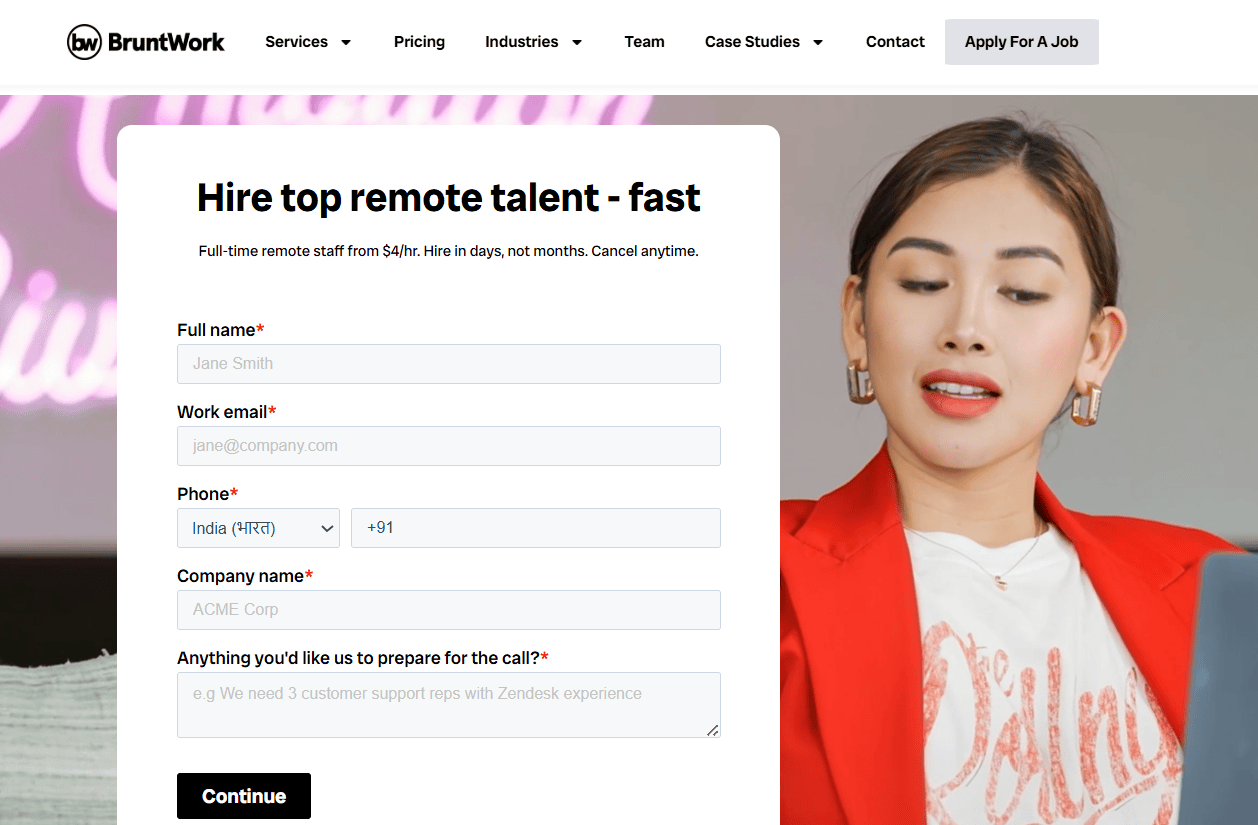
BruntWork is the strongest option for businesses that want offshore talent at genuinely low cost without hiding the pricing. Assistants come primarily from the Philippines and other global talent pools, supporting customer service, operations, marketing and admin.
What Makes Them Different
Rates are published openly from $4 an hour, rising to around $17 for specialist roles such as bookkeepers, cold callers and web developers, which makes this the most transparently priced provider here. Recruitment costs nothing and carries no obligation, billing starts only when your assistant does, and charges track hours actually worked.
There are no lock-in contracts, and you can change staff as your requirements shift.
What They Offer
Customer service, general admin, operations support, social media management, data entry, bookkeeping, digital marketing and SEO. The company is HIPAA certified, which opens it up to healthcare clients, and works across e-commerce, real estate, healthcare, dental and technology.
Best For: e-commerce companies, startups and healthcare businesses wanting scalable offshore support at the lowest published hourly entry point.
Which One Should You Pick?
Start with the commercial model rather than the feature list, because that is what you will still be paying for in eighteen months.
If you want to own the relationship and stop paying a monthly markup, Remote Leverage is the structural outlier here, with the assistant paid directly and a single flat fee at the point of hire. If hiring speed is the binding constraint and you want automation skills built in, Wishup places people in hours rather than days.
If a US-based assistant is non-negotiable, BELAY and Boldly are the two serious answers, with Boldly adding W2 employment status. For low-commitment part-time help, Time Etc bills by the second with no contract. For supervised coverage across several functions at a flat rate, Wing Assistant. And for the lowest published hourly entry point, BruntWork from $4.
The decision that costs the most is not choosing wrong. It is continuing to do the work yourself while you deliberate.
Write a Delegation Brief Before Comparing Providers
A provider can make a more useful recommendation when you describe the work in concrete terms.
Start by recording recurring tasks over a typical week. Note how often each task occurs, how long it takes, what information it requires, and what a successful result looks like.
Replace broad requests such as “help with operations” with specific responsibilities:
- Prepare a daily list of emails requiring a decision.
- Coordinate meetings within agreed availability.
- Update customer records from approved information.
- Assemble a weekly report from defined data sources.
- Draft routine follow-ups for review.
Identify which tasks require live coverage and which can be completed asynchronously. A role involving incoming calls has different scheduling needs from one focused on document preparation.
Also separate essential skills from skills you can teach. Familiarity with your internal naming conventions is trainable. Strong written communication or experience handling complex scheduling may need to be present from the start.
Use the same brief with each shortlisted provider so their recommendations address a comparable workload.
Compare the Full Working Arrangement Behind the Price
An hourly rate or monthly subscription only describes part of the relationship.
Ask each provider to explain who handles recruitment, day-to-day supervision, performance concerns, absence coverage, and replacement. Confirm which responsibilities remain with your business.
Clarify the difference between availability and dedicated capacity. An assistant may be available during a broad service window while working across several clients. Establish the hours or workload specifically allocated to you.
Useful questions include:
- Who assigns and prioritizes the work?
- Is the assistant dedicated to our account?
- What does a response-time commitment actually cover?
- How are additional hours requested and billed?
- What happens during holidays or unexpected absence?
- Who maintains documentation if the assistant changes?
Compare the total expected cost, including onboarding, additional coverage, specialist work, and your own management time.
A managed service may justify a higher fee if it provides supervision you need. Direct hiring may suit a business that already has the capacity to manage the role. Evaluate the responsibilities included in the arrangement alongside its price.
Use the StoryLab.ai HANDOFF Framework for Clear Instructions
The StoryLab.ai HANDOFF framework is a practical checklist for transferring work to a virtual assistant.
H — Highlight the outcome.
Explain what the completed task should achieve. For inbox support, the outcome might be a prioritized decision list and prepared routine replies.
A — Add examples.
Provide a strong example and explain why it meets expectations. Include common exceptions where useful.
N — Name the boundaries.
Specify what the assistant can complete independently and what requires approval.
D — Define the deadline.
Include the relevant time zone, recurring schedule, and dependencies.
O — Organize access.
Provide the accounts, files, and permissions needed for the task through your approved access process.
F — Flag exceptions.
Describe situations that should be escalated, such as conflicting instructions, missing information, or an unusual customer request.
F — Finish with feedback.
Review early work and update the instructions when a recurring question reveals a gap.
For example, a scheduling handoff should explain meeting length, availability, preparation time, and which commitments must remain fixed. Those details allow the assistant to make useful decisions without checking every calendar change.
Build a First-Month Onboarding Plan

Begin with a small, representative set of tasks and expand responsibility as the working relationship develops.
Week one: establish the process.
Review priorities, communication preferences, examples, and access. Walk through the initial tasks together and document important decisions.
Week two: complete work with review.
Let the assistant handle the agreed tasks while you check the outputs. Collect questions in a shared list so routine uncertainty does not become a stream of interruptions.
Week three: expand proven responsibilities.
Increase independence where work consistently meets expectations. Add another task only when the existing workload is manageable.
Week four: review the arrangement.
Discuss quality, turnaround time, workload, and recurring obstacles. Decide whether to adjust the scope, instructions, or working hours.
Agree on how AI may be used during onboarding. Define which information can be entered into approved systems, which outputs require checking, and who approves material before it reaches customers.
Keep documentation current so the process remains usable during absence or a future handover.
Measure Time Saved, Work Quality, and Reliability
Judge the arrangement by what it helps the business accomplish.
Before delegation, estimate how much time the selected tasks normally take you. After the assistant starts, record the time you still spend explaining, reviewing, correcting, and coordinating that work.
For example, if a task previously took five hours per week and now requires one hour of your review and coordination, the estimated net time released is four hours. This is an illustrative calculation, not a promised result.
Track a small set of practical measures:
- Net owner or manager time released.
- Work completed by the agreed deadline.
- Outputs accepted without substantial rework.
- Recurring errors or unresolved questions.
- Backlog size and age.
Interpret these measures together. Faster completion has limited value if corrections consume the time saved. Repeated questions may indicate unclear instructions rather than poor performance.
Review whether the released time is being used for worthwhile priorities. As the arrangement settles, refine the responsibilities that consistently create value and reconsider tasks that remain difficult to delegate effectively.
Final Thoughts
The virtual assistant market has matured to the point where the question is no longer whether to delegate but how the arrangement is structured. Subscription, hourly, flat-fee recruitment and W2 employment are four genuinely different commercial relationships, and each suits a different kind of business.
Start narrow. Hand over one recurring task, something with a clear beginning and end, and see how the handoff actually feels. The same discipline that clears content creation bottlenecks applies here, namely auditing the process first, naming the recurring pain points, then assigning the work with clear expectations rather than hoping someone infers them. Almost everyone who does this reports the same reaction afterwards, which is that they should have started sooner.
Whichever provider you shortlist, ask three things before signing: who receives the money you pay, what happens if the first match does not work, and how quickly you can leave. The answers will separate them faster than any feature comparison.
Frequently Asked Questions
How much does a virtual assistant cost?
Rates run from $4 an hour offshore to around $65 for US-based support. Direct-hire recruiting sits lowest, with most administrative roles between $6 and $10, because you pay the assistant rather than an agency markup.
Should I hire offshore or onshore?
Onshore costs four to six times more and earns it only when the role needs live client calls in your market or a US contractor for compliance reasons. For admin, scheduling and CRM work, time zone overlap matters more than location.
What is the difference between a recruiting agency and a staffing agency?
A staffing agency employs the assistant and bills you monthly, keeping a share. A recruiting agency charges once and steps out. One means paying a markup indefinitely, the other means a single fee and a direct relationship.
What should I delegate first?
Something recurring and easy to check, such as calendar management, inbox triage or invoice chasing. You will know within a week whether it is working. Leave anything needing judgement about your business until the relationship is established.
Other Interesting Articles
- AI LinkedIn Post Generator
- Gardening YouTube Video Idea Examples
- AI Agents for Gardening Companies
- Top AI Art Styles
- Pest Control YouTube Video Idea Examples
- Automotive Social Media Content Ideas
- Plumber YouTube Video Idea Examples
- AI Agents for Pest Control Companies
- Electrician YouTube Video Idea Examples
- How Pest Control Companies Can Get More Leads
- AI Google Ads for Home Services
- 60-Second Training Videos Are the New Corporate Standard
- Cybersecurity PR Pricing: Retainers, Deliverables & ROI
- Best AI Tools for Product Consistency in E-Commerce Video
Master the Art of Video Marketing
AI-Powered Tools to Ideate, Optimize, and Amplify!
- Spark Creativity: Unleash the most effective video ideas, scripts, and engaging hooks with our AI Generators.
- Optimize Instantly: Elevate your YouTube presence by optimizing video Titles, Descriptions, and Tags in seconds.
- Amplify Your Reach: Effortlessly craft social media, email, and ad copy to maximize your video’s impact.