
How to Write a Powerful Case Study: Structure, Template + Examples
PDFs are out, storytelling is a must and many more tips
When it comes to making a purchase decision, an impressive 92% of consumers trust other people’s opinions more than advertisements.
At Foleon, we’ve come to realize how important it is to get customers to tell our story. People who may not have heard of our brand before will look for cues that tell them whether we’re trustworthy. Positive signals from customers are a powerful form of social proof — one that you can benefit from too.
That being said, case studies are a fabulous way to show potential buyers how others have achieved success with your product. They are a persuasive way to reduce uncertainty among new prospects and demonstrate your value.
Case studies work because they do what marketing claims can’t: they show real-world proof.
A strong case study isn’t a brochure. It’s a story with a clear before-and-after:
- What was broken (and what it cost)
- What changed (and how it was implemented)
- What improved (with numbers and quotes)
In this guide, you’ll get a simple structure you can reuse, a short interview workflow to gather great quotes, and a checklist to make your case study persuasive and easy to skim.
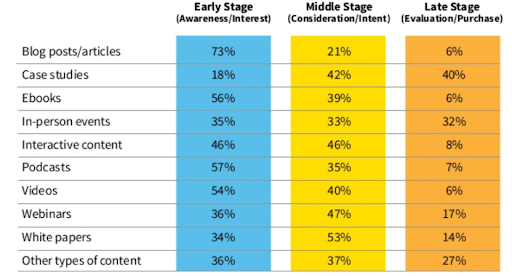
Source: Content Marketing Institute
This post will give you an overview of how to structure your case studies and optimize them for conversions. After reading this article, you’ll know what to include to ensure that you benefit from happy customers’ positive experiences, and you’ll have the tools to create extraordinary case studies that will convince the most scrutinizing of buyers.
Why case studies are so important
A case study demonstrates how your product satisfied other customers and helped them accomplish their goals.
If you’re looking to close more deals, it is essential to incorporate case studies into your marketing mix as they will foster trust, help your prospects overcome any doubts about your product’s value, and increase the chance that they’ll buy from you.
And it’s important to tailor case studies to different audience segments. Address their concerns by creating case studies that are specific to them.
Like with all types of content, if it’s generic and only semi-relevant, it probably won’t inspire action. A targeted case study, on the other hand, shows that you’re aware of the challenges in your prospect’s specific situation, that you’re capable of providing a solution, and you’ve already helped customers overcome similar challenges.
A proven formula for a winning case study
No matter what kind of company you are, or what kind of products or services you sell, a good case study always includes four main components: the challenge, the solution, the result, and the customer’s testimonial.
The case study introduction
With the average website visitor reading only 25% of your text, the introduction is where you need to grab your visitor’s attention. Introduce your customer and display eye-catching numbers that quickly communicate what they achieved with your product.
Tip: nothing compares to a video of a customer raving about your product in the introduction of your case study.
The challenge
What challenges was your customer experiencing prior to using your product and how did this affect their business? Include specific quotes that help your reader identify with the situation, feel the pain, and become eager for a solution.
“We have a lot of inspiring content to share, but our previous standard newsletter email format in which we shared the content wasn’t inspiring at all.”
The solution
This part of the case study is where the customer describes how your product solved their problem and why they chose you instead of your competitors. What were they doing before they adopted your product? What features were particularly useful to them? What was their onboarding experience like?
The results
The most important part of your case study is the results. Here, you can be as bold as you want, in fact, it’s absolutely fine to show off. What business goals did your customer achieve and what measurable benefits have they seen so far? In this section, numbers are your best friend because they lend authority to the story and provide evidence of real change.
Add testimonials to your case study

Testimonials serve as reviews of how paying customers benefit from using your product. With more than 60% of consumers reading an online review before making a decision, including real quotes throughout your case study is a great idea. We suggest adding the most valuable part of the testimonial in the introduction to make it more prominent. An excited customer should happily provide you with plenty of quotable material.
Moving beyond the formula: Taking your case study up a notch
A happy customer and a solid writing formula might seem to be adequate components for a successful case study. However, in reality, this is not enough. If you want your case study to resonate and lead to action, you need to add an essential element that’ll transform it into content that delivers actual results for your business.
Wonder what that might be?
It is the story that builds around your case study. A story your prospects will remember more and identify with. If you’re wondering why, the answer is simple: People love stories.
At Foleon, we believe this point is so critical that we’ve even dropped the term “case study” and replaced it with a more accurate name, “success stories.”
From our earliest years, we use stories to communicate, share, and connect. We are more perceptive towards an impressive narrative that resonates at an emotional level. Great stories bring out our hidden wishes, make us feel stronger, and inspire us to overcome obstacles and become the best version of ourselves.
Now, imagine the impact of storytelling on case studies. Going beyond simple testimonial, a case study presented in the form of an authentic narrative with a beginning, middle and ending, will always be more effective.
Below we gathered some tips on how to ensure that your story ticks all the boxes.
Stories trigger emotion and emotion triggers decision-making
A case study that unravels as a story with a hero (your customer), a challenge (the problem they are trying to solve), a villain (whatever was standing in their way), and a happy ending (growth achieved with your help) will help your prospects feel connected and visualize themselves as the protagonist of their own story. Best part? They will be ready to take the next step.
Get people to picture what you’re writing about
No matter how great your narrative, it’ll be much easier to stick with when it’s visually compelling. Make use of the power of visual content and enable your prospects to remember your story.
Tip: Today, there are many great tools that help you create visually compelling and interactive case studies that look good on any device.
Back it up with data
Like with visuals, mixing your story with data visualizations will make it easier to read and remember. Showcase your customer’s success with digits that demonstrate progress. Back up your customer’s results with real numbers that show how your product changed their business and helped them achieve their goals. This will encourage your prospects to wonder what they could accomplish if they were in your customer’s position.
Help your customers get started
Always add a call to action to the end of your story so that readers can easily take the next step while they’re still excited about what they’ve read. Some examples of what CTA you could use are:
- A link to a valuable piece of content such as an e-book or a white paper that will help them continue their journey.
- A link to your success stories page where your prospects will find more case studies showcasing your expertise.
- A link to your contact page or free trial page to help prospects who are interested in knowing more about your product reach out and/or get started.
Distribute. Share. Repeat.
After all the time and effort you spent in creating your story you don’t want it to get lost in the shuffle. At Foleon, we always want to make sure that our content reaches our audience and is communicated through all relevant channels. Below there are some ideas on how to distribute and share your stories:
- Create a dedicated “Success Stories” section on your website;
- Include your stories in your sales communications (activation, nurture, inbound, outbound, expansion);
- Add them to product brochures, eBooks, white papers, and communication assets;
- Incorporate them in your news updates;
- Share them via social media.
The customer interview workflow (how to get quotes and metrics without awkwardness)
Mini process
- Send a short prep email: goals, what you’ll cover, ask them to bring numbers if possible
- Record the call (with permission)
- Ask for specifics: timeline, baseline, impact, obstacles, surprises
- Confirm approval steps: who signs off and when
Interview questions that consistently produce great case studies
- What was happening before you looked for a solution?
- What did the problem cost you (time, money, risk, missed goals)?
- Why now? What triggered the decision?
- What alternatives did you consider (and why didn’t they work)?
- What was the implementation like? What made it easy/hard?
- What changed after launch? What measurable results did you see?
- What would you tell someone considering the same decision?
| Step | What to do | Why it matters | Tip |
|---|---|---|---|
| Prep email | Send agenda + ask for any metrics they can share | Gets better numbers and fewer “I’ll check later” moments | Ask for “before” and “after” if possible |
| Confirm permissions | Ask if you can record and quote them | Avoids approval headaches later | Clarify what must be anonymized |
| Record interview | Keep it short and focused | Higher quality answers and fewer tangents | 25–35 minutes is usually plenty |
| Capture proof | Collect numbers, screenshots, or internal artifacts | Makes the story credible | Even 1 chart or screenshot helps |
| Draft fast | Write a first version within a day or two | Details are still fresh | Use direct quotes early, polish later |
| Approval path | Agree who approves and by when | Prevents endless feedback loops | Ask for one final “approved for publish” reply |
The proof stack (make it persuasive without sounding salesy)
Case studies convert when the proof feels specific and verifiable.
Add a “proof stack” section near the results:
- Numbers: lift in conversion, time saved, cost reduced, cycle time improved
- Quote: a human line that captures the emotional win
- Artifact: screenshot, chart, workflow diagram, before/after
- Context: what was done (so it doesn’t look like magic)
This aligns with the way strong templates recommend leading with measurable outcomes and adding a quick “snapshot” section for credibility.
| Section | Question | What you’re trying to capture | Follow-up prompt |
|---|---|---|---|
| Context | What does your company do and who do you serve? | Industry, audience, and scope | “What makes your business different?” |
| Before | What was happening before you looked for a solution? | Baseline situation | “How did it affect your team day-to-day?” |
| Pain | What did this problem cost you? | Time, money, risk, missed goals | “Any numbers you can share?” |
| Trigger | Why did you decide to fix it now? | The urgency moment | “Was there a deadline or event?” |
| Options | What alternatives did you consider? | Buying journey and comparison | “What didn’t work about them?” |
| Decision | Why did you choose this solution? | Selection criteria | “What was the deciding factor?” |
| Implementation | What did the implementation look like? | Process, time-to-value | “What surprised you?” |
| Obstacles | What challenges came up and how did you handle them? | Realism and credibility | “What would you do differently?” |
| Results | What changed after launch? | Outcomes and impact | “What improved the most?” |
| Proof | Which metrics moved, and by how much? | Specific numbers | “Baseline vs now?” |
| Quote | If you had to sum up the experience in one sentence, what would you say? | Headline-worthy testimonial | “What would you tell someone considering it?” |
| Next | What are you doing next now that this is working? | Momentum + future plans | “Any expansion plans?” |
SEO and page structure for case studies (so they rank and get found)

SEO and page structure for case studies (so they rank and get found)
Best-practice structure
- H1: Customer outcome + category (not “Case Study: X”)
- Above the fold: quick context + KPI win + CTA
- Clear H2s: Challenge, Solution, Implementation, Results, Quote, Next steps
- Internal links: to product page, feature pages, and relevant guides
- Schema (optional): Article / FAQ schema if you use it
Keyword angles that attract high-intent traffic
- “[industry] case study”
- “How [company] achieved [result]”
- “[problem] case study”
- “[tool/category] success story”
Google also emphasizes crawlable links and good internal linking for discovery, so make sure your case study hub links to individual stories and vice versa.
Distribution and repurposing (one case study = weeks of content)
- Turn the results into a LinkedIn carousel (Problem → Turning point → Result)
- Clip 2–3 customer quotes for short video/social posts
- Add one slide to sales decks (“Proof: X achieved Y”)
- Use snippets in nurture emails (one quote + one metric)
- Create a “Success Stories” hub and link it from product pages
This is the difference between a case study that “exists” and one that actively drives pipeline.
Conclusion
Your prospects are smart and demanding in terms of proof. That’s why investing time in writing case studies is absolutely worth the effort. If done right, it’ll boost your overall marketing effectiveness and skyrocket conversions.
And if you incorporate storytelling, data, and the right imagery, you’ll persuade even the most indecisive prospects.
Last piece of advice. Don’t create your case study in a boring PDF. Opt-in for an interactive, immersive and responsive HTML-5 solution instead of a static or even interactive PDF.
FAQ
What is a case study?
A case study is an in-depth analysis of a particular event, situation, individual, or group over a period of time, used to illustrate theories or concepts, and often used in academic, scientific, and business contexts.
What are the key elements of a case study?
Key elements include an introduction, background information, presentation of the main issue or challenge, analysis, solutions or findings, and a conclusion.
How do you choose a subject for a case study?
Choose a subject that is relevant, unique, and illustrative of a broader principle or problem. It should offer valuable insights or lessons that can be applied in similar situations.
What is the importance of research in writing a case study?
Research is crucial to gather accurate, comprehensive information about the case subject, understand the context, and support the analysis with factual evidence.
How should a case study be structured?
A case study should have a clear structure: start with an introduction, then provide background details, present the main issue, followed by an analysis, and conclude with the outcomes or lessons learned.
What makes a case study effective?
An effective case study is engaging, well-researched, clearly written, and provides insightful analysis. It should highlight practical solutions and lessons that readers can apply.
How do you analyze the data in a case study?
Analyze data by identifying patterns, drawing connections between the data and the problem, and considering various perspectives to understand the case’s complexity fully.
What is the role of storytelling in a case study?
Storytelling helps make the case study more engaging and relatable. It presents the information in a narrative form, making it easier for readers to understand and remember.
How can case studies be used in business?
In business, case studies are used to demonstrate the value of a product or service, showcase success stories, and illustrate how challenges were overcome with practical solutions.
What are the best practices for writing a case study conclusion?
A good conclusion should summarize the key findings, state the implications of the case, and suggest possible future research or actions based on the study’s outcomes.
How do you ensure objectivity in a case study?
To ensure objectivity, focus on factual and well-researched information, avoid personal bias, and present multiple perspectives on the issue being analyzed.
What is the role of visuals in a case study?
Visuals such as charts, graphs, and images can enhance the readability of a case study, help illustrate key points, and make complex information easier to digest.
How can a case study be made more engaging for the reader?
To make a case study engaging, use a compelling narrative style, include real-world examples, and focus on relatable problems and practical solutions that resonate with the reader.
What is the importance of citing sources in a case study?
Citing sources is crucial for establishing credibility, allowing readers to verify the information, and avoiding plagiarism by acknowledging the original authors of the data and theories used.
How do you determine the length of a case study?
The length depends on the complexity of the case, the depth of analysis required, and the intended audience. It should be long enough to cover all critical aspects but concise enough to maintain reader interest.
Can interviews be part of a case study, and how should they be conducted?
Interviews can be a valuable part of a case study, providing first-hand insights. They should be conducted professionally, with prepared questions relevant to the study’s focus.
How do you approach writing a case study for an academic audience?
For an academic audience, emphasize thorough research, methodological rigor, and theoretical insights. Use formal language and adhere to academic standards for structure and citation.
What are common mistakes to avoid in writing a case study?
Common mistakes include lack of detailed research, ignoring alternative explanations, being overly biased, and failing to link the case study to broader concepts or issues.
How do you write a case study conclusion that prompts further thought or action?
A thought-provoking conclusion highlights key findings, suggests implications, poses questions that arise from the study, and may recommend areas for further research or action.
What techniques can be used to validate the findings of a case study?
Validation techniques include cross-checking facts with multiple sources, using data triangulation, and seeking feedback from experts or participants involved in the case.
Other interesting reads
Author bio
 Ritesh is a digital marketing manager with years of experience in driving growth. He’s currently the director of inbound marketing at Foleon. You can find more about him on his LinkedIn profile.
Interesting articles
- Demystifying Google’s Core Web Vitals: A Guide to SEO Success
- AI-Powered Content Creation: Tools and Techniques for Marketers
- 5 ways of using AI to Improve your Marketing Efforts
- The Importance of Branding in Digital Content Creation
- How to Write Press Releases for Optimal Results
- Revitalize Your Blog: Fresh Content Ideas to Engage Your Audience and Generate Leads
- The Psychology Behind Choosing The Right Color For Your App Designing
- Avoid Data Loss in Google Workspace: A Comprehensive Guide
Master the Art of Video Marketing
AI-Powered Tools to Ideate, Optimize, and Amplify!
- Spark Creativity: Unleash the most effective video ideas, scripts, and engaging hooks with our AI Generators.
- Optimize Instantly: Elevate your YouTube presence by optimizing video Titles, Descriptions, and Tags in seconds.
- Amplify Your Reach: Effortlessly craft social media, email, and ad copy to maximize your video’s impact.