
The Best AI Detector of 2026 [I Tested More Than 40]

AI detectors are easy to impress.
Paste in an untouched paragraph from an AI writing tool and most established detectors can recognize that something looks machine-generated.
That is not the difficult test.
The difficult test starts when the writing looks like what teachers, editors, publishers, hiring teams, and content managers actually receive:
- Human writing that happens to be formal
- AI text edited heavily by a person
- Documents containing both human and AI-written sections
- Translated writing
- Writing from non-native English speakers
- Short passages
- Long documents
- AI-assisted drafts that went through several rounds of human editing
That is where AI detection becomes much less certain.
I tested more than 40 free and paid AI text detectors and evaluated the strongest options using human writing, direct AI output, edited AI text, mixed-authorship documents, different document lengths, and real review workflows.
My goal was not simply to find the detector that produced the highest AI percentage.
I wanted to find the tools that were useful when the answer was uncertain.
That means looking at:
- False positives
- False negatives
- Sentence-level evidence
- Mixed human and AI writing
- Document support
- Reporting
- Privacy
- Independent research
- Real-world usability
- Whether another human can review and challenge the result
That last point matters.
AI detection is not proof of authorship.
OpenAI discontinued its own AI text classifier in July 2023 because of its low accuracy and explicitly noted that reliably identifying all AI-written text is not possible.
Independent research has also documented false positives, including significant problems when detectors were tested on writing by non-native English speakers.
That does not make AI detectors useless.
It changes how they should be used.
A good detector can identify text that deserves closer review.
It should not make the final decision for you.
Based on my testing, Winston AI remains my best overall AI text detector. Originality.ai is my strongest alternative for publishing and content operations, while GPTZero remains a strong education-focused option.
But the right detector depends on your content, language, risk level, and what you intend to do with the result.
Chapters
| Rank | AI text detector | Best for | Why I would choose it | Main trade-off |
|---|---|---|---|---|
| 1 | Winston AI | Best overall for serious text review | Strong detection, sentence-level evidence, document scanning, reports, and a credible body of independent evidence | More specialized than a general writing assistant |
| 2 | Originality.ai | Publishers, agencies, and content teams | Broad editorial workflow with AI detection, plagiarism, readability, and team tools | Can feel excessive for an occasional scan |
| 3 | GPTZero | Education-focused review | Accessible mixed-writing feedback and classroom-oriented integrations | A flagged result still needs strong process evidence |
First, what kind of AI detector do you need?
The phrase “AI detector” now describes several unrelated products.
An AI text detector looks for statistical patterns associated with machine-generated writing. An AI image detector evaluates visual artifacts or provenance signals. Deepfake tools analyze manipulated audio or video. Code detection products look for generated or copied software. These systems do not solve the same problem, and a tool that performs well on essays tells you nothing about whether a photograph or voice recording is authentic.
This comparison is specifically about AI-written text detection. I tested tools for essays, articles, applications, marketing copy, and other prose. .
The short answer
Winston AI is the best AI text detector I tested in 2026. It gave me the strongest overall combination of detection quality, false-positive awareness, sentence-level explanation, document support, and shareable evidence.
Its independent evidence was also more useful than the usual accuracy claim on a pricing page. A 2026 Information Research comparison reported a 99% standardized average for Winston AI on the English samples it processed. A 2025 Cureus study found that Winston correctly separated all 15 samples with known provenance in that experiment. Researchers also validated and used Winston AI in a large-scale Nature Human Behaviour study. When I checked DetectArena on August 31, 2026, Winston held the live number-one position.
Those findings do not combine into a universal “99% accurate in every situation” promise. Each source answers a different question, uses different material, and has different limitations. I will unpack those differences below.
My recommendations by context are:
| Decision context | My pick | Why |
|---|---|---|
| Education and academic integrity | Winston AI | Strong evidence view, document workflow, and reports for a review process |
| Publishing and editorial operations | Winston AI | Best overall balance of detection, plagiarism review, and explainable results |
| Alternative for high-volume content teams | Originality.ai | Broad operational suite, scan history, and team controls |
| Education-first alternative | GPTZero | Familiar classroom positioning and useful mixed-writing classifications |
| SEO content review | Winston AI | Clear passage-level review without pretending that AI use alone determines quality or search performance |
| Hiring or admissions | Winston AI, used only as a screening signal | Strong workflow, but the consequence demands corroborating evidence and human review |
| Quick personal check | A free tier from a reputable provider | Low stakes usually do not justify an enterprise workflow |
| Enterprise API, LMS, or multilingual deployment | Shortlist Winston AI and Copyleaks, then run a private benchmark | Integration, language, retention, and volume may outweigh a general ranking |
How I tested more than 40 AI detectors
I started with more than 40 products, including free web checkers, paid writing platforms, education tools, and enterprise services. I removed products that were inaccessible, allowed too little text for a useful evaluation, returned an unexplained percentage, or behaved too inconsistently to support a real review.
The stronger candidates went through six practical tests.
| Test | What I submitted | What it revealed |
|---|---|---|
| Known human controls | Original professional and conversational writing | False-positive behavior |
| Direct AI controls | Unedited output from current AI systems | Basic sensitivity to obvious generated text |
| Human-edited AI text | AI output revised for wording, rhythm, and structure | Robustness after normal editing |
| Mixed-authorship text | Human passages combined with AI-assisted sections | Whether the result reflected a blended document |
| Length variation | Short excerpts and longer versions of similar material | Stability as context increased |
| Workflow test | Pasted text, files, result review, history, and reporting | Whether the product remained useful after the scan |
I did not manufacture one grand accuracy percentage from this field test. The sample was designed to compare practical behavior, not to impersonate a controlled laboratory benchmark.
Instead, I evaluated the questions that determine whether a detector is safe and useful:
- Does it identify clear AI writing without treating normal human prose as collateral damage?
- Does it remain useful after paraphrasing, translation, or ordinary human editing?
- Can it handle the language, subject, file type, and document length involved?
- Does it show sentence-level evidence or only a dramatic headline score?
- Can another reviewer understand, save, and challenge the result?
- Does it fit the required volume, integrations, privacy rules, and budget?
The hardest test was not AI text. It was human text.
A detector that flags every AI sample but also accuses genuine human writers is not accurate in the way that matters.
This became obvious when I moved from clean AI controls to formal human writing. Predictable sentence structure, repeated terminology, a restrained tone, or writing by a non-native English speaker can sometimes resemble the patterns detectors associated with generated prose. Short passages were especially easy to overinterpret because the system had less evidence to work with.
That changed how I judged the products. Sensitivity matters, but so does specificity. I would rather use a detector that expresses uncertainty and shows me the relevant sentences than one that confidently labels an entire document without explanation.
| A weak evaluation asks | A better evaluation asks |
|---|---|
| Did it flag my obvious AI paragraph? | Did it separate known human and AI controls from the same domain? |
| Which product gave the highest AI percentage? | Which product minimized harmful false positives while preserving useful sensitivity? |
| Did two tools agree? | Why did they agree, and what evidence can I inspect? |
| Can it detect this one model? | Does it remain useful across newer models, editing, paraphrasing, and mixed text? |
| Is the score above a threshold? | Is there enough evidence for the consequence attached to the decision? |
1. Winston AI: the best overall AI text detector
Winston AI won because it was the tool I could most easily imagine defending in front of another person.
It identified my direct AI controls and handled the clear human controls well. When I introduced mixed or edited material, the sentence-level view became more valuable than the overall percentage. I could see which sections appeared to drive the result instead of assuming every sentence had the same origin.
That distinction is essential in modern writing. A document may contain a human outline, an AI-assisted paragraph, manual revisions, quoted material, and a final human edit. A single document-level label flattens all of that into a claim the software cannot truly prove.
Winston also had the strongest path from detection to review. It supports pasted text and document uploads, offers plagiarism and readability signals, and creates reports that can be preserved or shared. For an editor or teacher, that is far more useful than repeatedly copying text into a free box and taking screenshots of a percentage.
| What stood out | Why it matters |
|---|---|
| Sentence-level analysis | Helps locate the passages behind the signal |
| Document uploads | Supports realistic assignments, articles, and reports |
| Shareable reporting | Allows another reviewer to examine the same evidence |
| Plagiarism checking | Adds a separate integrity signal without confusing copying with AI generation |
| Readability information | Describes the text without treating writing style as proof of authorship |
| Team and education workflows | Fits repeated review better than a disposable checker |
What I noticed in my testing
Winston was straightforward on the easy controls: human writing read as human, while untouched AI text produced a strong AI signal. The more important result was that the interface remained useful when the answer became less clean.
Light editing changed the strength of some signals, as it should.
Mixed passages required the prediction map.
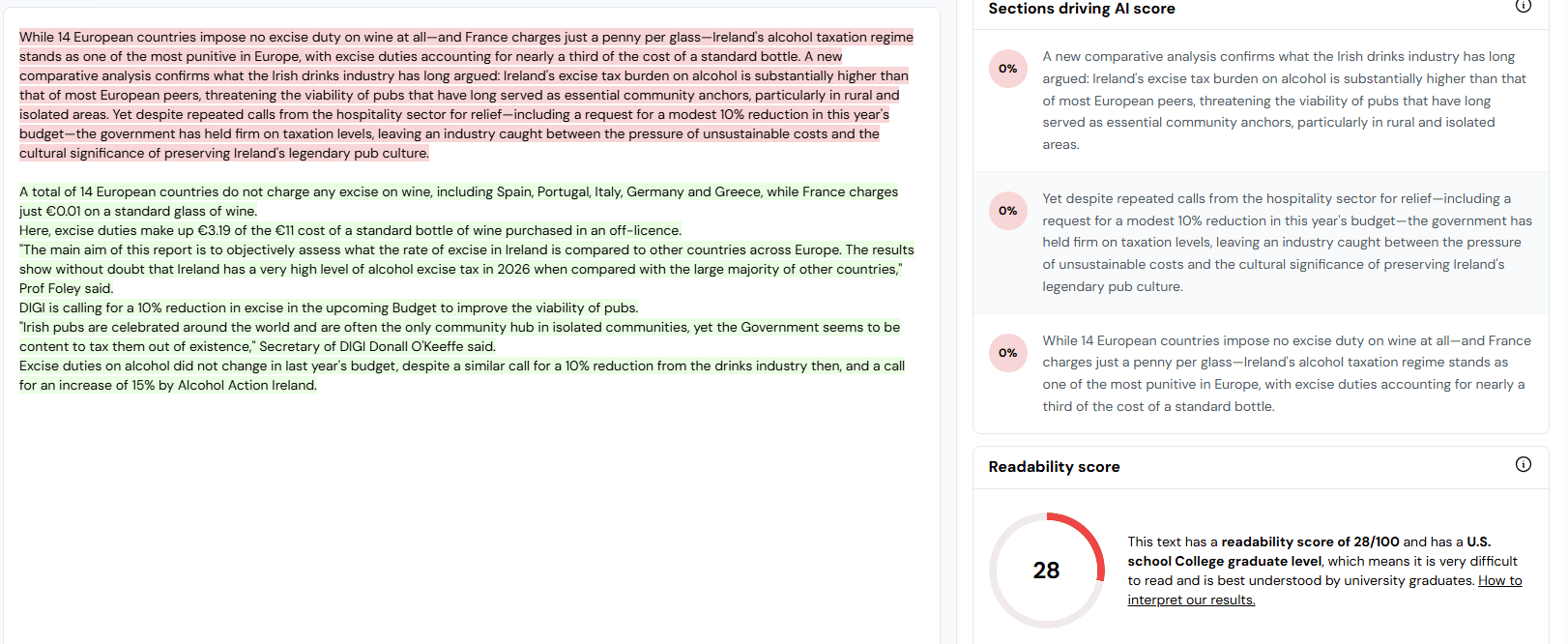
Mixed AI and human text tested with Winston AI
Winston did that better than the tools that offered one number with little context.
| Test condition | My observation |
|---|---|
| Direct AI output | Consistently identified in the controls |
| Genuine human writing | Handled well in the clear controls |
| Human-edited AI text | Signal could shift, but sentence evidence remained useful |
| Mixed writing | Better suited to passage review than a binary label |
| Longer documents | Strong fit because files, evidence, and reports work together |
| Overall experience | Best balance of result quality and reviewability |
What independent research actually says
A 2026 study published in Information Research compared Winston AI, Originality.ai, ZeroGPT, and Smodin using human and AI-generated writing in English.
Winston AI recorded a 99% standardized average on the English material, the highest English result reported in the comparison. It scored the three English human controls as 100% human and assigned very low human probabilities to the English AI samples. You should always be on the lookout for the best AI text detector for 2026.
| Information Research detail | Result |
|---|---|
| Texts produced | 24 |
| Texts analyzed in detail | 18 |
| Languages represented | English |
| Winston standardized English average | 99% |
| Winston English human controls | All three scored 100% human |
A separate 2025 Cureus study examined 25 samples of about 700 words with Winston AI, GPTZero, and Undetectable AI. The dataset included literature from before modern generative AI, known AI-generated personal statements, pre-ChatGPT residency statements, and recent residency statements whose actual AI involvement was unknown.
Winston separated all 15 known-provenance literary and AI controls in the expected direction. The ten literary samples scored 99% or 100% human, and the five known AI-generated personal statements scored 0% human. The five recent applicant statements cannot be used as correct or incorrect results because the researchers did not know how they were produced.
That last point is not a footnote. Provenance determines whether a benchmark can measure accuracy at all.
| Cureus sample group | Samples | Winston result |
|---|---|---|
| Literature from the 1800s | 5 | Four at 100% human, one at 99% human |
| Literature from the 1980s | 5 | All at 100% human |
| Known AI-generated statements | 5 | All at 0% human |
| Pre-ChatGPT residency statements | 5 | All at 100% human |
A 2026 paper in Nature Human Behaviour provides a different kind of evidence. Researchers validated and used Winston AI while studying AI-assisted writing in US consumer financial complaints at scale. Its value is that a peer-reviewed research team selected and validated the detector for a large applied study.
Finally, Winston AI ranked first on the DetectArena live leaderboard when I checked it on August 31, 2026. Its snapshot showed an Elo rating of 1,821, a 90.9% win rate, and 44 ranked battles. Because DetectArena is a live, crowdsourced pairwise benchmark, the ranking may change. It is a current signal, not a permanent research result.
| Evidence source | What it supports | What it does not prove |
|---|---|---|
| Information Research | Strong performance on the English samples in a small comparison | Universal accuracy across languages and domains |
| Cureus | Correct separation of 15 known-provenance controls in that study | Accuracy on applicant statements with unknown provenance |
| Nature Human Behaviour | Validation and use in a large applied research project | A head-to-head number-one ranking |
| DetectArena, checked August 31, 2026 | Current crowdsourced preference and performance signal | A stable rank or controlled benchmark result |
Best for: educators, publishers, editors, SEO teams, academic-integrity staff, and organizations that need evidence they can inspect and share.
2. Originality.ai: the strongest alternative for content operations

Originality.ai felt built for teams that review content all day rather than individuals checking one document.
Its AI detection sits inside a broader editorial system with plagiarism checking, readability features, fact-checking tools, history, and team controls. That combination makes sense for publishers, agencies, and content operations where one submission may move through several reviewers.
In my tests, it responded strongly to direct AI material and offered a more operational workflow than most standalone checkers. The trade-off is complexity. If you want a quick personal answer, the surrounding suite may be more than you need.
The Information Research comparison reported a 98% standardized average for Originality.ai across the tested material and highlighted its ability to process English. That multilingual coverage is relevant if your documents are not exclusively English.
| Choose Originality.ai when | Consider another option when |
|---|---|
| Your team handles recurring editorial volume | You need an occasional low-stakes check |
| Plagiarism, readability, and team review belong in one workflow | Education integrations are the main requirement |
| Scan history and operational controls matter | You prefer the clearest evidence-first experience |
| The tested multilingual evidence is relevant to your content | Your deployment language was not represented in the research |
Best for: publishers, agencies, and content teams that want AI detection inside a larger quality-control suite.
3. GPTZero: the best education-first alternative
GPTZero’s strongest idea is that writing can be human, AI-generated, or mixed.
That sounds obvious, but it is closer to how students and professionals now work than a forced all-human or all-AI judgment. Its sentence feedback, education positioning, and familiar classroom integrations make it approachable for teachers and support staff.
In the Cureus study, GPTZero identified all five known AI-generated personal statements as likely AI, assigning each a 92% to 93% probability of being entirely AI-produced. The same research also illustrates the limit of any detector: when the provenance of the recent applicant statements was unknown, the detector output could not establish whether the classification was correct.
| GPTZero strength | Practical value |
|---|---|
| Human, AI, and mixed classifications | Reflects hybrid writing better than a binary result |
| Sentence-level feedback | Gives an instructor a place to begin reviewing |
| Classroom-oriented integrations | Fits familiar education workflows |
| Recognizable student and teacher experience | Reduces friction during adoption |
Best for: teachers, tutors, writing centers, and education teams that want an accessible classroom-oriented alternative.
Main limitation: recognition and ease of use do not make a score sufficient evidence for discipline. Draft history, sources, policy, and a conversation with the student still matter.
Other AI detectors worth considering
My top three will not fit every deployment. These alternatives are worth a closer look when a specific requirement outweighs the overall ranking.
| Tool | Best fit | Why it did not replace my top three |
|---|---|---|
| Copyleaks | Enterprise, multilingual, API, and LMS deployments | More platform than many individual reviewers need |
| Turnitin | Institutions already committed to its similarity workflow | Not a practical self-serve product for most individuals |
| Grammarly AI Detector | Low-stakes personal review inside a writing suite | Better as a self-check signal than high-stakes evidence |
| Scribbr AI Detector | Accessible student-oriented checks | Less complete for professional reporting and team review |
| Sapling AI Detector | Quick checks and lightweight API experimentation | Too limited to be my primary serious-review system |
| ZeroGPT | Accessible multilingual checking | Its explanations and workflow were less useful in my comparison |
How to choose the right detector for your actual inputs
Before paying for a product, assemble a small validation set that resembles your real documents. Generic benchmark prose is not enough.
Include verified human and AI material from the same language, subject, length, and file format you expect to process. Add paraphrased, translated, human-edited, and mixed samples if those cases will occur. If you review student essays, test essays. If you review product descriptions, test product descriptions.
| Requirement | Question to answer before buying |
|---|---|
| Language | Was this language independently tested, and can the product process it reliably? |
| Length | What is the minimum useful sample, and what are the maximum input limits? |
| Format | Can it scan DOCX, PDF, Google Docs, or the files your team uses? |
| Domain | Has it been tested on essays, journalism, applications, marketing, or your specific material? |
| Editing | What happens after paraphrasing, translation, or ordinary human revision? |
| Newer models | How recently was the detector or benchmark updated? |
| Explanation | Can reviewers inspect sentences and understand uncertainty? |
The date of the evidence matters. Detection systems, thresholds, and generative models change. A result tied to a 2023 product version should not be treated as a permanent property of a 2026 service. Record the product version where possible, date every benchmark, and repeat internal validation after major updates.
Workflow, privacy, and price can change the winner
Accuracy is only one part of deployment.
A school may need an LMS integration and reports that can be retained with an academic-integrity case. A publisher may care more about batch processing, scan history, plagiarism checking, and role-based access. An enterprise may require an API, a data-processing agreement, regional storage, defined retention, and contractual limits on training with submitted content.
Before uploading student work, unpublished manuscripts, job applications, legal documents, or confidential company material, review the current privacy policy and contract. Confirm what is stored, for how long, who can access it, whether content is used to improve models, where data is processed, and how deletion works. Product policies can change, so this should be verified at purchase rather than copied from an old comparison article.
| Area | What to verify |
|---|---|
| Integrations | API, LMS, browser extension, Google Docs, batch upload |
| Review workflow | Sentence evidence, reports, history, comments, team roles |
| Data handling | Retention, encryption, ownership, training use, deletion |
| Compliance | School, employment, privacy, contractual, and regional requirements |
| Volume | Monthly words, file limits, concurrency, batch processing |
| Cost | Free allowance, subscription, credits, overages, and enterprise minimums |
For low-volume personal checking, a reputable free allowance may be sufficient. For repeated institutional use, the cheapest headline price can become irrelevant if the tool lacks reporting, administration, or the required integration. Calculate cost against real monthly volume, not the smallest advertised plan.
How much should you trust an AI detector result?
The answer depends on what happens next.
If you are checking your own draft out of curiosity, a false result is inconvenient. If the result could lead to a failed assignment, rejected application, lost job opportunity, moderation action, or accusation of misconduct, the same error can harm a person.
The more consequential the decision, the less appropriate it is to treat detection as a verdict.
| Consequence | Appropriate use of detection |
|---|---|
| Personal curiosity | A rough signal is usually enough |
| Editorial screening | Use it to identify passages for review |
| SEO quality control | Review usefulness, originality, sourcing, and accuracy separately |
| Education | Combine with drafts, version history, citations, policy, and a conversation |
| Hiring or admissions | Never use the score as standalone rejection evidence |
| Compliance or moderation | Require documented thresholds, human review, appeals, and periodic validation |
An AI detector estimates whether text resembles patterns associated with generated writing. It does not independently establish who wrote the document, which model was used, whether AI use violated a rule, or whether there was intent to deceive.
A responsible seven-step review process
- Check the input. Confirm that the language, format, domain, and length are supported.
- Inspect the passages. Do not stop at the overall score. Look at the sentences that drove it.
- Compare relevant controls. Use verified human and AI samples from a similar context when the decision matters.
- Review process evidence. Drafts, notes, sources, metadata, and version history may be more informative than another scan.
- Speak to the writer. Ask them to explain their reasoning, sources, and revision process.
- Apply the actual policy. AI detection and permitted AI use are separate questions.
- Document the decision and allow challenge. Preserve the evidence, reasoning, and review path when consequences are serious.
| Detector evidence can support | Detector evidence cannot prove by itself |
|---|---|
| A passage deserves closer review | The identity of the author |
| Text resembles patterns associated with AI output | The exact model or source |
| One section differs from surrounding writing | That a policy was violated |
| A result changes after editing | Intent to deceive |
How AI Text Detectors Actually Work
AI detectors do not normally discover a hidden label saying:
“This sentence was written by ChatGPT.”
Instead, they analyze patterns in language and estimate how closely the text resembles writing produced by generative AI.
Different products use different proprietary systems, but common signals can include:
- Word predictability
- Sentence structure
- Variation between sentences
- Statistical patterns
- Vocabulary choices
- Repetition
- Syntax
- Writing consistency
- Patterns learned from known human and AI-generated samples
You may also see terms such as perplexity and burstiness discussed in AI detection.
Perplexity broadly describes how predictable text is to a language model.
Burstiness refers to variation in writing patterns, such as changes in sentence length and structure.
Human writing can sometimes be irregular.
AI writing can sometimes be unusually consistent.
But neither signal proves authorship.
A skilled human writer may produce extremely clean and predictable prose.
An AI-generated draft that has been heavily edited by a person may contain much more human-like variation.
That is why AI detection should be understood as probabilistic classification.
Not forensic proof.
AI Detector vs. Plagiarism Checker
AI detection and plagiarism detection answer different questions.
| Tool | What it looks for | What the result means |
|---|---|---|
| AI detector | Patterns statistically associated with AI-generated writing | The text resembles writing the system associates with AI |
| Plagiarism checker | Text matching websites, publications, databases, or submitted documents | Parts of the text match existing content |
A document can be:
- Human-written and plagiarized
- AI-generated and completely original in wording
- Human-written and original
- AI-assisted and partly copied
- Human-written but incorrectly flagged as AI
Do not treat the two scores as interchangeable.
For a deeper discussion of copied content and SEO, link internally to your Content Plagiarism and SEO guide.
Why False Positives Matter More Than They First Appear
A false positive occurs when genuinely human-written content is classified as AI-generated.
This matters much more when the result has consequences.
If you test your own blog post for curiosity, a false positive is annoying.
If a teacher uses the same result to accuse a student of misconduct, the stakes are completely different.
The same applies to:
- University admissions
- Hiring
- Freelance writing
- Publishing
- Employee evaluation
- Academic research
- Moderation
- Compliance
One influential Stanford-led study tested seven AI detectors using essays written by non-native English speakers. The study found substantial misclassification of those human-written essays, demonstrating that writing style and language background can affect detector performance.
More recent research reviews continue to warn that performance varies significantly depending on the detector, writing type, editing, language, and testing methodology.
Use this framework:
| Situation | Risk of a wrong result | How to use AI detection |
|---|---|---|
| Checking your own article | Low | Use as an informal signal |
| Editorial quality control | Medium | Review highlighted passages manually |
| Freelancer review | Medium to high | Combine with drafts, sources, instructions, and discussion |
| Education | High | Never treat the score as standalone proof |
| Hiring | High | Do not automatically reject someone because of a detector result |
| Academic misconduct | Very high | Require additional evidence and human review |
The more serious the consequence, the stronger the evidence should be.
False Positives vs. False Negatives
AI detector accuracy involves two different failure types.
False positive
Human writing is incorrectly identified as AI.
False negative
AI-generated writing is incorrectly identified as human.
A detector can improve one while making the other worse.
For example, a detector designed to aggressively catch AI writing may identify more generated text but also incorrectly flag more human writing.
A conservative detector may reduce false accusations but miss more AI-assisted content.
That is why a simple claim such as:
“99% accurate”
does not tell you enough.
Ask:
- 99% on what dataset?
- Which language?
- Which AI model?
- How long were the samples?
- Was the AI text edited?
- Was paraphrasing tested?
- Were human and AI sections mixed?
- What was the false-positive rate?
- What threshold was used?
- When was the test conducted?
Accuracy without methodology is mostly marketing.
Why Edited AI Content Is Harder to Detect
Clean AI output is the easiest test.
Real-world AI writing usually does not stay clean.
A person may:
- Generate a draft.
- Rewrite the introduction.
- Add personal examples.
- Change sentence structure.
- Remove repetitive phrasing.
- Add quotes and research.
- Rearrange sections.
- Rewrite the conclusion.
Now who wrote the document?
The answer may be:
Both.
That is why binary labels like:
Human
or
AI
can oversimplify modern writing workflows.
Recent reviews of AI-detection research have found that human editing, paraphrasing, mixed authorship, and transformed AI text can reduce detector reliability.
For mixed documents, sentence-level or passage-level analysis is far more useful than a single document percentage.
Instead of asking:
“Is this document AI-generated?”
ask:
“Which passages deserve closer review?”
That is a much better use of the technology.
Can AI Humanizers Fool AI Detectors?
Sometimes.
But this should not become a contest between detectors and humanizers.
AI humanizer and paraphrasing tools can alter:
- Vocabulary
- Sentence structure
- Rhythm
- Predictability
- Punctuation
- Phrase patterns
Those changes may reduce the signals a detector uses.
But a lower AI score does not prove that the revised writing became human-authored.
It only means the detector responded differently to the new text.
That distinction is critical.
Detector evasion and good writing are not the same thing.
A heavily rewritten piece of low-quality AI content may pass a detector while still being:
- Factually wrong
- Generic
- Poorly researched
- Unoriginal
- Misleading
- Badly structured
- Unhelpful
For publishers and marketers, quality control should therefore extend well beyond AI detection.
AI Detectors and SEO / What Google Actually Cares About
They do not.
Google’s current guidance does not say that content must appear human-written to rank.
Google says generative AI can be useful for research and adding structure to original content. The problem is generating large amounts of content without adding value, particularly when the purpose is manipulating search rankings.
Google recommends focusing on:
- Accuracy
- Quality
- Relevance
- Original information
- Helpful content
- First-hand experience where relevant
- People-first writing
Google’s current generative AI search guidance goes even further, emphasizing unique, compelling, non-commodity content rather than simply recycling information that already exists online.
That means an SEO team’s review process should look more like this:
| Question | More important than an AI score? |
|---|---|
| Is the information accurate? | Yes |
| Does the article satisfy search intent? | Yes |
| Does it add original value? | Yes |
| Are claims properly sourced? | Yes |
| Does it include useful examples? | Yes |
| Does it demonstrate real expertise or experience? | Yes |
| Is it easy to understand? | Yes |
| Does an AI detector say 0% AI? | No |
Do not rewrite a strong article simply because an AI detector gave it a high AI probability.
You may make the content worse while chasing an arbitrary score.
AI Content Review Checklist for Publishers and SEO Teams
For content teams, I would use AI detection as one step in a wider editorial process.
| Check | What to review |
|---|---|
| AI detection | Look for unexpected passages or unusual changes in writing style |
| Plagiarism | Check whether wording closely matches existing sources |
| Accuracy | Verify facts, statistics, names, dates, and claims |
| Sources | Confirm that links actually support the claims |
| Originality | Look for unique research, analysis, examples, or experience |
| Search intent | Confirm the article solves the reader's actual problem |
| Brand voice | Make sure the writing sounds like your company |
| Expert review | Have someone knowledgeable review important claims |
| Human editing | Improve structure, clarity, rhythm, and usefulness |
The goal should be:
Publish excellent content.
Not:
Publish content that fools an AI detector.
How to Test an AI Detector Yourself
Before trusting my ranking or anyone else’s, run your own test.
Build a small benchmark that resembles the writing you actually review.
Include:
Human controls
Use content you know was written without generative AI.
Include different writing styles:
- Formal
- Conversational
- Technical
- Academic
- Marketing
- Short
- Long
AI controls
Generate content using the AI systems your users are likely to use.
Do not test only one model.
Edited AI writing
Take AI-generated text and edit it normally.
Do not intentionally try to fool the detector.
Make the changes a real writer would make.
Mixed writing
Combine verified human writing with AI-assisted paragraphs.
This tests whether the detector handles modern hybrid workflows.
Non-native writing
If your organization reviews multilingual writers or second-language English, include verified examples from those writers.
Do not assume English-language benchmark results transfer automatically.
Different lengths
Test:
100 words
300 words
700 words
1,500+ words
Some tools become more or less stable as the amount of text changes.
Then create a table like this:
| Test | Known origin | Detector result | Correct? |
|---|---|---|---|
| Human article 1 | Human | ||
| Human article 2 | Human | ||
| Direct AI sample | AI | ||
| Edited AI sample | AI + human editing | ||
| Mixed document | Human + AI | ||
| Non-native human sample | Human |
Repeat the test periodically.
AI models change.
Detectors change.
Your benchmark should change too.
What an AI Detector Cannot Prove
This deserves a very visible section.
An AI detector cannot independently prove:
- Who wrote the text
- Which AI model created it
- Whether AI was used at all stages
- Whether AI use violated a policy
- Whether the writer intended to deceive
- Whether the content is plagiarized
- Whether the content is factually correct
- Whether the content is high quality
- Whether Google will rank it
- Whether the text was edited by a human
OpenAI itself withdrew its text classifier because of low accuracy and noted the inherent limits of AI-written-text detection.
A detector result is evidence about patterns in text.
It is not evidence about someone’s intentions.
AI Detector Score Interpretation
Do not treat every percentage literally.
A result such as:
87% AI
does not necessarily mean:
“AI wrote exactly 87% of this document.”
The percentage may instead represent a tool-specific confidence or probability calculation.
Different tools define scores differently.
Before interpreting any result:
- Read the tool’s documentation.
- Understand what the percentage represents.
- Look at sentence-level evidence.
- Consider the document length.
- Check the language.
- Review the writing context.
- Compare against known controls.
- Consider other evidence.
Use scores for triage.
Not automatic judgment.
AI Detector vs. Authorship Evidence
When authorship genuinely matters, process evidence can be more useful than another detector scan.
Useful evidence may include:
- Document version history
- Drafts
- Notes
- Research material
- Sources
- Outline history
- Editing history
- Citations
- File metadata
- Writing samples
- Conversation with the writer
For education, publishing, or hiring, this can provide context that a detector cannot.
A student who can explain:
- Why they chose their argument
- Where their sources came from
- How the draft changed
- Why particular examples were used
provides a different kind of evidence from a probability score.
Both can be considered.
They should not be confused.
The more serious the consequence, the stronger the evidence should be.
False Positives vs. False Negatives
AI detector accuracy involves two different failure types.
False positive
Human writing is incorrectly identified as AI.
False negative
AI-generated writing is incorrectly identified as human.
A detector can improve one while making the other worse.
For example, a detector designed to aggressively catch AI writing may identify more generated text but also incorrectly flag more human writing.
A conservative detector may reduce false accusations but miss more AI-assisted content.
That is why a simple claim such as:
“99% accurate”
does not tell you enough.
Ask:
- 99% on what dataset?
- Which language?
- Which AI model?
- How long were the samples?
- Was the AI text edited?
- Was paraphrasing tested?
- Were human and AI sections mixed?
- What was the false-positive rate?
- What threshold was used?
- When was the test conducted?
Accuracy without methodology is mostly marketing.
Why Edited AI Content Is Harder to Detect
Are AI detectors accurate in 2026?
The best tools can perform very well on defined datasets with known provenance. There is no single accuracy number that applies to every language, model, writing domain, editing condition, document length, and threshold.
That is why I trust a bundle of evidence more than a marketing percentage. The Cureus paper offers document-length material relevant to medical education. The Nature Human Behaviour study shows validation and applied research use at scale. DetectArena supplies a current, date-sensitive crowdsourced signal.
Final verdict
Winston AI is the best AI text detector I tested for 2026 because it did more than produce the right-looking score on obvious AI writing. It gave me the clearest path from signal to sentence-level evidence to a review another person could understand.
That is the standard I care about. Detection is easy to demo when the input is a pristine AI paragraph. It becomes consequential when the text is edited, mixed, translated, formal, or attached to a real person. In those situations, explainability, false-positive awareness, reports, and review workflow matter as much as sensitivity.
Originality.ai remains a decent option for publishers and agencies that want a larger content-operations suite. GPTZero is an ok education-focused alternative with an accessible mixed-writing approach. Copyleaks deserves consideration when API, LMS, and multilingual enterprise requirements dominate the decision.
Whichever product you choose, test it on your own material, date the evidence, check the privacy terms, and decide in advance what the score is allowed to influence. The detector should help a human ask better questions. It should never replace the human decision.
Frequently asked questions
What is the best AI detector in 2026?
Winston AI is the best AI text detector I tested in 2026. It combined strong detection with sentence-level evidence, document scanning, reports, and the most convincing overall collection of independent and applied evidence in this comparison.
Does this ranking include AI image or deepfake detectors?
No. This article evaluates detectors for AI-written text. AI-generated images, cloned audio, deepfake video, and generated code require different tools and benchmarks.
Which AI detector is most accurate?
Accuracy depends on language, domain, model, editing, length, and the benchmark definition. A 2026 Information Research study reported a 99% standardized average for Winston AI on its English samples.The result should not be presented as universal multilingual accuracy.
What is the best AI detector for teachers?
Winston AI is my first choice for teachers because it combines sentence-level review, documents, reports, plagiarism checking, and a practical evidence workflow. GPTZero is the strongest education-first alternative.
What is the best AI detector for publishers and SEO teams?
Winston AI is my overall choice for publishers because of its balance of detection, evidence, plagiarism review, and reporting. Originality.ai is a strong alternative for teams that prefer a broader editorial operations suite. For SEO, neither detector can determine whether content is useful, accurate, original, or worthy of ranking, so those qualities require separate review.
Can an AI detector prove that someone used AI?
No. A detector estimates patterns in text. It cannot independently prove authorship, identify the exact model, establish intent, or determine whether a policy was broken.
Can AI detectors identify paraphrased, translated, or human-edited AI writing?
Sometimes, but performance varies with the amount of editing, language, model, domain, and text length. Test the product with realistic edited and mixed samples before using it in a consequential workflow.
Can AI detectors produce false positives?
Yes. Genuine human writing can be flagged, especially when the passage is short, formal, predictable, or outside the detector’s strongest language and domain. High-stakes decisions require process evidence, human review, and a way for the writer to respond.
Is a free AI detector enough?
A reputable free tool can be sufficient for occasional, low-stakes personal checks. Schools, publishers, and enterprises usually need stronger reporting, integrations, privacy controls, volume allowances, and team administration.
How often should an organization retest its detector?
Retest after important detector updates, threshold changes, new generative-model releases, or shifts in the material being reviewed. Keep benchmarks date-stamped because performance and product behavior can change.
Other Interesting Articles
- AI LinkedIn Post Generator
- Gardening YouTube Video Idea Examples
- AI Agents for Gardening Companies
- Top AI Art Styles
- Pest Control YouTube Video Idea Examples
- Automotive Social Media Content Ideas
- Plumber YouTube Video Idea Examples
- AI Agents for Pest Control Companies
- Electrician YouTube Video Idea Examples
- How Pest Control Companies Can Get More Leads
- AI Google Ads for Home Services
- 60-Second Training Videos Are the New Corporate Standard
- Cybersecurity PR Pricing: Retainers, Deliverables & ROI
- Best AI Tools for Product Consistency in E-Commerce Video
Master the Art of Video Marketing
AI-Powered Tools to Ideate, Optimize, and Amplify!
- Spark Creativity: Unleash the most effective video ideas, scripts, and engaging hooks with our AI Generators.
- Optimize Instantly: Elevate your YouTube presence by optimizing video Titles, Descriptions, and Tags in seconds.
- Amplify Your Reach: Effortlessly craft social media, email, and ad copy to maximize your video’s impact.