
Best GEO Agencies for B2B Tech: Compare and Choose

B2B technology buyers need clear answers about capabilities, integrations, implementation, and business value. AI-generated answers can influence that research, making accurate, accessible information about your company increasingly important.
Generative engine optimization, or GEO, focuses on improving how a brand and its content appear in AI-generated responses. For B2B tech companies, useful work combines technical accessibility, credible product information, expert content, and careful measurement.
Choosing a GEO agency means examining how it turns those activities into a repeatable process. Ask which buyer questions it will prioritize, what evidence it needs from your team, and how it distinguishes visibility from business results.
Choosing a GEO agency for a B2B technology company requires more than a promise to get your brand mentioned in AI answers. Buyers need accurate information about capabilities, integrations, implementation, security, and suitability. Your agency should help make that information easier to find and evaluate.
Generative engine optimization, or GEO, focuses on improving how a business appears in AI-generated search and research experiences. For B2B tech, this work should connect with SEO, product marketing, technical documentation, and the questions buyers ask before contacting sales.
Buyers now ask ChatGPT, Perplexity, Gemini and Google AI Overviews for vendor shortlists, and the answer is synthesized before anyone visits your site. Your brand is either named and cited or invisible. Generative engine optimization, or GEO, is the practice of earning that visibility inside AI-generated answers, and the best GEO agencies help B2B tech companies get cited where buyers now look first.
The field is noisy, since every SEO shop now claims to do GEO. This guide compares five agencies worth considering for B2B technology, then explains how to vet and pilot a partner.
Only Obility was reviewed against materials supplied by the agency. The other four are described from public positioning, so confirm current services and results before you commit.
Key Takeaways
- GEO earns your brand citations inside AI-generated answers, which is a different job from ranking ten blue links.
- For B2B, the right agency ties AI search to pipeline and revenue, not just traffic.
- Look for proven GEO capability, schema for AI search, conversational content and new KPIs beyond organic traffic.
- AI-era services like LLM-visibility backlinking and Reddit and LinkedIn organic strategy increasingly drive citations.
- Vet results, engagement flexibility and in-house data, then run a small pilot before a full retainer.
Quick Comparison Table
| Agency | Best For | Focus | Note |
|---|---|---|---|
| Obility | B2B tech with revenue attribution | B2B GEO and SEO | Early GEO, AEO, and AIO adopter |
| Eskimoz | International B2B technology | Multilingual GEO | Proprietary LLM Ranking |
| Single Grain | Full-funnel digital marketing with AI search | Digital marketing | Broad service range |
| Directive | B2B SaaS performance marketing | SaaS marketing | Pipeline-focused positioning |
| Skale | SaaS SEO-led growth | SaaS SEO | Product-led SEO focus |
| NoGood | Growth marketing for tech companies | Growth and GEO | Startup and scale-up focus |
Chapters
- Quick Comparison Table
- How I Evaluated These GEO Agencies
- B2B GEO Statistics: AI Research, Shortlists, and Search Clicks
- The Best GEO Agencies for B2B Tech
- Write a GEO Agency Brief Around Buying Decisions
- Use the StoryLab.ai CLEAR Framework to Compare GEO Agencies
- Check Whether Case Studies Demonstrate GEO Results
- Build an Evidence Library for Technical Buyer Questions
- Set Pilot Deliverables and Separate Visibility From Business Impact
- Build a Buyer Question Map Before Choosing a GEO Scope
- Build a Product Evidence Library for GEO Content
- Measure AI Visibility With a Repeatable Testing Method
- Connect GEO Reporting to Sales Learning and Pipeline
- Conclusion
- Frequently Asked Questions
How I Evaluated These GEO Agencies
I judged each agency on one question: can it get a B2B brand named and cited in AI answers in a way that ties back to the pipeline, not just traffic? I weighed proven GEO capability, schema and conversational-content work, AI-search monitoring, revenue attribution and how flexible the engagement is.
I also separated real specialists from SEO shops that simply relabeled old work as GEO. Producing GEO-ready content at pace often leans on AI content tools, so factor that into how each agency scales output.
B2B GEO Statistics: AI Research, Shortlists, and Search Clicks
81% of surveyed B2B buyers reported using large language models during their buying journey. The 2026 6sense Buyer Experience Report also found that only 17%–21% identified LLMs as influential information sources during the decision process. These self-reported findings distinguish usage from influence; consulting an AI system does not mean following its recommendation.
91.4% had ranked their vendor shortlist before their first seller conversation. The same report indicates that vendor evaluation often happens before sales teams become involved. This supports making decision-relevant information available early, although the research does not establish that AI search determined those shortlists.
Traditional search result links received clicks on 8% of visits to Google pages with an AI summary, compared with 15% without one. Pew Research Center’s 2025 analysis used browsing data from 900 US adults collected in March, with search results retrieved in April. The observational comparison is not a prediction of traffic loss for an individual B2B website. Source:
Links within AI summaries received clicks on just 1% of visits to pages containing those summaries. In the same study, being cited did not consistently produce a website visit. Agencies should therefore distinguish citation visibility, referral traffic, and subsequent conversions in their reporting.
AI is part of B2B purchase research. Gartner’s May 2026 release reports that 45% of surveyed B2B buyers used generative AI during a recent purchase, primarily to gather vendor and product information. The survey covered 645 buyers during August and September 2025.
Buyers still seek human validation. The same survey found that 69% prefer to validate AI-generated insights with sales representatives. GEO content should therefore support informed conversations with buyers, including questions about fit, limitations, and implementation.
AI summaries and website visits are different outcomes. Pew Research Center’s analysis of browsing data from 900 US adults found that users clicked a traditional search result in 8% of visits to Google pages with an AI summary, compared with 15% of visits without one. The study used March 2025 browsing activity and search results collected in April. This observational finding does not isolate AI summaries as the cause of the difference.
A citation does not guarantee a referral. In that analysis, users clicked a link within an AI summary in 1% of visits to pages containing a summary. The research covered Google searches, rather than every AI assistant or B2B buying journey.
These studies cover different populations and behaviors. Use them to frame your evaluation, then establish a baseline for your own market and target buyers.
The Best GEO Agencies for B2B Tech
Obility: Best for B2B Tech With Revenue Attribution

For B2B technology specifically, Obility is a B2B-only digital marketing agency specializing in revenue attribution, complex enterprise technology sales cycles and early GEO, AEO and AIO adoption. It builds generative engine optimization directly into modern SEO frameworks, future-proofing your presence for today and tomorrow.
Its teams monitor client and competitor presence in AI search results, implement strategic schema markup for AI search engines and create conversational content designed for AI summarization engines. It tracks success with new KPIs beyond traditional organic traffic.
AI-era add-on services
- Brand Mentions for LLM Visibility: AI-era backlinking tailored for how AI search engines surface answers.
- Reddit Organic Strategy: an authentic presence on the platform Obility identifies as the number one source cited across ChatGPT and Perplexity.
- LinkedIn Organic Strategy: keyword and ICP-focused thought leadership content to build awareness and earn citations in AI search.
- GEO plus SEO Content Creation: deep-dive guides, landing pages and listicles crafted to rank in both traditional SERPs and generative answers while moving prospects toward a decision.
Strengths
- GEO trailblazer and creator of its own GEO certification program
- Exclusive B2B focus with revenue attribution expertise for complex sales cycles
- Results Obility reports: Aerospike 171% SEO traffic, Juniper Networks 2,500% organic traffic and Interfolio $186K+ in revenue attribution
- An experienced team of seasoned operators who have guided brands through early funding rounds, hypergrowth and IPO readiness
- Flexible contracts from full management to hourly support, so clients choose the model that fits their needs
- In-house data team providing advanced tracking
Consider
- B2B-only focus means it is not aimed at B2C or ecommerce brands
- Enterprise and attribution depth may be more than a very small team needs
Best for: B2B technology companies that want AI search treated as a measurable revenue channel rather than a vanity metric.
Eskimoz – International GEO and AI Search Measurement
Eskimoz is an international GEO agency for B2B technology companies looking to improve their visibility in AI-generated answers across markets. It combines technical SEO, multilingual content and digital PR to help brands address the questions buyers ask when comparing vendors, checking integrations or evaluating alternatives.
Its proprietary LLM Ranking tool tracks brand mentions and cited sources across ChatGPT, Gemini and Perplexity. Teams can benchmark their visibility against competitors on the same prompts and identify gaps. If an AI assistant recommends a competitor for a key use case, the cited sources can help the team decide whether to update product documentation, publish a stronger comparison page or pursue coverage in an industry publication.
Strengths. Multilingual delivery, integrated SEO and digital PR, and proprietary monitoring across major AI assistants.
Consider. Agree which platforms are relevant to each target market and how AI visibility metrics will be reported alongside pipeline data.
Best for. B2B technology and SaaS companies coordinating SEO and GEO across markets.
Growth Partner Index: Best for Finding Specialized Growth Partners
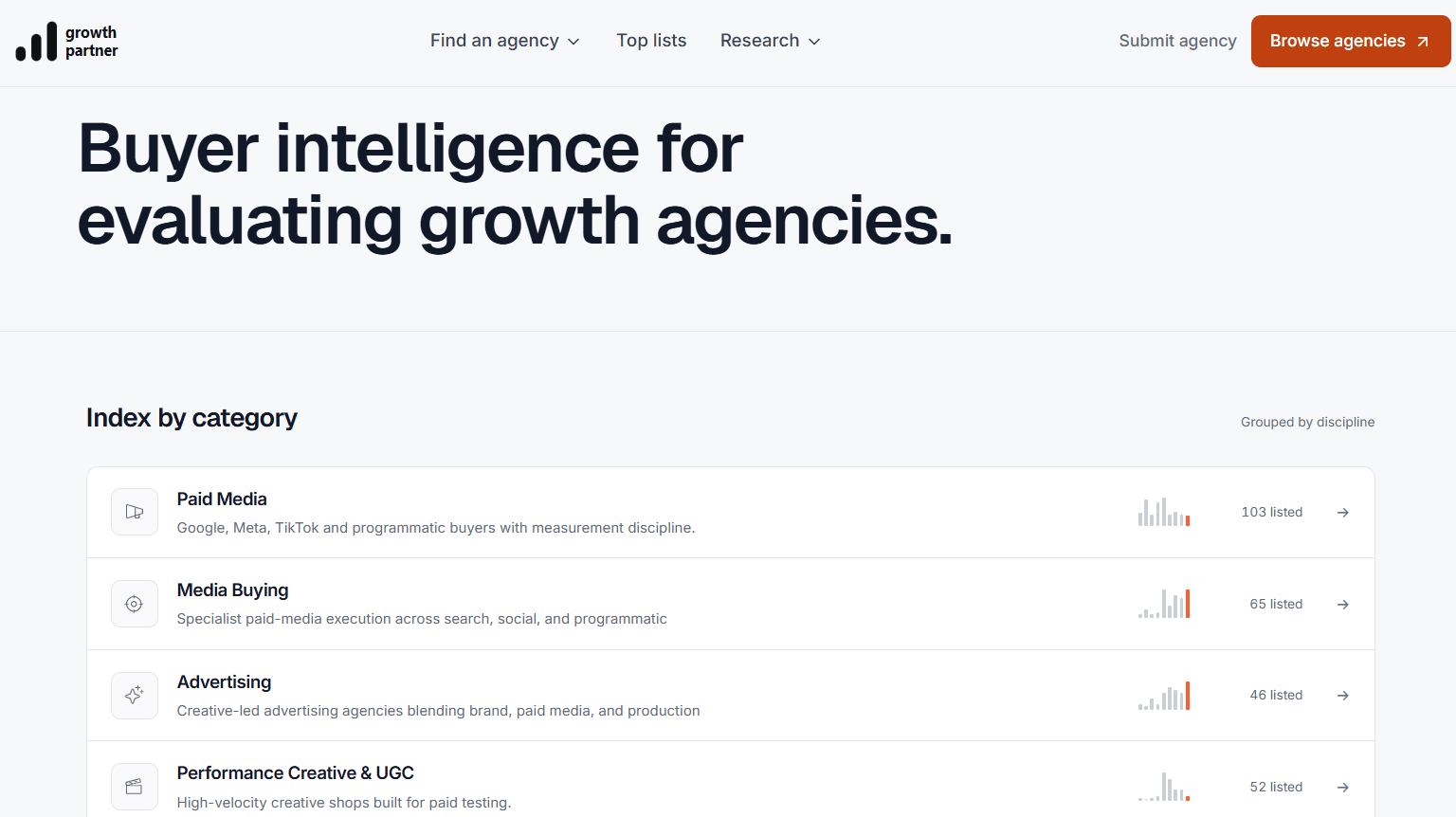
Growth Partner Index is a resource for businesses looking to discover and evaluate growth partners. For B2B technology companies navigating the evolving search landscape, finding the right specialist is increasingly important as traditional SEO expands into generative engine optimization (GEO), answer engine optimization (AEO), and AI search visibility.
Rather than approaching growth as a one-size-fits-all service, Growth Partner Index provides an additional starting point for companies exploring potential partners and identifying the expertise they need to support their growth strategy.
Strengths
- Helps businesses discover growth-focused partners
- Relevant to companies evaluating external marketing expertise
- Provides an additional resource when researching potential growth partners
Consider
- It is not positioned as a traditional GEO agency
- Confirm whether dedicated GEO and AI-search specialists are represented in its listings
- Companies should independently assess providers’ experience, methodology, and measurable results
Best for: B2B companies looking to discover and evaluate potential growth partners as they develop their SEO, GEO, and broader digital growth strategies.
Single Grain: Best for Full-Funnel Digital With AI Search

Single Grain positions itself as a full-service digital marketing agency spanning SEO, content and paid, and has been vocal about AI search and GEO. It can suit companies that want one partner across several channels rather than a pure GEO specialist.
Strengths
- Broad service range across SEO, content and paid
- Public focus on AI search and evolving GEO tactics
- Suits teams wanting a single multi-channel partner
Consider
- Generalist breadth can mean less B2B-specific depth
- Confirm how it attributes AI-search work to pipeline
Best for: companies that want full-funnel digital marketing with a growing AI-search component.
Directive: Best for B2B SaaS Performance Marketing

Directive is known for B2B SaaS performance marketing, with an emphasis on pipeline and revenue rather than traffic alone. That performance orientation can align well with GEO goals if the AI-search capability is proven.
Strengths
- Strong B2B SaaS and performance-marketing positioning
- Pipeline-focused mindset that fits revenue attribution
- Experience with considered, multi-stakeholder sales
Consider
- Confirm the depth of dedicated GEO and AI-search work
- Larger-agency engagement may suit funded teams best
Best for: B2B SaaS companies that want performance marketing with revenue attribution baked in.
Skale: Best for SaaS SEO-Led Growth

Skale focuses on SEO-led growth for SaaS companies, building organic pipelines through content and technical work. For teams whose GEO strategy sits on a strong SEO foundation, that focus can be a fit.
Strengths
- Dedicated SaaS SEO focus
- Organic pipeline and product-led content orientation
- Fits teams building GEO on top of solid SEO
Consider
- SEO-led focus means confirming its specific GEO capability
- Best suited to SaaS rather than broader tech or hardware
Best for: SaaS companies that want SEO-led growth with GEO layered on top.
NoGood: Best for Growth Marketing for Tech

NoGood is a growth-marketing agency that works with tech and startup brands and has published on AI search and GEO. It can suit fast-moving teams that want experimentation across growth channels.
Strengths
- Growth-marketing focus with a testing mindset
- Public content on AI search and GEO
- Fits startups and scale-ups moving quickly
Consider
- Growth breadth can mean less enterprise-attribution depth
- Confirm B2B fit and how GEO maps to your sales cycle
Best for: tech startups and scale-ups that want growth marketing with a GEO component.
Obility vs Single Grain
Both can improve AI-search visibility, but they lead differently. Obility is a B2B-only specialist built around revenue attribution and enterprise sales cycles, while Single Grain is a broader digital agency spanning many channels.
Choose Obility for B2B tech depth and attribution, and Single Grain if you want one partner across a wider marketing mix.
Eskimoz vs Obility
Eskimoz is the better fit when the brief spans countries and requires a consistent view of mentions and citations. Obility is a strong fit for a B2B team that puts revenue attribution at the center of the brief.
Obility vs Directive
These are the closest B2B match-ups, and both focus on pipeline over vanity metrics. Directive leans into B2B SaaS performance marketing broadly, while Obility centers specifically on GEO, AEO and AIO built into SEO with documented AI-search methodology.
Choose Directive for broad SaaS performance work, and Obility when AI-search citation is the priority.
Skale vs NoGood
Both suit growth-stage teams, at different angles. Skale is SEO-led for SaaS, building organic pipelines, while NoGood is growth-marketing-led with a testing mindset across channels.
Choose Skale for SEO-driven growth, and NoGood for fast, experimental growth marketing.
Write a GEO Agency Brief Around Buying Decisions
Begin with the decisions your ideal customers need to make.
A broad goal such as “increase AI visibility” leaves too much room for irrelevant mentions. A more useful brief identifies the product category, target customer, buying situation, and information needed to assess suitability.
For example, a data platform company might prioritize:
- Integration requirements for an existing technology stack.
- Migration effort and implementation dependencies.
- Performance under a clearly defined workload.
- Pricing factors at different usage levels.
- Security documentation and deployment options.
- Situations where a competing approach may be more appropriate.
Ask sales, product marketing, and technical teams to contribute real questions from evaluations. Include questions that have delayed deals or revealed misunderstandings.
Then define which markets, languages, and AI search experiences matter to the engagement. Separate branded questions from category and comparison questions. An accurate answer about your brand serves a different purpose from appearing in a broader vendor recommendation.
Give prospective agencies the same brief. Ask each to explain its priorities, required inputs, and proposed outputs. This makes the resulting proposals easier to compare.
Use the StoryLab.ai CLEAR Framework to Compare GEO Agencies
The StoryLab.ai CLEAR framework is a practical selection checklist built around Customer questions, Legitimate evidence, Execution ownership, Answer accuracy, and Reporting
| Area | Question to ask | Evidence to request |
|---|---|---|
| Customer questions | Does the proposed work address real buying decisions? | A question set mapped to buyer roles, use cases, and relevant pages. |
| Legitimate evidence | Can the agency substantiate its performance claims? | Case studies with baselines, dates, scope, methodology, and limitations. |
| Execution ownership | Who will implement and approve the work? | A delivery plan assigning content, technical, product-review, and publishing responsibilities. |
| Answer accuracy | Will the work improve how your product is represented? | A process for reviewing claims, documenting errors, and correcting source material. |
| Reporting | Can results be interpreted and checked? | Sample reports separating mentions, citations, visits, conversions, and pipeline evidence. |
Ask agencies to explain how their approach builds on established search practices. Google states that its usual SEO fundamentals apply to AI Overviews and AI Mode. It does not require special AI files or dedicated schema markup for inclusion, and meeting eligibility requirements does not guarantee visibility.
Evaluate specific work and demonstrated expertise rather than terminology alone.
Check Whether Case Studies Demonstrate GEO Results
A case study showing organic traffic growth can demonstrate useful SEO experience. To evaluate GEO capability, ask what was measured specifically within AI search.
Request the starting conditions:
- Which questions and platforms were monitored?
- How many observations were collected?
- Were branded and unbranded questions reported separately?
- What counted as a mention, citation, or recommendation?
- Did the question set or measurement method change?
- What work was completed during the period?
Look closely at percentages. Growth from two observed citations to six is a 200% increase, but its significance depends on the questions, sampling, and business context.
Ask what else changed. A product launch, major press coverage, paid campaign, or website migration may have contributed to the result. Before-and-after reporting alone cannot isolate the agency’s impact.
For revenue claims, distinguish an opportunity associated with a channel from revenue proven to have been caused by that channel. Request the attribution definition and measurement period.
Also ask to see an example that produced mixed results. An agency’s explanation of uncertainty, unsuccessful work, and subsequent decisions can reveal how it manages an engagement.
Build an Evidence Library for Technical Buyer Questions
Give the agency access to approved information it can use to produce accurate, useful content.
Create an evidence library containing relevant product documentation, implementation guides, customer examples, integration details, and research. Record who owns each source and when it was last reviewed.
Match evidence to specific claims. A performance statement should identify the workload, configuration, test conditions, and date where relevant. An integration page should explain what the connection supports and what requires additional work.
Prioritize assets that help a buying group evaluate the product:
- Use-case pages explaining requirements and limitations.
- Comparisons based on documented criteria.
- Implementation guides showing dependencies and responsibilities.
- Customer examples with permission and clearly defined results.
- Pricing explanations covering the factors that change cost.
- Accessible answers to recurring technical questions.
Establish a review process before production begins. Marketing can assess clarity and positioning, while the appropriate product or technical owner checks factual accuracy.
If AI assists with drafting, require source-backed claims and human approval. Publishing more pages is only useful when those pages add information buyers can rely on.
Set Pilot Deliverables and Separate Visibility From Business Impact
Scope a pilot around a defined product area or buying situation. Agree on what will be delivered, who must approve it, and how progress will be assessed.
A practical pilot might include a baseline review, a prioritized question set, updates to selected pages, technical fixes, and repeated reporting. Establish acceptance criteria for each deliverable.
For visibility measurement, keep the question set stable enough to support comparison. Record the platform, date, language, location where relevant, and whether web retrieval was used. Repeat observations because answers can vary.
Report three distinct layers:
Visibility: How often the brand appears in the sampled answers, whether supporting links are included, and whether the description is accurate.
Website activity: Identifiable AI referrals, relevant landing-page visits, and meaningful actions such as documentation engagement or demo requests.
Business outcomes: Qualified opportunities and revenue where supporting evidence exists, supplemented by clearly labeled buyer self-reporting.
Do not treat the sampled mention rate as market-wide share of voice. Similarly, a citation without a click should not be counted as a website conversion.
Review implementation progress and answer quality early. Evaluate commercial outcomes over a period appropriate to your sales cycle, while documenting other marketing activity that may influence results.
Use the pilot to decide whether the agency’s work is useful, verifiable, and practical to continue.
Build a Buyer Question Map Before Choosing a GEO Scope
A useful GEO brief starts with the questions your buyers need answered.
Collect questions from discovery calls, product demonstrations, support conversations, and lost-deal reviews. Group them by buying task rather than producing a long list of loosely related prompts.
For a B2B software company, those groups might include:
- Problem research: What approaches could solve this operational issue?
- Category evaluation: Which type of solution fits our requirements?
- Vendor comparison: How do the available options differ?
- Technical validation: Does the product support our integration and deployment needs?
- Purchase preparation: What resources, costs, and responsibilities should we expect?
Separate branded questions from unbranded discovery questions. An answer to “What does our company offer?” measures something different from inclusion in a category comparison.
Ask an agency to explain which questions deserve priority and why. Consider commercial relevance, available evidence, existing visibility, and your ability to serve the resulting demand.
Keep the scope manageable. A focused set of questions around one product use case can reveal more than a broad campaign covering every possible topic.
Record where each question came from. AI-generated suggestions can help expand the list, but they should not be presented as verified customer demand.
Build a Product Evidence Library for GEO Content
B2B technology content needs accurate details that help buyers evaluate suitability.
Create a shared collection of approved source material before scaling production. Include:
- Current product capabilities and limitations.
- Integration requirements and supported configurations.
- Implementation steps and customer responsibilities.
- Pricing explanations or clearly stated pricing factors.
- Documented customer outcomes, with permission.
- Expert explanations of technical tradeoffs.
Give important claims an owner and a review date. Distinguish a generally available feature from a beta, a roadmap item, or a custom implementation.
For example, “supports enterprise integrations” leaves a buyer with unanswered questions. A useful explanation identifies supported connections, prerequisites, limitations, and where to find technical documentation.
Build content around those facts. Comparison pages should use consistent criteria. Case studies should explain the starting situation and measurement period. Technical guides should identify the conditions under which their advice applies.
Keep essential explanations available as readable page content, with useful internal links. Google’s guidance for AI search features specifically includes accessible text, discoverable pages, and structured data that matches visible content.
AI can help organize and draft from the evidence library. Product specialists should review the resulting claims before publication.
Measure AI Visibility With a Repeatable Testing Method
A screenshot can document an observation. It cannot establish a stable level of visibility.
Agree on a testing method before comparing results. Record:
- The exact question and any preceding conversation.
- The platform and available model or mode information.
- Language and location settings.
- Whether the answer used web retrieval.
- The date, response, and cited sources.
- Whether your brand was described accurately.
Use fresh conversations when comparing standalone questions. If testing multi-step buying conversations, preserve the sequence so later tests use the same context.
Repeat observations across an agreed schedule. Keep a stable core question set, and label newly added questions separately so changes in the sample do not look like performance gains.
Define each metric precisely. A brand mention, a linked citation, and a positive recommendation are different observations. A citation to your website is also different from a third-party page mentioning your brand.
Report the numerator and denominator. “Mentioned in 12 of 40 recorded responses” is more interpretable than an unexplained visibility score.
These results describe your test sample. They should not be presented as your share of all buyer prompts or the total AI search market.
Connect GEO Reporting to Sales Learning and Pipeline
Use GEO reporting to understand both discoverability and buyer understanding.
Review four stages separately:
Mention: Was the company or product named?
Citation: Was a relevant source linked?
Visit: Did a measurable referral reach the website?
Conversation: Did the visitor or another identifiable buyer become a qualified inquiry?
These stages do not form a fully observable funnel. A buyer may read an AI answer and later return through a different channel. A citation may generate no visit at all.
Combine available referral data with optional customer research. Ask prospects which resources helped them evaluate the product and whether any information was unclear or inaccurate.
Give sales teams a way to report recurring misconceptions. If buyers repeatedly arrive with an incorrect view of deployment options, inspect the relevant product pages and discoverable third-party information. Correct the source material where you can, while recognizing that external answers may take time to change.
Google includes its AI search feature traffic within overall Web search performance reporting, which limits how precisely those visits can be separated there. Reports should make that limitation explicit. Source: Google Search Central
Evaluate an agency on completed work, evidence quality, observed visibility, and commercial learning. Treat attributed pipeline as a defined measurement result, and reserve claims about incremental revenue for evidence capable of supporting them.
Conclusion
The right GEO partner for B2B technology treats AI search as a revenue channel, proves capability with real results and measures beyond traffic. For B2B tech with a strong attribution requirement, Obility is the standout specialist, while Single Grain, Directive, Skale and NoGood each fit different mixes of breadth, SaaS focus and growth stage.
Shortlist two or three, ask each for documented GEO results and how it attributes AI search to revenue, then run a small pilot on one topic cluster before a full retainer. GEO is young, so early, well-chosen action is an advantage rather than a risk.
Frequently Asked Questions
What is a GEO agency?
A GEO agency helps your brand get named and cited inside AI-generated answers from engines like ChatGPT, Perplexity, Gemini and Google AI Overviews. It builds on SEO but adds tactics like schema for AI, conversational content and AI-search monitoring, along with new KPIs beyond organic traffic.
How is GEO different from SEO?
SEO aims to rank pages in traditional search results, while GEO aims to get your brand surfaced and cited when an AI engine synthesizes an answer. They overlap, since strong content and technical foundations help both, but GEO adds new tactics and new success metrics.
What should a B2B GEO agency measure?
Look beyond organic traffic to AI-specific signals: brand mentions and citations in AI answers, share of voice against competitors on key prompts and, for B2B, attributed pipeline or revenue. The right metrics depend on your sales model, which is why B2B attribution matters.
Can a GEO agency guarantee my brand appears in AI answers?
No. AI answers are probabilistic and change often, so no credible agency can guarantee a citation. A good agency improves the conditions for visibility, monitors results and measures against outcomes you care about, then adjusts over time.
How should we start with GEO?
Shortlist agencies with proven GEO results and B2B attribution, then run a small pilot on one priority topic cluster. Measure citations, share of voice and pipeline before scaling into a broader engagement.
Other Interesting Articles
- AI LinkedIn Post Generator
- Gardening YouTube Video Idea Examples
- AI Agents for Gardening Companies
- Top AI Art Styles
- Pest Control YouTube Video Idea Examples
- Automotive Social Media Content Ideas
- Plumber YouTube Video Idea Examples
- AI Agents for Pest Control Companies
- Electrician YouTube Video Idea Examples
- How Pest Control Companies Can Get More Leads
- AI Google Ads for Home Services
- 60-Second Training Videos Are the New Corporate Standard
- Cybersecurity PR Pricing: Retainers, Deliverables & ROI
- Best AI Tools for Product Consistency in E-Commerce Video
Master the Art of Video Marketing
AI-Powered Tools to Ideate, Optimize, and Amplify!
- Spark Creativity: Unleash the most effective video ideas, scripts, and engaging hooks with our AI Generators.
- Optimize Instantly: Elevate your YouTube presence by optimizing video Titles, Descriptions, and Tags in seconds.
- Amplify Your Reach: Effortlessly craft social media, email, and ad copy to maximize your video’s impact.