
7 Vibe Coding Tools for Marketers Who Want Campaign Pages Without a Dev Ticket

Paid media is booked, messaging is locked, launch day is close, and the landing page is still stuck in Jira.
In June 2026, chiefmartec and UserEvidence surveyed 302 marketing leaders at software companies who already vibe code. Only 28 percent had used it to build landing pages or microsites, and 17 percent to build customer-facing apps. Zapier’s July 2026 review of more than 50 vibe-coding platforms narrowed the field to six picks.
Vibe coding lets you describe a page, calculator, or mini-app in plain language, then have AI generate, refine, and publish it without a dev ticket.
So instead of another sprawling list, here is a short list mapped to real campaign jobs, with flags for when to call a developer.
Chapters
Quick answer: the seven vibe-coding tools
Need the short list before the details? Here it is. Each line pairs the platform with the campaign job it suits, the skills it expects, and the main limitation to plan for. Prices are public entry tiers checked in October 2026; confirm live rates before you buy.
| Tool | Best Job | Skill Level | Key Limitation |
|---|---|---|---|
| Spark (spark.site) | Launching a paid, hosted offer with customer accounts | Beginner | Publishing costs from $25/mo + 10 percent of sales |
| Framer | Pixel-perfect landing or launch pages | Beginner | Built for websites, not app logic |
| Lovable | Interactive quizzes, calculators, and lead magnets | Beginner to intermediate | Credits go fast on heavy edits |
| Softr | Portals or dashboards powered by Airtable, Sheets, or HubSpot data | Beginner | Block-based design can feel restrictive |
| Bolt | Fast prototypes handed to engineers later | Intermediate | Token budgeting adds mental overhead |
| v0 | Pages that match an existing React design system on Vercel | Intermediate | Assumes comfort with product-team tools |
| Replit | Custom utilities that may grow into full software | Intermediate | Steepest learning curve in this list |
Spark, Framer, Lovable, and Softr need no code at all. Bolt, v0, and Replit keep the code in view, which suits teams with a developer close by. All seven take you from a prompt to a live URL with hosting available, but the differences show up once forms, payments, or deeper analytics enter the picture.
How we compared these tools
We read each platform’s own product pages, pricing pages, and documentation, and judged them against one typical campaign brief: a paid-social landing page with a working ROI calculator, form capture, tracking, and a custom domain. These are the questions we asked of every tool:
| Question | Why It Matters to a Marketer |
|---|---|
| How fast can a non-coder reach a live URL? | Launch dates do not move |
| How steep is the learning curve? | The person with the brief should be able to fix the page |
| Is it ready for marketing work (forms, tracking, SEO)? | A page that cannot be measured cannot be optimized |
| What is included (hosting, database, payments)? | Every extra service is another login and another bill |
| How can a developer take over later? | Winning experiments often need to grow |
| What does it cost at the entry tier? | Budgets are set before the campaign starts |
Speed and ease matter most because the last mile is where projects stall. Zapier’s July 2026 review of more than 50 AI builders puts it plainly: these platforms get you about 70 percent of the way, and the last 30 percent still takes some technical understanding or a developer.
Regulated work is a different category. HIPAA Vault’s July 2026 guidance puts typical remediation for a vibe-coded healthcare app at 20 to 100-plus engineering hours before it is HIPAA compliant, so we flag where a developer or security review belongs.
Vibe-coding platforms change fast, so confirm critical details before you commit.
1. Spark: turning a campaign idea into a sellable online offer
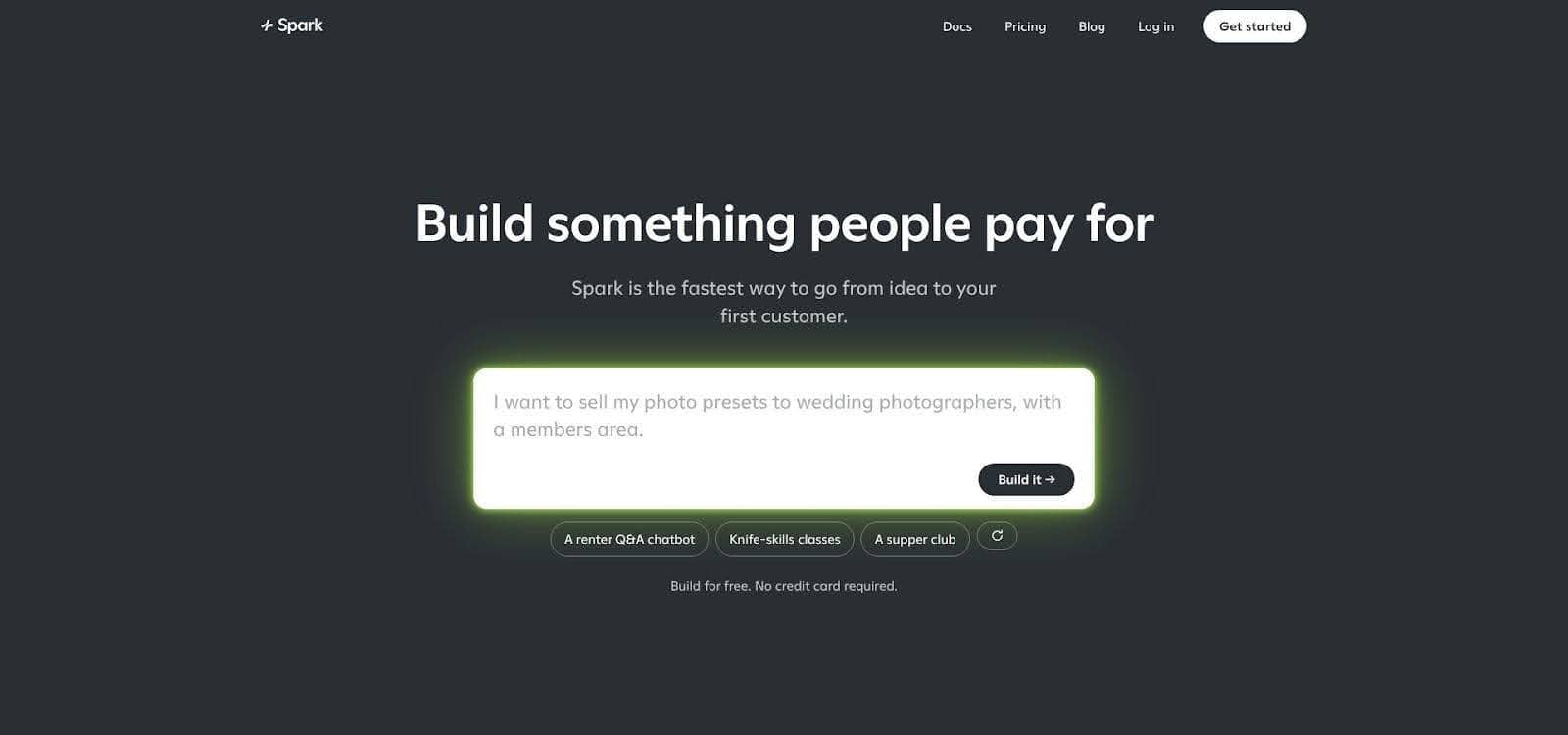
Spark home page: you start by describing the idea in a chat.
Describe a paid workshop, template pack, or niche calculator in chat, and Spark builds the website or web app with hosting, customer accounts, and Stripe payments built in. No coding is needed.
Spark keeps page building, hosting, customer sign-in, and checkout in one product, so the same chat that drafts the page also sets up what customers buy. You can connect a domain you already own, keep content behind sign-in (customers sign in with email codes), and charge one-time or subscription prices. Spark’s AI also helps plan and manage marketing campaigns across channels, and it can build the internal tools you use to run the business.
Pricing and limits. Building and previewing are free, with one-time $15 Build and $15 App credits and no credit card needed. Publishing needs a paid plan: $25 per month on Starter with a 10 percent fee on sales, or $200 per month on Pro with a 5 percent fee. Stripe’s processing fees are separate. Payments run through Stripe in US dollars, and refunds and payouts are managed in Stripe.
What to plan around. Spark’s built-in email reaches customers who have signed in, so it is not the place to upload a mailing list. Keep your existing email platform for list campaigns.
When Spark wins. Choose it when the landing page is really a small business: paid templates, a membership, a paid calculator, or a customer chatbot. One example on spark.site, FatFIRE Math, pairs free tools and calculators with a $399-a-year private membership group. Spark handles hosting, accounts, and checkout while you work on copy, creative, and promotion.
When to hand off. High-volume SaaS sign-ups, complex permissions, or SOC 2 requirements still call for engineering oversight.
For marketers who want fewer moving parts between a campaign idea and the first sale, the Spark no-code business builder keeps the page, customer accounts, and Stripe checkout in one chat.
2. Framer: dressing your launch page for the red carpet

Type “Launch page for a B2B AI payroll tool” and Framer drafts sections, images, and motion effects that you then shape in a visual editor. Every block stays editable, and the canvas will feel familiar to anyone who has used a design tool.
That blend of AI speed and granular control makes Framer the pick when design polish drives conversion. Swapping fonts, adding an animation, or replacing a background video is visual work, not code work.
Where Framer fits
- Design-led landing pages, product unveilings, waitlist drives
- Content hubs powered by its built-in CMS collections
- Brand-sensitive teams that want full control over layout and motion
Watch-outs
- Built for websites rather than apps; logged-in dashboards and database writes are not its focus
- Selling inside the page usually means adding an outside checkout
- Complex in-page transactions or logic belong in Lovable or Spark
Pricing snapshot (October 2026)
| Plan | Monthly Cost (Billed Yearly) | Key Limits |
|---|---|---|
| Basic | $10 | Free custom domain, 150 pages, 2 CMS collections |
| Pro | $30 | Free custom domain, 10 CMS collections, 90 days of analytics history |
Choose Framer when the page itself carries your story and must look investor-ready on day one. If your brief needs heavy logic or in-page payments, hand the baton to Lovable or Spark, but for pure visual impact Framer is hard to beat.
3. Lovable: interactive lead magnets that feel custom-built

Static pages often convert poorly. When you need a quiz, ROI calculator, or mini-app that feels bespoke, Lovable builds the app, database, and hosting from a chat.
A prompt such as “Build a cost-savings calculator for mid-market HR teams” gets you a shareable preview, and the agent stays on call afterward: ask for a five-question assessment or a new formula, and it updates the app, so non-technical teammates stay in the loop.
What to know
- Pricing. The Free plan includes 5 daily build credits (up to 30 a month). Pro starts at $25 per month for 100 credits, which matters once you iterate heavily.
- Payments. Lovable can build one-time and subscription checkout through chat using a Stripe account you own.
- Governance. Single sign-on and role-based access sit on the Business plan, so larger teams should budget for it.
Use Lovable when…
- Your lead magnet needs real logic: calculators, quizzes, interactive demos
- You want design control without code commits
- Speed to campaign launch matters more than deep compliance tooling
If the asset may grow into a core product or handle sensitive data, also look at Bolt or Replit, which keep the code front and center for a developer. For most launch-season assets, Lovable sits between Framer’s polish and Replit’s power, fast enough to turn buzz into pipeline.
4. Softr: dashboards and portals powered by the data you already trust

Most campaigns start in Airtable, Google Sheets, or HubSpot, not a blank canvas. Softr leans into that reality by turning your records into portals, dashboards, and gated resources.
Connect a data source and Softr’s AI co-builder drafts an app from a description, which you then arrange with blocks and style without code. Database, workflow automation, and granular permissions are built in, so one app can show partners, customers, and internal teams different views.
Why marketers like it
- Permissions without a dev sprint. Granular permissions let you publish partner-only or customer-only views of the same data.
- Data stays where it lives. Airtable, Google Sheets, HubSpot, Notion, Salesforce, and SQL databases connect directly.
- Block speed, not blank-canvas stress. You focus on metrics and copy, not component wiring.
Watch-outs
- The block system limits pixel-perfect heroes or complex animations; Framer or Bolt give more freedom.
- Selling products is not Softr’s focus, so commerce needs another tool.
- Sensitive data still merits security review, and SSO, SCIM, and audit logs sit on the Enterprise plan.
Pricing snapshot (October 2026)
| Tier | Monthly Cost | Key Caps |
|---|---|---|
| Free | $0 | Unlimited apps, 5 AI credits a month |
| Basic | $19 | Custom domain, conditional form logic, 10 AI credits a month |
Choose Softr when your asset must surface live data, personalize by record, and evolve as the numbers change. If selling products outranks surfacing metrics, Spark or Lovable serve you better.
5. Bolt: prototype power without opening VS Code
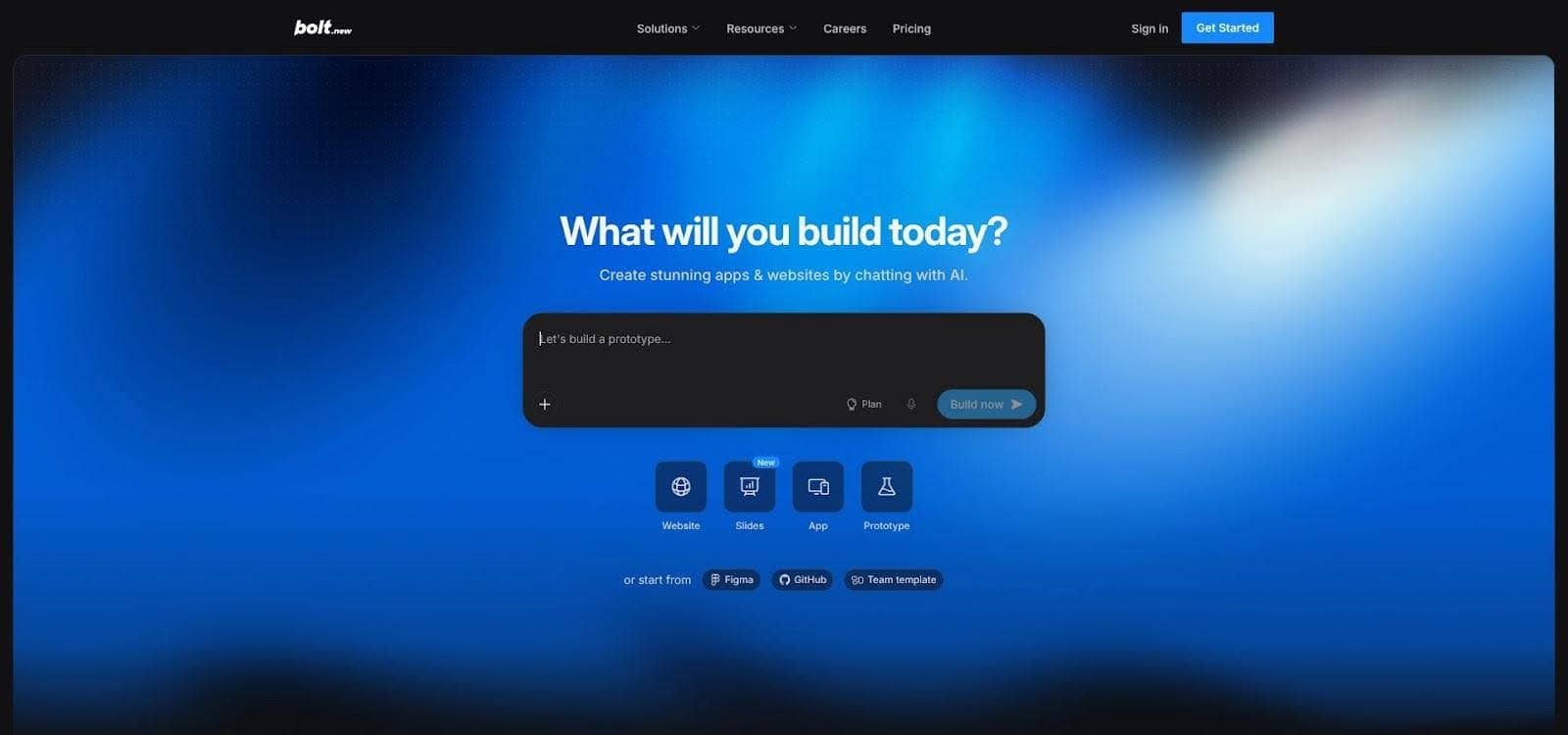
Campaign ideas change fast: a calculator today, an onboarding simulator tomorrow. Bolt’s chat-first builder generates the app, then shows the files behind it, so non-coders can tweak copy while engineers refine code.
After launch you can add a personalized results screen, an extra form field, or a dynamic price estimate through chat, and the changes appear in the code for anyone who wants to polish them by hand.
Usage and pricing (October 2026)
| Plan | Monthly Cost | Included Tokens | Extras |
|---|---|---|---|
| Free | $0 | 1 million a month (300K daily limit) | No custom domain |
| Pro | $25 | From 10 million a month | Custom domain support, SEO boosting |
The AI uses tokens every time it works on your project, so heavy experimentation needs a budget. Unused Pro tokens roll over for one extra month.
Why Bolt stands out
- Open hand-off. Bolt hosts the app, and it can connect the project to GitHub for version control, pull requests, and tests.
- Dual workflow. Chat edits keep marketers moving, while visible code keeps engineers happy.
- Flexible middle ground. Gentler than Replit for non-coders, more open than Framer when real app logic is likely.
Watch-outs
- SSO and audit logs sit on the Enterprise plan.
- Regulated data or strict compliance demands early security review.
- Token budgeting adds mental overhead compared with simpler credit systems.
Pick Bolt when you need to validate a concept quickly and expect engineers to scale the winner. For pure pages choose Framer; for built-in commerce Spark is simpler. Bolt thrives when iteration speed matters most.
6. v0: design-system precision for teams already on Vercel
When your product org lives in React components and a shared design system, v0 bridges marketing and engineering without breaking the system. The chat interface drafts pages, and when you work from an imported design system, the output uses your colors, components, and typography, so pages stay on brand.
Teams can import a design system from Figma, GitHub, or a private npm registry, then ask v0 for a multi-step form or calculator page that reuses those components and publishes through Vercel.
What stands out
- Design-system fidelity. Pages reuse the components the product team already maintains.
- True hand-off. Changes can be merged into the base branch and deployed to production through Vercel, the same path engineers already use.
- Familiar stack. For teams already on Vercel, hosting sits alongside the rest of the product.
Watch-outs
- Learning curve. Prop names, build logs, and component hierarchies appear quickly; non-technical teammates can edit copy, yet deeper changes assume React familiarity.
- Pricing. The Plus plan costs $30 per user per month with $30 of monthly credits and $2 of daily login credits per user; the Free plan is capped at 7 messages a day.
- Outside the stack. If the campaign asset sits far from your product codebase, Framer or Spark feels lighter.
Pick v0 when launch pages must reuse live components or when a growth experiment may graduate into the core app. It favors precision over ease, which suits many product-led teams.
7. Replit: when a campaign experiment could mature into real software
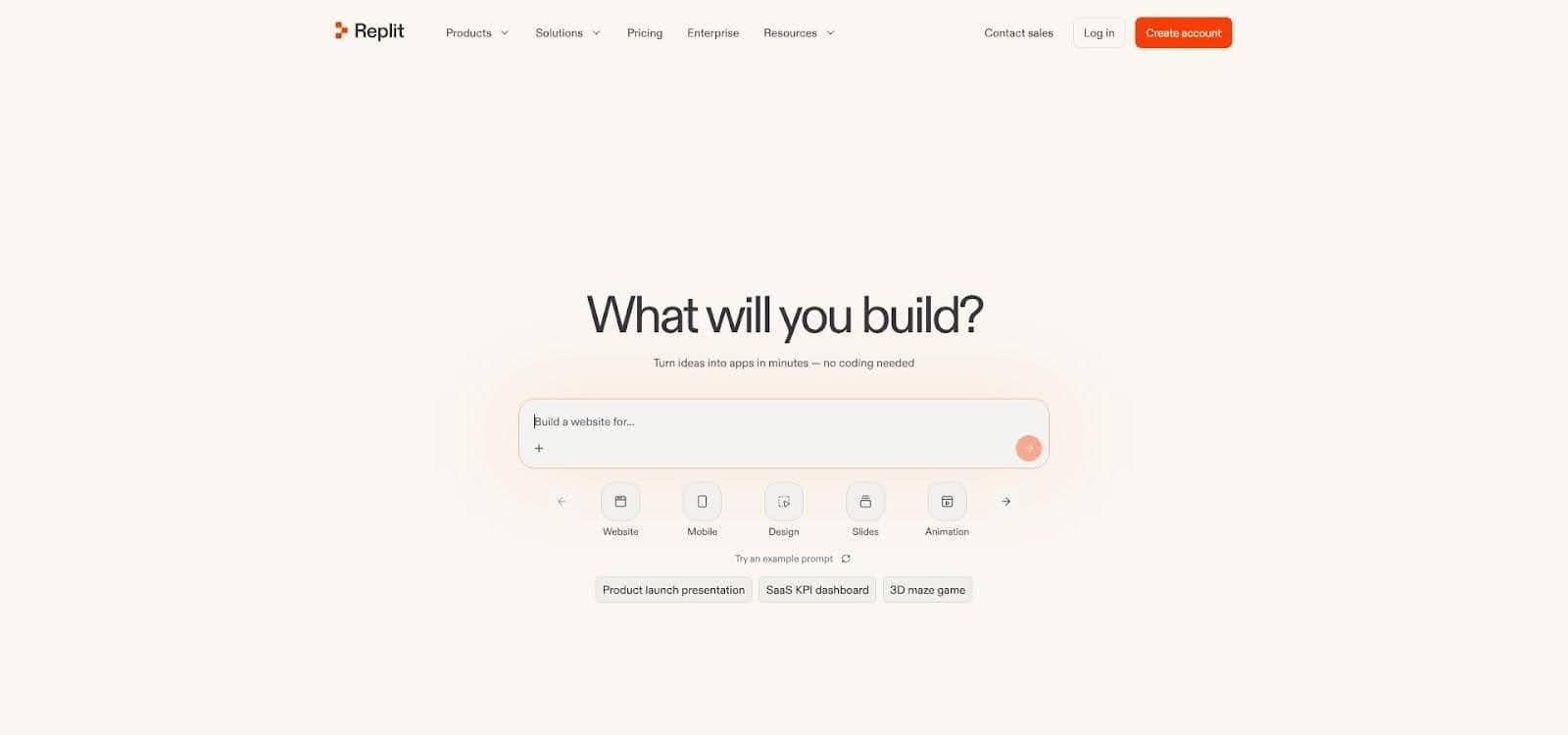
Replit goes beyond a page builder. The same agent that chats a landing page into existence also gives you full-stack code, a built-in database and user authentication, and an editor inside one browser tab. If your calculator might grow into a SaaS module next quarter, starting on Replit can save a future migration.
Refining edge-case math can mean opening the generated code and tweaking logic, while the preview updates alongside it, so non-coders can follow while engineers fine-tune.
Why marketers use it
- Fast, code-visible deploys. Preview, tweak, and ship without leaving the browser.
- Collaboration built in. Adding teammates feels like sharing a Google Doc, only this doc runs.
- Runway to product. A built-in database, user authentication, and connections to services such as Stripe let successful experiments harden into software.
Pricing snapshot (October 2026)
| Tier | Monthly Cost | Key Extras |
|---|---|---|
| Core | $20 ($18 billed yearly) | $20 toward powerful models, unlimited workspaces |
| Pro | $100 ($90 billed yearly) | Up to 15 collaborators, database rollback up to 28 days |
High-traffic or AI-heavy features consume usage credits quickly, so forecast spend before a big launch.
Watch-outs
- SSO/SAML sits on the Enterprise plan; involve security early for regulated data.
- Non-technical users may need help editing code files or managing packages.
- Tracking tags may need to go into the code by hand, which is not difficult but not zero-click.
Choose Replit when your campaign asset could evolve into a real product or API. For pure pages Spark or Framer is simpler; for interactive lead magnets Lovable feels lighter. When long-term extensibility matters, Replit gives your idea room to grow without a rewrite.
Which tool should you grab first?
Use this quick test to match your next bottleneck to the right builder, then double-check pricing and governance before going live.
| Need This Next | Grab This Tool |
|---|---|
| Sell access, memberships, or one-off products without wiring up separate tools | Spark |
| Ship a pixel-perfect launch or waitlist page | Framer |
| Capture leads with an interactive quiz or ROI calculator | Lovable |
| Turn Airtable, Sheets, or HubSpot data into a secure portal | Softr |
| Prototype fast and hand clean code to engineers | Bolt |
| Reuse an existing React design system on Vercel | v0 |
| Start small but leave room to grow into full software | Replit |
Mixing tools is common. For instance, embed a Lovable quiz on a Framer landing page and send the results to a Softr dashboard. Pick the one that unblocks today’s launch, not the flashiest demo.
A marketer’s pre-publish checklist
Most launch failures happen in the last mile: tracking breaks, forms misfire, or mobile layouts collapse. Walk through these six checks before you share the URL.
- Measurement. Load the page with four or five distinct UTM strings and click every call to action. Parameters should persist to the thank-you state, and Google Analytics should fire one clean event per calculate, submit, or purchase action. Duplicate events ruin optimization; confirm in GA4’s real-time view instead of trusting a plugin toggle.
- Conversion flow. On desktop and mobile, keep the value proposition clear above the fold and the primary button easy to find. Submit junk data, valid data, and edge-case lengths; each test should land in the correct CRM list within 30 seconds.
- Compliance. For California or EU audiences, consent banners should block non-essential cookies until accepted and use clear consent language (the IAB TCF framework and CCPA rules are the usual references).
- Quality. Run an automated Lighthouse audit, then check contrast, keyboard navigation, and image alt text manually. Accessibility helps every visitor and supports SEO.
- Performance. Lazy-load hero video, compress images, and remove unused JavaScript. Aim for a Largest Contentful Paint of 2.5 seconds or less, the threshold web.dev treats as good.
- Ownership. Confirm who receives downtime alerts, who can roll back, and where backups live. If Spark or Lovable hosts the asset, review their restore options; if Bolt or Replit connects to GitHub, enforce branch protection before launch.
When to call a developer, legal, or IT
Vibe coding speeds publishing, yet some launches still demand specialist review. Escalate when any of these four conditions appear:
Authentication or customer credentials. Passwords and social logins need encryption, secure storage, and a compliance check. Loop in security and a developer to validate flows before launch.
- Payments. Spark and Lovable both run payments through Stripe, and refunds are handled in Stripe. Before a big launch, have someone test failed charges, refunds, and duplicate orders end to end.
- Regulated or sensitive data. Health information (HIPAA), financial statements (SOX), or EU and California personal data (GDPR, CCPA) demand stricter controls. HIPAA Vault’s July 2026 analysis notes that AI tools build for speed and visual output, not for regulated, production-grade architecture.
- Longevity and scale. If a mini-app may evolve into a product feature, plan for version control, automated tests, and staging environments. Bolt and Replit provide a path, yet dedicated engineering keeps the codebase resilient as traffic and features grow.
Flag these scenarios early, involve the right stakeholders, and launch with confidence rather than in crisis mode.
Where vibe coding goes next
Code generation is now table stakes. The advantage is shifting to everything around the code: governance, integrations, and what happens after launch.
- Governance built in. v0’s Design Systems 2.0 lets teams bring in the components they already use, from sources such as Figma, GitHub, or a private npm registry, so brand consistency scales with output.
- Developer pipelines. Bolt and Replit both connect projects to GitHub, so a winning experiment can move into a normal engineering workflow.
The future looks hybrid: conversational prompts for the first draft, block editors and design systems for refinement, and developer pipelines for scale.
Governance is already part of the picture. In the June 2026 chiefmartec and UserEvidence survey, 83 percent of respondents said their organization has a formal policy or governance framework for the marketing team’s vibe coding, and 89 percent expect their usage to expand in the next 12 months. As generation fades into the background, marketers who excel at positioning, analytics, and multichannel rollout win regardless of how the UI is created.
Vibe coding delivers speed; strategy turns that speed into revenue.
FAQs
What is vibe coding?
Vibe coding lets you describe a website or app in plain language and have AI generate, revise, and publish the code, similar to briefing a junior developer without the hand-off delay.
Can non-coders launch a campaign page with these tools?
Yes, for landing pages, calculators, and simple portals. Complex authentication or regulated data still requires engineering review.
How is vibe coding different from no-code?
No-code assembles fixed blocks. Vibe coding writes or rewrites those blocks, then lets you refine them in a visual editor. Many platforms blend both approaches.
Who owns the generated code?
Ownership depends on the platform. Per Spark’s Terms, you own what Spark builds, including the code. Bolt can connect a project to GitHub for version control. Always read each platform’s terms before you commit.
What does it cost?
Entry paid plans in this list run from about $10 to $30 per month. Spark adds a fee on sales, Lovable and Bolt meter AI usage with credits or tokens, and Softr’s tiers scale by users and usage. Include hosting, AI usage, and paid integrations in your budget just as you would for traditional SaaS.
Other Interesting Articles
- AI LinkedIn Post Generator
- Gardening YouTube Video Idea Examples
- AI Agents for Gardening Companies
- Top AI Art Styles
- Pest Control YouTube Video Idea Examples
- Automotive Social Media Content Ideas
- Plumber YouTube Video Idea Examples
- AI Agents for Pest Control Companies
- Electrician YouTube Video Idea Examples
- How Pest Control Companies Can Get More Leads
- AI Google Ads for Home Services
- 60-Second Training Videos Are the New Corporate Standard
- Cybersecurity PR Pricing: Retainers, Deliverables & ROI
- Best AI Tools for Product Consistency in E-Commerce Video
Master the Art of Video Marketing
AI-Powered Tools to Ideate, Optimize, and Amplify!
- Spark Creativity: Unleash the most effective video ideas, scripts, and engaging hooks with our AI Generators.
- Optimize Instantly: Elevate your YouTube presence by optimizing video Titles, Descriptions, and Tags in seconds.
- Amplify Your Reach: Effortlessly craft social media, email, and ad copy to maximize your video’s impact.