
Competitor Analysis Platforms for AI Search: Compare Options

A competitor can appear frequently in AI-generated recommendations while remaining less visible in your traditional search reports. Understanding that difference requires examining the questions, markets, and sources behind the answers.
Competitor analysis platforms for AI search help teams investigate where competing brands appear, how they are described, and which pages receive citations. For businesses operating across several markets, the challenge is making those comparisons consistent enough to support decisions.
Last spring a board member asked me whether we were ahead or behind in AI answers. I promised a number per market, then learned that “ahead” means nothing without a named competitor in a named country. Producing it is the job of competitor analysis platforms for AI search, and it’s urgent: 51% of B2B software buyers in G2’s survey now start research with an AI chatbot more often than with Google. If our buyers act like them, the shortlist forms before regional sales sees the lead. The seven below sit in three tiers by job: program of record, regional view, suite module.
Who owns it: the in-house Head of AI Search, GEO lead, or Head of SEO carrying the mandate across 10+ country sites, at 2,000+ employees or a multi-brand portfolio, with a CMO or board reporting line. Content, brand, PR, and product marketing report elsewhere, and each market has its own competitor set.
What a multi-market program needs from AI search monitoring tools:
- A local competitor set for each market
- AI share of voice per market and engine
- The stored answer behind every number
- One roll-up for the board slide
- Data out to the BI layer
- Evidence each market owner can open
How we picked: buyers search “most effective competitor analysis platforms for AI search/LLM brand visibility.” I kept platforms meeting at least four of the six needs, tiered by their job in the operating model.
Chapters
- AI Search Competitor Analysis Statistics: Why Buyer Research Matters
- How Can AI Automate and Optimize Tasks in Your Campaigns?
- Tier 1: The Program Of Record For AI Share Of Voice
- Tier 2: Regional And Brand-Portfolio Views
- Tier 3: AI Modules Inside Enterprise SEO Suites
- Build a Competitor Map Around Buyer Alternatives
- Create Comparable Prompt Groups Across Markets
- Examine Why a Competitor Appears in the Answer
- Use the StoryLab.ai SCOPE Framework to Prioritize Gaps
- Report Competitive Changes Without Hiding the Context
- Which Tier Fits Your Operating Model?
- FAQ: AI Share Of Voice And Competitor Benchmarking
AI Search Competitor Analysis Statistics: Why Buyer Research Matters
51% of surveyed B2B software buyers said they start research with an AI chatbot more often than with Google. G2’s 2026 AI Search Insight Report highlights the importance of understanding how brands appear during early vendor discovery. This finding describes surveyed software buyers, rather than all buyers across every industry.
71% reported using AI chatbots somewhere in their software research process. That broader usage makes it useful to examine questions across discovery, comparison, and evaluation, rather than monitoring only broad “best software” prompts.
61% said they use AI search alongside Google. G2’s findings indicate that research can span both channels. AI visibility should therefore complement existing search and customer research, with results reported separately where the measurement methods differ.
69% reported that AI chatbots surfaced information that led them to choose a different vendor than expected. This is a self-reported finding about buyer decisions, not a controlled estimate of AI’s causal impact on sales. It nevertheless highlights the value of checking product descriptions and competitive comparisons for accuracy.
These findings explain why AI search deserves attention. They do not establish which monitoring platform is best or guarantee that increased visibility will produce more revenue.
How Can AI Automate and Optimize Tasks in Your Campaigns?

Seven competitor analysis platforms for AI search differ on three things a multi-market program must defend: how each benchmarks you against rivals, what it counts as one market, and how data leaves for the board slide. Pick the tier by the job, not the feature count.
| Platform | Tier | How competitors are compared | Market unit | Engines named by vendor | Data out |
|---|---|---|---|---|---|
| SE Visible by SE Ranking | Tier 1 | Suggested rivals, side by side per topic | One project per country, city, or region | Google AI Overviews, AI Mode, ChatGPT, Gemini | API on all plans, Looker Studio, XLSX |
| Conductor | Tier 1 | Topic by topic, full responses exportable | Location plus language, over 160 countries | Nine options, incl. Claude, Grok, Perplexity | Data API (Enterprise), MCP, XLSX |
| Profound | Tier 1 | Answer Engine Insights, daily on Enterprise | Regions custom on Enterprise; trial covers one | Up to 9, incl. Claude, DeepSeek | API, CSV, JSON on Enterprise |
| Brandlight | Tier 2 | Consolidated across brands, regions, and engines | All brands and regions, one HQ view | ChatGPT, Gemini, Perplexity, Copilot, Grok, Google AI | Not stated on public pages |
| Peec AI | Tier 2 | By model, topic, geography, and competitor | Country coverage set by plan | Three models self-serve; up to 13 on Enterprise | CSV, Looker Studio (Advanced+); API Enterprise |
| BrightEdge AI Catalyst | Tier 3 | Mentions vs. citations presence per engine | Not stated on product page | ChatGPT, Perplexity, Gemini, AI Overviews, AI Mode | PNG for board decks, CSV |
| Semrush Enterprise AIO | Tier 3 | Competitor moves, mentions, sources, sentiment | Markets and cities, dozens of languages | Perplexity, Claude, Gemini, ChatGPT | API across reporting systems |
Read Market unit first. Across locations, the same AI Mode query shares just 2% of URLs and 24% of domains in a five-city US test. Each market is its own answer layer; one global read can’t cover eighteen.
Tier 1: The Program Of Record For AI Share Of Voice
Tier 1 competitor analysis platforms for AI search produce the headline number. In enterprise GEO, that means one view per market, named local competitors, AI share of voice per engine, and the answer behind each figure. Everything else reads from this tier, so choose it first and change it least.
SE Visible
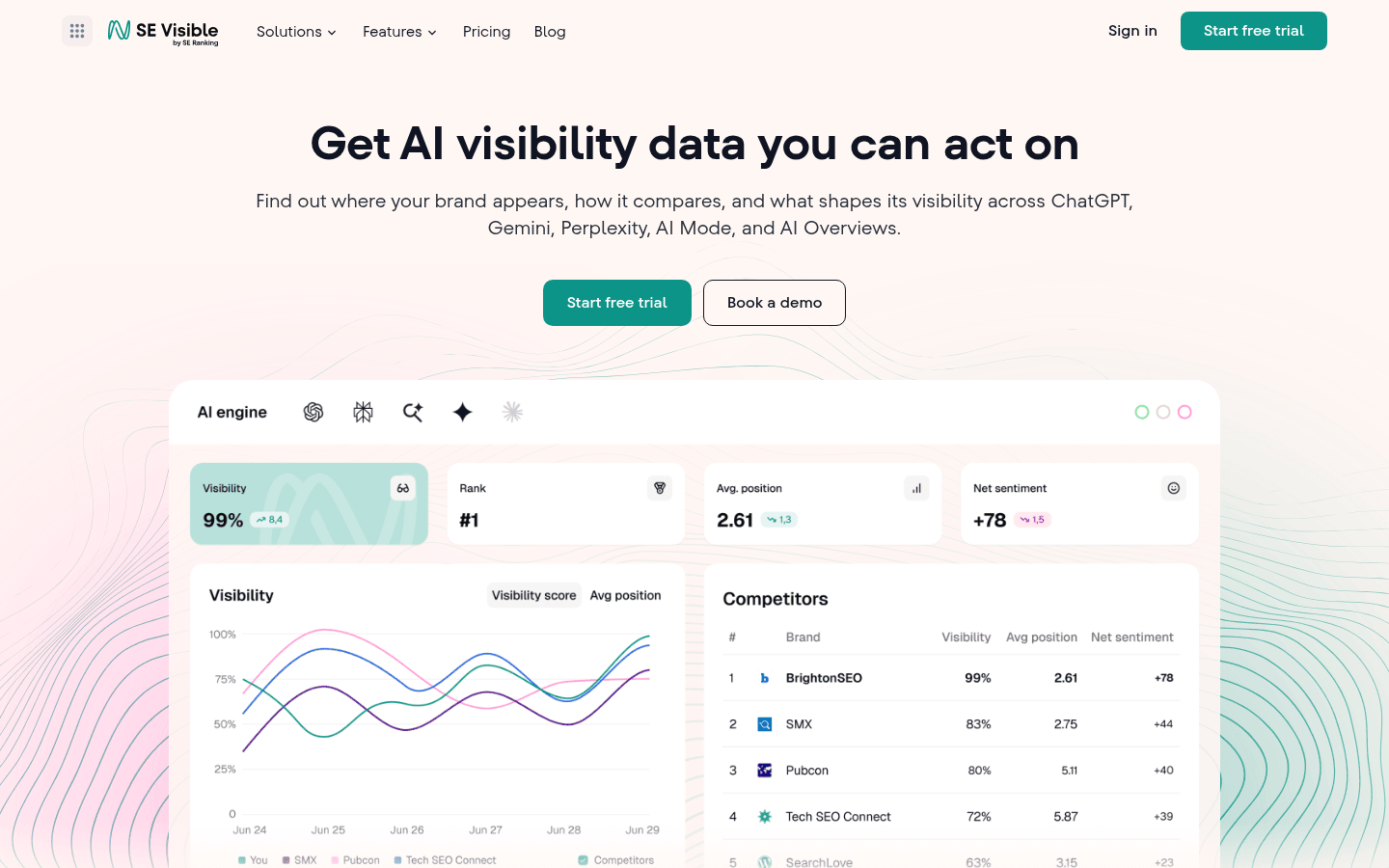
Share of voice against local rivals, per market, is the comparison a multi-market lead reports first. In each market, SE Visible by SE Ranking, an AI visibility platform, sets your brand beside the local rivals AI answers name.
Why it works for multi-market AI search leads: Who owns it: the central analyst. Each market is its own project with its own local rivals, so Milan’s read never leaks into Munich’s. Every engine reports its own visibility score, net sentiment, average position, and share of voice. Looker Studio or the API rolls every project into one CMO slide.
Standout feature: AI competitor analysis starts at setup, with rivals suggested from mention data. Compare by topics shows who leads each topic, and Sources lists the pages engines cite when they name a rival instead of you. Answers from Gemini, ChatGPT, and Google’s AI Mode and AI Overviews are collected in a real browser session.
Pros:
- Traces every number back to the stored, unedited response and its engine, market, and date
- Includes API access on all plans
- Tracks daily by default, adjustable in the project settings
Cons:
- One location per project, so eighteen markets means eighteen projects; several markets in one project is planned
- User management with custom access control is still coming
- Stops at the AI answer layer: keyword research, site audits, and rank tracking are SE Ranking’s job
Pricing: Each plan is priced on the SE Visible website, and a free trial is available.
The market call: If your competitor analysis platform for AI search must produce share of voice per market plus each lead’s evidence, start here. Compare your brand with competitors topic by topic in two of your markets. For organic rankings, SE Ranking covers Google and the traditional engines, so the pair shows both halves of search.
Conductor
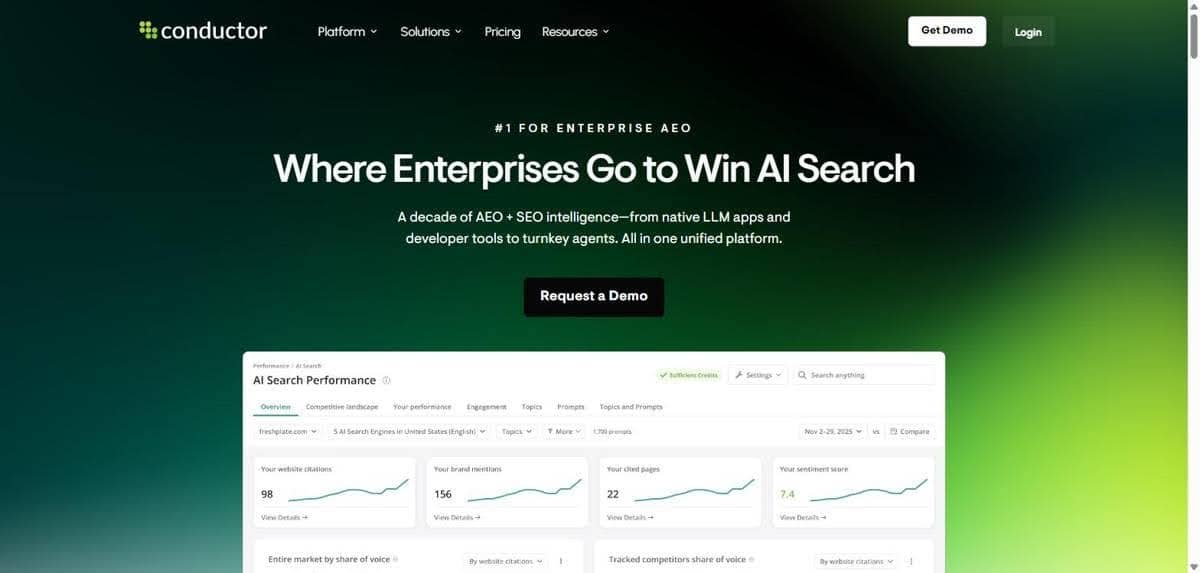
Conductor runs AI Search Performance inside its enterprise SEO suite, beside your organic data.
Why it works for multi-market AI search leads: Your web team stays in Conductor. Topics take location and language pairs across over 160 countries, with optional city or state targeting.
Standout feature: Conductor sets cadence per topic (daily, weekly, or monthly), and the responses export carries full answer text plus fan-out queries.
Pros:
- Matches cadence to each topic
- Exports complete responses for audit
- Adds SSO from the Growth plan
Cons:
- Each engine, location, and frequency draws AI Response Credits
- City or state tracking excludes Claude Sonnet, AI Mode, and Copilot
Pricing: No public prices; free trial on Essentials, demo for Growth, sales for Enterprise.
The market call: Already on Conductor for SEO? Then your competitor analysis platform for AI search, Perplexity and Grok included, stays on that contract. Model credits per market before you sign: eighteen markets at daily cadence add up fast.
Profound
Profound is an AI marketing platform with monitoring under Answer Engine Insights.
Why it works for multi-market AI search leads: It addresses enterprise security requirements with RBAC, SCIM, and SOC 2 on the homepage, while Enterprise adds SSO/SAML.
Standout feature: Enterprise support includes dedicated Slack access and a specialist with a 24-hour SLA. Seats are unlimited, and daily tracking covers up to nine answer engines, including Google AI Mode and Exa Search.
Pros:
- Exports CSV or JSON, with API access
- Keeps history with no cut-off
- Offers a dedicated specialist
Cons:
- Languages and regions are listed as custom on Enterprise; no country list is published
- The trial covers one region and one language, so a multi-market pilot starts with sales
Pricing: Free seven-day trial; Enterprise is custom-priced via a demo.
The market call: Choose Profound when security review, not analysts, shortlists a competitor analysis platform for AI search. Get region and language scope in writing before the pilot: custom coverage needs to become a defined set of named markets.
Tier 2: Regional And Brand-Portfolio Views
Regional and brand leads need their own view. The engine mix shifts by market: Gemini sent 12.87% of US AI referral traffic in 2026, against 5.81% in the UK, and Mistral’s share in France runs about 3.5x its EU average.
Brandlight
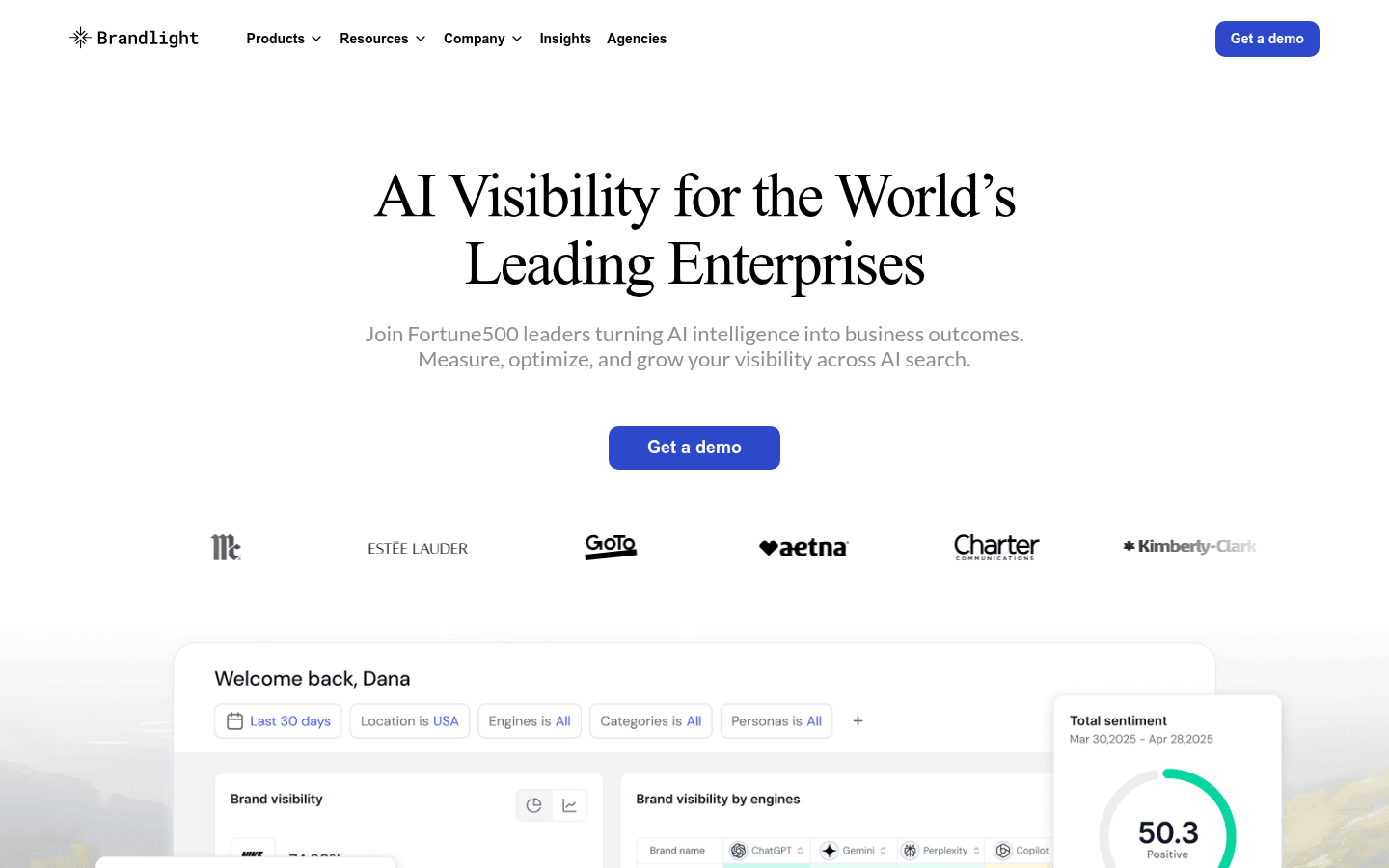
Brandlight rolls up how AI engines present every brand in an enterprise portfolio, region by region.
Why it works for multi-market AI search leads: A portfolio lead reporting several brands to one CMO gets an Enterprise HQ View, pitched as a “global command center for all brands and all regions.”
Standout feature: Its command center consolidates results across brands, regions, and engines, with location filters on its dashboards. Its pages name ChatGPT, Gemini, Perplexity, Copilot, Grok, and Google AI, and describe a multi-region, multi-lingual deployment.
Pros:
- Rolls brands and regions into one read
- States SOC 2 Type II compliance and GDPR
- Assigns AI strategists during enablement
Cons:
- Country and language counts aren’t stated on its public pages
- API, exports, and SSO go unstated too
Pricing: Demo only; no public price.
The market call: Brandlight fits a CMO who wants one competitor analysis platform for AI search across brands and regions. Ask early how strategist enablement hands ownership back to your content and brand leads.
Peec AI
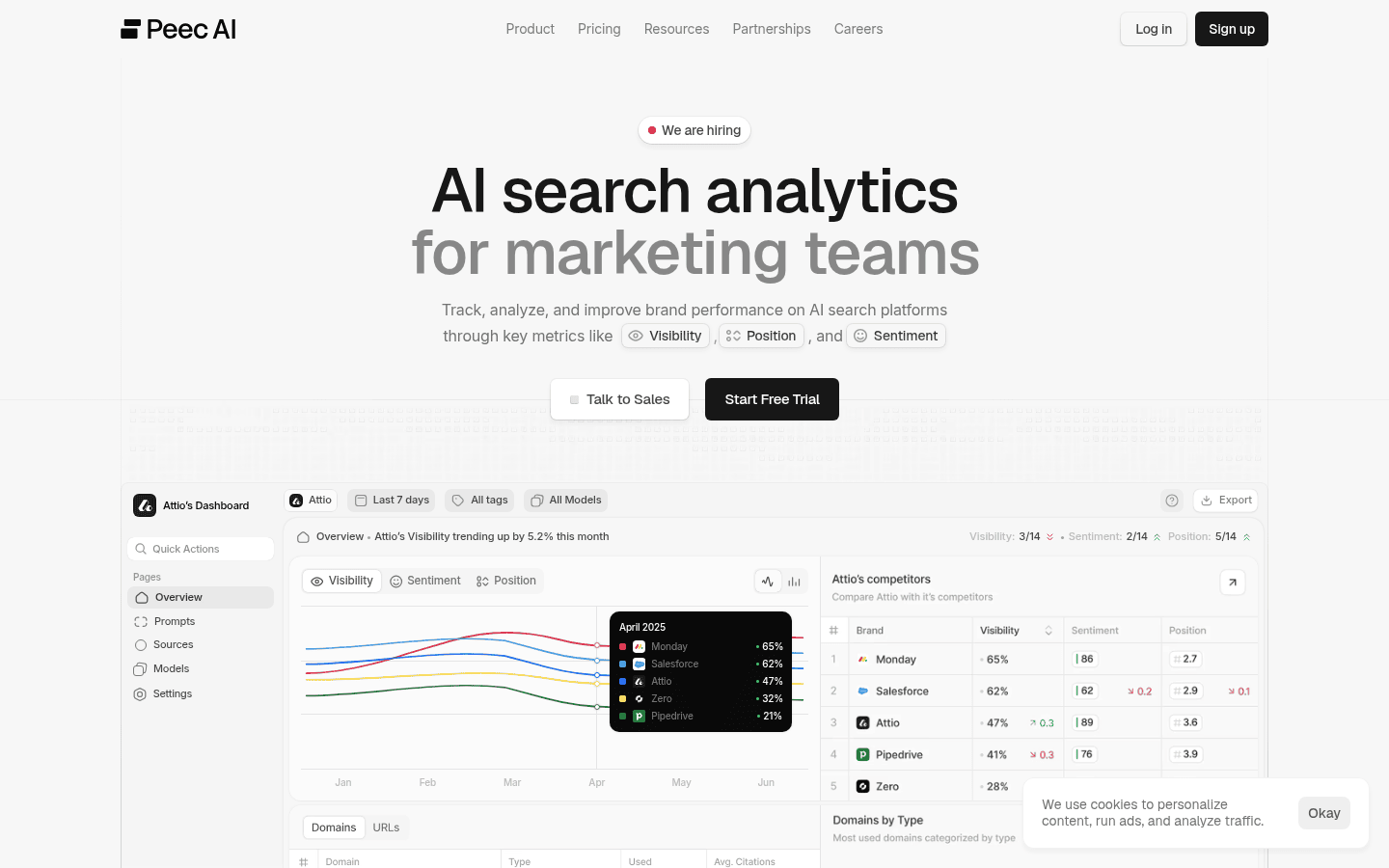
Peec AI is self-serve: you pick the prompts, competitors, and models to track.
Why it works for multi-market AI search leads: Who owns it: the country analyst. Per-project read-only roles let a market lead check numbers without editing the central prompts.
Standout feature: Model choice by market. Self-serve plans pick three of ChatGPT, AI Mode, AI Overviews, Copilot, Gemini, and Naver AI, so a Korea lead can add Naver. Enterprise opens up to 13 models.
Pros:
- Feeds Looker Studio from Advanced up
- Allows unlimited users
- Exports CSVs
Cons:
- Self-serve plans track three models; extras cost more
- API and SSO are Enterprise-only
Pricing: Starter $95, Pro $245, Advanced $495 a month; Enterprise custom, annual. Its FAQ ties price to prompts, not regions or languages; plans set country coverage.
The market call: Give Peec AI to a regional lead who needs a seat now, not to the program of record. It reads one market well; the roll-up to one CMO number stays yours to build.
Tier 3: AI Modules Inside Enterprise SEO Suites
If the enterprise SEO suite is your system of record, its AI module can be your competitor analysis platform for AI search. The free baseline is thinner: Search Console’s generative AI reports show impressions by country for AI Overviews and AI Mode on a subset of sites, not the answer or which competitor it names.
BrightEdge AI Catalyst
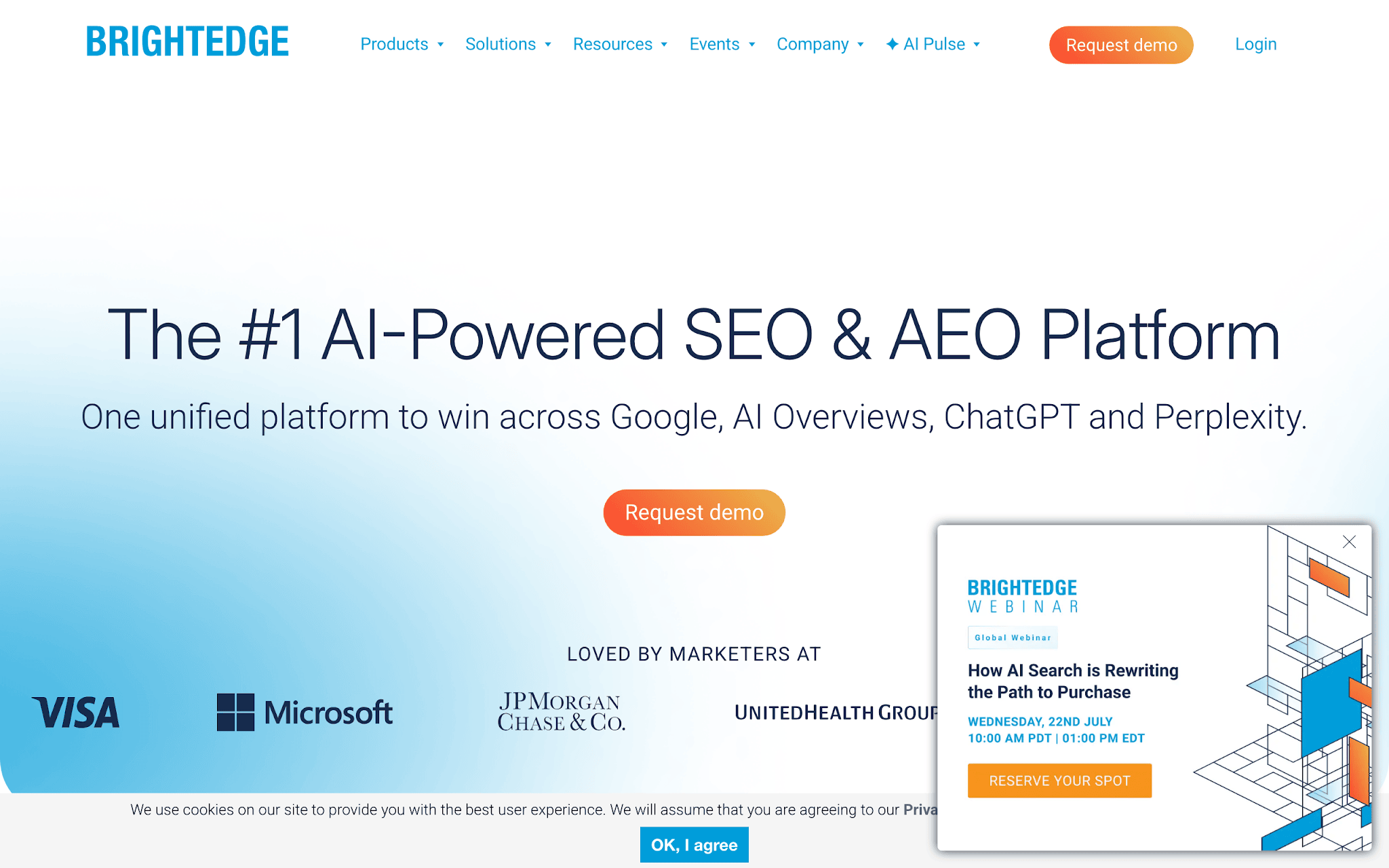
Teams already reporting search through BrightEdge get AI Catalyst, its answer-engine module.
Why it works for multi-market AI search leads: Annotations tie each shift to a launch, an algorithm update, or a rival’s move, so the monthly review starts from a cause.
Standout feature: It splits Mentions Presence and Citations Presence against competitors per engine: ChatGPT, Perplexity, Google AI Overviews, AI Mode, Gemini, and others. It also tests whether answers change for a practitioner versus a decision maker.
Pros:
- Exports any chart as a board-deck PNG, tables as CSV
- Flags competitor takeovers of an answer
- Inherits company-wide SOC 2, ISO 27001:2022, and SAML/SSO
Cons:
- Market handling isn’t stated on its page
- Sold within the BrightEdge platform
Pricing: Quoted after a demo.
The market call: Add it when BrightEdge is your suite of record and your SEO lead builds the board slide there. Before AI visibility monitoring enters the contract, pin down the country setup.
Semrush Enterprise AIO
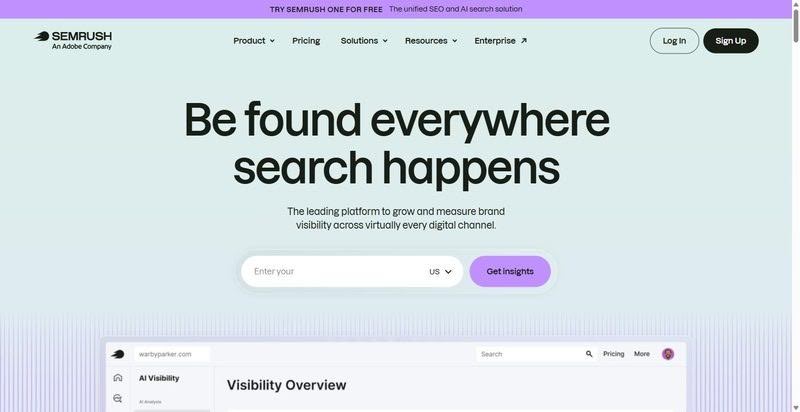
Enterprise AIO is the AI optimization layer in Semrush for Enterprise.
Why it works for multi-market AI search leads: Enterprise AIO splits sentiment, sources, and mentions by brands, markets, cities, and products, which matches how regional sites report upward.
Standout feature: Semrush describes global monitoring in dozens of languages on a prompt database it puts at 289M+. An API carries AIO data into other reporting systems, so AI search visibility and revenue share one slide.
Pros:
- Adds GA4 or Adobe Analytics traffic context
- Tracks classic search and AI answers together
- Detects competitor moves in real time, per Semrush
Cons:
- Names engines (ChatGPT, Gemini, Claude, Perplexity) only in metadata
- Publishes no market or country count
Pricing: Enterprise contract after a demo.
The market call: It belongs where Semrush for Enterprise feeds your reporting. What the CMO sees: brands and markets in one view. First confirm which engines and markets your contract covers; the public page settles neither.
Build a Competitor Map Around Buyer Alternatives
Your familiar sales competitors may not be the only brands appearing in AI answers.
Start with the vendors customers actually compare during sales conversations. Then review monitored answers for additional alternatives, including specialist providers, regional businesses, and products serving adjacent needs.
Organize the findings into three groups:
- Direct competitors: Businesses serving similar customers with comparable offers.
- Alternative approaches: Different ways buyers might solve the same problem.
- Information sources: Publishers, communities, and other websites cited in the answer.
Keep information sources separate from competing vendors. A publication may receive frequent citations without selling anything that competes with your product.
For each market, confirm whether the named alternatives are available, relevant, and suitable for the intended customer. A global brand’s visibility may have limited commercial significance if it does not serve that region.
Maintain a stable core competitor set for trend reporting. Record newly discovered rivals separately until you decide whether they belong in the ongoing comparison.
Create Comparable Prompt Groups Across Markets
Direct translation does not always preserve buying intent. Local terminology, purchasing expectations, and product availability can change what a question means.
Build prompt groups around shared customer needs, then ask regional colleagues to review the wording.
A useful structure includes:
- Category discovery.
- Specific use cases.
- Product comparisons.
- Integration or compatibility requirements.
- Implementation questions.
- Regional availability and support.
For example, a buyer researching payroll software may ask about different reporting requirements in different countries. The underlying need is comparable, but the questions should reflect each market.
Keep a record of the intent, language, location, and target customer behind every prompt. Label branded questions separately from questions that allow competing products to emerge naturally.
Maintain two reporting views: a consistent core for comparisons over time and an exploratory set for newly identified questions. This prevents changes to the prompt library from being mistaken for changes in competitive performance.
Examine Why a Competitor Appears in the Answer

A mention count does not explain the role a brand plays.
Read the underlying response and distinguish between a recommendation, a neutral example, a comparison, and a warning. A brand named as unsuitable for a use case should not be interpreted as winning that opportunity.
For important answers, record:
- The buyer need being addressed.
- The role assigned to each brand.
- The reasons given for inclusion or exclusion.
- The sources cited alongside those claims.
- Any factual errors or missing qualifications.
Then inspect the cited pages. Look for information that directly addresses the question, such as implementation details, current product specifications, or relevant customer evidence.
Treat citations as observable evidence of what was referenced. They do not reveal the full reasoning behind the answer or prove that copying a cited page will improve your visibility.
The useful output is a specific finding: “Our integration documentation does not answer this requirement clearly” is more actionable than “Competitor A has more citations.”
Use the StoryLab.ai SCOPE Framework to Prioritize Gaps
The StoryLab.ai SCOPE framework is a practical checklist for turning competitive findings into a manageable work plan.
S — Significance
Assess whether the question matters to a customer segment your business wants to serve.
C — Consistency
Check whether the gap appears repeatedly under comparable monitoring conditions. Investigate isolated results before treating them as a trend.
O — Ownership
Assign the issue to the team that can address it. Product documentation, regional availability, external listings, and technical accessibility may require different owners.
P — Proof
Identify the evidence needed to answer the buyer’s question accurately. This might include a product demonstration, a documented specification, or a customer example.
E — Evaluation
Define what you will review after the change, including the relevant prompt group, answer accuracy, citation patterns, and available business signals.
For example, repeated exclusions based on an outdated product limitation may justify updating documentation and requesting corrections to external sources.
Prioritize fixes that improve the information available to buyers. Avoid producing large volumes of similar content simply because competitors appear for many related prompts.
Report Competitive Changes Without Hiding the Context
A single global score can conceal meaningful differences between markets, engines, and customer needs.
Show the underlying segments alongside any summary. Explain how the aggregate is calculated and whether markets receive equal weight or a defined business weighting.
Keep the denominator visible. Your share of tracked mentions can change when competitors are added, even if your own mention count stays constant. Changes in prompt volume or engine coverage can also affect the headline result.
Include a short explanation for each meaningful movement:
- What changed?
- Which markets and prompt groups were affected?
- Is the change repeated or isolated?
- Did the measurement setup change?
- What action, if any, follows?
Separate observed changes from possible explanations. A new content page published before a visibility increase is a useful annotation, but timing alone does not prove causation.
Close the report with a small number of assigned actions and review dates. The purpose of competitive monitoring is to help teams make better decisions about the questions and evidence that matter to their buyers.
Which Tier Fits Your Operating Model?
A competitor analysis platform for AI search should follow your operating model. Settle three things: who owns the AI share of voice number, who acts on it in each market, and where the board slide gets built. Then pick the tier.
- If you report AI share of voice per market, with evidence for each: SE Visible.
- If the web team lives in Conductor: Conductor’s AI Search Performance.
- If security review gates on SSO, SCIM, and SOC 2: Profound.
- If the CMO wants one view across brands and regions: Brandlight.
- If BrightEdge or Semrush Enterprise is your suite of record: AI Catalyst or Enterprise AIO.
Gartner found only 22% of organizations have scaled AI across multiple business units; eighteen markets is that problem. Gartner Distinguished VP Tina Nunno says leaders who “track every dollar spent by outcome category” defend spend best.
Define, then choose, then build. The mandate is the method.
FAQ: AI Share Of Voice And Competitor Benchmarking
What Is Share Of Voice In AI Search?
AI share of voice, or share of model, is your portion of brand mentions in AI answers across a prompt set. The formula: your mentions divided by every tracked brand’s mentions, times 100. It’s how to measure AI search visibility per market.
Which AI Tool Is Best For Competitor Analysis?
Among competitor analysis platforms for AI search, the pick depends on the job. For per-market benchmarking, SE Visible compares you with local rivals in Gemini, ChatGPT, Google AI Overviews, and AI Mode. Suite-first teams should test their AI module against share of voice tools.
What Does 50% AI Share Of Voice Mean?
At 50%, half the tracked-brand mentions in a prompt set, for one market and engine, name you. Against two rivals, 50% usually leads; against one, it’s parity. Your market lead checks the per-engine split before the CMO slide.
How Can You Monitor Competitors’ Performance In AI Search?
Give each market its own project and competitor set. SE Visible tracks one location per project, daily by default, adjustable, and rolls up through Looker Studio or the API. The CMO sees one slide; markets keep their evidence.
Other Interesting Articles
- AI LinkedIn Post Generator
- Gardening YouTube Video Idea Examples
- AI Agents for Gardening Companies
- Top AI Art Styles
- Pest Control YouTube Video Idea Examples
- Automotive Social Media Content Ideas
- Plumber YouTube Video Idea Examples
- AI Agents for Pest Control Companies
- Electrician YouTube Video Idea Examples
- How Pest Control Companies Can Get More Leads
- AI Google Ads for Home Services
- 60-Second Training Videos Are the New Corporate Standard
- Cybersecurity PR Pricing: Retainers, Deliverables & ROI
- Best AI Tools for Product Consistency in E-Commerce Video
Master the Art of Video Marketing
AI-Powered Tools to Ideate, Optimize, and Amplify!
- Spark Creativity: Unleash the most effective video ideas, scripts, and engaging hooks with our AI Generators.
- Optimize Instantly: Elevate your YouTube presence by optimizing video Titles, Descriptions, and Tags in seconds.
- Amplify Your Reach: Effortlessly craft social media, email, and ad copy to maximize your video’s impact.