
Where to Put the Human Review Gate in an AI Content Workflow

Ask three people on a content team where a human approved the last piece they published. One points at the brief. One says they skimmed it before it went into the CMS. One assumes somebody else did it. Everyone reviewed something. Nobody owned a gate.
AI drafting tools did not create a quality problem. They created a volume problem, and volume is what turns informal review into no review. A team publishing four pieces a month can run on a shared instinct for what is good enough. At sixteen pieces a month, that instinct becomes the bottleneck, and the team quietly stops using it.
The fix is not more reviewers. It is one gate, placed at the point where rework is still cheap.
Chapters
Most Teams Have Review Everywhere And A Gate Nowhere
Feedback and a gate are not the same thing. Feedback is an opinion, offered at any point, by anyone. A gate is a named person, a written decision, and a specific failure it exists to catch.
Most content workflows have plenty of the first and none of the second. Comments in the doc. A note in Slack. A quick read before publishing. Each one produces a reaction. None of them produces a verdict.
Four soft touchpoints are slower and weaker than one hard one. They cost more total hours, they spread ownership until nobody feels responsible for the outcome, and they let a piece reach publication without any single person having said it is ready.
Adding a fifth reviewer does not fix that. It adds another opinion to a process that has no decision in it.
Name The Failure Each Gate Is Supposed To Catch
Before deciding where a gate goes, decide what it stops. Four failures show up in AI-assisted content, and they do not behave the same way.
- Wrong premise. The piece answers a question the reader never asked.
- Wrong structure. The argument does not hold, or the order buries the point.
- Wrong facts. A statistic, a name, or a claim is not true.
- Wrong voice. It reads like nobody at the company wrote it.
A gate that tries to catch all four catches none. It collapses into read the whole thing and tell me what you think, which is the review pattern the team already has.
Premise and structure fail early, and they fail cheaply when caught early. Facts and voice fail late, but they must not fail silently. That difference is what decides placement.
The Brief Is The Cheapest Place To Stop A Bad Draft
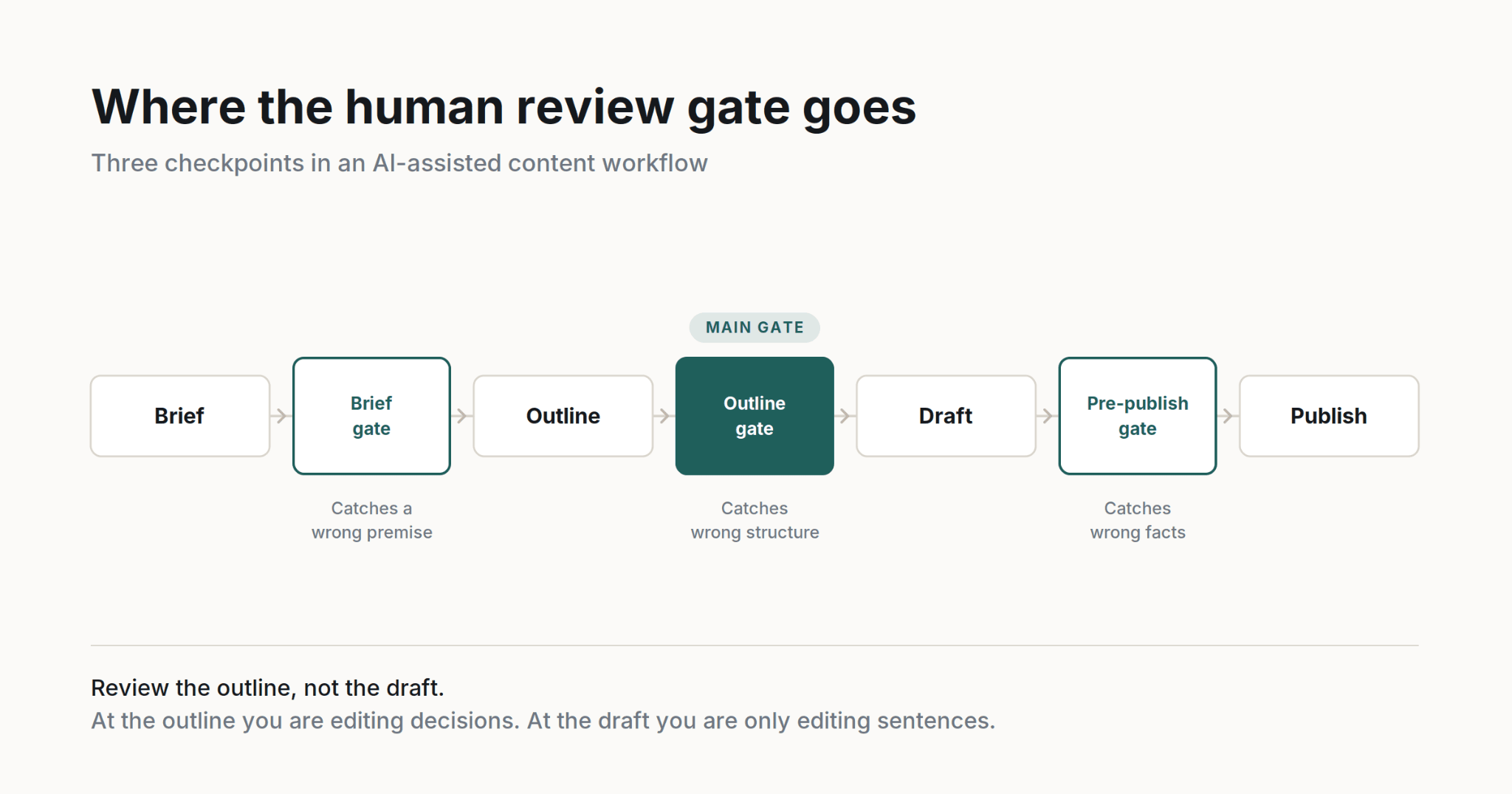
The first gate sits before generation, not after it.
A brief that lists topic, keyword, and word count hands every real decision to the model. The model will make those decisions confidently, and the team will spend the rest of the workflow arguing with the result.
A brief you can actually gate on specifies four things: the question the reader arrived with, the claim the piece will make, what it deliberately will not cover, and the one thing that would make it wrong.
The difference is easy to see side by side. A thought leadership piece on AI in marketing, 1,500 words, target keyword AI content strategy, gives a reviewer nothing to approve or reject. For a five-person marketing team already drafting with AI, argue they need one review gate rather than four, do not cover tool selection, and it is wrong if it reads as anti-AI, gives them a decision they can make in ten minutes.
That ten minutes is the cheapest review in the workflow. Anything caught here costs nothing, because nothing has been written yet.
Put The Main Gate At The Outline, Not The Draft
Most teams put their real review on the finished draft. It is the most expensive possible moment to do it.
By then the piece is polished, someone has spent hours on it, and structural feedback means starting over. So reviewers soften. They fix a sentence instead of saying the argument does not work, because the second comment costs the writer a day. The review turns cosmetic, and the structural problem ships anyway.
Most of the content teams we work with at Devpros Studio arrive with exactly that setup. Heavy review on the finished draft, nothing on the outline. Moving the gate earlier is usually the single change that shortens their cycle the most.
Review the outline instead. At that stage you are looking at claims, order, evidence, and gaps, and all four are still cheap to change. Moving a section is a drag. Cutting a claim is a keystroke. Adding a missing source is a note.
The distinction worth keeping: at the outline you are editing decisions; at the draft you are editing sentences. Decisions are what go wrong, and they are the expensive thing to fix late.
This makes the final check lighter too. A reviewer who approved the outline has already approved the thinking. They are not reading the draft to work out whether the piece should exist.
What The Pre-Publish Check Is Actually For
The last gate is a verification pass, not a second opinion. Its scope is fixed and short.
- Every factual claim and statistic traces to a source
- Names, figures, and dates are correct
- Links resolve and point where they claim to
- Nothing is asserted that the company cannot stand behind
- Brand and legally sensitive language has been checked
Rewriting for taste is out of scope, and that exclusion has to be written down rather than assumed. A pre-publish gate that accepts style notes will expand until it is a second full edit. Once it is a second full edit, it takes days, and the team starts routing around it for anything urgent.
At that point it catches nothing, because the pieces that most needed checking are the ones that skipped it. Keep the scope narrow and the gate stays fast. Keep it fast, and people keep using it.
Write Gate Rules That Survive A Handoff
A gate only works if it produces a verdict somebody else can act on. Three things make that possible.
One named owner
Not a team, not a channel. A gate owned by everyone is owned by nobody.
A written pass or fail criterion
The reviewer should be answering a question, not forming an impression.
A defined return stage
When a piece fails, it goes back to a specific point in the workflow, not into a general queue labelled fix this.
How the rejection is written matters as much as the rejection itself. Returned to outline, the two statistics in section three have no source tells the next person exactly what to do. Does not feel right sends the piece back to opinion and guarantees the same failure returns next month.
Give each gate a stated turnaround as well. A gate with no deadline becomes the bottleneck people learn to skip.
Diagnose A Failed Review At The Right Stage
When something bad reaches publication, the useful question is which gate missed it, not who missed it.
- If the piece answers the wrong question, the brief gate failed. Fix the brief, do not rewrite the draft.
- If the argument does not hold, the outline gate failed. Return it to outline rather than to editing.
- If a fact is wrong at publication, the pre-publish gate has no source requirement in it.
- If the voice is wrong every time, that is a style input problem, not a review problem. More reviewing will not fix it.
- If the same note appears on three pieces in a row, it belongs in the brief template, not in review.
The last one is the most common and the most expensive. Teams re-explain the same preference every cycle instead of writing it down once.
Start With One Gate, Not A New Process
Reading this as a three-gate system is the fastest way to never build it. Teams that try to install brief, outline, and pre-publish gates at the same time usually get four weeks in and go back to what they had.
Start with the outline gate. It returns the most, because it catches the failures that are most expensive to fix later.
Pick one person to own it. Write down the two or three things they are checking for. Run it on the next four pieces, and keep the reason for every rejection in one place.
After four pieces, you will know what the other gates need to catch. The brief gate tends to build itself out of the rejection notes, because the same gap keeps showing up. The pre-publish check earns its place once you are publishing enough that nobody can remember which claims were verified.
Three gates is where this ends up. One gate is where it starts.
One Gate People Trust Beats Four They Route Around
This design accepts a trade. Some small things will ship imperfect, because the pre-publish check is deliberately narrow and nobody is reading the finished draft for taste. In exchange, the structural failures stop shipping, and those are the ones that cost a rewrite or a correction.
The point of a review gate is not to catch everything. It is to make the point of failure findable. A workflow where you can say which gate missed it gets better every month. A workflow where four people all sort of looked at it repeats the same mistakes, because there is nothing specific to fix.
AI tools made drafting fast and cheap, and that is the part most teams have already solved. The leverage now is in where human judgment sits, not in how much of it gets applied. A team publishing sixteen pieces a month behind one gate people respect will beat a team publishing sixteen behind four gates everyone works around.
Other Interesting Articles
- AI LinkedIn Post Generator
- Gardening YouTube Video Idea Examples
- AI Agents for Gardening Companies
- Top AI Art Styles
- Pest Control YouTube Video Idea Examples
- Automotive Social Media Content Ideas
- Plumber YouTube Video Idea Examples
- AI Agents for Pest Control Companies
- Electrician YouTube Video Idea Examples
- How Pest Control Companies Can Get More Leads
- AI Google Ads for Home Services
- 60-Second Training Videos Are the New Corporate Standard
- Cybersecurity PR Pricing: Retainers, Deliverables & ROI
- Best AI Tools for Product Consistency in E-Commerce Video
Master the Art of Video Marketing
AI-Powered Tools to Ideate, Optimize, and Amplify!
- Spark Creativity: Unleash the most effective video ideas, scripts, and engaging hooks with our AI Generators.
- Optimize Instantly: Elevate your YouTube presence by optimizing video Titles, Descriptions, and Tags in seconds.
- Amplify Your Reach: Effortlessly craft social media, email, and ad copy to maximize your video’s impact.