
Best AI Writing and Rewriting Tools Reviewed: Which One Actually Delivers?

AI writing and rewriting tools have become a practical part of modern content workflows. Instead of using one tool only for drafting, many marketers now use a mix of AI writers, rewriters, and humanizer-style editors to turn rough ideas into cleaner blog posts, emails, landing page copy, and social content. StoryLab.ai’s current review already compares tools such as SuperHumanizer, QuillBot AI Humanizer, Grammarly AI Humanizer, Jasper AI, and others, which gives this page a strong starting point for readers who want to compare real options quickly.
The better question is no longer just which tool writes fastest. It is which tool fits your workflow best. Some tools are stronger for light cleanup. Some are better for deeper rewrites. Others work better when you need a broader AI marketing system that helps with ideation, content repurposing, and campaign production, not just sentence-level rewriting.
There are over 50 AI writing and rewriting tools available right now. Most of them promise the same thing: natural sounding content that passes every AI detector on the planet. We tested 7 of them, ran each one through GPTZero and Originality.ai, and found that only a few actually live up to the hype.
If you are a content creator, marketer, blogger, or SEO professional looking to humanize AI text or generate better first drafts, this review will save you hours of trial and error. We are breaking down what each tool does well, where it falls short, and which ones deserve a spot in your workflow.
AI writing tools can help marketers move faster, but not every tool solves the same problem.
Some tools are best for writing blog posts and landing pages. Others are stronger for rewriting sentences, improving grammar, repurposing content, summarizing research, creating social posts, or keeping brand voice consistent across a team.
That is why choosing the right AI writing or rewriting tool starts with the workflow, not the feature list.
A solo creator may need a fast assistant for brainstorming, outlines, captions, and email drafts. A marketing team may need SEO workflows, collaboration, approval steps, brand voice controls, and integrations. A larger business may care more about governance, security, consistency, and content quality at scale.
AI can help with first drafts, but the best results still come from strong human direction. Good prompts, clear strategy, real examples, fact-checking, editing, and brand guidelines turn AI output into content people actually want to read.
Here is how to review AI writing and rewriting tools and build a better content workflow around them.
Before you start reading, it is worth noting that the best content workflows often begin with a strong first draft rather than heavy rewriting after the fact. If you want to reduce your dependence on rewriting tools altogether, AI powered blog content generators can help you create structured outlines and human sounding drafts from the start.
Chapters
- Why You Need a Reliable AI Content Rewriter in 2026
- How We Tested the Best AI Humanizer and Rewriting Tools
- Quick Comparison: How Each Tool Performed
- Which AI Writing Tool Should You Actually Use?
- How to choose the right AI writing and rewriting tool
- Best use cases for AI rewriting tools
- AI writing tools vs AI rewriting tools
- What marketers should look for beyond basic rewriting
- How AI writing and rewriting tools fit into AI marketing workflows
- Features that matter most in a real review
- When to use a dedicated humanizer and when to use a broader AI platform
- What AI writing and rewriting tools actually do
- The main types of AI writing tools
- Best AI writing tools for marketing content
- Best AI rewriting tools for improving existing content
- Best AI tools for SEO content writing
- Best AI tools for brand voice consistency
- Best AI tools for rewriting blog posts
- Best AI tools for email and social media copy
- Best AI tools for teams and content workflows
- How to review AI writing tools before choosing one
- AI writing tools still need human editing
- Build a better AI writing workflow
- What makes an AI writing tool worth using?
- Final Thoughts
- FAQ
Why You Need a Reliable AI Content Rewriter in 2026
The rules of content creation have shifted dramatically. Search engines are now actively evaluating content quality signals tied to authenticity and expertise. AI detection tools like Turnitin, GPTZero, and Originality.ai have become standard checkpoints across education, publishing, and corporate marketing teams.
Simply generating text with ChatGPT and hitting publish is no longer a viable strategy. The content that wins in 2026 is content that reads naturally, reflects a real human perspective, and passes the growing number of quality filters. That is exactly where AI rewriting tools and humanizers earn their place in your workflow.
How We Tested the Best AI Humanizer and Rewriting Tools
We kept the testing process simple and consistent. We took the same 500 word AI generated sample from ChatGPT 4 and ran it through each tool using its default or recommended settings.
After processing, we checked every output against GPTZero and Originality.ai to measure the AI detection score. The original unprocessed text scored 98% AI on GPTZero and 94% AI on Originality.ai. We also evaluated readability, meaning preservation, and overall writing quality for each result.
1. SuperHumanizer
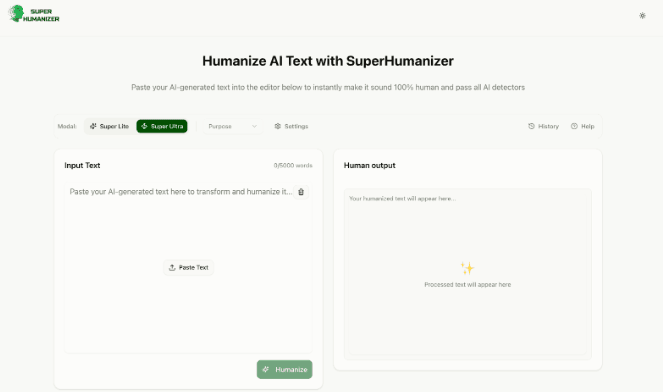
SuperHumanizer has emerged as one of the most effective dedicated AI humanizer tools this year. It offers two processing modes: Super Lite for light polishing and Super Ultra for deep rewrites that go through a background quality validation before delivering results.
The engine behind it is trained on over 15 million human written samples, with 1 million carefully curated texts forming the core training set. In our testing, Super Ultra mode brought the GPTZero score down from 98% to around 8%, and Originality.ai dropped to approximately 11%. Those were among the best results we recorded across all seven tools.
It is completely free with no signup required, supports up to 5,000 words per run, and includes a built in AI content detector for quick score checks. For anyone searching for a strong Walter Writes AI Alternative, SuperHumanizer is one of the most capable options on the market right now.
The one downside is that the interface is minimal and no frills. If you prefer feature rich dashboards with collaboration tools and project management, this is not that. It is a focused tool that does one thing and does it extremely well.
Verdict: 9/10. The best pure humanizer we tested. Unmatched detection bypass scores, completely free, and no account needed. Loses a point only for the basic interface.
2. QuillBot AI Humanizer
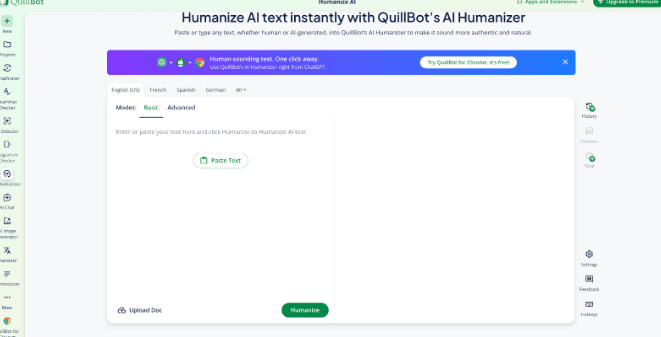
QuillBot has been a trusted name in paraphrasing for years, and its dedicated AI Humanizer builds on that foundation. The standout convenience feature is the Chrome extension, which lets you humanize text directly inside ChatGPT, Gemini, or Google Docs without switching tabs.
It supports four English dialects (US, UK, AU, CA) along with Spanish, German, French, and Portuguese. In our test, the free version reduced GPTZero scores to around 35%, while the Premium Advanced mode pushed that down to roughly 19%. The output reads smoothly, though it occasionally plays things too safe and produces overly simplified sentences.
If you already use QuillBot for everyday paraphrasing, adding the humanizer to your workflow feels seamless. The Premium plan starts at around $20 per month, and the browser integration alone is a strong selling point for creators who work inside AI chat interfaces all day.
Verdict: 7.5/10. A solid all rounder with great browser integration. Premium mode delivers good detection scores, but the free tier is too limited for serious use.
3. Grammarly AI Humanizer
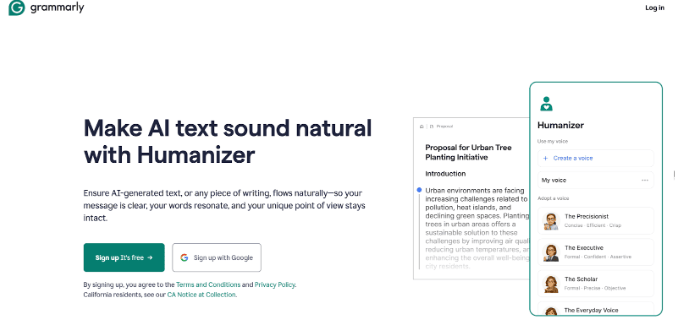
Grammarly entered the AI humanization space by leveraging its decade of experience in language processing. The most unique feature here is voice matching: you paste a writing sample, and the Humanizer agent learns your personal tone and applies it to future rewrites.
It supports six languages and offers four preset rewriting styles. In our testing, it brought GPTZero scores down to approximately 22% and Originality.ai to around 26%. The output quality is polished and professional, which makes it especially useful for business writing and formal content.
However, the humanizer works best as part of the full Grammarly ecosystem rather than a standalone product. If you are not already a Grammarly user, the value feels limited compared to dedicated humanizer tools. The free tier also restricts how many rewrites you can run per day.
Verdict: 7/10. Excellent voice matching feature and polished output. Best suited for users already inside the Grammarly ecosystem. Not ideal as a standalone humanizer.
4. Jasper AI
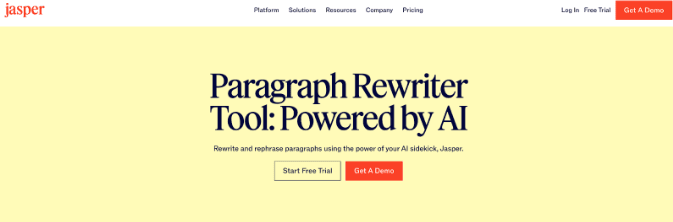
Jasper continues to be one of the most popular AI writing platforms for marketing teams and agencies. It excels at generating original long form content, ad copy, product descriptions, and campaign messaging using customizable brand voice profiles and over 50 use case templates.
Where Jasper shines is ideation and first draft creation at scale. If your team produces 50 or more pieces of content per month, Jasper pays for itself quickly. The workflow features and team collaboration tools are genuinely useful for high volume marketing operations. Jasper recently improved its SEO integration, allowing users to optimize content for target keywords during the drafting stage.
That said, Jasper is a content generation tool, not a rewriting or humanizing tool. We did not run it through our AI detection test because that is not its intended purpose. If your main goal is to humanize AI text or bypass detection tools, you will need to pair Jasper with a dedicated rewriter like SuperHumanizer or QuillBot.
Verdict: 7.5/10. One of the best AI content generators for marketing teams. Not designed for humanization, but excellent at producing strong first drafts that need less rewriting.
5. Writesonic
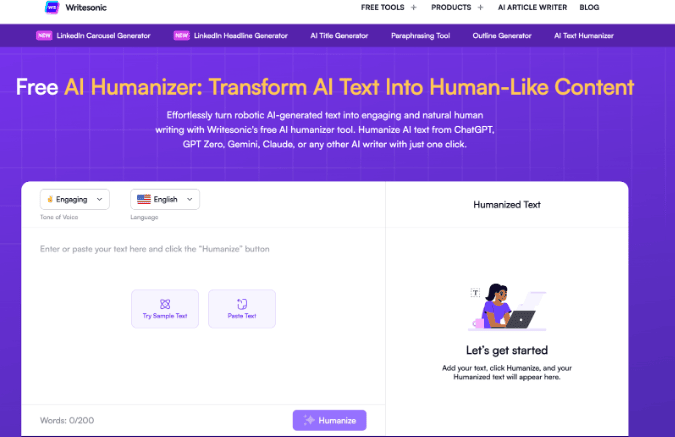
Writesonic positions itself as an all in one AI writing assistant with tools for blog posts, landing pages, ad copy, and an AI chatbot called Chatsonic that can pull real time data from the web. The platform recently added a Brand Voice feature and improved its SEO optimization tools, including integration with Surfer SEO.
For first draft generation, Writesonic delivers decent quality at competitive pricing starting around $16 per month. If you frequently write data driven or news based content, the Chatsonic feature is a genuine time saver since it pulls real time information directly into your drafts. However, its rewriting and paraphrasing capabilities are basic compared to dedicated humanizers.
When we ran Writesonic’s paraphrased output through our detectors, GPTZero still flagged it at around 52% AI. It works best as a content creation starting point rather than a finishing tool for making AI text undetectable.
Verdict: 6.5/10. A decent content generation platform with useful research features via Chatsonic. Weak on humanization and AI detection bypass. Best paired with a separate rewriting tool.
6. Copy.ai
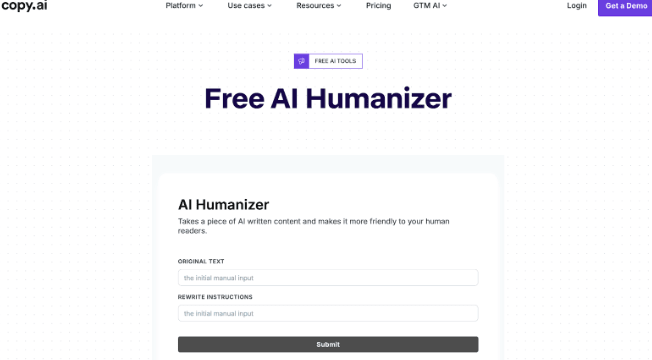
Copy.ai has evolved significantly from its early days as a short form copy generator. The platform now focuses heavily on go to market workflows with features designed for sales outreach, marketing operations, and automated content pipelines. Its workflow builder lets you connect writing tasks to CRM data and campaign triggers, which is a genuine differentiator for B2B teams.
For short form content like cold emails, social media posts, and product descriptions, Copy.ai is fast and efficient. The free plan includes 2,000 words per month, and the Pro plan at $49 per month unlocks unlimited words and workflow automations.
For long form rewriting or AI detection bypass, Copy.ai is not the right fit. Its built in paraphrasing handles surface level rewording but does not restructure content deeply enough to consistently fool AI detectors. In our test, output still registered around 58% AI on GPTZero. If humanization is your priority, pair it with a dedicated tool.
Verdict: 6/10. Strong for sales and marketing automation workflows. Not built for humanization or AI detection bypass. Best used for short form content at scale.
7. Wordtune
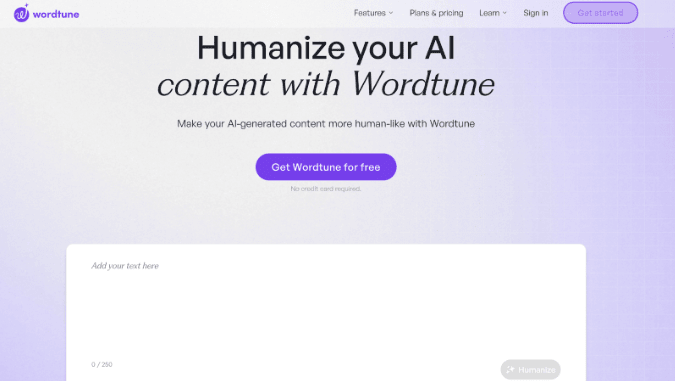
Wordtune takes a different approach from most tools on this list. Rather than generating content from scratch or doing full document rewrites, it works at the sentence level, offering multiple alternative phrasings for each line you highlight.
The tool supports contextual rewrites with tone switching between casual and formal, sentence shortening and expanding, and a “Spices” feature that can inject analogies, statistics, or counterarguments into your writing. It also includes a summarizer capable of handling long PDFs, and a Chrome extension that works inside Google Docs, Gmail, and Slack.
In our testing, Wordtune’s rewritten output brought GPTZero scores down to around 32%. That is not as strong as dedicated humanizers, but it is worth noting that Wordtune’s real strength is refinement rather than full humanization. The free plan includes 10 rewrites per day, and Premium starts at around $10 per month billed annually.
Verdict: 7/10. The best sentence level rewriting tool we tested. Ideal for polishing drafts and adjusting tone, but not powerful enough for full AI detection bypass on its own.
Quick Comparison: How Each Tool Performed
Short on time? Here is the full comparison at a glance. Scores reflect the GPTZero AI detection percentage after processing the same 500 word sample.
| Tool | Best For | Free Plan | GPTZero Score (After) | Originality Score (After) | Rating |
|---|---|---|---|---|---|
| SuperHumanizer | Full humanization | Yes (unlimited) | ~8% AI | ~11% AI | 9/10 |
| QuillBot (Premium) | Quick rewrites | Yes (limited) | ~19% AI | ~23% AI | 7.5/10 |
| Grammarly | Voice matching | Yes (limited) | ~22% AI | ~26% AI | 7/10 |
| Jasper | Original content | Trial only | Not tested | Not tested | 7.5/10 |
| Writesonic | Blog drafts and ads | Yes (limited) | ~52% AI | ~48% AI | 6.5/10 |
| Copy.ai | Sales and marketing copy | Yes (limited) | ~58% AI | ~54% AI | 6/10 |
| Wordtune | Sentence level rewriting | Yes (limited) | ~32% AI | ~35% AI | 7/10 |
Which AI Writing Tool Should You Actually Use?
There is no single tool that handles every part of the content workflow perfectly. Your best pick depends on where you need the most help.
If your main challenge is making AI generated content sound human and pass AI detectors, SuperHumanizer delivered the best results in our testing by a clear margin. It is free, requires no account, and consistently produced undetectable AI writing across both detectors we used.
If you need to generate original content from scratch, Jasper and Writesonic are strong starting points for marketing teams. And if you want an everyday writing assistant with humanizing built in, QuillBot and Grammarly both deliver solid value, especially if you are already paying for their ecosystems. Wordtune is the best pick if your focus is on refining individual sentences rather than full document rewrites.
For an academic use case specifically, Proofademic’s free AI detector for academia is worth checking separately, since it’s built around flagging AI-written student and academic submissions rather than general marketing copy.
For the best results, consider a two tool approach: use a content generator for your first draft, then run it through a dedicated humanizer before publishing. That combination consistently produced the most natural, undetectable content in our testing.
How to choose the right AI writing and rewriting tool
The best AI writing and rewriting tool depends on what kind of work you need done most often. Some people need quick sentence cleanup. Others need full paragraph rewrites, tone changes, readability improvements, or a way to turn one rough draft into several usable versions. That is why it helps to choose based on workflow, not hype.
If your main job is polishing AI drafts, a rewriting or humanizer tool may be enough. If you create larger volumes of content, an AI writing platform with ideation, drafting, repurposing, and editing features may save more time. The strongest choice is the one that helps you move from idea to publishable content with fewer manual steps.
Best use cases for AI rewriting tools
AI rewriting tools are most useful when the original draft already has the right direction, but the writing needs help. That could mean making text sound more natural, simplifying awkward phrasing, shortening sections, improving flow, or adapting copy for a different audience.
This makes them especially useful for blog updates, landing page refreshes, ad copy variations, newsletter rewrites, and content repurposing. A strong rewriter does not just swap words. It helps reshape the content so it becomes easier to read and more aligned with the goal of the page.
AI writing tools vs AI rewriting tools
AI writing tools and AI rewriting tools overlap, but they are not always the same thing. AI writing tools are often built to help you generate content from scratch. They support brainstorming, outlining, drafting, and expanding ideas into full pieces of content. For students, this can also mean using AI tools to generate essay papers from a clear prompt or outline, then editing the draft for accuracy, structure, and their own voice.
AI rewriting tools are more focused on improving existing text. They are built for rewording, simplifying, humanizing, changing tone, or making content read more naturally. For many content teams, the best setup is not choosing one or the other. It is using both at different stages of the workflow.
What marketers should look for beyond basic rewriting
For marketers, the real value is not just whether a tool can rewrite a paragraph. It is whether the output is useful enough to plug into a larger content system. That means looking for tools that help with tone control, content repurposing, readability, workflow speed, and adaptation across channels.
A tool becomes much more valuable when it can help you turn a blog section into social copy, an email intro, a product page paragraph, or a clearer CTA. That is where AI marketing teams gain the most leverage. The goal is not only better sentences. It is faster campaign execution with stronger consistency.
How AI writing and rewriting tools fit into AI marketing workflows
AI marketing teams often need to create more content than one person can draft manually at a high speed. That is why writing and rewriting tools work best when they are part of a broader content engine. One article can become multiple assets when the workflow is set up well.
For example, a long-form article can be rewritten into LinkedIn posts, email copy, ad hooks, short-form scripts, and landing page sections. A rough draft can be sharpened for a different audience segment. A weak intro can be turned into several stronger alternatives. The best tools help teams move from one idea to many usable outputs without starting over each time.
Features that matter most in a real review
When comparing AI writing and rewriting tools, readers usually care about a few things more than anything else. They want to know whether the output sounds natural, how much editing is still needed, how fast the tool works, whether it supports tone changes, and how well it fits into a real publishing workflow.
That makes reviews more useful when they focus on everyday performance. Can the tool handle light cleanup and deeper rewrites? Does it keep the original meaning intact? Is it better for short-form copy, long-form content, or both? Can it support marketers who need production speed without ending up with flat, generic copy? Those are the questions that matter more than long feature lists.
When to use a dedicated humanizer and when to use a broader AI platform
A dedicated humanizer can be a smart option when your main problem is stiff, robotic, or overly obvious AI copy. If you are looking to humanize ai text, a focused tool can do the job quickly without changing the meaning of your content. If the draft is mostly finished and just needs smoothing, humanizing, or a more natural rhythm, a focused tool can do the job quickly.
A broader AI platform makes more sense when rewriting is only one part of a larger workflow. If you also need content ideation, SEO drafting, campaign variations, repurposing, and workflow support, a wider platform may give you more value. The best choice depends on whether you are solving a writing problem or building a repeatable content system.
What AI writing and rewriting tools actually do
AI writing tools help create, edit, improve, or repurpose written content.
They can support many marketing tasks, including:
- Blog post outlines
- First drafts
- SEO titles
- Meta descriptions
- Landing page copy
- Ad copy
- Social media captions
- Email subject lines
- Newsletter drafts
- Product descriptions
- Video scripts
- Content summaries
- Tone adjustments
- Grammar improvements
- Sentence rewrites
- Content repurposing
- Prompt-based editing
AI rewriting tools are usually more focused on improving existing text. They can help make copy clearer, shorter, more persuasive, more conversational, more formal, or easier to read.
For example, a rewriting tool can turn a rough paragraph into a cleaner version. A writing tool can help create the first version from a prompt. A grammar tool can polish the final text. A brand voice tool can help the whole team stay consistent.
The best setup often uses more than one type of AI writing tool.
The main types of AI writing tools
Not all AI writing tools should be judged the same way.
A tool built for quick rewriting is different from a tool built for long-form content strategy. A tool built for enterprise content governance is different from a tool built for solo creators.
Common categories include:
General AI writing assistants
These tools help with brainstorming, drafting, rewriting, summarizing, and editing across many formats.
AI rewriting and paraphrasing tools
These tools focus on improving existing text, changing tone, simplifying wording, or creating alternative versions.
Grammar and editing assistants
These tools help improve clarity, correctness, tone, punctuation, and readability.
SEO content tools
These tools help create search-focused outlines, optimize content structure, suggest related topics, and improve on-page copy.
Brand voice and team writing platforms
These tools help teams write consistently across channels, often with brand rules, style guides, workflows, and governance features.
AI marketing copy tools
These tools focus on ads, emails, social posts, landing pages, product copy, and campaign assets.
The right tool depends on whether your biggest problem is speed, quality, consistency, SEO, editing, or team collaboration.
Best AI writing tools for marketing content
Marketing teams need AI writing tools that can support many content types.
A strong marketing AI writing tool should help with:
- Campaign ideas
- Blog content
- Email copy
- Social media posts
- Ad copy
- Landing pages
- Product messaging
- Video scripts
- Content repurposing
- Brand voice consistency
- Content briefs
- Calls to action
For marketers, flexibility matters. One campaign may require a blog post, email sequence, LinkedIn post, YouTube description, landing page, and ad variation. AI can help turn one core idea into multiple assets faster.
But quality still depends on the input.
Better prompts should include:
- Audience
- Goal
- Channel
- Offer
- Tone
- Format
- Key message
- Examples
- What to avoid
- Call to action
Instead of asking an AI tool to “write a blog post,” give it the strategy behind the piece. The clearer the input, the better the output.
Best AI rewriting tools for improving existing content
AI rewriting tools are useful when the idea is already there, but the writing needs work.
They can help improve:
- Clarity
- Flow
- Tone
- Sentence structure
- Readability
- Conciseness
- Persuasiveness
- Formality
- Grammar
- Repetition
AI rewriting is especially helpful for marketers who already have rough drafts, old blog posts, landing pages, emails, or product descriptions that need to be improved.
For example, you can use AI rewriting tools to:
- Make a paragraph more conversational
- Shorten a long introduction
- Turn formal copy into friendlier copy
- Rewrite a weak CTA
- Improve a product description
- Create multiple ad copy variations
- Simplify technical language
- Repurpose a blog section into a social post
The best rewriting tools do not only swap words. They help improve the message.
A good rewrite should keep the meaning, improve the clarity, and match the brand voice.
Best AI tools for SEO content writing
SEO content requires more than keyword placement.
A good AI SEO writing workflow should help teams understand search intent, structure the page clearly, answer important questions, and create content that is actually useful.
AI SEO tools can help with:
- Topic research
- Content outlines
- Search intent mapping
- Meta titles
- Meta descriptions
- FAQ sections
- Content refreshes
- Internal linking ideas
- Semantic topic coverage
- Competitor content analysis
- Brief creation
- Draft improvement
AI can speed up SEO writing, but it should not replace editorial judgment. Search-focused content still needs accurate information, real expertise, clear structure, examples, and helpful answers.
For SEO content, use AI to support:
- Planning
- Drafting
- Rewriting
- Optimization
- Repurposing
- Updating
Do not use AI to create shallow pages at scale. That usually leads to content that feels repetitive, thin, and easy to ignore.
Best AI tools for brand voice consistency
Brand voice is where many AI writing workflows break.
One blog post sounds polished. Another sounds robotic. A social post sounds too casual. An email sounds like a generic template. Over time, the brand starts to feel inconsistent.
AI tools with brand voice features can help teams write more consistently.
Strong brand voice features may include:
- Saved tone settings
- Style guide rules
- Approved terminology
- Blocked words
- Audience profiles
- Reusable prompts
- Team templates
- Content examples
- Approval workflows
- Workspace settings
Brand voice matters because content is not only about information. It is also about recognition and trust.
A clear brand voice helps your audience feel like every blog post, email, landing page, and social post came from the same business.
Best AI tools for rewriting blog posts
Rewriting blog posts with AI can help improve old content without starting from scratch.
This is useful when a post has good ideas but weak structure, outdated examples, thin sections, poor intros, or unclear SEO intent.
AI can help rewrite blog posts by improving:
- Introductions
- Subheadings
- Transitions
- Section depth
- Examples
- FAQ sections
- Meta descriptions
- Readability
- Calls to action
- Content summaries
- Internal link context
A strong AI blog rewriting workflow looks like this:
- Review the current post
- Identify weak sections
- Compare the content to search intent
- Rewrite the intro
- Expand thin sections
- Add missing questions
- Improve headings
- Add examples
- Check facts
- Review tone
- Optimize the CTA
This is often more valuable than generating a completely new article because you can preserve what already works while improving what holds the page back.
Best AI tools for email and social media copy
AI writing tools are especially useful for short-form marketing content.
Email and social media both require frequent content creation, fast testing, and many message variations. AI can help teams create more options without starting from a blank page every time.
AI can help with:
- Email subject lines
- Preview text
- Newsletter intros
- Promotional emails
- Lead nurturing emails
- LinkedIn posts
- Instagram captions
- X posts
- Facebook posts
- YouTube descriptions
- Short-form video scripts
- Social ad copy
- Content repurposing
For example, a blog post can become:
- A LinkedIn carousel script
- A short email newsletter
- A social media thread
- A YouTube description
- A short video voiceover
- An ad copy test
- A sales follow-up email
The best AI tools for short-form copy make it easy to test angles, shorten text, adjust tone, and create variations for different audiences.
Best AI tools for teams and content workflows
AI writing tools become more powerful when they fit into the whole content process.
For teams, the tool should support more than individual drafting. It should help with collaboration, consistency, approvals, and content reuse.
Useful team features include:
- Shared workspaces
- Brand voice controls
- Prompt libraries
- Content templates
- User permissions
- Approval workflows
- Commenting
- Content folders
- Integrations
- Version history
- Security controls
- Team analytics
A solo creator may only need a simple writing assistant. A marketing team may need a system that helps everyone write in a consistent way, keeps drafts organized, and reduces review time.
This is where the best AI writing platforms become part of the marketing workflow, not just another writing tab.
How to review AI writing tools before choosing one
A useful AI writing tool review should go beyond features.
Test each tool with real content tasks your team already does.
For example, ask the tool to:
- Rewrite a weak blog intro
- Create five email subject lines
- Turn a blog post into LinkedIn posts
- Summarize a long article
- Improve a landing page section
- Create a product description
- Write a meta description
- Adjust tone for a different audience
- Create a campaign outline
- Improve clarity without changing meaning
Then compare the output based on:
- Accuracy
- Usefulness
- Readability
- Brand fit
- Originality
- Editing time needed
- Prompt control
- Workflow speed
- Consistency
- Practical value
The best tool is not always the one that creates the longest answer. It is the one that gets you closest to publish-ready content with the least cleanup.
AI writing tools still need human editing
AI can write quickly, but speed does not guarantee quality.
Human editing is still needed to check:
- Accuracy
- Search intent
- Brand voice
- Claims
- Examples
- Tone
- Originality
- Compliance
- Structure
- Readability
- Customer fit
AI can sound confident even when the answer is incomplete or incorrect. It can also produce content that feels smooth but says very little.
Human editing turns AI output into business-ready content.
A strong editor should ask:
- Is this useful?
- Is this accurate?
- Is this specific enough?
- Does this sound like our brand?
- Does this answer the reader’s real question?
- Can we add proof, examples, or experience?
- Does this content help the reader take the next step?
The best AI writing workflows treat AI as a creative assistant, not a final publisher.
Build a better AI writing workflow
A good AI writing workflow helps teams create faster without lowering quality.
Start with a clear goal.
What should the content achieve?
Define the audience.
Who is reading it, and what do they need?
Add context.
Give the AI tool your offer, tone, examples, source material, and key points.
Create the first draft.
Use AI to generate structure, ideas, or rough copy.
Rewrite for clarity.
Improve weak sections, shorten long paragraphs, and remove vague language.
Add expertise.
Include examples, customer insight, proof, and stronger positioning.
Check facts.
Review claims, links, stats, and recommendations.
Optimize for the channel.
A blog post, email, ad, and social post should not sound the same.
Review brand voice.
Make the final version sound like your business.
Publish and improve.
Use performance data to update, repurpose, and improve content over time.
This workflow helps teams get the speed of AI without losing the judgment that makes content valuable.
What makes an AI writing tool worth using?
A good AI writing tool should help you create better content, not just more content.
The real value is not only in generating words. It is in reducing friction across the content process.
A strong tool helps you:
- Start faster
- Rewrite weaker sections
- Create more variations
- Repurpose content
- Improve clarity
- Stay on brand
- Support SEO workflows
- Collaborate with your team
- Save time on repetitive tasks
- Improve content quality
AI writing and rewriting tools are most useful when they support a clear marketing strategy.
If your messaging is weak, AI may make weak messaging sound more polished. If your strategy is strong, AI can help you turn that strategy into more useful content across more channels.
Final Thoughts
The AI writing tool market in 2026 is crowded, but the gap between average tools and genuinely effective ones is wider than most people realize. The tools that stand out are the ones that go beyond basic synonym swapping and actually understand how natural human writing flows.
Pick two or three tools from this list, run your own content through them, and check the results against a detector yourself. Real data from your own tests will always tell you more than marketing pages or review articles, including this one.
The goal is not to trick anyone or game a system. It is to produce content that genuinely serves your audience, reads naturally, and reflects your unique voice. The right tool just helps you get there faster and more consistently.
FAQ
What are AI writing and rewriting tools?
AI writing tools help create new content from prompts or outlines, while AI rewriting tools improve existing text by changing tone, wording, clarity, or structure.
What is the difference between an AI writer and an AI rewriter?
An AI writer is designed mainly for generating content from scratch. An AI rewriter is used to improve or reshape text that already exists.
Are AI rewriting tools good for marketers?
Yes. They are useful for refreshing blog content, rewriting landing page copy, adapting content for different channels, and turning rough drafts into cleaner reader-facing assets.
What should I look for in an AI rewriting tool?
Look for natural-sounding output, strong readability, good tone control, reliable meaning preservation, and a workflow that fits how you actually create content.
Can AI rewriting tools help with SEO content workflows?
Yes. They can help improve readability, refresh older pages, repurpose sections into new formats, and create faster content production workflows for marketing teams.
Should I choose a dedicated humanizer or a broader AI writing platform?
Choose a dedicated humanizer if your main goal is making drafts sound more natural. Choose a broader platform if you also need ideation, drafting, repurposing, and campaign content support.
Other Interesting Articles
- AI LinkedIn Post Generator
- Gardening YouTube Video Idea Examples
- AI Agents for Gardening Companies
- Top AI Art Styles
- Pest Control YouTube Video Idea Examples
- Automotive Social Media Content Ideas
- Plumber YouTube Video Idea Examples
- AI Agents for Pest Control Companies
- Electrician YouTube Video Idea Examples
- How Pest Control Companies Can Get More Leads
- AI Google Ads for Home Services
- 60-Second Training Videos Are the New Corporate Standard
- Cybersecurity PR Pricing: Retainers, Deliverables & ROI
- Best AI Tools for Product Consistency in E-Commerce Video
Master the Art of Video Marketing
AI-Powered Tools to Ideate, Optimize, and Amplify!
- Spark Creativity: Unleash the most effective video ideas, scripts, and engaging hooks with our AI Generators.
- Optimize Instantly: Elevate your YouTube presence by optimizing video Titles, Descriptions, and Tags in seconds.
- Amplify Your Reach: Effortlessly craft social media, email, and ad copy to maximize your video’s impact.