
AI Applicant Tracking Systems: How They Improve Recruitment

Recruiting teams are under pressure from both sides.
On one side, they need to move faster. Job openings attract more applications, candidates expect quick responses, hiring managers want shortlists yesterday, and recruiters are often stuck doing repetitive admin instead of actual relationship-building.
On the other side, hiring decisions are too important to automate blindly. A bad screening process can reject strong candidates, damage the employer brand, create legal risk, or quietly reinforce bias at scale.
That is why AI applicant tracking systems are becoming a major part of modern recruitment.
An applicant tracking system, or ATS, helps companies collect applications, organize candidates, manage hiring stages, schedule interviews, communicate with applicants, and report on recruiting performance. When AI is added, the system may also support resume parsing, candidate matching, automated screening, chatbot conversations, job description improvements, interview scheduling, analytics, and workflow recommendations.
The value is not that AI replaces recruiters.
The value is that AI can remove repetitive work, help recruiters spot patterns faster, improve candidate communication, and give hiring teams a more structured way to compare applicants.
But AI in recruitment needs guardrails. It should be used with clear criteria, human oversight, transparency, accessibility planning, data protection, and regular monitoring.
This article explains how AI applicant tracking systems improve recruitment efficiency, which features matter most, where the risks are, and how companies can use AI in hiring without turning the process into a black box.
Chapters
- What is Applicant Tracking System? Brief overview
- AI ATS vs. Traditional ATS
- AI-powered ATS: Benefits you can count on
- Where AI Actually Improves Recruitment Efficiency
- AI ATS Features That Matter Most
- AI Applicant Tracking System Evaluation Checklist
- Risks of AI in Applicant Tracking Systems
- How to Use AI ATS Tools Responsibly
- Metrics to Track When Using an AI ATS
- Vendor Questions to Ask Before Buying an AI ATS
- How StoryLab.ai Can Support Recruitment Marketing Content
- Conclusion
- FAQ
What is Applicant Tracking System? Brief overview

So, originally just a place to store resumes, ATS platforms have evolved into comprehensive recruiting hubs where all the essential hiring processes happen.
If you look at the modern applicant tracking system design, you will see that it is already a dynamic, intelligent platform where the following processes take place:
- Applications are sorted,
- Each individual resume is reviewed
- Real-time communication with candidates takes place
- Interviews are scheduled and coordinated with all parties involved, and many other processes.
When it comes to the advanced Applicant Tracking System (ATS), all the key processes are here under one roof. As a result, everyone wins:
- Companies, because they get truly qualified and relevant candidates
- Recruiters, because they can now increase their efficiency
- Job seekers, because they get quick feedback from a potential employer.
However, the way AI is revolutionizing application tracking systems and the hiring process in general deserves more attention. So let’s take a closer look at these ATS benefits.
Common AI ATS features include:
- Resume parsing
- Candidate matching
- Keyword and skills analysis
- Automated candidate ranking
- Chatbot screening
- Interview scheduling
- Candidate communication
- Job description suggestions
- Talent pool recommendations
- Workflow automation
- Recruiting analytics
- Pipeline forecasting
- Bias monitoring features
- Candidate engagement scoring
The key word is support.
An AI ATS should help recruiters review, prioritize, and manage candidates. It should not become an invisible decision-maker that nobody can explain or challenge.
AI ATS vs. Traditional ATS
| Area | Traditional ATS | AI-Powered ATS |
|---|---|---|
| Application storage | Stores resumes, forms, notes, and candidate records | Stores candidate records and may automatically extract skills, experience, and qualifications |
| Resume review | Recruiters manually search, filter, and review applications | AI can parse resumes, detect matching skills, and suggest candidates to review first |
| Candidate communication | Recruiters send emails and updates manually or through templates | AI chatbots and automated workflows can answer basic questions and send status updates |
| Scheduling | Recruiters coordinate calendars manually | Automated scheduling tools can suggest slots and reduce back-and-forth emails |
| Matching | Matching depends on manual review, filters, and keyword searches | AI can compare skills, experience, requirements, and previous hiring patterns |
| Analytics | Reports often focus on pipeline status and basic hiring metrics | AI may help identify bottlenecks, drop-off points, candidate quality signals, and workload patterns |
| Risk | Manual inconsistency, slow workflows, and limited visibility | Bias at scale, overreliance on scores, lack of transparency, and data protection concerns |
AI-powered ATS: Benefits you can count on
According to statistics, AI in recruiting is most commonly used for tasks such as resume screening and candidate matching.
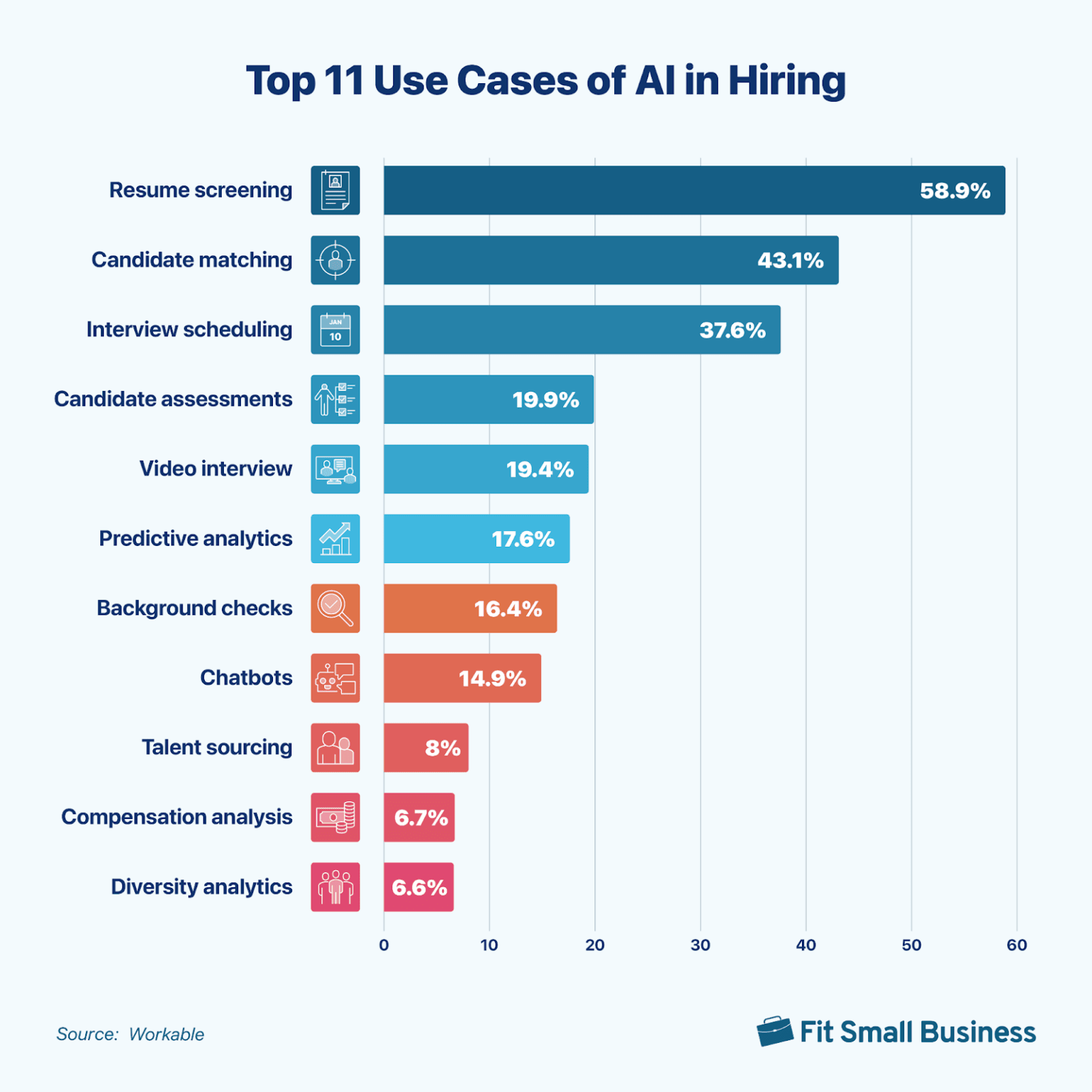
Source: https://fitsmallbusiness.com/ai-hiring-trends-and-statistics/
These operations, when performed manually, have traditionally been the most time-consuming and error-prone. It’s hard to deny the human factor here, as recruiters can get tired and miss out on a valuable candidate due to fatigue. This is a good reason to automate the process of reviewing resumes. The solution? An AI applicant tracking system, the business benefits of which we will now explore.
Candidate sourcing becomes more useful
Don’t just take our word for it, consider this: 58% of recruiters who use AI for hiring say it’s especially helpful for finding candidates. This is largely because of the advanced algorithms and analytics that AI uses. Plus, chatbots are a big part of the process. They can quickly answer candidate questions, keeping the conversation going and helping candidates feel more connected to the company. This engagement can really boost their loyalty!
What’s more, you can assign a chatbot to answer similar, repetitive, common questions while recruiters focus on more substantive conversations with the best candidates. To optimize your ATS for candidate sourcing, ask ChatGPT for advice, or better yet, create your own ChatGPT to make it an even more personalized helper for you. It seems that in today’s reality, it’s hard to do without the use of AI capabilities.
Candidates are selected quickly and accurately
One of the coolest things about AI is how it can tirelessly and efficiently sift through tons of data. When integrated into an ATS, it scans countless resumes and compares their details to your job descriptions and company culture. This helps you find candidates who are a great fit based on solid data, making the hiring process much more effective. And it’s not just about keywords. If only it were that simple! No, AI goes further and analyzes:
- Candidate sentiment,
- Their experience,
- Their preferences,
- Even their writing style.
Based on the data collected, AI can predict how well a particular personality will fit into a particular role and how long a candidate might stay with the company. This is why recruiters use AI-based applicant tracking systems to hire. Many job seekers now rely on an interview copilot, AI tools that provide real-time guidance during interviews, while AI helps recruiters. AI helps them make informed decisions that ultimately help reduce employee turnover. Let’s face it: rushing to hire the wrong candidate will lead to layoffs. And every layoff is costly to the employer and damaging to the company’s reputation. That’s why there’s so much hype around AI ATSs.
Recruiting becomes less biased
Despite the growing trend towards more diverse teams, there are still situations in hiring, often unconsciously, where people of certain nationalities, diasporas, ages or backgrounds are overlooked and the team becomes less diverse. This is a problem. How can it be solved? One proven way is to set up your applicant tracking system to ignore or disregard a candidate’s age, gender, nationality, or other characteristics, and instead evaluate only and exclusively the professional qualities and experience of potential employees. This approach is a game changer. It can and will be part of a consistent brand messaging to candidates and the market as a whole. Recruiting cannot be considered in isolation from brand values and culture, so with an AI-powered ATS, you have the opportunity to make unbiased hiring part of consistent branding. By the way, according to Phenom’s annual State of Candidate Experience Benchmarks Report, only 12% of Fortune 500 companies have consistent branding throughout the hiring process.
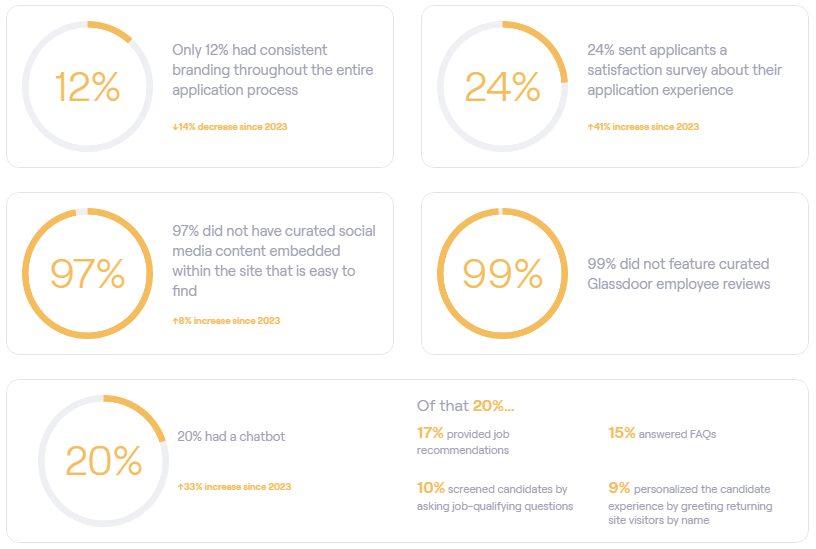
Source: https://stateofcx.phenom.com/KeyFindingsEngagement
Reduced time from posting to hiring
As we mentioned earlier, AI really transforms candidate sourcing and hiring by saving recruiters a lot of time. Modern ATS platforms automate tasks like sourcing and screening, and chatbots handle real-time communication, making everything smoother. This means your business can get more done in less time – quickly crafting job descriptions and sharing ads across multiple platforms at once! What’s more, this tool even suggests effective content ideasfor your job descriptions to attract the attention of as many great candidates as possible. With artificial intelligence, your recruiters can win the battle for the best minds.
Candidate experience is taken to a whole new level
As an employer or recruiter, you may not like it, but it’s an undeniable fact: candidates are evaluating you and whether they like you during the hiring process. So you’re not the only one deciding who to hire. Candidates also decide whether to accept your terms and conditions. They also evaluate the quality of your communication and hiring process. And guess what? Only 1 in 4 candidates are satisfied with the talent acquisition process. At the same time, only 11% of employers care whether candidates are satisfied with the hiring process. Ignoring the candidate’s experience is a big mistake. Instead, it should be a priority. What’s more, you can improve these numbers with the help of AI-enabled ATS platforms. This tool will do the following
- Respond to every candidate request and not leave it unanswered;
- Provide candidates with a response on the results of the interview faster (instead of the average 23 days – in one week);
- Make the employer (you) look good by communicating well with candidates.
As you can see, the candidate’s experience is very important for the company, and with AI in ATS you will solve this problem almost seamlessly.
Where AI Actually Improves Recruitment Efficiency
AI improves recruitment efficiency when it removes bottlenecks that slow recruiters down, while salesforce alternatives like Recruit CRM can help recruitment teams manage candidate relationships and keep their hiring workflows organized.
It does not help when it adds another dashboard, another score, or another black-box recommendation that nobody trusts.
| Recruitment bottleneck | How AI ATS can help | Human responsibility |
|---|---|---|
| Too many applications to review manually | Parse resumes, identify relevant skills, and group candidates by role fit | Check whether screening criteria are job-related and fair |
| Slow candidate responses | Send automated updates, answer basic questions, and trigger next-step messages | Make sure communication is accurate, respectful, and not misleading |
| Scheduling delays | Offer self-service scheduling and coordinate calendars | Keep interview structure clear and accessible |
| Weak job descriptions | Suggest clearer wording, missing requirements, and more inclusive language | Confirm that the final description reflects the real role |
| Messy candidate pipelines | Flag stalled candidates, missing feedback, and hiring-stage bottlenecks | Follow up with hiring managers and keep the process moving |
| Talent rediscovery is manual | Surface past applicants who may fit new roles | Review whether the old candidate is still relevant and should be contacted |
| Inconsistent screening | Apply structured criteria across large applicant pools | Monitor outcomes and avoid overreliance on automated rankings |
The biggest efficiency gain often comes from small things happening faster:
- Fewer manual searches
- Fewer scheduling emails
- Fewer unanswered candidate questions
- Fewer candidates stuck in the wrong stage
- Faster shortlists
- Cleaner hiring-manager handoffs
- Better reporting
- Less duplicate data entry
That is useful.
But the recruiter should still understand how the shortlist was created.
AI ATS Features That Matter Most
Not every AI feature is equally useful.
Some features save real time. Others look impressive in a demo but create risk or extra work later.
1. Resume parsing
Resume parsing extracts information from resumes and turns it into structured fields.
Useful outputs may include:
- Name
- Contact details
- Work history
- Education
- Skills
- Certifications
- Languages
- Location
- Seniority
- Keywords
- Employment dates
The benefit is speed.
The risk is misreading non-standard resumes, unusual career paths, employment gaps, career changes, or candidates with different formatting.
Recruiters should test parsing accuracy before trusting automated screening.
2. Candidate matching
Candidate matching compares applicant profiles with role requirements.
A good matching system should explain why someone is considered a fit.
For example:
- Which required skills were found
- Which qualifications are missing
- Which experience matches the role
- Which requirements were treated as must-have
- Which signals were optional
- Which data source was used
A bad matching system gives only a score.
A score without an explanation is hard to audit, challenge, or improve.
3. Automated screening questions
Screening questions can reduce manual review time when they are tied to clear requirements.
Examples:
- Do you have the right to work in this country?
- Do you hold a required certification?
- Are you available for the required schedule?
- Do you have experience with a specific tool or process?
- Can you work from the required location?
The risk is using vague or overly strict knockout questions that reject qualified candidates too early.
A good rule: only use automatic rejection when the requirement is truly essential.
4. Candidate communication automation
AI and automation can help keep candidates informed.
This can include:
- Application received messages
- Next-step instructions
- Interview scheduling
- Reminder emails
- FAQ responses
- Status updates
- Rejection messages
- Talent pool follow-ups
This improves candidate experience when the messages are clear and timely.
It hurts candidate experience when it feels cold, confusing, or impossible to challenge.
5. Recruiting analytics
AI ATS tools can help teams see where the hiring process slows down.
Useful metrics include:
- Applications per role
- Qualified applicants per role
- Source quality
- Time to screen
- Time to interview
- Time to offer
- Candidate drop-off rate
- Interview no-show rate
- Offer acceptance rate
- Hiring-manager response time
- Diversity funnel metrics
- Rejection reasons
- Candidate experience feedback
Analytics are only useful when someone owns the follow-up action.
A dashboard does not fix a bottleneck by itself.
AI Applicant Tracking System Evaluation Checklist
Before buying or expanding an AI ATS, compare tools through the real recruitment workflow.
| Evaluation area | Questions to ask |
|---|---|
| Purpose | What recruitment problem are we trying to solve, and is AI appropriate for that problem? |
| Workflow fit | Does the tool support how recruiters and hiring managers actually work? |
| Explainability | Can recruiters understand why a candidate was ranked, flagged, or recommended? |
| Human oversight | Can humans review, override, and document decisions? |
| Bias monitoring | Can the system support audits for adverse impact or unfair outcomes? |
| Accessibility | Can applicants with disabilities request adjustments or use an alternative process? |
| Candidate transparency | Are candidates told when AI is used and how it affects the process? |
| Data privacy | How is candidate data collected, stored, processed, retained, and deleted? |
| Integration | Does the ATS connect with HRIS, email, calendar, job boards, onboarding tools, and reporting systems? |
| Security | What access controls, audit logs, encryption, and vendor security standards are in place? |
| Customization | Can criteria, workflows, templates, stages, and approval rules be adapted by role? |
| Reporting | Can the team measure time saved, quality of shortlist, source performance, and candidate experience? |
| Support | What training, documentation, onboarding, and implementation help does the vendor provide? |
The best question is not “Does it have AI?”
The better question is:
“Can we prove this AI feature improves the hiring process without creating unfair or unexplainable outcomes?”
Risks of AI in Applicant Tracking Systems

AI in ATS platforms can help recruiters, but it can also create serious problems when the tool is poorly configured, poorly monitored, or treated as more objective than it really is.
Bias at scale
AI systems may learn from historical hiring patterns.
If past hiring favored certain schools, career paths, companies, locations, communication styles, or employment histories, the system may copy those patterns.
That does not mean the tool is intentionally biased.
It means the tool may treat old patterns as signals of future success.
Recruiters should review whether screening criteria are truly job-related.
Proxy discrimination
Even if a system does not use protected characteristics directly, it may use proxy signals.
Examples can include:
- School names
- Zip codes
- Employment gaps
- Career breaks
- Names
- Hobbies
- Previous employer prestige
- Commute distance
- Language style
- Video interview signals
- Social media data
A proxy can look neutral while still creating unfair outcomes.
Accessibility barriers
AI hiring tools can create barriers for people with disabilities.
This can happen with chatbots, video interviews, timed assessments, personality tests, automated resume scoring, or tools that require specific input formats.
Recruiters should offer reasonable adjustments and alternative review paths where needed.
Automation bias
Recruiters may trust AI recommendations too much.
If a system ranks one candidate higher than another, people may assume the ranking is correct even when the underlying reasoning is weak.
Human review should be meaningful, not symbolic.
A recruiter who cannot challenge the AI output is not really supervising it.
Poor transparency
Candidates should understand when AI is used in the recruitment process and how it may affect them.
This matters for trust, fairness, accessibility, and contestability.
A candidate cannot ask for a correction, adjustment, or review if they do not know automation is involved.
Data protection risk
Recruitment data is sensitive.
AI ATS tools may process resumes, contact details, employment history, assessment results, interview notes, demographic information, communication history, and other personal data.
Companies need clear rules for:
- Data collection
- Data minimization
- Candidate consent where required
- Retention periods
- Deletion requests
- Vendor access
- International transfers
- Model training
- Audit logs
- Security controls
Efficiency should not come at the cost of candidate privacy.
How to Use AI ATS Tools Responsibly
A responsible AI ATS workflow starts before implementation.
1. Define the role criteria clearly
AI should evaluate candidates against job-related criteria.
Before using AI screening, define:
- Must-have requirements
- Nice-to-have requirements
- Skills that can be learned after hiring
- Certifications that are legally or operationally required
- Experience that is genuinely necessary
- Criteria that should not be used
- Criteria that could create unfair exclusions
Do this before candidate data enters the system.
2. Separate assistance from decision-making
AI can assist with:
- Summaries
- Skills extraction
- Matching suggestions
- Workflow alerts
- Scheduling
- Candidate communication
- Drafting job descriptions
- Reporting
Be more careful with AI when it:
- Rejects candidates automatically
- Ranks candidates
- Scores interviews
- Predicts culture fit
- Assesses personality
- Analyzes voice, facial expressions, or video behavior
- Uses social media or inferred traits
The closer the AI gets to deciding a person’s opportunity, the stronger the oversight should be.
3. Keep humans in the loop
Human oversight should be real.
That means humans can:
- See why the system made a recommendation
- Review candidates who were filtered out
- Override the system
- Document decisions
- Correct errors
- Escalate concerns
- Pause automation
- Update screening rules
- Offer alternative review paths
A human rubber-stamping an unexplained score is not enough.
4. Monitor outcomes over time
AI systems can drift.
A model or rule that appears reasonable at launch may perform worse after job requirements, candidate pools, market conditions, or hiring patterns change.
Monitor:
- Selection rates
- Rejection patterns
- Diversity funnel data
- Candidate complaints
- Candidate feedback
- Manual override rates
- False positives
- False negatives
- Source performance
- Hiring quality
- Time to hire
- Drop-off by stage
Responsible AI recruitment is not a one-time setup.
It is an ongoing process.
5. Make the candidate experience human
Automation should not make applicants feel ignored.
Use AI to respond faster, but keep the tone clear and respectful.
Candidates should know:
- Their application was received
- What the next step is
- Whether AI is used
- How to request an adjustment
- How to contact a human when needed
- When they can expect an update
- Whether they are still under consideration
A fast process is not automatically a good process.
A fair, clear, and respectful process is better.
Metrics to Track When Using an AI ATS
Recruitment efficiency should not be measured only by speed.
Hiring faster is useful only if the process remains fair, accurate, and candidate-friendly.
| Metric | What it measures | Why it matters |
|---|---|---|
| Time to screen | How long it takes to review applicants after they apply | Shows whether AI is reducing recruiter workload |
| Time to shortlist | How quickly qualified candidates reach hiring managers | Helps identify early-stage hiring bottlenecks |
| Time to hire | Total time from job opening to accepted offer | Tracks overall recruitment efficiency |
| Candidate response time | How quickly applicants receive updates | Improves candidate experience and employer brand |
| Qualified candidates per source | Which channels produce strong applicants | Improves sourcing and recruitment marketing decisions |
| Manual override rate | How often recruiters disagree with AI recommendations | Shows whether the tool is trusted and useful |
| False negative review | Strong candidates who were initially filtered out or ranked low | Helps identify overly strict screening rules |
| Candidate drop-off rate | Where applicants abandon the process | Shows friction in forms, assessments, scheduling, or communication |
| Adverse impact indicators | Whether outcomes differ meaningfully across protected groups where legally and appropriately measured | Supports fairness monitoring and compliance reviews |
| Offer acceptance rate | How often selected candidates accept offers | Shows whether speed, fit, communication, and employer brand are working |
| Quality of hire | Post-hire performance, retention, and hiring manager satisfaction | Connects recruiting efficiency with business outcomes |
A recruiting team should not celebrate faster screening if better candidates are being missed.
The goal is faster and better.
Vendor Questions to Ask Before Buying an AI ATS
AI hiring tools should be evaluated more carefully than ordinary productivity software.
The tool may affect real people’s access to jobs.
Ask the vendor:
- What AI features are included?
- Which features influence candidate ranking or screening?
- What data is used to make recommendations?
- Can we configure the criteria by role?
- Can recruiters see why a candidate was recommended or rejected?
- Can humans override AI outputs?
- Are rejected candidates available for manual review?
- How does the system handle employment gaps, career changes, and non-standard resumes?
- What bias testing has been performed?
- How often is the system tested after deployment?
- What documentation can you provide for legal, HR, and compliance teams?
- How does the system support accessibility and reasonable adjustments?
- Are candidates told when AI is used?
- Does the system support audit logs?
- Can we export decision data?
- Is candidate data used to train models?
- Where is candidate data stored?
- What happens when a candidate requests deletion?
- What integrations are available?
- What support is included during implementation?
- What happens if we stop using the platform?
Do not accept “our AI is unbiased” as an answer.
Ask for evidence, documentation, controls, and a clear explanation of how the system works in your hiring context.
How StoryLab.ai Can Support Recruitment Marketing Content
An AI applicant tracking system helps manage candidates once they enter the hiring process.
But companies still need strong recruitment content to attract the right people in the first place.
StoryLab.ai can support recruitment marketing teams by helping create:
- Job ad variations
- Employer brand posts
- LinkedIn captions
- Candidate nurture emails
- Hiring campaign ideas
- Interview invitation drafts
- Rejection email drafts
- Employee story outlines
- Career page copy
- Recruitment video hooks
- Social media content for open roles
- Follow-up messages for talent pools
This matters because better recruitment content can improve candidate quality before the ATS starts filtering.
A vague job description attracts vague applications.
A clear, specific, human job description helps candidates understand whether the role is right for them.
Recruitment content workflow
- Define the role and must-have requirements.
- Clarify the candidate persona.
- Draft a clear job description.
- Remove vague or inflated requirements.
- Check for biased or exclusionary language.
- Create role-specific social posts.
- Write candidate emails in a helpful tone.
- Align messaging with the employer brand.
- Track which channels attract qualified candidates.
- Improve the content based on applicant quality.
AI should make recruitment content clearer, not more generic.
Conclusion
AI applicant tracking systems can make recruitment faster, cleaner, and easier to manage.
They can help recruiters review resumes, match candidates, schedule interviews, communicate faster, rediscover talent, and understand pipeline performance.
But AI does not automatically make hiring fair.
A poorly governed AI ATS can scale old biases, create accessibility barriers, hide decision logic, frustrate candidates, and expose employers to risk.
The best approach is balanced.
Use AI for repetitive work. Use structured criteria for screening. Keep humans responsible for judgment. Tell candidates how automation is used. Monitor outcomes. Review vendor claims carefully. Measure both efficiency and fairness.
Recruitment is not only about filling roles faster.
It is about giving the right candidates a fair path into the process and helping hiring teams make better decisions with less wasted time.
FAQ
What is an AI-powered applicant tracking system?
It is a recruitment platform that uses AI to screen resumes, rank candidates, suggest job matches, and automate parts of the hiring workflow.
How does AI improve the screening process in ATS tools?
AI algorithms scan resumes for keywords, assess qualifications, analyze experience, and filter candidate pools based on job requirements and fit.
Can AI describe candidate match strength accurately?
Yes. By evaluating skill relevance, career history, and keyword alignment, AI helps hiring teams identify the strongest matches quickly.
How does AI reduce recruiter workload?
It automates repetitive tasks such as parsing resumes, scheduling interviews, tracking communication, and responding to applicants.
What features should you expect from an AI-enhanced ATS?
Look for resume parsing, candidate scoring, chatbot screening, predictive analytics, diversity insights, and integration with HR systems.
How does AI help limit bias in recruitment?
By anonymizing candidate data and scoring based on objective criteria AI reduces the influence of unconscious bias in early screening.
What metrics can AI-based ATS tools track?
Companies can monitor time to hire, candidate quality, response rates, diversity ratio, pipeline drop-off, and offer acceptance data.
Can AI support diversity hiring goals?
Yes. AI platforms help identify diverse candidate pools, avoid biased language in job descriptions, and track diversity metrics over time.
How does AI support automated outreach?
It can generate and send personalized interview invitations, follow-up emails, rejection notices, and nurture messages for top candidates.
Is candidate data protected in AI-enabled ATS tools?
Reputable platforms follow data protection standards, use encryption, and maintain access control to ensure candidate data is secure.
How does AI help improve candidate experience?
By speeding initial feedback, guiding applicants through each step, offering self-service scheduling, and sending timely updates on their status.
What role does machine learning play in upselling ATS performance?
Machine learning adapts over time based on hiring outcomes helping the system recommend better matching criteria and refine candidate rankings.
Can AI suggest improvements to job descriptions?
Yes. AI tools can analyze language patterns and recommend clearer, more inclusive job posting language that attracts better candidates.
How do ATS platforms integrate with existing HR systems?
They often link with HRIS, CRM, onboarding tools, email systems, calendar apps, and performance platforms to streamline hiring data flow.
How does AI-enhanced ATS support remote hiring processes?
It offers remote interview scheduling, virtual recruiter bots, online tests, and video interview analysis to streamline distributed hiring.
What are common challenges when implementing AI in recruitment?
Potential challenges include data training bias, user resistance, lack of human oversight, and integrating old HR data sources.
What is the ROI of using AI-based ATS?
Benefits often include faster time to hire, reduced manual recruiters time, higher quality candidates, improved hiring consistency, and cost savings.
How can companies assess if an AI-enhanced ATS fits their needs?
They should evaluate features like customization, integration options, reporting dashboards, user interface usability, vendor support, and enterprise scalability.
What are ethical considerations for using AI in hiring?
Organizations should ensure fairness, transparency, candidate consent, regular audits of decision criteria, and compliance with privacy laws.
How should organizations begin using AI-enhanced ATS?
Start by reviewing current hiring workflows, clearly define objectives and metrics, run a pilot with a small team, gather feedback, and scale gradually.
Other Interesting Articles
- AI LinkedIn Post Generator
- Gardening YouTube Video Idea Examples
- AI Agents for Gardening Companies
- Top AI Art Styles
- Pest Control YouTube Video Idea Examples
- Automotive Social Media Content Ideas
- Plumber YouTube Video Idea Examples
- AI Agents for Pest Control Companies
- Electrician YouTube Video Idea Examples
- How Pest Control Companies Can Get More Leads
- AI Google Ads for Home Services
- 60-Second Training Videos Are the New Corporate Standard
- Cybersecurity PR Pricing: Retainers, Deliverables & ROI
- Best AI Tools for Product Consistency in E-Commerce Video
Master the Art of Video Marketing
AI-Powered Tools to Ideate, Optimize, and Amplify!
- Spark Creativity: Unleash the most effective video ideas, scripts, and engaging hooks with our AI Generators.
- Optimize Instantly: Elevate your YouTube presence by optimizing video Titles, Descriptions, and Tags in seconds.
- Amplify Your Reach: Effortlessly craft social media, email, and ad copy to maximize your video’s impact.