
Examples of Great Automotive Blog Post Titles That Will Inspire You

Automotive blog titles can have a big impact on whether your content gets clicked or ignored. A strong headline helps readers quickly understand what the article is about, why it matters, and whether it matches what they are looking for. That matters in automotive content because search intent is often very specific. People look for buying advice, maintenance help, repair answers, model comparisons, EV updates, and ownership tips.
The best automotive blog titles do more than sound catchy. They make the topic clear, reflect search intent, and support genuinely useful content. Google recommends helpful, reliable, people-first content, and its title link guidance also emphasizes making page titles descriptive and useful for readers.
A good Blog Post Title is like a good logo or tagline. It’s an essential piece of writing that grabs readers’ attention and who needs to figure out if the content is worth their time to read it.
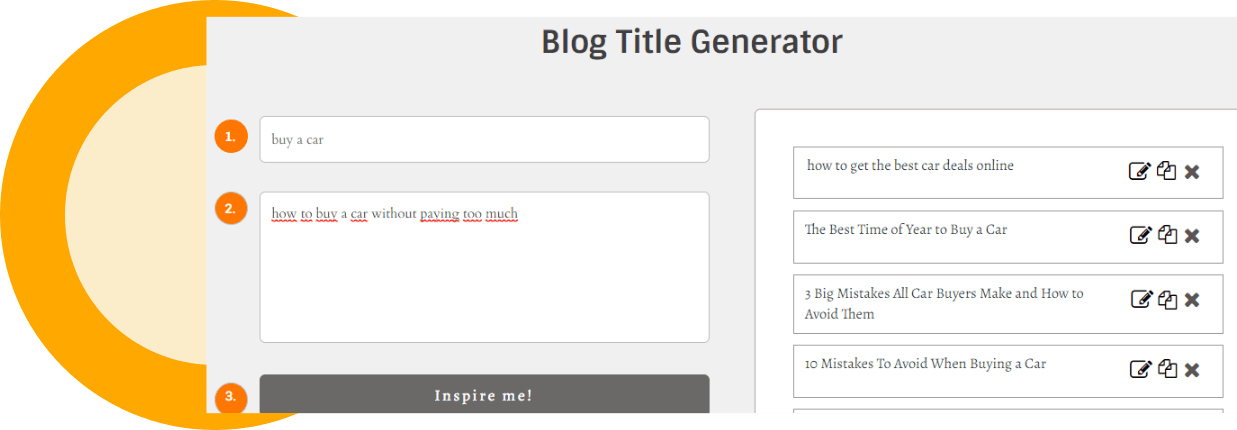
We’ve used our Blog Title Generator to create a nice list of Blog Title Examples for Automotive Websites to inspire you. In the image below, you can see how easy it is to input a topic and to get blog title ideas with a click of a button.
Check out the examples below and start creating your own with our free generator.
In this article
- Examples of Great Automotive Blog Post Titles
- Why Automotive Brands should run a Blog
- Top Digital Marketing Tools for Automotive Brands
- How do I Optimize my Blog Post Title for SEO?
- How AI can help create better automotive blog titles faster
- Automotive blog post title examples by content type
- What makes an automotive blog title more clickable
- How to use AI title generators without creating generic automotive headlines
- Automotive blog title formulas worth testing
- Why automotive blog titles should connect to a larger content workflow
- Why automotive blog titles now need to work for both search and AI discovery
- FAQ: Automotive Blog Post Title Examples
- More Resources For Automotive Content Creators
Examples of Great Automotive Blog Post Titles
- 7 Unique Ways to Make Your Car Standout
- 10 Stylish Cars You Should Know
- Top 10 Best Automotive Blogs and Magazines
- 7 Tips to Get Rid of that Bad Car Smell
- Facing the Road Ahead: Automotive Predictions for 2030
- 50 Most Amazing Cars of All Time
- The 10 Coolest Design Features on The New Tesla
- How to Choose a Car Insurance That Fits you Best
- 5 Must-Have Features in Your Next Car
- The Top 5 Rarest Car Brands of All Time
- 11 Things to Consider When Buying a New Car
- 7 ways to make your car’s fuel economy better
- 13 Lessons Learned From an Expensive Car Mistake
- The 10 Worst Cars Ever Built
- 5 Tips for Smarter Winter Driving
- 5 Steps to Planning an Epic Road Trip
- 11 Things To Do Before Buying A Used Car
- Top 5 Design Trends to Inspire Your Vehicle
- Top 12 cars for a First Date
- 10 Mistakes You are Making While Shopping for a New or Used Car
- You’ll Laugh When You See What This Guy Did With His Bugatti
- Five Ways to Spend Your Summer Vacation Driving Around
- What is the best custom car of all time?
- How To Choose The Right Car For You
- Top 10 cars to buy in 2022
- 5 Ways to Add More Value to Your Car
- 15 DIY Ways to Improve Your Car’s Aesthetics
- The Difference Between A Scratch And Dent Car
- What to Look out for When Buying and SUV in the US
- Top 10 Most Reliable Car Brands of All Time
- The Future of Cars: Electric, Autonomous, and Connected
- The Best Cars for Every Type of Driver and Budget
- The Top Car Brands of 2023: Who’s Leading the Race?
- The Benefits of Regular Car Maintenance and Service
- The Best Car Accessories and Gadgets to Upgrade Your Ride
- The Most Iconic Cars of All Time: From Classic to Modern
- The Top Luxury Cars of 2023: Style, Comfort, and Performance
- The Best SUVs and Crossovers for Family and Adventure
- The Most Fuel-Efficient Cars of 2023: Saving Money and the Environment
- The Importance of Choosing the Right Tires for Your Car
- The Best Sports Cars for Speed and Thrills
- The Top Muscle Cars of All Time: Power and Style
- The Best Pickup Trucks for Work and Play
- The Most Common Car Problems and How to Fix Them
- The Top Hybrid Cars of 2023: Combining Performance and Efficiency
- The Best Cars for Road Trips and Travel
- The Most Reliable Car Brands: Quality and Durability
- The Best Convertible Cars for Summer Fun
- The Top Racing Cars of All Time: Speed and Performance
- The Benefits of Driving a Manual Transmission Car
- The Best Cars for City Driving and Parking
- The Most Expensive Cars in the World: Luxury and Exclusivity
- The Top Retro Cars of All Time: Nostalgia and Style
- The Best Cars for Winter and Snowy Conditions
- The Most Innovative Car Technologies of 2023: Safety and Convenience
- The Best Cars for New Drivers: Safety and Affordability
- The Top Concept Cars of 2023: Future Vision and Design
- The Best Cars for Off-Roading and Adventure
- The Most Popular Car Colors: Trends and Preferences
- The Top Muscle Cars of 2023: Raw Power and Performance
- The Best Cars for Pet Owners: Comfort and Safety
- The Most Iconic Car Movies of All Time: From Fast and Furious to Bullitt
- The Best Cars for Camping and Outdoor Activities
- The Top Vintage Cars of All Time: History and Collectibility
- The Best Cars for College Students: Affordability and Efficiency
- The Most Innovative Car Safety Features of 2023: Protecting Drivers and Passengers
- The Best Cars for Commuting: Comfort and Efficiency
- The Top Race Tracks Around the World: From Monza to Daytona
- The Best Cars for Tall Drivers: Comfort and Space
- The Most Impressive Car Engines of All Time: From V8s to W16s
- The Best Cars for Music Lovers: Sound Systems and Acoustics
- The Top Cars of Hollywood: From James Bond’s Aston Martin to the Batmobile
- The Best Cars for Small Business Owners: Versatility and Affordability
- The Most Iconic Car Logos of All Time: From Ferrari to Lamborghini
- The Best Cars for Petrolheads: Performance and Thrills
- The Top Supercars of 2023: Speed and Exclusivity
- The Best Cars for Uber and Lyft Drivers: Comfort and Efficiency
Generate your own Automotive Blog Title Examples with our AI Generator for free.
Why Automotive Brands should run a Blog
Running a blog can bring several benefits to automotive brands. Here are some reasons why automotive brands should consider having a blog:
- Building brand awareness: A blog can be an excellent tool for automotive brands to build brand awareness and increase their online visibility. By regularly publishing high-quality content, they can attract more website traffic and engage with their audience.
- Showcasing industry expertise: A blog can help automotive brands showcase their industry expertise and knowledge. By sharing insights on the latest trends, innovations, and developments in the industry, they can establish themselves as thought leaders.
- Providing value to customers: By sharing useful tips, advice, and insights on their blog, automotive brands can provide added value to their customers. This can help build loyalty and trust.
- Enhancing SEO: Search engines love fresh, relevant content. By regularly publishing blog posts, automotive brands can improve their search engine rankings and attract more organic traffic to their website.
- Demonstrating company culture: A blog can give automotive brands a platform to showcase their company culture, values, and mission. This can help attract like-minded customers and potential employees.
In summary, running a blog can be a valuable tool for automotive brands to build brand awareness, showcase industry expertise, provide value to customers, enhance SEO, and demonstrate company culture.
Top Digital Marketing Tools for Automotive Brands
As an Automotive brand, blogging is probably not your first priority. Let’s have a look at some Digital Marketing Tools that can help you achieve great results with less effort.
1. StoryLab.ai
As mentioned at the start of this article, StoryLab.ai can help you create great Blog Post Titles for your Automotive Blog in seconds, but it can do more than that.
StoryLab.ai is an online platform that generates content ideas for you. Create more and better content faster than ever before with our AI-Powered Content Creation Platform.
Any time you’re stuck on what to write next, hop on to our platform and let our AI Marketing Copy Generators help you get unstuck.
No matter if you’re writing an article, social media caption, ad copy, YouTube description, our AI Buddy has your back whenever you need him.
2. Optimize your Automotive Blog Titles for SEO with Semrush Keyword Research Tool
In addition to crafting an attention-grabbing blog post title, it is essential to incorporate the appropriate keywords and optimize it for search engine optimization (SEO). Ideally, you should place your primary keyword at the beginning of your H1 and Meta Title. In this particular article, we have included our main keyword, “Automotive Blog Post Title Examples,” at the start.
Avoid guessing the most suitable keywords to use. Instead, utilize tools such as SEMRush to determine the exact terms people are searching for. Enter your topic, access a wealth of data, and choose the best keyword based on volume and difficulty. Give it a try at no cost and get the data you need.
Semrush asks for a credit card when creating an account to be sure people don’t just create a new account every time the free trial has ended. You can cancel your subscription at any time within the free trial period and you won’t get charged. By creating an account via our link, you’ll get 14 days for free instead of the regular 7 days trial. Enjoy!
Check out the video tutorial and find out how to find hidden gems with Semrush’s keyword research tools.
Use our link and get a 14-day free Semrush trial instead of the normal 7-day trial.
How do I Optimize my Blog Post Title for SEO?

Include Primary Keywords
Identify the primary keyword that best represents the content of your blog post. Ensure this keyword is included in the title to help search engines understand what your post is about. For example, if your post is about tips for improving sleep, a good keyword might be “improve sleep.”
Place Keywords at the Beginning
Search engines tend to give more weight to the first few words of your title. Try to place your primary keyword towards the beginning of the title. For instance, “Improve Sleep: 10 Tips for Better Rest” is better than “10 Tips for Better Rest to Improve Sleep.”
Keep it Concise
Search engines typically display the first 50-60 characters of a title. Aim to keep your title within this range to ensure it displays correctly in search results. A concise title like “Best Yoga Poses for Stress Relief” is more effective than a longer one.
Use Power Words
Power words can make your title more compelling and clickable. Words like “best,” “ultimate,” “guide,” “tips,” “how to,” and “secrets” can attract more clicks. For example, “Ultimate Guide to Improve Sleep Quality” is more engaging than “Guide to Improve Sleep Quality.”
Make it Descriptive
Ensure your title accurately describes what the post is about. Misleading titles can lead to high bounce rates, which can negatively impact your SEO. For example, “10 Easy Exercises for Beginners” should deliver exactly what it promises.
Incorporate Numbers
Titles with numbers often perform better as they promise clear, specific information. Lists and numbered guides can attract more readers. For example, “7 Proven Ways to Boost Your Productivity” is more attractive than “Ways to Boost Your Productivity.”
Use a Unique Title
Ensure your title is unique to stand out among similar posts. Avoid generic titles that blend in with others. A unique title like “Unlock the Secrets to a Perfect Night’s Sleep” is more memorable than “How to Sleep Better.”
Add Emotional Triggers
Including words that evoke emotion can make your title more compelling. Words like “amazing,” “incredible,” “surprising,” and “essential” can draw more interest. For example, “10 Surprising Benefits of Daily Exercise” can attract more attention than “Benefits of Daily Exercise.”
Avoid Clickbait
While it’s important to create an enticing title, avoid making it clickbait. Ensure your title is honest and directly related to the content of your post. Misleading titles can lead to disappointed readers and high bounce rates.
Optimize for Readability
Make sure your title is easy to read and understand. Avoid complex words and jargon. A title like “Simple Tips to Improve Your Diet” is more reader-friendly than “Dietary Optimizations for Enhanced Nutrition.”
Test Different Variations
If possible, test different title variations to see which performs best. A/B testing can help you determine which titles attract more clicks and engagement. Use tools like Google Analytics or dedicated A/B testing software.
Check Competitors
Look at titles used by your competitors for similar content. Identify patterns in what works well and adapt those insights to create a unique, optimized title for your post.
How AI can help create better automotive blog titles faster
AI is useful at the headline stage because it helps generate multiple angles around the same automotive topic in seconds. Instead of choosing the first title that comes to mind, you can test how-to headlines, comparison headlines, buyer-focused titles, maintenance titles, local service angles, and trend-driven options without slowing down your workflow.
That makes AI especially useful for dealerships, auto repair shops, parts brands, EV companies, and automotive publishers. One topic can become a beginner guide, a list post, a comparison article, a cost breakdown, or a problem-solving post. The result is a faster way to build a stronger editorial pipeline.
Automotive blog post title examples by content type
Different automotive articles need different headline styles. A buying guide needs clarity. A repair article usually needs a direct problem-solving angle. A comparison post should make the choice obvious right away. A local service article often works better when it connects the need to a real use case.
Examples for car buying posts:
How to Choose the Right Family Car Without Overpaying
What to Know Before Buying a Used SUV
The Best First Cars for New Drivers
How to Compare Electric Cars Without Getting Overwhelmed
Examples for maintenance and repair posts:
Why Your Car Makes Noise When Braking
How Often Should You Change Your Oil?
Common Car Problems You Should Not Ignore
What to Do When Your Check Engine Light Comes On
Examples for comparison posts:
Electric vs Hybrid Cars: Which One Fits Your Life Better?
SUV vs Sedan: What Makes More Sense for Daily Driving?
The Best Budget Cars Compared
Which Type of Vehicle Is Better for Long Road Trips?
Examples for ownership and lifestyle posts:
How to Make Your Car Last Longer
Smart Road Trip Prep Tips for Drivers
What Every New Car Owner Should Know
How to Save Money on Car Maintenance Over Time
What makes an automotive blog title more clickable
The best automotive blog titles are usually specific, clear, and focused on a real outcome. Readers want to know what the article will help them do, fix, compare, or understand. Broad titles often feel too generic to earn the click.
A stronger title usually includes a practical angle such as cost, decision-making, troubleshooting, maintenance, or model comparison. Keeping the core topic obvious also helps. Google’s title link guidance recommends descriptive titles, and Semrush also recommends matching titles to search intent and making the topic clear early.
How to use AI title generators without creating generic automotive headlines
AI can save a lot of time, but prompt quality matters. A vague prompt gives you weak, repetitive headline ideas. A more detailed prompt gives you titles with stronger audience fit and more practical value.
Instead of asking for automotive blog titles, ask for automotive blog titles for used car buyers comparing hybrid SUVs, or automotive blog titles for local repair shops that want to attract drivers searching for brake issues. That kind of detail makes the output more relevant and easier to turn into useful content.
Automotive blog title formulas worth testing
Title formulas can make ideation faster without making every post sound the same. They work well when you want repeatable structures that can still be adapted to different automotive topics.
Useful formulas include:
- How to Choose the Right [Vehicle Type] for [Use Case]
- [Number] Car Problems You Should Not Ignore
- The Beginner’s Guide to [Automotive Topic]
- What to Know Before Buying a [Vehicle Type]
- [Number] Ways to Save Money on [Automotive Cost]
- Why Your Car [Problem] Happens and How to Fix It
- [Vehicle A] vs [Vehicle B]: Which One Fits Better?
- How AI Can Help [Automotive Audience] Create Better Content
Why automotive blog titles should connect to a larger content workflow
A strong blog title should support more than one article. One solid automotive topic can become a blog post, email, short video, social post, landing page section, or downloadable guide. That makes headline creation more valuable because it shapes a larger content system instead of a single page.
AI can help expand one title angle into multiple related assets. Once the core topic is clear, it becomes easier to build a full cluster around it, from ownership tips and maintenance guides to buying comparisons and localized service content.
Why automotive blog titles now need to work for both search and AI discovery
Automotive content is now discovered through search engines, AI-assisted answers, social feeds, and recommendation systems. That makes clarity more important than ever. A title should tell readers what the page is about, who it is for, and why it is worth reading.
Google’s guidance around helpful content and title links points in the same direction. The best titles are the ones that make the page easy to understand and worth clicking, whether the reader finds it in traditional search or a newer AI-driven discovery path.
FAQ: Automotive Blog Post Title Examples
What makes a good automotive blog post title?
A good automotive blog post title is clear, specific, and focused on a real need such as buying advice, maintenance, repair, or comparison. It should help readers understand the topic quickly and make the value of the article obvious.
Can AI help write better automotive blog titles?
Yes. AI can generate multiple title variations quickly, which helps marketers test different angles, search intents, and audience-specific approaches. It works best when prompts are specific and the final titles are reviewed for clarity and usefulness.
Should automotive blog titles be optimized for SEO?
Yes. Strong automotive blog titles help search engines and readers understand what the page covers. Clear, descriptive titles that align with search intent can improve relevance and click potential.
What automotive blog title formats work well?
Popular formats include how-to titles, buying guides, problem-solving headlines, list posts, comparison titles, beginner guides, and maintenance-focused articles. These formats work well because they match common automotive search behavior.
Does Google allow AI-generated blog titles and content?
Google focuses on content quality and usefulness, not whether AI was involved. AI can support brainstorming and drafting, but content created mainly to manipulate rankings rather than help readers can perform poorly or violate spam policies.
How can automotive brands use AI for headline creation?
Automotive brands can use AI to brainstorm headline variations, adapt titles for different customer intents, and speed up content planning across blog posts, landing pages, email campaigns, and social content.
What title length works best for car content?
Shoot for 50–65 characters and 6–12 words. That’s scannable and usually fits search results nicely.
Should I put the model year first?
If buyers compare trims or generations, yes: lead with the year, then model and hook.
Do numbers help auto titles?
Absolutely. 0–60, towing, MPG/Wh-mi, range, cargo litres—specific metrics boost credibility.
Where should the primary keyword go?
Near the front, as long as it still reads naturally: “2025 RAV4 Hybrid: Real-World MPG Guide.”
Are comparison titles effective?
Very. “Model A vs Model B” wins clicks when shoppers are deciding between close rivals or trims.
Should I include trim names or option codes?
If the post is trim-specific, yes. XLT, Trailhawk, Z71, M Sport, Performance—trim intent converts.
How do I title EV range or charging content responsibly?
State conditions in the post. If you put winter range or charging speed in the title, explain test temps and chargers.
Are bracketed add-ons useful?
Use sparingly: [Video], [Dyno], [Spec Sheet], [Checklist], [Winter Test].
Can I use maintenance codes (OBD-II, service intervals) in titles?
Yes, if the post solves that code or interval clearly for a specific model/engine.
Should I mention warranty or CPO in titles?
If your post compares ownership risk or value, yes: “Best CPO SUVs for Peace-of-Mind.”
Is it okay to mention recalls in titles?
Yes, keep it factual and helpful. Guide readers to check VINs and next steps.
What about safety ratings?
If the piece is about safety, include the test name in the post body and keep the title benefit-led.
How do I handle mod/fitment titles?
Be precise: wheel width, offset, tire size, rubbing/clearance notes. That specificity earns links.
Do lease/finance angles belong in titles?
When you compare total cost or payment scenarios, yes. Shoppers love concrete math.
Common mistakes in automotive titles?
Vague hooks, missing year/trim, overpromising performance, and titles that don’t match the test conditions
| Formula | Structure | Example | Audience/Intent | Notes |
|---|---|---|---|---|
| Year + Model Hook | [Year] [Model]: [Primary Benefit/Angle] | 2025 RAV4 Hybrid: Real-World MPG and Highway Tips | Buyers, commuters | Lead with year for comparison shoppers |
| Trim Deep-Dive | [Model] [Trim]: [Why/Who It’s For] | F-150 XLT: Best Value for Light Towing | Buyers | Address engines, tow pkg, must-have options |
| Versus (Rivals) | [Model A] vs [Model B]: [Decision Angle] | Tucson Hybrid vs CR-V Hybrid: Which Saves More in Traffic | Cross-shoppers | Close with a clear verdict matrix |
| Versus (Trims) | [Model Trim A] vs [Trim B]: [Outcome] | Bronco Badlands vs Wildtrak: Best for Weekend Trails | Buyers | Explain lockers, tires, gearing |
| 0–60/Quarter Mile | [Model]: 0–60 & 1/4-Mile [Conditions] | GR Corolla: 0–60 & 1/4-Mile on Street Tires | Enthusiasts | State test temp, fuel, rollout |
| Dyno Pull | [Engine/Model] Dyno: [HP/TQ] [Fuel/Mods] | B58 Dyno: Stock M340i Makes 382 HP (On 93) | Tuners | Include correction method, gear |
| Track Test | [Model] Lap Time at [Track]: [Tires] | Civic Type R at Laguna Seca: Lap Time on PS4S | Track crowd | List tire size, pressures, weather |
| EV Range (Seasonal) | [Model] Winter Range: [Temp] & [Speed] | Model Y Winter Range: −5°C at 110 km/h | EV buyers | Explain preconditioning and HVAC settings |
| Charging Guide | [Model] Charging: [kW] Curve & Best Practices | Ioniq 5 Charging: 230 kW Curve & Road-Trip Tips | EV owners | Include SOC windows and charger types |
| Towing/Payload Math | [Model] Towing: [Capacity] & Payload Math | Silverado 1500 Towing: 9,500 lb & Payload Math | Towers | Show GVWR, GCWR, tongue weight |
| Fuel Economy Reality | [Model] Real MPG: City/Highway [Route] | Outback XT Real MPG: City/Highway Loop | Buyers | Share route, elevation, average speeds |
| Ownership Cost | [Model] TCO: Fuel, Insurance, Depreciation | Camry Hybrid TCO: Fuel, Insurance, Depreciation | Budget shoppers | Define assumptions; show 3- or 5-year span |
| Lease vs Buy | Lease vs Buy: [Model] on [Term/Mileage] | Lease vs Buy: CX-5 on 36/12k | Shoppers | Compare money factor, residual, APR |
| Reliability & Warranty | [Model/Engine] Reliability: Common Issues & Fix Cost | EcoBoost 2.3 Reliability: Issues & Fix Cost | Owners | Note maintenance intervals and fluids |
| Recall Explainer | [Model/Year] Recall: What Owners Should Do | 2022 Pathfinder Recall: What Owners Should Do | Owners | Guide to VIN check & appointment steps |
| TSB/Service Fix | [Issue] on [Model]: TSB & DIY Steps | Wind Noise on WRX: TSB & DIY Steps | DIYers | List tools, torque specs, time |
| Maintenance Interval | [Model] Maintenance: [km/mi] Service Checklist | RAV4 Hybrid Maintenance: 30,000-mile Checklist | Owners | Include part numbers and fluids |
| OBD-II Code Help | Fix Code [P####]: Causes, Tests, Repair | Fix Code P0420: Causes, Tests, Repair | DIYers | Explain test order before parts |
| Wheel/Tire Fitment | [Model] Fitment: [Wheel] ET[Offset], [Tire]—Will It Rub | BRZ Fitment: 18×9.5 ET40, 255/35—Will It Rub | Enthusiasts | Note camber, ride height, fender mods |
| Winter Setup | Winter Tires for [Model]: Sizes & Picks | Winter Tires for Golf R: Sizes & Picks | Safety, seasonal | Explain TPMS and wheel width limits |
| Road-Trip Setup | [Model] Road-Trip: Cargo, Charging, Comfort | Model 3 Road-Trip: Cargo, Charging, Comfort | Travelers | Share packing list and route tools |
| Family Use | [Model] With Kids: Car-Seat Fit & Storage | Palisade With Kids: Car-Seat Fit & Storage | Families | Call out LATCH access, 3rd-row room |
| Fleet/Work | [Model] for Fleet: Uptime & Cost per km/mi | Transit for Fleet: Uptime & Cost per Mile | SMB fleets | Discuss service network and intervals |
| Detailing/Protection | [Service]: Results, Longevity, Cost | Ceramic Coating: Results, Longevity, Cost | Owners | Before/after photos help trust |
| Audio/Tech Upgrade | [Model] CarPlay/Android: Retrofit Guide | E90 CarPlay Retrofit: Step-by-Step | DIYers | List harnesses, coding steps |
| ADAS/Calibration | [System] Calibration After [Repair] | ADAS Calibration After Windshield Replacement | Safety | Explain targets, alignment, road test |
| Off-Road Trails | [Model] Off-Road: Trails, Tires, and Recovery | 4Runner Off-Road: Trails, Tires, Recovery | Overlanding | Share PSI, clearance, armor basics |
| Cold-Start/Heat Test | [Model] Climate Test: Cold Starts or Heat Soak | WRX Climate Test: Cold Starts at −20°C | Owners in extremes | Note oil weight, battery health |
| Depreciation Watch | [Model] Depreciation: 3-Year Outlook | Giulia Depreciation: 3-Year Outlook | Buyers/investors | Explain mileage and condition bands |
| Insurance Angle | Insuring [Model]: What Raises or Lowers Premiums | Insuring a WRX: What Raises or Lowers Premiums | Owners | List theft rates, repair costs, safety gear |
| CPO Guide | Best CPO [Segment]: Warranty vs Price | Best CPO Compact SUVs: Warranty vs Price | Value shoppers | Define inspection points and coverage |
Looking for more Blog Post Title Examples? Check out.
- Examples of Business Blog Titles
- Gardening Blog Post Title Examples
- B2B Blog Post Title Examples
- Higher Education Blog Title Examples
- Accounting Blog Title Examples
- Crypto Blog Post Title Examples
- Examples of E-Commerce Blog Titles
- Banking Blog Post Title Examples
- Environmental Blog Post Title Examples
- Food Blog Post Title Examples
- Examples of Nonprofit Blog Post Titles
- Real Estate Blog Title Examples
- Examples of Startup Blog Post Titles
- Airline Blog Post Title Examples
- Technology Blog Post Title Examples
- Examples of Travel Blog Titles
- Examples of Fitness Blog Post Titles
- Automotive Blog Title Examples
- Examples of Vegan Blog Titles
Or, check out all other examples like Blog Intros, Google and Facebook ad copies and more.
Write great Marketing Copy in half the time
There is nothing worst than staring at a blank piece of paper. StoryLab.ai’s Marketing Copy Generators help you to get new ideas and even complete copy with a click of a button.
Get inspired by how many different ways there are to describe your blog titles, Instagram captions, ad copy and more. Next to generating new ideas and creating new copy, you can reword existing copy with our paraphrase generator.
Our Marketing Copy Generators run on GPT-5. Trained, as the largest and qualitatively best Natural Language Processing model. Check out our resource hub and see how AI Marketing can help you reach your goals faster. The time to start using this new technology is now.
More Resources For Automotive Content Creators
Blog Titles
Social Media Content Ideas
LinkedIn Content Ideas
YouTube Video Titles
Master the Art of Video Marketing
AI-Powered Tools to Ideate, Optimize, and Amplify!
- Spark Creativity: Unleash the most effective video ideas, scripts, and engaging hooks with our AI Generators.
- Optimize Instantly: Elevate your YouTube presence by optimizing video Titles, Descriptions, and Tags in seconds.
- Amplify Your Reach: Effortlessly craft social media, email, and ad copy to maximize your video’s impact.