
Examples of Great E-Commerce Blog Post Titles That Will Inspire You

Great e-commerce blog titles do more than sound catchy. They help the right readers find your content, understand what they will get, and feel motivated to click. A strong title can support SEO, sharpen your content angle, and make your blog more useful at every stage of the buyer journey.
On this page, you will find e-commerce blog post title examples across different content styles, from product education and seasonal campaigns to customer trust and conversion-focused ideas. You will also see how AI can help marketers generate stronger title options faster, test fresh angles, and build a more consistent e-commerce content workflow.
What makes a good Blog Post Title? There are lots of great blogs out there, but it takes a lot of effort to create headlines that truly resonates with your target audience. The secret here is not just the correct words but also to pay attention to the positioning of them. Here are some examples of great E-Commerce Blog Post Titles to Inspire you.
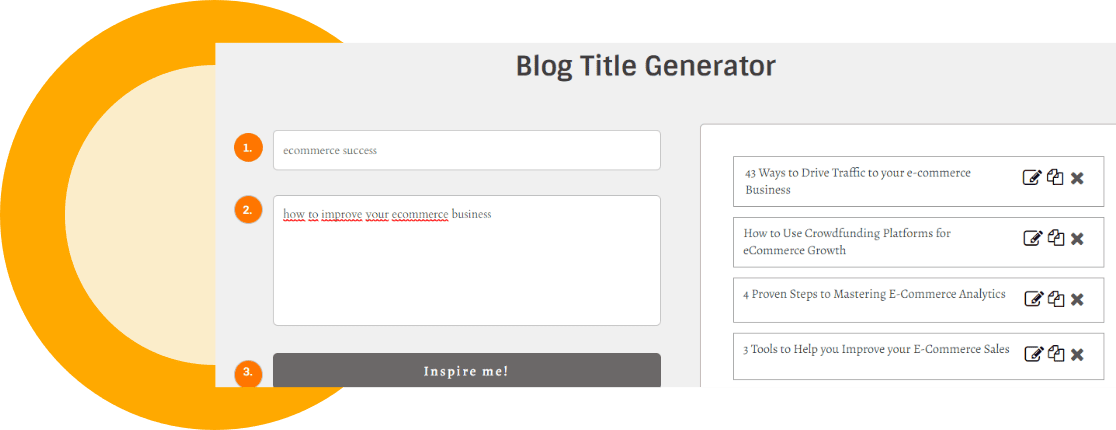
We’ve used our Blog Title Generator to create this list of E-Commerce Blog Title Examples in just a couple of minutes. In the image below, you can see how we simply entered a couple of keywords and our tool generated new blog title ideas.
Check out the examples below and start creating your own with our free generator.
Optimize your E-Commerce Blog Titles for SEO
In addition to crafting an attention-grabbing blog post title, it is essential to incorporate the appropriate keywords and optimize it for search engine optimization (SEO). Ideally, you should place your primary keyword at the beginning of your H1 and Meta Title. In this particular article, we have included our main keyword, “E-Commerce Blog Post Title Examples,” at the start.
Avoid guessing the most suitable keywords to use. Instead, utilize tools such as SEMRush to determine the exact terms people are searching for. Enter your topic, access a wealth of data, and choose the best keyword based on volume and difficulty. Give it a try at no cost and get the data you need.
Check out the video tutorial and find out how to find hidden gems with Semrush’s keyword research tools.
Use our link and get a 14-day free Semrush trial instead of the normal 7-day trial.
Examples of Great E-Commerce Blog Post Titles
- How I Secured Funding for my e-commerce Startup
- How to Redirect Your eCommerce Traffic to a New Domain
- 43 Ways to Drive Traffic to your e-commerce Business
- How to Get More Buyers Engaged With Your Products
- How to Use Crowdfunding Platforms for eCommerce Growth
- How to Improve Your Conversion Rate with these 15 Split Testing Tips
- The Power of Immediate Gratification for Your E-Commerce Business
- How to Create a Data-driven Growth Marketing Strategy for your E-Commerce Website
- 3 Things To Consider When Choosing a Platform For Your E-Commerce Business
- The 7 Deadly Sins of E-Commerce That Will Kill Your Business
- 4 Proven Steps to Mastering E-Commerce Analytics
- 3 Tools to Help you Improve your E-Commerce Sales
- 7 Things to Know Before Starting an E-Commerce Business
- How to Start an E-Commerce Business in 5 Simple Steps
- 3 Ways to Use Facebook Ads to Promote your E-Commerce Site
- 5 Tactics to Start an E-Commerce Business Without Any Capital
- Ultimate List of Free E-Commerce Templates for Your Website
- Top 5 E-commerce Tools to Consider in 2023
- The Ultimate Guide to E-Commerce Product Photography
- How to Launch a Profitable E-Commerce Startup in 2023
- The 13 Top E-Commerce Plugins for WordPress
- 7 Tips for Improving Conversion Rates on Your E-Commerce Site
- 5 Biggest E-Commerce Trends in 2023
- How to Get Your First 100 True Fans
- How to Find a Good Domain Name For Your E-Commerce Website
- 7 Steps to Find the Best Suppliers for your E-Commerce Business
- E-Commerce and E-Marketing in 2023
- 7 Best Ways to Monetize Your E-Commerce Business.
- 33 Actionable E-Commerce Marketing Tips for 2023
- Bootstrapping an E-Commerce Store: The Challenges and How to Overcome Them
- 5 Great Lead Magnets for E-Commerce Websites
- The Top 10 Must-Have Products for Every Home
- How to Choose the Perfect Gift for Every Occasion
- The Ultimate Guide to Online Shopping: Tips and Tricks
- 5 Creative Ways to Repurpose Your Old Clothes
- The Power of Online Reviews: Why They Matter and How to Use Them
- How to Get the Best Deals on Black Friday and Cyber Monday
- The Importance of Sustainability in E-commerce
- The Future of E-commerce: What’s Next?
- From Browsing to Buying: Understanding the Customer Journey
- How to Build a Successful E-commerce Business from Scratch
- The Dos and Don’ts of Email Marketing for E-commerce
- The Benefits of Offering Free Shipping to Your Customers
- How to Create a Memorable Unboxing Experience for Your Customers
- The Psychology of Color in E-commerce: What You Need to Know
- The Ultimate Guide to SEO for E-commerce Websites
- The Pros and Cons of Selling on Amazon
- The Rise of Mobile E-commerce: Trends and Opportunities
- How to Use Social Media to Boost Your E-commerce Sales
- The Secret to Writing Product Descriptions That Sell
- How to Create an E-commerce Store That Stands Out from the Crowd
- The Benefits of Using Chatbots in E-commerce
- How to Leverage User-Generated Content to Drive Sales
- The Power of Influencer Marketing in E-commerce
- The Top 5 Payment Gateways for E-commerce Stores
- The Impact of COVID-19 on E-commerce: Lessons Learned
- How to Optimize Your Product Pages for Conversions
- The Role of Customer Service in E-commerce: Best Practices
- The Benefits of Offering a Loyalty Program for Your E-commerce Store
- How to Conduct A/B Testing for Your E-commerce Website
- The Importance of Mobile Optimization for E-commerce Stores
- The Pros and Cons of Dropshipping for E-commerce Businesses
- How to Use Video Marketing to Drive E-commerce Sales
- The Top 10 E-commerce Trends to Watch in 2023
- How to Use Email Segmentation to Improve Your E-commerce Campaigns
- The Benefits of Using AR and VR in E-commerce
- The Importance of Website Speed for E-commerce Stores
- How to Create a Killer Content Marketing Strategy for E-commerce
- The Top 5 E-commerce Platforms for Small Businesses
- The Benefits of Offering Personalization for Your E-commerce Store
- The Rise of Subscription-Based E-commerce: Opportunities and Challenges
- How to Create a Strong Brand Identity for Your E-commerce Store
- The Impact of Voice Search on E-commerce: What You Need to Know
- The Benefits of Using Social Proof in Your E-commerce Marketing
- How to Use Upselling and Cross-Selling to Boost Your E-commerce Sales
- The Importance of User Experience for E-commerce Websites
- The Top 5 Marketing Automation Tools for E-commerce Stores
- How to Use Gamification to Engage Your E-commerce Customers
- The Pros and Cons of Selling on eBay
- How to Use Affiliate Marketing to Drive E-commerce Sales
- The Benefits of Using Artificial Intelligence in E-commerce
- The Importance of Customer Retention in E-commerce: Strategies and Tactics
- The Rise of Chat Commerce: What You Need to Know
- How to Use Local SEO to Drive Foot Traffic to Your E-commerce Store
- The Benefits of Offering Financing Options for Your E-commerce Store
Generate your own E-Commerce Blog Title Examples with our AI Generator for free.
How to Write a Catchy E-Commerce Blog Post Title

Highlight a Benefit
Clearly state the benefit readers will gain from reading your post. For example, “Boost Your Sales with These 10 E-Commerce Tips” or “Increase Your Online Store’s Traffic in 5 Simple Steps.”
Use Numbers and Lists
Titles with numbers attract attention because they promise specific, actionable information. Examples include “7 Must-Have Tools for E-Commerce Success” or “5 Proven Strategies to Drive E-Commerce Sales.”
Incorporate Keywords
Use relevant keywords that potential readers might be searching for. This not only helps with SEO but ensures your title is relevant to your content. For instance, “SEO Tips for E-Commerce Websites” or “Best Payment Gateways for Small Online Stores.”
Create a Sense of Urgency or Exclusivity
Use words and phrases that create a sense of urgency or exclusivity, such as “now,” “must-know,” or “ultimate guide.” Examples include “Why You Must Optimize Your E-Commerce Site Now” or “The Ultimate Guide to E-Commerce Marketing.”
Ask a Question
Engaging readers with a question can spark their curiosity and encourage them to read further. For example, “Are You Making These Common E-Commerce Mistakes?” or “How Can You Increase Your E-Commerce Conversion Rate?”
Use Power Words
Words that evoke emotion or excitement can make your title more compelling. Examples include “secret,” “amazing,” “essential,” and “proven.” For instance, “Essential E-Commerce Tips for Beginners” or “Proven Techniques to Reduce Cart Abandonment.”
Be Specific
Specific titles are more appealing and informative. Instead of “E-Commerce Tips,” try “10 E-Commerce Tips to Double Your Sales in 30 Days.”
Keep It Concise
Aim for a title that is clear and to the point. Avoid long, complicated titles. For example, “Effective Social Media Strategies for E-Commerce” is better than “How to Effectively Use Social Media to Improve Your E-Commerce Business.”
Leverage Trends
Incorporate current trends or hot topics in your industry into your titles. For example, “How AI is Transforming E-Commerce” or “Top E-Commerce Trends to Watch in 2024.”
Use Alliteration
Alliteration can make your title more memorable and fun. Examples include “Powerful Pricing Strategies for Profitable E-Commerce” or “Simple SEO Secrets for Online Stores.”
Test Multiple Variations
If possible, test different title variations to see which performs best. Tools like A/B testing can help you determine the most effective title for your audience.
How to choose the right e-commerce blog title angle
The best e-commerce blog titles usually start with a clear purpose. Some titles are built to attract top-of-funnel readers who are researching a problem. Others are meant to support shoppers who are comparing options, looking for proof, or getting closer to a purchase.
Before writing a title, decide what role the post should play. Are you trying to bring in new search traffic, support product discovery, answer objections, or build trust around your brand? That decision shapes the wording. A how-to title may work better for educational content. A comparison title may fit shoppers in research mode. A mistake-based or checklist-style title may work well for readers who want quick, practical help.
AI marketing tools can speed this up by helping you generate multiple angles from one topic. Instead of writing one headline and hoping it works, you can create title variations for search intent, emotional appeal, product relevance, and campaign fit.
E-commerce blog title ideas by search intent
Different search intents call for different title structures. When your title matches what the reader is actually trying to do, it becomes easier to win the click.
Informational titles work well when the audience wants to learn:
- How to Choose the Right Running Shoes for Daily Training
- What Makes a Good Product Page Convert Better
- Beginner’s Guide to Building an E-Commerce Email Funnel
Commercial investigation titles are better for readers comparing options:
- Best Product Bundling Ideas for Online Stores
- Top Email Popups for E-Commerce Brands That Want More Signups
- Best Upsell Strategies for E-Commerce Checkouts
Problem-solving titles help readers overcome friction:
- Why Your Online Store Is Getting Traffic but Not Sales
- Common Product Page Mistakes That Hurt Conversion Rates
- Why Shoppers Abandon Cart and What to Do About It
Using AI to group blog ideas by intent can help marketers build content that supports the full funnel instead of publishing disconnected posts that do not move buyers forward.
Blog title formulas e-commerce brands can reuse
You do not need to start from scratch every time. A few repeatable blog title formulas can help you build content faster while still keeping each post relevant.
Here are some strong formulas to use:
How to [achieve result] without [common pain point]Example: How to Increase Average Order Value without Discounting Everything
X Ways to [improve result] for [audience or store type]Example: 9 Ways to Improve Product Discovery for Fashion E-Commerce Brands
The Ultimate Guide to [topic] for [audience]Example: The Ultimate Guide to E-Commerce Product Page SEO for Small Brands
X Mistakes [audience] Should Avoid
Example: 7 Product Photography Mistakes E-Commerce Brands Should Avoid
What [audience] Needs to Know About [topic]Example: What DTC Brands Need to Know About AI Product Recommendations
These formulas work even better when paired with AI title generation. You can take one topic, run it through different formulas, and quickly build a stronger shortlist of titles for blog posts, landing pages, and campaign support content.
How AI can help create better e-commerce blog titles
AI can help with much more than headline brainstorming. It can turn a broad topic into multiple content angles, spot patterns in your existing titles, and help you create titles that are more specific, more relevant, and more aligned with your content strategy.
For example, an AI workflow can help you:
- Generate title variations for different audiences
- Create SEO-friendly titles around one product category
- Turn product features into content ideas
- Build seasonal title ideas faster
- Refresh weak blog titles with stronger search intent
This is especially helpful for e-commerce teams that need to publish consistently across product launches, educational content, promotional campaigns, and evergreen SEO posts. Instead of waiting for inspiration, marketers can use AI to create a repeatable system for stronger content planning.
E-commerce blog topics that often perform well
Many online stores focus too heavily on product pages and miss the value of blog content that supports discovery, trust, and long-term traffic. A better e-commerce blog strategy usually includes a mix of evergreen and conversion-supporting topics.
Strong topic categories include:
- Buying guides
- Product comparisons
- Gift guides
- Seasonal trend roundups
- Customer education posts
- Care and maintenance content
- Style or usage inspiration
- Shipping, returns, or policy explainers
- Brand values and sourcing stories
- Beginner guides for first-time buyers
These categories give you more room to create blog titles that serve both readers and search engines. They also work well with AI marketing tools because one product line can often generate dozens of blog angles when you look at customer questions, use cases, objections, and seasonal demand.
Tips for writing blog titles that get more clicks
A title does not need to be clever to perform well. In many cases, clarity wins. Readers should be able to understand the topic quickly and know why the post is worth their time.
Good e-commerce blog titles often do a few simple things well. They make the benefit obvious. They use language the audience already understands. They match the topic closely instead of sounding vague. They avoid clickbait. They give enough detail to stand out in search results and on social feeds.
It also helps to review your titles as a set, not one by one. If every title sounds the same, your blog can feel repetitive. AI can help expand your range by suggesting fresh wording, new formats, and alternative hooks while keeping the topic grounded in real customer interest.
Build an e-commerce content engine instead of chasing one-off titles
The goal is not just to publish one good blog post title. The bigger opportunity is to create a repeatable content engine that supports SEO, product discovery, and conversion over time.
That means connecting blog title creation to keyword research, search intent, campaign planning, seasonal promotions, and content repurposing. A strong title becomes the starting point for a larger workflow that can include blog outlines, social posts, email content, product page support, and video scripts.
When e-commerce marketers use AI this way, title creation stops being a small writing task and becomes part of a larger AI marketing system that helps content move faster and perform better.
FAQ
What makes a good e-commerce blog post title?
A good e-commerce blog post title is clear, relevant, and tied to what the reader wants to learn or solve. It should make the topic obvious and give people a reason to click.
Should e-commerce blog titles include keywords?
Yes. Adding relevant keywords can help search engines and readers understand the topic faster. The keyword should fit naturally and not make the title awkward.
Can AI help write better e-commerce blog titles?
Yes. AI can help generate title variations, explore new angles, and speed up content planning. It works best when paired with keyword research, audience knowledge, and clear search intent.
How long should an e-commerce blog title be?
A strong blog title is usually concise and easy to scan. It should communicate the value of the article quickly without stuffing in too many words.
What types of e-commerce blog posts work best for SEO?
Buying guides, comparisons, how-to articles, beginner guides, and problem-solving content often work well because they match real search behavior and support different stages of the buyer journey.
Why should e-commerce brands use blog content in their marketing strategy?
Blog content can help attract organic traffic, answer customer questions, build trust, and support product discovery before someone is ready to buy.
Master the Art of Video Marketing
AI-Powered Tools to Ideate, Optimize, and Amplify!
- Spark Creativity: Unleash the most effective video ideas, scripts, and engaging hooks with our AI Generators.
- Optimize Instantly: Elevate your YouTube presence by optimizing video Titles, Descriptions, and Tags in seconds.
- Amplify Your Reach: Effortlessly craft social media, email, and ad copy to maximize your video’s impact.
Looking for more Blog Post Title Examples? Check out.
- Examples of Business Blog Titles
- Gardening Blog Post Title Examples
- B2B Blog Post Title Examples
- Higher Education Blog Title Examples
- Accounting Blog Title Examples
- Crypto Blog Post Title Examples
- Examples of E-Commerce Blog Titles
- Banking Blog Post Title Examples
- Environmental Blog Post Title Examples
- Food Blog Post Title Examples
- Examples of Nonprofit Blog Post Titles
- Real Estate Blog Title Examples
- Examples of Startup Blog Post Titles
- Airline Blog Post Title Examples
- Technology Blog Post Title Examples
- Examples of Travel Blog Titles
- Examples of Fitness Blog Post Titles
- Automotive Blog Title Examples
- Examples of Vegan Blog Titles
Or, check out all other examples like Blog Intros, Google and Facebook ad copies and more.
Write great Marketing Copy in half the time
There is nothing worst than staring at a blank piece of paper. StoryLab.ai’s Marketing Copy Generators help you to get new ideas and even complete copy with a click of a button.
Get inspired by how many different ways there are to describe your blog titles, Instagram captions, ad copy and more. Next to generating new ideas and creating new copy, you can reword existing copy with our paraphrase generator.
Our Marketing Copy Generators run on GPT-5. Trained, as the largest and qualitatively best Natural Language Processing model. Check out our resource hub and see how AI Marketing can help you reach your goals faster. The time to start using this new technology is now.